Identify the right being demanded and the exclusion or violence that made the claim urgent.
Timeline
Rights, Independence, and Social Movements Timeline
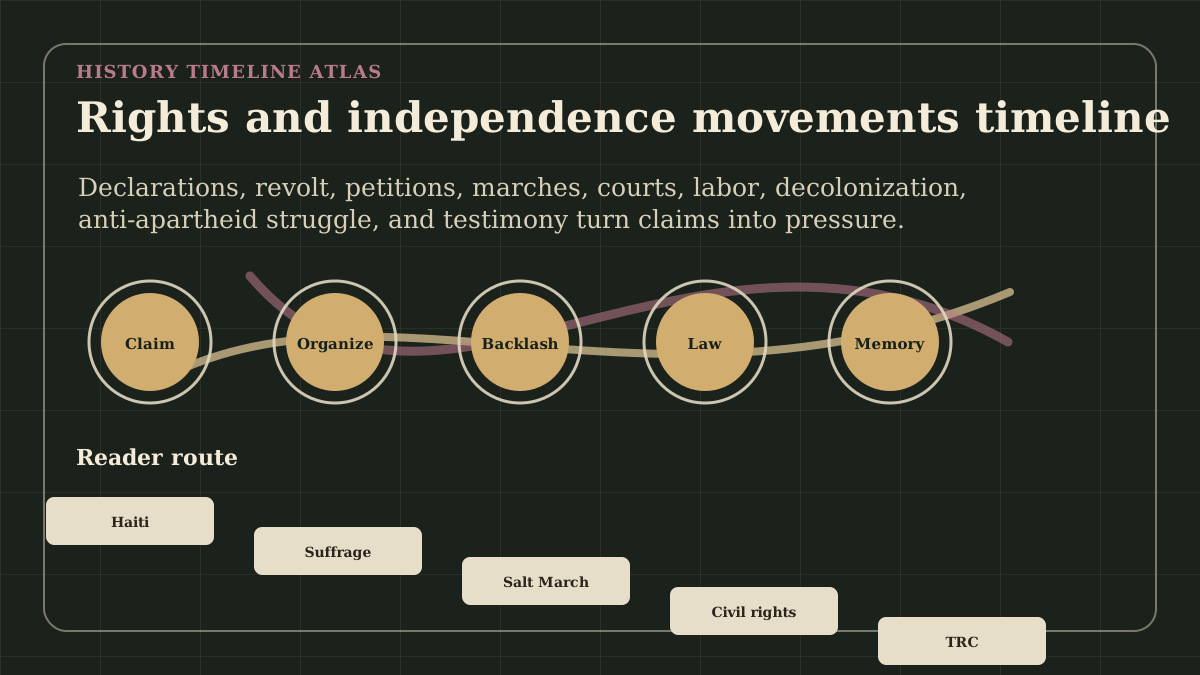
Connect abolition, suffrage, civil disobedience, civil rights, anti-apartheid, labor, democracy, and independence movements.
Timeline Guide
How did movements turn claims about rights, freedom, and dignity into laws, institutions, states, and public memory?
Read this edited guide as a path through dates, places, affected lives, source limits, and contested memory rather than as an exhaustive database.
Read the first screen through people taking risks: an enslaved rebel in Saint-Domingue, a Seneca Falls organizer drafting demands, an Ethiopian soldier at Adwa, a villager watching Gandhi's salt march pass, a Black parent backing a school case, a shipyard worker in Gdansk, a student in Soweto, and a mother testifying after state violence. Rights become history when claims enter bodies, streets, courts, prisons, and memory.
The movements are connected, but they are not the same. Abolition, suffrage, anti-colonial independence, labor organizing, civil rights, anti-apartheid struggle, and democracy protest used different tactics under different dangers. A student can compare claim, tactic, institution, backlash, and memory without pretending local goals were identical.
Specific episodes keep the global frame honest: Saint-Domingue rebels turned plantation violence into revolution; Gandhi's Salt March made law visible through walking; Adwa showed an African army defeating an imperial invasion; Soweto students faced police bullets over language and apartheid schooling; Gdansk workers made a shipyard into a political forum. The source trail names the UN, South African History Online, and public-history archives so the route does not lean only on U.S. civil-rights memory.
Internal conflict belongs inside the story. Suffrage movements could marginalize working-class women and women of color; anti-colonial parties could silence rivals after independence; civil-rights coalitions disagreed over courts, direct action, armed self-defense, and Black Power; labor movements could exclude migrants. Freedom politics is more compelling when its unfinished arguments remain visible.
Start With These Dates
- July 4, 1776Declaration of Independence
The Continental Congress adopted a declaration that presented the American colonies as independent states and justified separation from Britain.
- 1789 CEFrench Revolution Begins
Fiscal crisis, social inequality, Enlightenment politics, and popular mobilization pushed France into revolution against the old regime.
- July 14, 1789Storming of the Bastille
Parisian crowds stormed the Bastille fortress during the French Revolution, turning political crisis into a visible attack on royal authority.
- 1791 CEHaitian Revolution Begins
The Haitian Revolution began as enslaved people and free people of color challenged plantation slavery, French colonial power, and racial hierarchy in Saint-Domingue.
- October 1945Fifth Pan-African Congress
The Fifth Pan-African Congress brought activists and future leaders together in Manchester, sharpening demands for African independence and anti-colonial solidarity.
- February 11, 1990Nelson Mandela Released
Nelson Mandela was released from prison after twenty-seven years, signaling a new phase in negotiations to end apartheid in South Africa.
- 1994Fall of Apartheid
South Africa held its first fully democratic elections, ending apartheid rule and bringing Nelson Mandela to the presidency.
- 1996 CESouth African Truth and Reconciliation Commission Hearings
South Africa's Truth and Reconciliation Commission held public hearings on apartheid-era abuses, linking testimony, amnesty, public memory, and democratic transition.
Sources Used Here
- Official United Nations: Universal Declaration of Human Rights
Primary institutional reference for postwar human-rights language and global rights claims.
- Gandhi Heritage Portal
Reference archive for Gandhi, civil disobedience, and Indian independence movement material.
- U.S. National Archives: Civil Rights Act
Archive reference for federal civil-rights legislation and the institutional record behind the 1964 Civil Rights Act.
- South African History Online: Anti-apartheid resistance
Specialist reference for apartheid, resistance, liberation politics, Soweto, and public memory in South Africa.
This timeline treats rights as something people make under pressure. It begins with revolutionary claims, follows abolition, suffrage, anti-colonial independence, civil rights, human rights, labor, democracy movements, anti-apartheid struggle, and truth-telling after violence. The route matters because rights do not enforce themselves. They become historical through organization, risk, law, backlash, and memory.
The revolutionary opening gives the page its vocabulary and its contradictions. American and French claims about liberty, citizenship, and representation expanded political language while leaving major exclusions intact. Haiti then transformed the argument by showing enslaved people making freedom through revolution. This sequence makes the timeline more honest: rights history begins with promise and hypocrisy side by side.
The nineteenth-century chapter moves through abolition, women's rights, labor, and anti-imperial resistance. Seneca Falls, emancipation, the Paris Commune, and Adwa all show different kinds of claims: voting, freedom from slavery, worker and urban power, and defense against imperial conquest. They also show that rights language can move through declarations, war, street politics, and battlefield victory.
The early twentieth century widens the route. Mexican, Chinese, Irish, suffrage, Indian, and Pan-African nodes show land reform, republicanism, national sovereignty, women's voting rights, civil disobedience, and diaspora politics. Movements borrow symbols and tactics, but they are not copies of one another. Each has its own institutions, opponents, and social pressures.
The Salt March gives the timeline a vivid strategy lesson. A tax on salt became a public test of imperial authority because the movement connected law, walking, discipline, media attention, arrest, and moral claim. Social movements often gain force by turning something ordinary into evidence of a larger injustice. That pattern appears again in schools, buses, factories, prisons, and public squares.
The postwar human-rights chapter changes the scale. The Universal Declaration gave activists, governments, courts, and diplomats a shared language, but the document did not end violence or inequality. Its importance lies in the new public measure it created. States could be judged against words they had accepted, and local movements could connect their claims to international vocabulary.
Civil-rights events show the interaction of local organizing and national law. Brown v. Board, the March on Washington, and the Civil Rights Act are not three isolated milestones. They connect families, students, teachers, lawyers, churches, local organizers, federal courts, national media, presidential politics, congressional bargaining, and violent resistance. The route makes law and movement infrastructure visible together.
Decolonization and independence make the timeline global. India, Ghana, Bangladesh, Pan-African organizing, and anti-apartheid movements show that rights can mean national self-determination as well as individual liberty. Independence raises difficult follow-up questions: who belongs to the new nation, what happens to minorities, how borders are governed, and whether formal sovereignty changes everyday inequality.
Cold War and late twentieth-century nodes add another layer. Hungary, Helsinki, Solidarity, Tiananmen, Soweto, Mandela's release, apartheid's end, and truth-commission testimony show rights claims under party states, racial states, police power, censorship, international diplomacy, and public memory. The route shows how movements use official language, media, labor power, student networks, and moral pressure when direct power is unavailable.
The geography of this timeline is concrete. Rights history happens in plantations, convention halls, courtrooms, schools, churches, prisons, factories, streets, capitals, colonies, borderlands, public squares, and hearing rooms. The location changes the tactic. A march, lawsuit, strike, revolt, election, or testimony process each creates a different kind of public pressure.
Evidence also changes across the route. Declarations, petitions, newspapers, court decisions, police files, prison letters, photographs, speeches, songs, diplomatic texts, oral histories, and truth-commission testimony reveal different actors. Official records often preserve the state's view; movement records reveal strategy and hope; memory sources show what later communities needed the event to mean.
The final reading path follows the gap between victory and fulfillment. A declaration can exclude, emancipation can be followed by racial terror, suffrage can leave other barriers intact, independence can produce partition, civil-rights law can face backlash, and truth commissions can name harm without repairing all damage. Rights history keeps moving because each achievement creates a standard that later generations can use.
This timeline follows rights as a historical process rather than a list of noble statements. Declarations, revolutions, petitions, court cases, strikes, marches, anti-colonial campaigns, student protests, liberation movements, and truth commissions all appear because rights become durable only when claims enter institutions, streets, law, memory, and international pressure.
The route begins with revolution because modern rights language often emerged from crisis. The American and French revolutions transformed sovereignty, citizenship, representation, and public argument, but they also exposed exclusions around slavery, gender, class, religion, and empire. The Haitian Revolution makes those contradictions impossible to ignore. Enslaved people did not wait for rights to be granted; they remade the Atlantic political world by force and imagination.
The nineteenth-century chapter shows rights moving through abolition, suffrage, labor, national self-determination, and anti-imperial resistance. Seneca Falls made women's rights a public program in the United States; the Emancipation Proclamation changed the legal and military meaning of the Civil War; the Paris Commune raised questions about labor, urban democracy, and state violence; Adwa became a symbol of African victory over European invasion.
Rights claims rarely move in one direction. The same century that expanded abolitionist and suffrage languages also saw racial science, imperial conquest, segregation, gender exclusion, and violent repression. That tension gives the route its energy. Each advance creates a new argument over who counts, who enforces the claim, and what institutions are willing to change.
The early twentieth-century nodes widen the map. The Mexican Revolution, Xinhai Revolution, Easter Rising, women's suffrage, Salt March, and Pan-African Congress show rights language crossing land reform, republicanism, anti-imperial nationalism, women's voting rights, civil disobedience, and diaspora politics. These events are not interchangeable. They show different movements using different tools under different constraints.
The Salt March is a key model of movement strategy. Gandhi turned law, salt, walking, publicity, arrest, and moral theater into a challenge to empire. The event matters because it shows how a small object can expose a large political system. Rights movements often gain force when they make an abstract injustice visible through a practice people can understand and repeat.
Postwar rights language changes the scale. The Universal Declaration of Human Rights did not end state violence, racism, colonialism, or inequality. It did give activists, diplomats, courts, journalists, and governments a shared vocabulary. That vocabulary could be used sincerely, selectively, or strategically. The timeline treats human rights as a tool people fought over, not as a magic solution.
Decolonization belongs at the center. Indian independence, Ghana independence, Bangladesh, anti-apartheid struggle, and other independence movements show that rights were not only individual liberties. They involved sovereignty, land, language, development, partition, borders, education, labor, race, and international recognition. A movement could win a flag and still inherit deep conflicts over who the new state served.
The U.S. civil-rights sequence gives the route a legal and mass-movement layer. Brown v. Board, the March on Washington, and the Civil Rights Act show litigation, local organizing, church networks, student activism, federal power, media, backlash, and legislative compromise. The timeline keeps these events together because a court ruling, a march, and a statute each do different political work.
Eastern Europe and China reveal another dimension. Hungary, Helsinki, Solidarity, Tiananmen, and related Cold War nodes show rights language inside party-state systems, labor organizing, student protest, censorship, surveillance, and international diplomacy. Rights claims could be local, national, and global at the same time. A factory strike, a human-rights monitoring group, or a student square could expose the limits of official legitimacy.
South Africa gives the timeline a long arc from resistance to transition to memory. Soweto, Mandela's release, the end of apartheid, and the Truth and Reconciliation Commission show education protest, international pressure, negotiation, elections, testimony, and unresolved inequality. The end of formal apartheid did not close the moral ledger. It created a public process for naming violence while leaving hard questions about repair.
The route treats social movements as organized labor, not spontaneous feeling. Movements require meeting spaces, newspapers, churches, unions, schools, student networks, legal funds, songs, symbols, leaders, local organizers, international allies, and people willing to risk punishment. Famous speeches matter, but the timeline becomes deeper when readers see the infrastructure behind public moments.
Law matters, but law is not enough. A declaration can be ignored, a court ruling can be resisted, a constitution can exclude, and a treaty can be violated. Law becomes powerful when people can mobilize enforcement, publicity, political cost, and institutional change. That is why the timeline moves between texts and streets, between rights language and the people who force institutions to answer it.
The route also keeps backlash visible. Revolutions can produce terror, civil war, dictatorship, or exclusion. Abolition can be followed by segregation and racial violence. Suffrage can leave economic and racial inequality untouched. Independence can be followed by partition or authoritarian rule. Human-rights language can be used selectively by powerful states. A serious rights timeline does not pretend moral claims automatically win.
A geography of rights is not only capitals and parliaments. It includes plantations, schools, courtrooms, prisons, churches, factories, streets, villages, borders, exile communities, conference halls, and memorial sites. The March on Washington means one thing on the National Mall; Salt March means another along a coastal route; Soweto means another in classrooms and streets; Tiananmen means another in a square watched by the world.
Evidence changes across the route. Declarations and statutes show official language. Petitions and newspapers show movement strategy. Photographs and songs show public memory. Court records show legal framing. Police files and prison letters show repression. Oral history shows lived risk. International resolutions show diplomatic pressure. Truth commissions show testimony after violence. The archive itself often reveals power.
For readers searching for civil-rights timeline, the route gives local specificity while connecting to a wider world. For readers searching for decolonization timeline, it shows independence as one branch of rights history. For readers searching for women's suffrage, abolition, or anti-apartheid, it shows how movements learn from one another without becoming the same movement.
The strongest comparison is between moral claim, movement strategy, and institutional result. A movement may begin with a claim about equality, land, voting, dignity, education, or national freedom. It then chooses tools: petition, boycott, strike, lawsuit, march, revolt, diplomacy, election, or testimony. The result may be a law, a state, a court decision, a public memory, a partial reform, or a new conflict.
People in this timeline are not only famous leaders. Enslaved rebels, suffrage organizers, students, workers, teachers, parents, prisoners, lawyers, clergy, journalists, nurses, farmers, exiles, and families all make rights history. Leaders can focus attention, but movements become durable when ordinary participants turn risk into repeated action.
The timeline can also be read through communication. Pamphlets, declarations, newspapers, sermons, songs, photographs, radio, television, courtroom transcripts, prison letters, samizdat, union leaflets, and international reports all carried movement language. A claim becomes harder to ignore when people can repeat it, print it, sing it, photograph it, broadcast it, or cite it in law.
A second reading follows repression. Empires, states, police, employers, courts, parties, and vigilante groups often tried to make movements costly through arrests, censorship, dismissal, exile, violence, surveillance, or legal restriction. Repression can silence people, but it can also create martyrs, expose hypocrisy, and attract wider support. The route keeps that dangerous feedback loop visible.
A third reading follows coalition. Rights movements rarely consist of one social group with one interest. They bring together uneasy alliances: lawyers and workers, students and clergy, rural communities and urban organizers, local activists and international supporters, moderates and radicals, exiles and people who remain under threat. Coalition makes movements stronger and more fragile at the same time.
International pressure becomes increasingly important after 1945. Human-rights language, decolonization diplomacy, sanctions, exile networks, global media, religious organizations, and transnational student movements gave local struggles a wider audience. That audience did not control every outcome, but it changed costs for governments that wanted legitimacy abroad.
The route remains expandable. Future pages can deepen Indigenous rights, labor unions, feminism beyond U.S. suffrage, disability rights, LGBTQ rights, environmental justice, Arab Spring movements, Latin American human-rights campaigns, and postcolonial constitutional struggles. Each addition belongs when it clarifies how a claim becomes organized pressure and what remains unresolved after formal recognition.
The timeline can also be read through time lag. A declaration can create a language decades before institutions change. A court ruling can announce a principle before local enforcement arrives. An independence ceremony can change international status before social equality follows. A truth commission can record harm before material repair occurs. Rights history often moves through these gaps between statement and transformation.
A fourth reading follows education. Schools appear repeatedly because they define citizenship, language, racial order, national memory, gender expectation, and state legitimacy. Brown v. Board, Soweto, student movements, and civic education after independence all show that classrooms are political spaces. A movement that changes schooling can change how future citizens imagine belonging.
A fifth reading follows prisons and punishment. Imprisonment, exile, surveillance, emergency law, and political trials often reveal what power fears. Mandela, Gandhi, suffrage activists, labor organizers, student protesters, and dissidents all show that punishment can suppress action while also creating symbols, letters, networks, and international attention that keep claims alive.
A strong visual layer for this route can map movement tactics rather than only geography: declaration, revolt, petition, march, lawsuit, strike, boycott, international appeal, election, and testimony. That kind of map helps readers see that social movements are not random eruptions. They choose tactics based on institutions, repression, allies, and the public they need to persuade.
The route also clarifies why rights searches often feel fragmented. A user might search for women's suffrage, civil rights, human rights, decolonization, anti-apartheid, or democracy movements, but those searches share a deeper problem: how people make power answer a claim about dignity or belonging. The timeline supplies the connecting sequence before the reader moves into narrower pages.
A final comparison follows victory types. Some movements win a document, some win a court ruling, some win a law, some win international recognition, some win a transition government, and some win public testimony after violence. These victories are not equal, and none is self-enforcing. Comparing them helps readers understand why formal success often begins another struggle.
The timeline follows the same rule across the route: a node matters when it reveals a new claim, tactic, institution, backlash, coalition, or memory problem. That rule keeps the route large enough for world history while preventing disconnected movement trivia.
The sequence also helps readers separate three questions that often blur together. What did the movement demand? What changed in law or government? What changed in daily life for the people most affected? A rights timeline becomes useful when those answers are allowed to differ. A movement can win language before enforcement, recognition before equality, and testimony before repair.
This is why the route keeps returning to memory. Public memory is not a soft ending after politics. It shapes school curricula, monuments, anniversaries, court arguments, apology debates, and future organizing. Movements that lose in the short term can still leave memory that later generations use as evidence and encouragement.
The final reading path follows unfinished work. Rights history creates victories, but it also leaves gaps between language and life. The Universal Declaration, Civil Rights Act, independence ceremonies, and truth commissions are not endings. They are moments when a claim becomes visible enough to measure future failure against it. That is why the timeline remains alive for readers today.
The story is strongest when read in layers. First, follow the dates from July 4, 1776 to 1996 CE. Then read across the event types: political declaration, revolution, urban uprising, revolution. The timeline becomes more than chronology when those dates reveal decisions, institutions, violence, reform, and memory.
Fifth Pan-African Congress sits near the middle of the sequence. Ask what had already become unavoidable by October 1945, what actors still believed they could control, and which consequences were already beginning to move beyond the original setting.
The named events are Declaration of Independence, French Revolution Begins, Storming of the Bastille, Haitian Revolution Begins, Execution of Louis XVI, Seneca Falls Convention. Each one pushes a more precise question: what changed, who benefited, who paid the cost, and what later page explains the aftermath more clearly?
Read the timeline against geography too. Places matter because power moves through corridors, borders, cities, ports, capitals, and frontiers. The map below keeps those distances visible while the event pages explain the human and institutional consequences.
A good timeline has a pulse: pressure, decision, expansion, resistance, and aftermath. When you move through Age of Revolutions, keep asking whether an event is creating a new problem, revealing a hidden weakness, or making an earlier choice harder to reverse.
The human layer matters because timelines can become too abstract. Figures such as Thomas Jefferson, George Washington, John Adams, Louis XVI, Maximilien Robespierre, Parisian crowds, and Toussaint Louverture help the sequence feel lived rather than mechanical. Their choices do not explain everything, but they show where institutions, ideas, military systems, social movements, and public fear entered real decisions.
The ending is not only the last date. With closing events such as Tiananmen Square Protests, Nelson Mandela Released, Fall of Apartheid, and South African Truth and Reconciliation Commission Hearings, the reader can ask what remained unsettled: which institutions survived, which arguments continued, which victims or opponents were left outside the official story, and which later crisis reused the same vocabulary.
Read this page once quickly for order, then read it again for contrast. Compare early confidence with later uncertainty, local decisions with global consequences, and visible turning points with slower changes in law, economy, belief, technology, borders, or memory. That second pass is where a timeline becomes an explanation.
Causation in this sequence is layered. One event may supply the trigger, another may reveal an older weakness, and a later event may show the consequence that people at the beginning did not expect. The useful habit is to separate background pressure, immediate decision, turning point, and aftermath before deciding which event matters most.
Consequences are uneven. A political settlement might look successful in one capital while creating resentment elsewhere; a military victory might end a campaign while deepening civilian trauma; a scientific or institutional breakthrough might solve one problem while creating new risks. The timeline is strongest when those mixed outcomes remain visible.
The final pass is comparative. After reading this sequence, open a neighboring topic or person page and ask whether the same pattern appears again. Repetition usually points to a structure; contrast usually points to a historical choice that could have gone another way.
Importance is not the same thing as drama. Some events are remembered because they were spectacular, while others matter because they changed rules, expectations, alliances, legal categories, technologies, or public language. Use the timeline to test both kinds of importance before deciding what belongs at the center of the story.
The page rewards moving outward. A timeline gives order, but the event pages give causes, maps, people, sources, and reading paths. When a date feels too compressed, open the full event page and then return here; the sequence becomes clearer with each pass instead of asking the reader to memorize a list.
Compare revolt, petition, convention, lawsuit, march, boycott, strike, diplomacy, and testimony.
Look for the court, state, empire, party, school, workplace, or international body being pressured.
Ask what remained unresolved after victory and how later memory judged the outcome.
Track how declarations, court rulings, statutes, constitutions, independence ceremonies, and commissions turn movement claims into public structures.
Look for meetings, newspapers, churches, unions, schools, legal funds, songs, marches, boycotts, prisons, and international allies.
Ask how states, employers, empires, courts, police, parties, and local opponents resisted or narrowed rights claims.
Use the Universal Declaration, Helsinki, decolonization, and anti-apartheid campaigns to see rights moving through international institutions.
Read every victory beside the inequalities, violence, exclusions, and memory conflicts that remained after formal change.
Declaration of Independence gives the opening problem a date and place. Ask what was already unstable before it happened.
Fifth Pan-African Congress is a compression point: earlier causes are now crowded together with decisions that will shape the sequence's ending.
Follow the path through Philadelphia, Paris, Saint-Domingue, and Seneca Falls and ask how distance changed communication, logistics, fear, and control.
South African Truth and Reconciliation Commission Hearings works as both an ending and a beginning: it closes one sequence while opening later disputes, institutions, memories, or reforms.
Which conditions existed before the first event, and which later decision turned those conditions into visible historical change?
Who had the power to choose, who had fewer choices, and who is missing when the story is told only through leaders or institutions?
Which facts are date anchors, which are interpretations, and which claims need checking through the event sources before being repeated?
Which linked event, person, year, or topic page would change your interpretation if you read it next?
Interactive Timeline
Explore Rights, Independence, and Social Movements Timeline by sequence
Declaration of Independence
The Continental Congress adopted a declaration that presented the American colonies as independent states and justified separation from Britain.
Read the full event pageNarrative Stages
Read this timeline in chapters
Opening Context
The pressures and early conditions that set this sequence in motion.
- Declaration of IndependenceJuly 4, 1776
- French Revolution Begins1789 CE
- Storming of the BastilleJuly 14, 1789
- Haitian Revolution Begins1791 CE
- Execution of Louis XVIJanuary 21, 1793
- Seneca Falls ConventionJuly 1848
- Indian Rebellion of 18571857-1858 CE
- Emancipation ProclamationJanuary 1, 1863
- Paris CommuneMarch-May 1871
- Battle of AdwaMarch 1, 1896
- Mexican Revolution Begins1910
Turning Points
The events where choices and consequences became harder to reverse.
- Xinhai Revolution1911
- Easter RisingApril 1916
- Women's Suffrage in the United StatesAugust 18, 1920
- Salt MarchMarch-April 1930
- Fifth Pan-African CongressOctober 1945
- Indian Independence and PartitionAugust 1947
- Universal Declaration of Human RightsDecember 10, 1948
- Brown v. Board of EducationMay 17, 1954
- Hungarian RevolutionOctober-November 1956
- Ghana IndependenceMarch 6, 1957
Aftermath
The outcomes and later institutions that carried the sequence forward.
- March on WashingtonAugust 28, 1963
- Civil Rights Act of 1964July 2, 1964
- Bangladesh Liberation War1971 CE
- Helsinki Final ActAugust 1, 1975
- Soweto UprisingJune 16, 1976
- Solidarity Movement in Poland1980
- Tiananmen Square Protests1989
- Nelson Mandela ReleasedFebruary 11, 1990
- Fall of Apartheid1994
- South African Truth and Reconciliation Commission Hearings1996 CE
Map Layer
Rights, Independence, and Social Movements Timeline geography
Gold pins mark the approximate locations of published event pages. This is a schematic locator map, not a historical border map.
Event location Simplified land areaClick a pin to open the event page
Coordinates are approximate and are used to help readers orient themselves before opening a full event page.
References
Where to Check the Facts
- Official United Nations: Universal Declaration of Human RightsPrimary institutional reference for postwar human-rights language and global rights claims.
- Gandhi Heritage PortalReference archive for Gandhi, civil disobedience, and Indian independence movement material.
- U.S. National Archives: Civil Rights ActArchive reference for federal civil-rights legislation and the institutional record behind the 1964 Civil Rights Act.
- South African History Online: Anti-apartheid resistanceSpecialist reference for apartheid, resistance, liberation politics, Soweto, and public memory in South Africa.