At a Glance
The shape of the event
- Date
- May 17, 1954
- Place
- Washington, D.C.
- Type
- Court Decision
The U.S. Supreme Court ruled that racial segregation in public schools was unconstitutional, overturning legal support for separate schooling.
May 17, 1954; place the event in Washington, D.C. before comparing causes or consequences.
Brown became a cornerstone of the civil rights movement and a major test of federal authority and equal protection.
Thurgood Marshall / U.S. Supreme Court are the first names or groups to compare before widening the story.
The decision challenged Jim Crow education but required long struggles over enforcement.
The decision challenged Jim Crow education but required long struggles over enforcement.
Brown became a cornerstone of the civil rights movement and a major test of federal authority and equal protection.
Read next through the March on Washington, Civil Rights Act, Voting Rights Act, and Little Rock pages to follow the path from courtroom victory to federal enforcement and mass protest.
Background
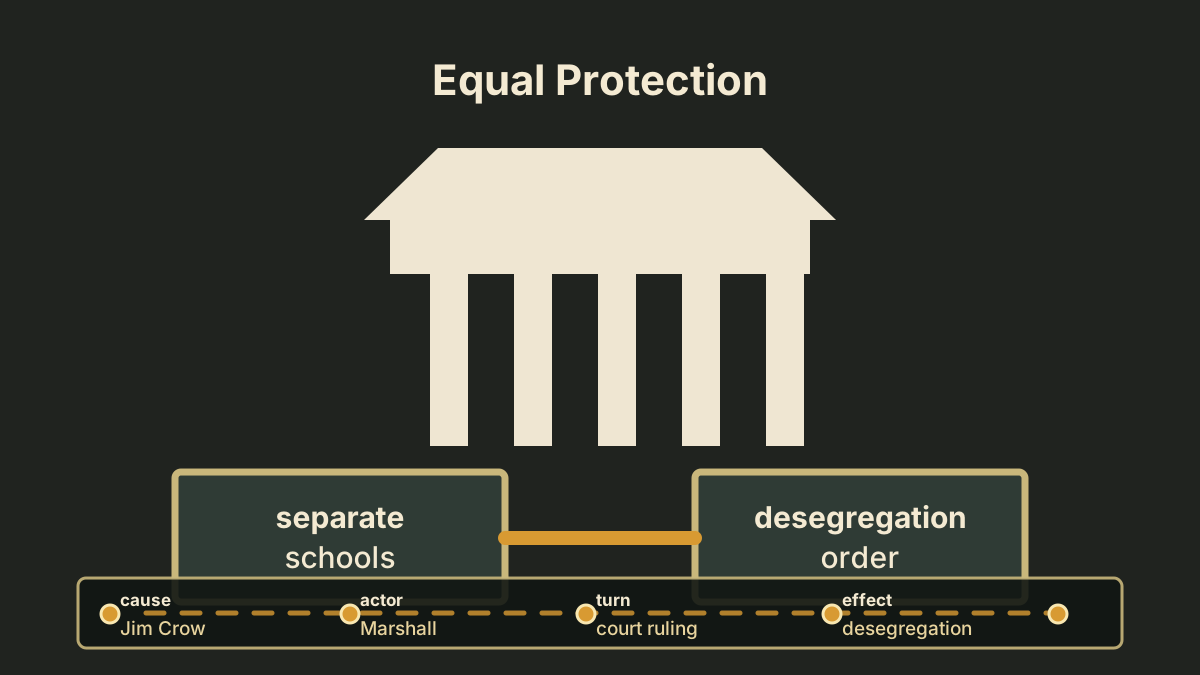
The case emerged from a long campaign against Jim Crow education. Thurgood Marshall and the NAACP Legal Defense Fund built a strategy that challenged segregation through unequal facilities, graduate-school cases, and eventually the premise of separation itself. Brown combined cases from several states and the District of Columbia, making clear that the problem was national in legal principle even when southern segregation was most visible. Linda Brown's name became famous, but the case represented many families who risked retaliation by challenging local school systems. The Warren Court faced a constitutional question with enormous social consequences: whether state-mandated school separation violated the Equal Protection Clause of the Fourteenth Amendment. Brown grew out of multiple local cases, not only Topeka.
Cases from South Carolina, Virginia, Delaware, the District of Columbia, and Kansas showed different versions of the same constitutional injury. Some schools were unequal in facilities; others were closer in material terms but still organized around racial separation. That range helped the NAACP challenge the doctrine itself rather than only its worst examples. Social science evidence, including work associated with Kenneth and Mamie Clark, helped argue that segregation marked Black children as inferior, though the constitutional claim did not depend on psychology alone. It rested on equal protection and the state's role in producing hierarchy.
The Turning Point
The turning point was the Court's unanimous rejection of separate-but-equal schooling. Chief Justice Earl Warren worked to produce a single voice because a divided ruling might have invited even more defiance. The decision did not instantly integrate schools, and Brown II's phrase 'with all deliberate speed' gave opponents room to delay. Still, the ruling removed constitutional legitimacy from school segregation and gave civil rights activists a powerful legal tool. It changed the terrain from asking whether Black schools received enough funding to asking whether state-imposed racial separation was itself an injury. The unanimity of the Warren Court was politically important. A split decision might have given segregationists more room to portray the ruling as partisan or unstable.
The Court's language made a clear doctrinal break with Plessy in public education, but implementation remained deliberately less clear. Brown II in 1955 ordered desegregation with 'all deliberate speed,' a phrase that tried to manage resistance but also allowed delay. That gap between principle and remedy became the lived story of Brown. The Constitution had spoken, but local school boards, governors, federal judges, presidents, and communities would decide how much the words changed classrooms.
Consequences
The consequences were immediate in law and slow in daily life. Massive Resistance, school closures, pupil placement laws, intimidation, and local delay campaigns showed that court doctrine could be blocked by political power. The Little Rock crisis of 1957 revealed how federal authority might be needed to enforce constitutional rights. In the longer term, Brown helped energize the civil rights movement, shaped later litigation, and became a symbol of judicial intervention against state-backed racial hierarchy. It also raises unresolved questions about implementation, residential segregation, school funding, and the difference between formal desegregation and equal educational opportunity. Brown helped inspire direct action and later legislation, but it also triggered organized backlash.
White Citizens' Councils, state interposition claims, school closures, private segregation academies, and intimidation campaigns all sought to preserve racial hierarchy by other means. The Little Rock crisis revealed that federal troops might be needed to enforce a student's right to attend school. Later cases and policies struggled with busing, neighborhood segregation, funding inequality, and the difference between dismantling official segregation and achieving integrated education. Brown's importance lies in that continuing tension: a landmark decision that opened a door but did not walk every child through it. The page should make clear that Brown's greatness lies partly in its incompleteness. A decision can name a constitutional wrong before a country is willing to repair it.
That is why the aftermath belongs in the same story as the ruling itself: Little Rock, local school boards, federal judges, parents, students, and segregationist politicians all shaped what Brown meant in practice. For readers, this prevents a common SEO-page weakness: treating a Supreme Court case as if the published opinion were the whole event. The real event includes the law, the resistance, and the children asked to carry the risk.
Interpretation Notes
Brown v. Board of Education raises a debate about scale: did the decisive change come from the visible court decision, or from older pressures around Civil Rights and Education that had already narrowed what people could do?
Why Keep Reading
Read next through the March on Washington, Civil Rights Act, Voting Rights Act, and Little Rock pages to follow the path from courtroom victory to federal enforcement and mass protest. Brown is essential because it shows both the power of constitutional language and the limits of law when institutions, voters, and local officials resist change. Read Brown with Little Rock, March on Washington, Civil Rights Act, Voting Rights Act, and modern education equality debates. The sequence shows why court victories need enforcement, local courage, administrative detail, and political coalitions to become lived rights. Evidence note: Brown can be studied through Supreme Court opinions, NAACP legal briefs, local school-board records, family testimony, photographs, oral histories, and backlash legislation.
That variety is essential because the constitutional ruling and the lived experience of desegregation are not identical. The page should therefore keep Linda Brown, Thurgood Marshall, Earl Warren, local parents, and resistant officials in the same frame. Law created a mandate; people and institutions determined how costly it became. Reader bridge: Brown is a reminder that a timeline date can mark the announcement of a principle, not the completion of a change. The years after 1954 are therefore part of the event's meaning, because implementation exposed what the ruling could and could not do alone.
Reading Path
Follow the story without losing the thread
Before This
- Truman DoctrineMarch 1947
- Attack on Pearl HarborDecember 7, 1941
- Wall Street Crash of 1929October 1929
After This
- Bay of Pigs InvasionApril 17-20, 1961
- March on WashingtonAugust 28, 1963
- Civil Rights Act of 1964July 2, 1964
Same Period
- March on WashingtonAugust 28, 1963
- Civil Rights Act of 1964July 2, 1964
- Declaration of IndependenceJuly 4, 1776
Wider Timeline
Mind Map
How to think about Brown v. Board of Education
Jim Crow schools
State-mandated segregation created unequal educational systems and racial hierarchy.
Map Layer
Where this event sits geographically
Gold pins mark the approximate locations of published event pages. This is a schematic locator map, not a historical border map.
Coordinates are approximate and are used to help readers orient themselves before opening a full event page.
References
Where to Check the Facts
- U.S. National Archives: Brown v. Board of EducationArchive reference for the 1954 Supreme Court decision and school desegregation context.
- Encyclopaedia BritannicaBackground reference for chronology, names, and historical context.
- WikidataStructured reference for dates, places, alternate names, and entity links.