At a Glance
The shape of the event
- Date
- August 28, 1963
- Place
- Washington, D.C.
- Type
- Mass Protest
Hundreds of thousands gathered in Washington for jobs and freedom, making civil rights demands visible at the national level.
August 28, 1963; place the event in Washington, D.C. before comparing causes or consequences.
It remains one of the most visible demonstrations in U.S. history and a key moment in the politics of equality.
Martin Luther King Jr. are the first names or groups to compare before widening the story.
The march strengthened pressure for civil rights legislation and became closely associated with King's public rhetoric.
The march strengthened pressure for civil rights legislation and became closely associated with King's public rhetoric.
It remains one of the most visible demonstrations in U.S. history and a key moment in the politics of equality.
Read next through Brown v.
Background
The march drew on decades of Black labor activism, legal strategy, church organizing, and direct action. A. Philip Randolph had threatened a march during World War II to pressure the federal government on defense employment. Bayard Rustin brought logistical genius to the 1963 event, coordinating transportation, marshals, speakers, sound systems, and negotiations with officials. The Southern Christian Leadership Conference, NAACP, Student Nonviolent Coordinating Committee, Congress of Racial Equality, National Urban League, labor allies, and religious leaders did not always agree on tactics or tone. That tension mattered. The march was carefully organized to appear disciplined and broad, but it carried sharper demands for jobs, a higher minimum wage, fair employment, desegregation, voting rights, and federal enforcement.
The march should be read alongside the Birmingham campaign earlier in 1963, where televised police violence against demonstrators forced many Americans to confront segregation's brutality. Kennedy's civil rights proposal was already moving into political debate, but it faced resistance and uncertainty. The Washington march raised the cost of delay. It also exposed generational and strategic tensions. John Lewis's prepared remarks, criticized as too sharp by some organizers and officials, were revised before delivery. That episode shows that the event was not a smooth pageant. It was a negotiated coalition balancing radical impatience, labor demands, church leadership, federal pressure, and the need to keep a mass event from being dismissed as disorder.
The Turning Point
The turning point was visibility under national pressure. Television, newspapers, and the symbolic setting of the Lincoln Memorial made the march a civic stage. King's speech gave the event a moral vocabulary that many Americans could remember, but the political force came from the crowd and from the program behind it. Organizers proved that civil rights was not a sectional problem to be managed quietly by southern courts and local police. It was a national democratic crisis, watched by the White House, Congress, foreign observers, and millions of citizens. The march also showed movement discipline at scale: a mass protest that was peaceful, orderly, and insistent enough to challenge claims that activists were reckless or marginal.
The march worked because its message was both moral and practical. It asked the country to recognize the moral injury of segregation, but it also demanded a jobs program, fair employment, voting rights, desegregated schools, and federal enforcement. Those demands made the event harder to reduce to sentiment. The Lincoln Memorial setting linked the protest to the unfinished meaning of emancipation, while the presence of labor and religious groups signaled that civil rights was not a narrow sectional concern. King's speech became the best-known moment, but the full program showed a movement speaking in several registers at once: law, work, faith, citizenship, and economic survival.
Consequences
In the short term, the march strengthened pressure behind the Civil Rights Act of 1964 and helped make federal inaction harder to defend. It did not pass legislation by itself; local campaigns, Birmingham, legal work, voter organizing, presidential politics, and congressional bargaining all mattered. But the march changed the public frame by linking moral urgency to legislative demand. In the longer term it became a model for later movements that used capital-city protest, coalition staging, and media visibility. Its memory can also flatten complexity. Some participants thought the event was too cautious; others feared it was too confrontational. Remembering those debates makes the march richer than a single speech or photograph. The event's afterlife is double-edged.
It helped create one of the strongest visual memories of the civil rights era, which later movements used as proof that disciplined mass protest could shift national conversation. But public memory sometimes turns the march into a comforting story of consensus, leaving out the conflict around policing, unemployment, housing, and federal power. Many demands from 1963 remained unfinished even after landmark legislation. That gap gives the page its continuing relevance: the march was both a historic success in public persuasion and a reminder that visibility is only one stage in the struggle for structural change. The most common shallow reading turns the march into a single uplifting photograph.
A richer reading keeps the pressure visible: the unemployment numbers behind the jobs demand, the threat of racial violence faced by travelers, the negotiations with federal officials, and the disagreements among organizers about how forceful the program should be. That tension does not weaken the event. It makes the achievement more impressive. A coalition with real differences managed to present a disciplined national demand without erasing the fact that democracy was failing millions of citizens in schools, workplaces, voting booths, and housing markets.
Interpretation Notes
The memory of March on Washington often depends on who tells the story. A court, army, religious community, merchant network, or later nation can emphasize different causes and make Washington, D. C. stand for different lessons.
Why Keep Reading
Read next through Brown v. Board, the Civil Rights Act, Voting Rights Act, and later movement pages to follow the shift from legal challenge to mass protest to federal enforcement. This page is a gateway into how movements convert pressure into policy and why symbolic victories still require institutions, local organizing, and continued struggle. Follow Brown v. Board, Montgomery, Birmingham, March on Washington, Civil Rights Act, and Voting Rights Act as one sequence. The arc shows how legal strategy, direct action, media, federal politics, and local courage worked together, and why none of those elements was sufficient by itself.
Reading Path
Follow the story without losing the thread
Before This
- Bay of Pigs InvasionApril 17-20, 1961
- Brown v. Board of EducationMay 17, 1954
- Truman DoctrineMarch 1947
After This
- Civil Rights Act of 1964July 2, 1964
- Tiananmen Square Protests1989
- September 11 AttacksSeptember 11, 2001
Same Period
- Brown v. Board of EducationMay 17, 1954
- Civil Rights Act of 1964July 2, 1964
- Declaration of IndependenceJuly 4, 1776
Wider Timeline
Mind Map
How to think about March on Washington
Jobs and freedom
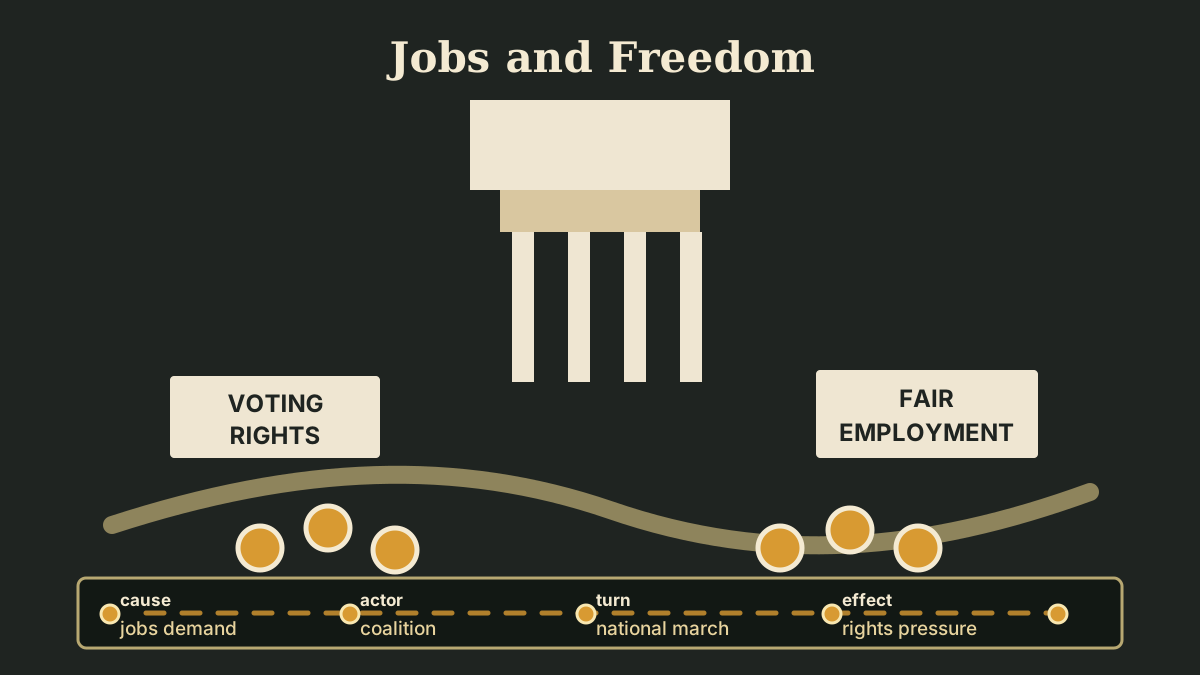
The march joined economic justice, voting rights, school desegregation, and public dignity in one demand set.
Map Layer
Where this event sits geographically
Gold pins mark the approximate locations of published event pages. This is a schematic locator map, not a historical border map.
Coordinates are approximate and are used to help readers orient themselves before opening a full event page.
References
Where to Check the Facts
- U.S. National Archives: Official Program for the March on WashingtonArchive reference for the 1963 March on Washington program, demands, and civil-rights context.
- Encyclopaedia BritannicaBackground reference for chronology, names, and historical context.
- WikidataStructured reference for dates, places, alternate names, and entity links.