At a Glance
The shape of the event
- Date
- 1857-1858 CE
- Place
- Meerut, Delhi, Kanpur, Lucknow, and North India
- Type
- Rebellion
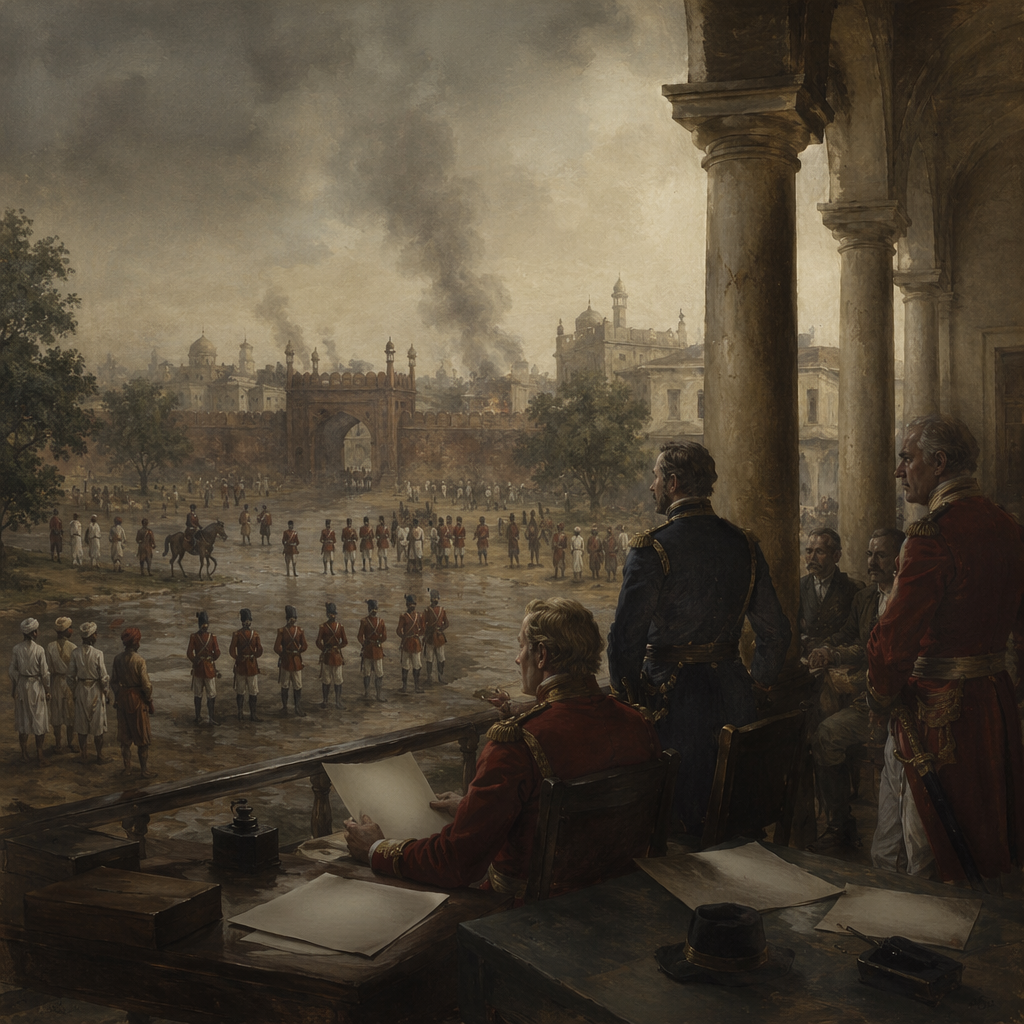
Soldiers and civilians across parts of north India rose against East India Company rule, producing a major rebellion that transformed British governance of India.
1857-1858 CE; place the event in Meerut, Delhi, Kanpur, Lucknow, and North India before comparing causes or consequences.
The event reshaped colonial administration, military recruitment, racial attitudes, princely-state policy, and later nationalist memory.
Bahadur Shah II / Rani Lakshmibai / Sepoy rebels are the first names or groups to compare before widening the story.
The rebellion was suppressed, the East India Company's rule ended, and Britain moved India under direct Crown rule.
The rebellion was suppressed, the East India Company's rule ended, and Britain moved India under direct Crown rule.
The event reshaped colonial administration, military recruitment, racial attitudes, princely-state policy, and later nationalist memory.
Follow the maps and timelines that trace how 1857 forced the British government to redesign imperial rule, altered patterns of military recruitment, and changed relations with princely states.
Background
By the 1850s the East India Company governed large tracts of the subcontinent, collecting revenue, administering courts, and maintaining its own armies. That governance rested on fragile partnerships: treaties with princely states, recruitment of Indian soldiers known as sepoys, and local intermediaries who enforced Company orders. Several kinds of pressure converged in the decade before 1857. Reforms in military organization and enlistment unsettled some soldiers; land- and revenue-collection practices strained peasants and landlords; and cultural and legal interventions created anxieties about religion and social status among many communities. Local rulers and urban populations watched Company influence creep into courts and religious institutions.
The initial outbreak at Meerut soon spread along established lines of communication and trade to cities such as Delhi, Kanpur and Lucknow, where political symbols and contested authority intensified the crisis. Bahadur Shah II was drawn into a leadership role he did not fully control; Rani Lakshmibai stood out as one of several leaders whose actions would be retold in later histories. The causes were multiple, overlapping and locally specific rather than the product of a single, unified conspiracy. The rebellion becomes more compelling when it is read through several local worlds at once.
Sepoys worried about service, caste, pay, and trust; dispossessed rulers and landlords saw Company expansion as a threat; peasants and townspeople carried grievances over revenue, debt, policing, and religious interference. Those pressures did not merge into one simple program, but they made Company rule feel fragile across a wide region. Delhi, Kanpur, Lucknow, Jhansi, and rural districts each shaped the revolt differently. A stronger route follows rumor, oath, siege, proclamation, reprisal, and survival from place to place, showing why the same crisis could look like military mutiny, popular rebellion, dynastic restoration, religious defense, and anti-colonial memory.
The Turning Point
What changed in 1857 was not simply the scale of violence but the character of political authority in north India. A mutiny among sepoys at Meerut quickly triggered wider uprisings: units abandoned their barracks, civilians joined in, and urban centres became theatres of contested sovereignty. When the unrest reached Delhi the Mughal court — long a shadow of its former power — became a rallying point, with Bahadur Shah II serving as a symbol around which disparate groups converged. In Kanpur and Lucknow fighting and sieges made clear that the conflict was both military and civic: supply lines, local alliances, and decisions by civilian magistrates, merchants and princes all mattered.
Figures like Rani Lakshmibai crystallized popular responses in some regions, representing armed defence of local domains and honor. British authorities, confronted with simultaneous crises in multiple towns, faced urgent strategic and legal choices: send reinforcements, apply martial measures, or attempt negotiated settlements. Those decisions — whether to hold towns, relieve garrisons, or make punitive examples — amplified the rebellion’s immediate destructiveness and set the terms for how the uprising would be suppressed and politically resolved. The turning point was not only the outbreak at Meerut, but the move toward Delhi and the symbolic return to Mughal authority. That choice gave scattered anger a visible center, even though coordination remained uneven and local motives continued to differ.
Consequences
In the short term the rebellion was suppressed by 1858, but its suppression did not restore the pre-1857 status quo. The most immediate institutional outcome was the end of East India Company rule and the transfer of responsibility to the British Crown; governance was reorganized with new administrative practices and different chains of command for military and civil power. British policy toward princely states, recruitment of Indian troops, and stationing of forces were all reassessed. Attitudes among British officials and settlers hardened in ways that affected racial perceptions and everyday governance.
In the longer run the uprising left enduring marks on political culture: it altered recruitment norms and military structures, reshaped how the imperial state interacted with Indian rulers, and became an important reference point in later nationalist memory. How the event was named — mutiny, rebellion, revolt, or war of independence — reflects different emphases and silences in subsequent histories. Memory of 1857 fed into both British debates about colonial policy and Indian debates about resistance and identity, making the episode a recurring touchstone in the making of modern South Asia. The aftermath remade imperial government.
The East India Company lost direct rule, the British Crown took over India, the army was reorganized, and colonial suspicion hardened into new racial, administrative, and military boundaries. For Indian memory, 1857 also became a long argument over names: mutiny, rebellion, revolt, and first war of independence each preserve a different political claim.
Interpretation Notes
Names for the event vary: mutiny, rebellion, revolt, or war of independence. The page explains what each label emphasizes and what it can hide.
Why Keep Reading
Follow the maps and timelines that trace how 1857 forced the British government to redesign imperial rule, altered patterns of military recruitment, and changed relations with princely states. Read the biographies and local accounts that show how figures such as Bahadur Shah II and Rani Lakshmibai were cast by contemporaries and by later historians. Explore neighbouring events — earlier Company expansions, later reforms under Crown rule, and the evolving politics of memory — to see how a single uprising rippled through institutions, armies and stories for decades. Continue from 1857 to Plassey, Crown rule, Indian nationalism, Gandhi, Partition, and decolonization routes.
That path shows why a failed rebellion could still change the structure of empire and the vocabulary of later resistance.
Reading Path
Follow the story without losing the thread
Before This
After This
- German East Africa Established1885 CE
- Salt MarchMarch-April 1930
- Second Battle of El AlameinOctober 23-November 11, 1942
Same Period
- Columbus's First Atlantic Voyage1492 CE
- Fall of the Aztec Empire1521 CE
- First Opium War Begins1839 CE
Wider Timeline
Mind Map
How to think about Indian Rebellion of 1857
army grievances
Discontent among sepoy soldiers over organization and service conditions helped trigger the initial disturbances at Meerut.
Map Layer
Where this event sits geographically
Gold pins mark the approximate locations of published event pages. This is a schematic locator map, not a historical border map.
Coordinates are approximate and are used to help readers orient themselves before opening a full event page.
References
Where to Check the Facts
- The National Archives: India 1857Archive education reference using documents for the causes and interpretation of the 1857 rebellion.
- British Library: India Office Records and Private PapersInstitutional archive reference for East India Company and British India records.
- Encyclopaedia Britannica: Battle of PlasseyReference for the battle, East India Company victory, Bengal context, and colonial consequences.
- Encyclopaedia Britannica: Indian Rebellion of 1857Reference for the 1857 revolt, sepoy context, British rule, and transfer toward direct imperial government.
- Library of Congress: U.S. History Primary Source TimelinePrimary-source timeline reference for Atlantic settlement, colonial expansion, reform, and later U.S. history paths.