At a Glance
The shape of the event
- Date
- July 4, 1776
- Place
- Philadelphia
- Type
- Political Declaration
The Continental Congress adopted a declaration that presented the American colonies as independent states and justified separation from Britain.
July 4, 1776; place the event in Philadelphia before comparing causes or consequences.
The document influenced republican movements, constitutional debates, and later arguments over rights and equality.
Thomas Jefferson / George Washington / John Adams are the first names or groups to compare before widening the story.
The war for independence gained a public statement of political purpose and international meaning.
The war for independence gained a public statement of political purpose and international meaning.
The document influenced republican movements, constitutional debates, and later arguments over rights and equality.
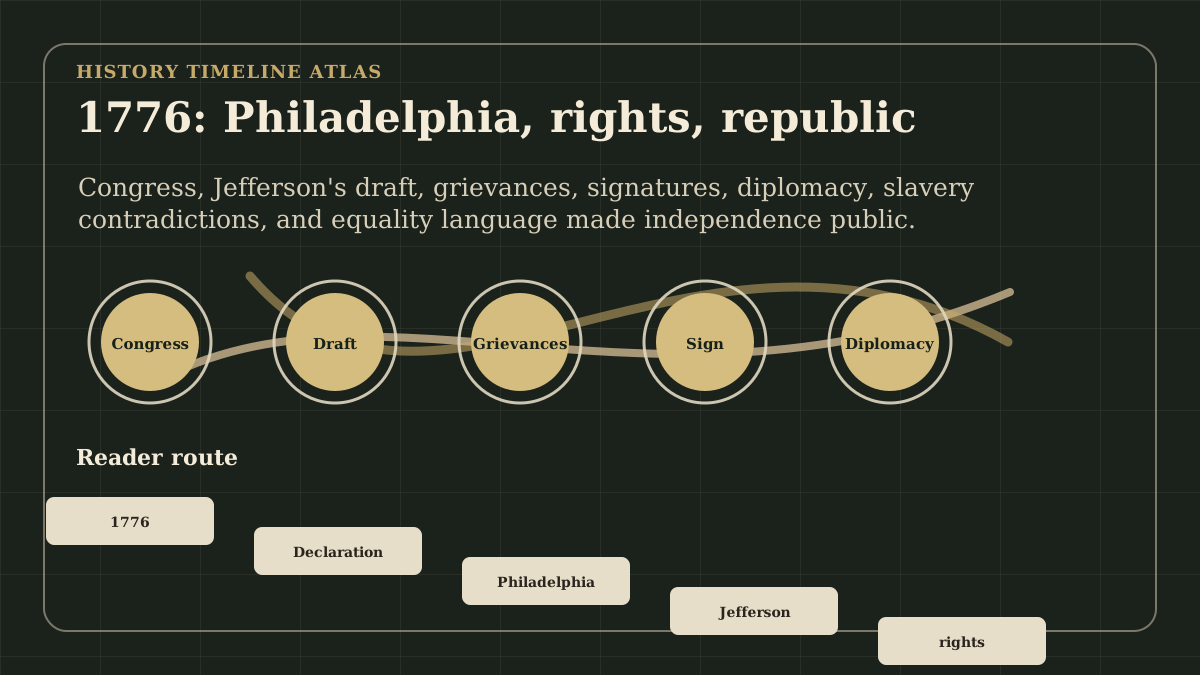
Follow the Declaration's lines forward and backward.
Background
The Declaration emerged from a decade of mounting friction that combined immediate grievances, evolving political habits, and new ideas from the Enlightenment. Colonial legislatures, merchants and military leaders had all been drawn into disputes with imperial officials; skirmishes and blockades hardened perceptions on both sides. At the same time a vocabulary of natural rights, consent and republican government circulated among lawyers, clergy and pamphleteers, giving political claims a philosophical backbone. The Continental Congress met in Philadelphia as the colonies wrestled with whether to press for reconciliation within the empire, seek redress, or assert outright independence.
Thomas Jefferson wrote the principal draft, John Adams argued energetically for a break, and George Washington's role as commander of the Continental Army made the politics of separation inseparable from the reality of armed struggle. Colonial newspapers, correspondence networks and public meetings amplified decisions made in halls, and the question of recognition by other powers loomed: independence required political as well as military resolve. Those layered pressures explain why the declaration was both a statement of principles and a practical step toward diplomatic life. The Declaration of Independence should not read like a sacred document detached from conflict.
It was adopted during war, after years of imperial dispute over taxation, representation, sovereignty, trade, military force, and the authority of Parliament over colonial assemblies. It gave a political and diplomatic language to a rebellion already underway. The drafting process matters because it shows politics in motion. Thomas Jefferson wrote the principal draft, but Congress edited it, delegates negotiated wording, and the final text had to speak to multiple audiences: colonial supporters, hesitant communities, British officials, enslaved and free people listening for the meaning of rights language, Native nations watching colonial expansion, and foreign powers whose recognition or aid could shape the war. A richer page must keep the contradiction at the center.
The claim that all men are created equal traveled widely, but the new states did not abolish slavery, did not include women as political equals, and did not treat Indigenous sovereignty as equal. The document's power came partly from that tension: later movements could cite its promises against the society that issued it.
The Turning Point
Adoption of the Declaration on July 4, 1776, shifted the conflict's register from contested rights within an empire to an assertion of separate sovereignty. Thomas Jefferson's draft supplied the careful, polemical prose that framed grievances as principles; John Adams and other delegates pressed colleagues to take the decisive step of formal separation. In Philadelphia's Continental Congress the choice was not automatic; delegates debated tone, timing and the legal claim being made. The decision to present the colonies as independent states meant more than rhetoric: it transformed political strategy, altered diplomatic possibilities, and clarified for soldiers and civilians what they were fighting for.
George Washington, commanding the Continental Army, now led military forces whose cause was publicly tied to a claim of national birth. Delegates amended Jefferson's language in committee and on the floor, trimming phrases that proved controversial in order to secure a majority. For those who lent their names or votes, the choice was perilous: breaking with Britain exposed property, reputation and safety to military and legal consequences. The declaration made the revolution's aims explicit to foreign audiences while leaving many practical questions unresolved. The turning point was the conversion of colonial grievance into a public claim of independent statehood. After July 1776, the war was no longer only about restoring rights within empire.
It became a struggle over whether new states could survive, govern, win alliances, and justify revolution to the world. The editing of the text was also a turning point. Congress made the declaration more politically usable by removing or changing language that could fracture support. That compromise helped adoption, but it also left silences that later generations would challenge.
Consequences
In the immediate aftermath the Declaration supplied the American cause with a compact statement of political purpose and an appeal to international opinion. It clarified what diplomatic recognition and foreign assistance would be asked to support: a claim to independent statehood. At home the declaration became a touchstone for mobilizing support, even as battlefield success remained decisive. Long-term, its language entered global conversations about republicanism and rights; later constitutional debates in the United States returned repeatedly to its assertions about equality and consent, and activists and reformers in other lands cited its rhetoric as they argued for new political orders.
Historians note, however, that the document did not settle questions about who counted within its promises: arguments over slavery, voting rights and economic inclusion would draw on and contest its phrases for generations. Interpretation remains contested - some emphasize the decisive agency of individuals and political choices, others point to economic structures, transatlantic intellectual currents and the contingencies of war. The Declaration's power lies as much in its capacity to be invoked, contested and repurposed as in any single intended outcome. The immediate consequence was diplomatic and military clarity. The Continental Army fought for a declared political object, and American representatives could seek foreign support for independence rather than reform.
The text helped turn a colonial war into an international question. The longer consequence was argumentative. Abolitionists, women's rights advocates, civil rights leaders, anti-colonial thinkers, and constitutional reformers returned to the declaration because its language could be used beyond the founders' intentions. It became both a founding document and a measuring stick.
Interpretation Notes
The memory of Declaration of Independence often depends on who tells the story. A court, army, religious community, merchant network, or later nation can emphasize different causes and make Philadelphia stand for different lessons.
Why Keep Reading
Follow the Declaration's lines forward and backward. Trace the military campaigns and diplomatic negotiations that tested the claim it made; read the debates that followed as Americans turned principle into law in state constitutions and later national documents. Compare Jefferson's prose with contemporaneous Enlightenment writing to see how ideas traveled across the Atlantic. For entry points, read biographies of Jefferson, Adams and Washington, follow the Continental Congress timeline in Philadelphia, and explore later constitutional debates. Keep the contested interpretations in view: people made choices, but so did institutions and circumstances. Read the Declaration beside the American Revolution timeline, French Revolution, Haitian Revolution, Seneca Falls, abolition, and civil rights pages. That route shows how rights language travels, widens, and exposes contradictions.
Reading Path
Follow the story without losing the thread
Before This
No direct path yet.
After This
- French Revolution Begins1789 CE
- Storming of the BastilleJuly 14, 1789
- Haitian Revolution Begins1791 CE
Same Period
- French Revolution Begins1789 CE
- Haitian Revolution Begins1791 CE
- Storming of the BastilleJuly 14, 1789
Wider Timeline
Mind Map
How to think about Declaration of Independence
Enlightenment ideas
Philosophical arguments about natural rights, consent and republican government provided a vocabulary for colonial leaders to frame grievances as universal principles.
Map Layer
Where this event sits geographically
Gold pins mark the approximate locations of published event pages. This is a schematic locator map, not a historical border map.
Coordinates are approximate and are used to help readers orient themselves before opening a full event page.
References
Where to Check the Facts
- Library of Congress: The American Revolution, 1763-1783Primary-source timeline reference for the American Revolution and founding-era context.
- Encyclopaedia BritannicaBackground reference for chronology, names, and historical context.
- WikidataStructured reference for dates, places, alternate names, and entity links.