At a Glance
The shape of the event
- Date
- July 14, 1789
- Place
- Paris
- Type
- Urban Uprising
Parisian crowds stormed the Bastille fortress during the French Revolution, turning political crisis into a visible attack on royal authority.
July 14, 1789; place the event in Paris before comparing causes or consequences.
The event became one of the most recognizable symbols of revolution, state legitimacy, and the power of urban crowds.
Parisian crowds are the first names or groups to compare before widening the story.
The fall of the Bastille strengthened revolutionary momentum and became a symbol of popular action.
The fall of the Bastille strengthened revolutionary momentum and became a symbol of popular action.
The event became one of the most recognizable symbols of revolution, state legitimacy, and the power of urban crowds.
If the Storming of the Bastille compels you, follow the paths it opened: how urban crowds translated symbolic victories into political power, how questions of rights and legitimacy were debated in provincial towns and...
Background
The summer of 1789 found Paris charged with suspicion and debate over power, rights, and the monarchy. Political institutions and arguments were in motion, and large numbers of Parisians — artisans, shopkeepers, and other urban residents — were watching those arguments for their practical effects on daily life and liberty. In this environment the Bastille had acquired significance beyond its stones: it was a visible emblem of royal authority, a place to which power and punishment were attached in public imagination. The story of July 14 cannot be reduced to a single cause.
Contemporary actors faced immediate choices amid accumulated pressures: popular expectations about rights, anxiety about the state’s willingness to use force, and the very human calculus of what a crowd might be able to do. Historians debate how far the outcome was the product of structural forces — long-term political and social tensions — or of discrete decisions taken in a charged moment. This entry keeps both kinds of explanation in view rather than resolving the dispute. The Storming of the Bastille should be read as more than a dramatic attack on a prison. Paris was already tense from bread prices, political rumor, royal troop movements, fears of repression, and the struggle between the king and the National Assembly.
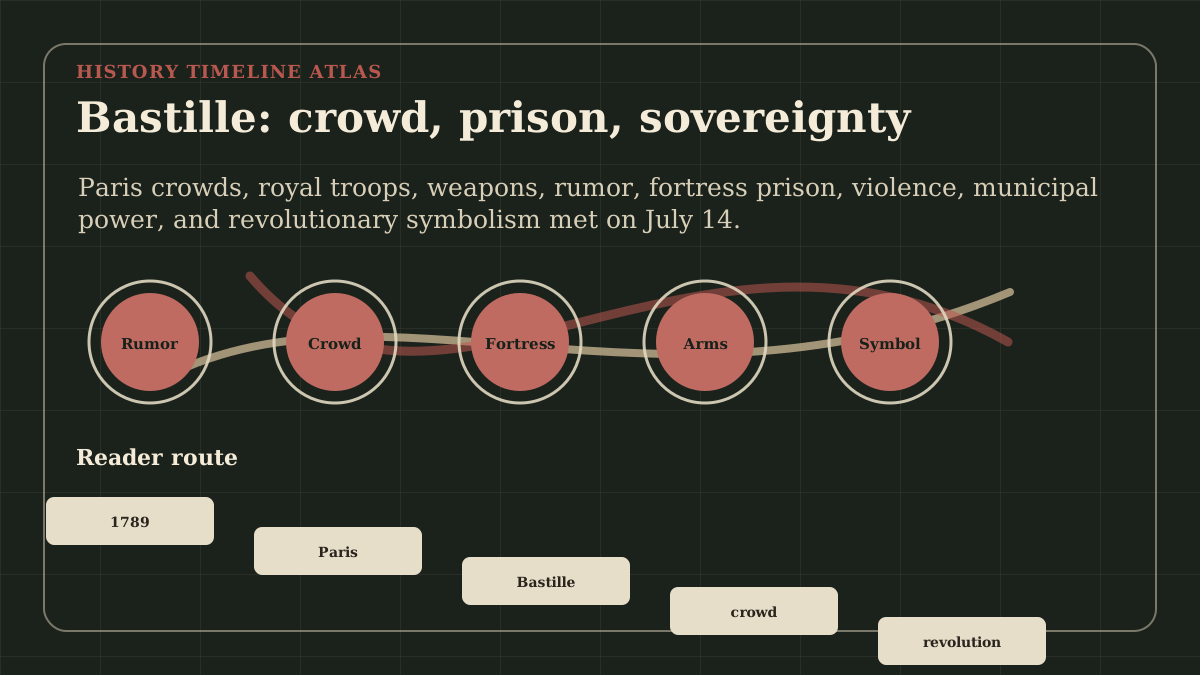
The Bastille became important because it stood where fear, weapons, and symbolism met. The crowd was political, practical, and volatile at once. Many Parisians wanted arms and gunpowder, but they also acted inside a world of rumor, municipal authority, neighborhood mobilization, and anger at royal power. The fortress held few prisoners, yet its image as arbitrary authority mattered more than its actual prison population. Violence must stay visible. The event included negotiation, confusion, killing, heads displayed in public, and the collapse of royal authority in the capital. A strong page should avoid turning the day into a clean myth of freedom while still explaining why it became a revolutionary symbol.
The Turning Point
The decisive change on 14 July was how an escalating political crisis crossed the line into overt urban uprising. Parisian crowds moved from protest and petition into direct action by assaulting the Bastille fortress. That choice — to gather in force at a heavily guarded symbol of royal authority and to attempt its seizure — transformed abstract crisis into a public, irreversible event. The crowd itself was the central actor: its decision to press forward against masonry and weaponry redefined what was at stake.
The fall of the Bastille did not simply remove a building from the cityscape; it projected a new political fact into the open: royal authority could be contested in the streets and could be overcome by popular initiative. Contemporaries and later observers read the moment differently, some emphasizing the deliberate coordination and leadership behind the assault, others the spontaneous energy of an urban multitude. Whatever the balance, the day produced a visible rupture: the crisis of the moment became, through collective action, a public defeat of a royal emblem. The turning point was the moment the crowd's search for arms became a successful assault on a royal fortress. That changed the balance of fear in Paris.
The king still ruled formally, but he could no longer assume obedience in the capital. The symbolic turn came almost immediately. The Bastille's fall was narrated, celebrated, criticized, and commemorated as proof that ordinary people could intervene in sovereignty. Political legitimacy now had to account for crowds, municipalities, and revolutionary public opinion.
Consequences
In the immediate aftermath the fall of the Bastille strengthened revolutionary momentum in Paris. The event galvanized people who had been debating options into actors who expected change to follow. Politically, it sent a clear signal that opposition to the monarchy could be expressed through mass action rather than only through petitions or elite negotiation. Over the longer term the storming became one of the most recognizable symbols of the French Revolution: a shorthand for popular action, for challenges to state legitimacy, and for the power of urban crowds. That symbolic legacy shaped politics and memory in ways that outlasted the stones of the fortress.
At the same time, historians caution against simple causation: the Bastille’s fall was both effect and cause — it emerged from existing tensions and then intensified them, prompting new rounds of decision-making by officials, militias, and citizens. The event remains contested terrain for interpretation because it sits at the intersection of individual choices and deeper structural pressures, and because its symbolic life has been shaped by many subsequent retellings. The immediate consequence was a surge in revolutionary confidence, the reorganization of Parisian authority, and pressure on the king to recognize changed political realities. The longer consequence was memory: July 14 became a national symbol because it joined popular action to the destruction of arbitrary power.
The event also warns readers that symbols can simplify. The Bastille became freedom's emblem, but the revolution that followed also raised questions about violence, fear, law, representation, and who counted as the people.
Interpretation Notes
Storming of the Bastille can look simple when reduced to one date, but the evidence usually points to a wider setting. The useful debate is which part mattered most: leadership, logistics, belief, social pressure, or the institutions that survived afterward.
Why Keep Reading
If the Storming of the Bastille compels you, follow the paths it opened: how urban crowds translated symbolic victories into political power, how questions of rights and legitimacy were debated in provincial towns and at the national level, and how the monarchy responded to visible challenges within the capital. Each subsequent moment — decisions by municipal authorities, the formation of new civic bodies, and the shifting patterns of popular mobilization — helps explain how a single day came to mark an entire revolutionary era. Reading on will show how short, dramatic actions and slower institutional transformations worked together.
Read the Bastille after the opening of the French Revolution and before the execution of Louis XVI, Haitian Revolution, and Revolutions of 1848. That route shows how crowd action, sovereignty, and rights traveled through revolutionary politics.
Reading Path
Follow the story without losing the thread
Before This
- French Revolution Begins1789 CE
- Declaration of IndependenceJuly 4, 1776
- English Civil War Begins1642 CE
After This
- Haitian Revolution Begins1791 CE
- Haitian Revolution Begins1791 CE
- Execution of Louis XVIJanuary 21, 1793
Same Period
- Declaration of IndependenceJuly 4, 1776
- French Revolution Begins1789 CE
- Haitian Revolution Begins1791 CE
Wider Timeline
Mind Map
How to think about Storming of the Bastille
Political crisis
The broad, escalating political crisis that made direct action a plausible response
Map Layer
Where this event sits geographically
Gold pins mark the approximate locations of published event pages. This is a schematic locator map, not a historical border map.
Coordinates are approximate and are used to help readers orient themselves before opening a full event page.
References
Where to Check the Facts
- Encyclopaedia Britannica: French RevolutionReference for French Revolution chronology, causes, political phases, and consequences.
- Encyclopaedia BritannicaBackground reference for chronology, names, and historical context.
- WikidataStructured reference for dates, places, alternate names, and entity links.