At a Glance
The shape of the event
- Date
- March-May 1871
- Place
- Paris
- Type
- Revolutionary Government
Radicals and workers in Paris established the Commune after war and political collapse, governing the city before being violently suppressed.
March-May 1871; place the event in Paris before comparing causes or consequences.
The Commune became a powerful memory for socialist, republican, and conservative interpretations of revolution and order.
Paris Commune members are the first names or groups to compare before widening the story.
French government forces crushed the Commune after intense street fighting.
French government forces crushed the Commune after intense street fighting.
The Commune became a powerful memory for socialist, republican, and conservative interpretations of revolution and order.
If the Commune asks a question—who governs the modern city—follow the aftermath and the longer arc of European politics to see how different answers were proposed and enforced.
Background
After months of military defeat and the collapse of national authority, Paris became both a refuge and a pressure cooker. The city still sheltered soldiers, refugees, and civilians who had seen political promises fail and public services fray. Longstanding grievances—economic insecurity, crowded housing, and the concentration of industrial labor—sat alongside newer shocks: food shortages, demobilized fighters, and a vacuum of effective governance. Municipal institutions and neighborhood associations took on tasks the state no longer performed: distributing supplies, organizing local defense, and adjudicating disputes. At the same time, political life in Paris had its own character—radical clubs, cooperative workshops, and workers’ committees that debated the shape of a more equitable city.
Outside the capital, political leaders and the reconstituted national government labored to restore order and authority. Those two currents—urban collective self-organization and a national push for restoration—pulled in different directions. Historians still debate how much weight to give structural pressures like economic crisis and military collapse versus the contingent decisions of local actors. This account preserves that tension: the Commune grew from concrete, immediate failures of war and governance, but it was also made by the choices and networks of Parisians who decided to govern themselves. The Paris Commune should be read as city government under siege, not only as an uprising.
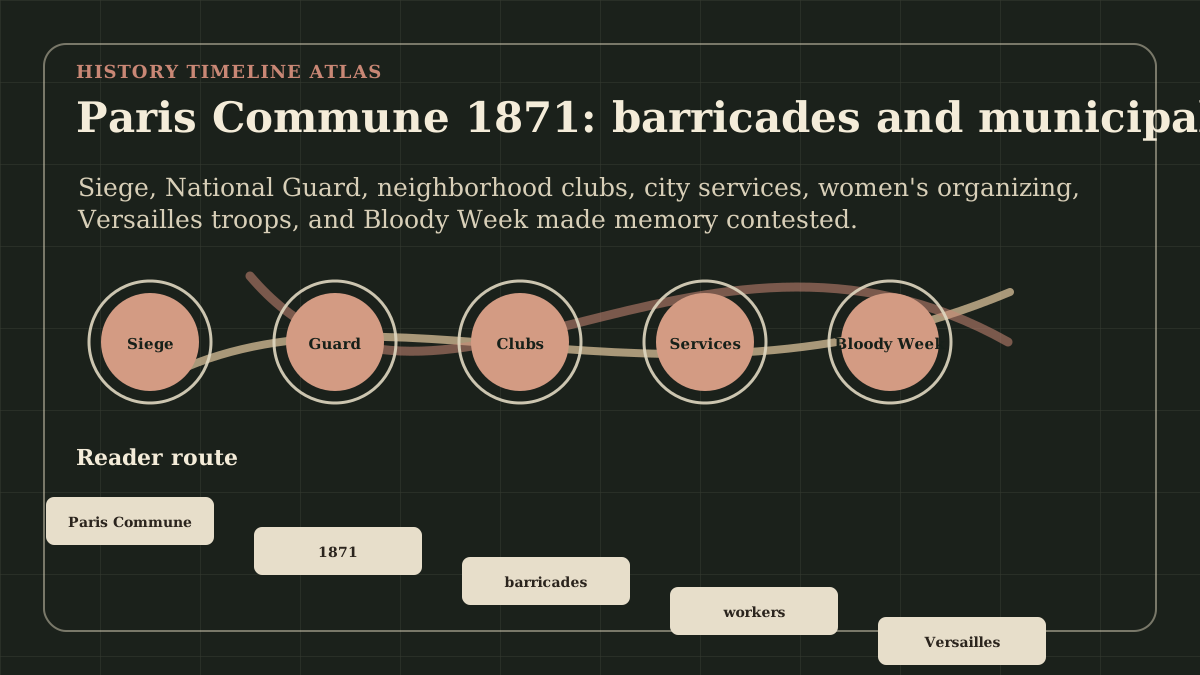
Paris had endured the Franco-Prussian War, hunger, bombardment, political collapse, and distrust of national leaders who seemed willing to surrender both the capital's pride and the republic's promise. The Commune's daily work matters because it turns the event from symbol into lived politics. National Guard units, neighborhood committees, clubs, teachers, printers, artisans, women organizers, workers, and municipal officials debated rents, wages, schooling, church power, military defense, and public services while expecting attack from Versailles. Its memory is inseparable from violence. Bloody Week was not an afterthought but the means by which the national government reasserted control.
Executions, deportations, trials, burned buildings, barricades, and later commemorations turned the Commune into a warning for conservatives and an inspiration for socialists, anarchists, and municipal reformers.
The Turning Point
In March 1871 a sequence of rapid decisions turned a crisis of governance into an experiment in urban republican power. Members of the Paris Commune—radicals, working-class organizers, and neighborhood committees—seized municipal authority and set about running the city themselves. They organized essential services, formed militias, and placed power in local assemblies that prioritized direct accountability. These were active choices: to reject the restored national leadership, to manage food and services locally, and to arm citizens as guardians of their neighborhoods. From the other side, the national government confronted a city it no longer controlled. Over the following weeks, political leaders and military commanders resolved to restore central authority and prepared forces to do so.
That decision set the scene for a clash that was not merely military but symbolic: whether a popular, urban government could persist beside a state determined to reassert itself. The Commune held Paris through April and into May 1871, testing practices of social and municipal self-rule. When government forces finally entered the city, fierce street fighting followed; those choices—by Commune members to hold the city and by the national authorities to reconquer it—produced the turning point that ended the experiment. The turning point was the split between Paris and Versailles after the attempted seizure of National Guard cannon.
What had been postwar crisis became a contest over who had the right to govern the capital: elected communal institutions or the national government. A second turning point came when Versailles forces entered Paris. Street-by-street fighting made the end of the Commune intensely urban; barricades, neighborhoods, prisons, public buildings, and civilians became part of the battlefield and the later memory.
Consequences
The immediate consequence was harsh and decisive: French government forces crushed the Commune after intense street fighting, and the city returned to rule under the restored national authority. That suppression closed the experiment in municipal self-government and removed the Commune’s capacity to shape institutions in the near term. Yet the longer consequences were less final. In the years that followed, the Commune became a touchstone in political debate across Europe. Socialists portrayed it as proof that urban workers could govern themselves; republicans read it as a warning about the fragility of representative institutions; conservatives used it to argue for stronger state control to prevent disorder.
Its brief rule entered art, literature, political speeches, and commemorations, becoming a malleable memory that each tradition could claim. Historians continue to argue about causation: whether structural forces—war, economic dislocation, demographic pressures—made the uprising inevitable, or whether particular decisions by Commune members and national leaders determined its fate. Practically, the Commune influenced later debates about municipal socialism, the role of armed civilians in politics, and how states respond to internal insurrection. In short, defeat dissolved the Commune as a government, but its ideas and images persisted as contested resources for later movements and state policies. The immediate consequence was suppression, imprisonment, execution, exile, and the restoration of central authority over Paris.
The Commune's practical reforms were cut short before they could become a stable municipal order. The longer consequence was political imagination. Later movements read the Commune as proof that workers and neighborhoods could govern; opponents read it as proof that social revolution led to disorder. Both readings kept 1871 alive far beyond its seventy-two days.
Interpretation Notes
Paris Commune can look simple when reduced to one date, but the evidence usually points to a wider setting. The useful debate is which part mattered most: leadership, logistics, belief, social pressure, or the institutions that survived afterward.
Why Keep Reading
If the Commune asks a question—who governs the modern city—follow the aftermath and the longer arc of European politics to see how different answers were proposed and enforced. Read next about the collapse that preceded it, the national government’s response in 1871, and the cultural work—commemorations, novels, and political rhetoric—that kept the Commune alive in public memory. Tracing those threads leads to later municipal experiments, the rise of organized socialist parties, and recurrent debates over armed citizens and state power. Each step shows how a few months in Paris shaped policy, protest, and political imagination across decades. The maps and timelines that follow will help you place the Commune inside those wider movements.
Read the Commune after 1848 and the Franco-Prussian War, then continue to socialist movements, labor politics, the Russian Revolution, and debates over city government. That path shows how a short urban experiment became a long political memory.
Reading Path
Follow the story without losing the thread
Before This
- First Transcontinental Railroad CompletedMay 10, 1869
- Emancipation ProclamationJanuary 1, 1863
- Darwin Publishes On the Origin of Species1859 CE
After This
- Telephone Patented1876 CE
- Mexican Revolution Begins1910
- Xinhai Revolution1911
Same Period
- Seneca Falls ConventionJuly 1848
- Emancipation ProclamationJanuary 1, 1863
- Darwin Publishes On the Origin of Species1859 CE
Wider Timeline
Mind Map
How to think about Paris Commune
war & collapse
Military defeat and collapse of national authority created a governance vacuum in Paris
Map Layer
Where this event sits geographically
Gold pins mark the approximate locations of published event pages. This is a schematic locator map, not a historical border map.
Coordinates are approximate and are used to help readers orient themselves before opening a full event page.
References
Where to Check the Facts
- Encyclopaedia Britannica: Commune of ParisSpecific reference for the 1871 Paris Commune, causes, repression, and political legacy.
- Encyclopaedia BritannicaBackground reference for chronology, names, and historical context.
- WikidataStructured reference for dates, places, alternate names, and entity links.