At a Glance
The shape of the event
- Date
- 1911
- Place
- Wuchang
- Type
- Revolution
The Xinhai Revolution overthrew the Qing dynasty and opened the way for the Republic of China after centuries of imperial rule.
1911; place the event in Wuchang before comparing causes or consequences.
The revolution transformed Chinese political language and began a long struggle over republicanism, nationalism, and state unity.
Sun Yat-sen / Qing dynasty are the first names or groups to compare before widening the story.
The Qing abdicated, but the new republic faced fragmentation, warlord power, and contested authority.
The Qing abdicated, but the new republic faced fragmentation, warlord power, and contested authority.
The revolution transformed Chinese political language and began a long struggle over republicanism, nationalism, and state unity.
If this turning point interests you, follow the next chapters to see how the promise of 1911 unfolded unevenly across decades: the ways regional military power shaped politics, how republican and nationalist vocabular...
Background
The Xinhai Revolution did not appear from nowhere. By 1911, a long period of strain had gathered inside China: debates over reform and modernization, political experiments aimed at limiting imperial power, and new languages of nationhood and citizenship. These pressures interacted with regional divisions and the growing prominence of modern armed forces under local command. Revolutionary ideas—most often gathered under the banner of republicanism—circulated among exiles, students, military men, and local elites, even as many people continued to live within older, imperial frameworks of authority. Foreign presence and economic change shaped some of the choices available to both reformers and defenders of the dynasty, but no single explanation captures the full story.
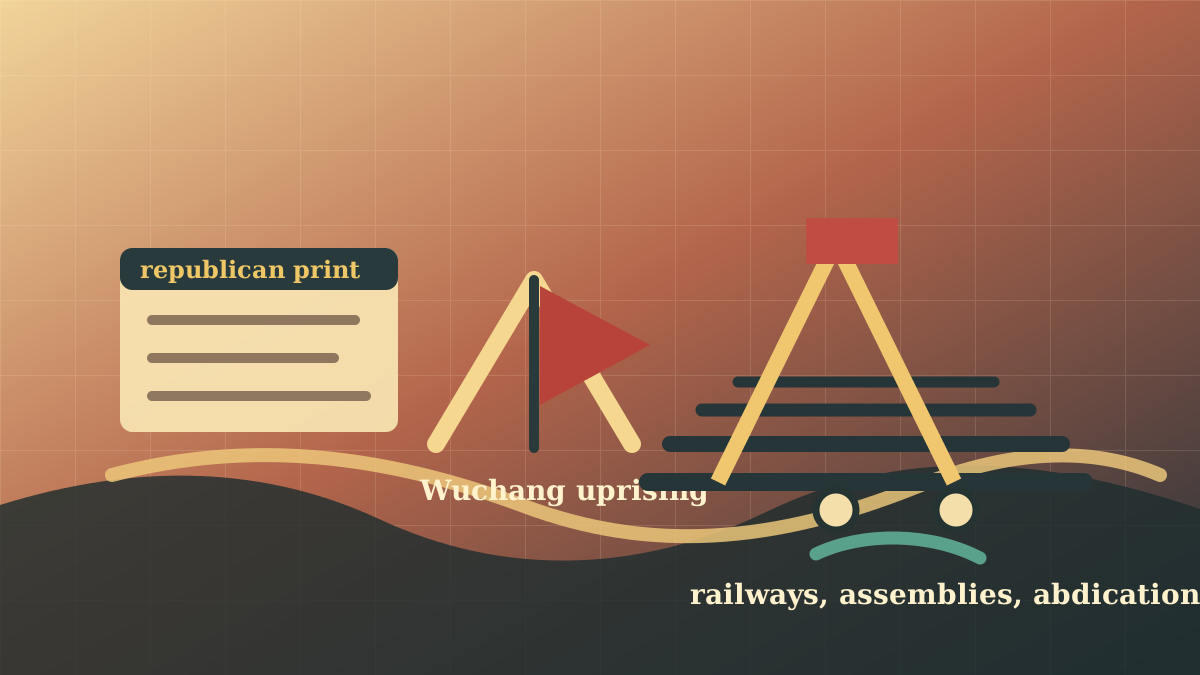
Historians continue to dispute how much was driven by individual leaders, short-term crises, or deep structural forces. This account aims to keep those disagreements visible rather than present one definitive cause. The revolution also belonged to print, schools, railways, assemblies, overseas networks, and new military units. Newspapers and political societies gave republican arguments wider reach; students and exiles connected China to Japan, Southeast Asia, and global constitutional debates; provincial assemblies created expectations that officials could be challenged. These channels made the Qing crisis national before any one city could control the outcome. The Xinhai Revolution brought together military mutiny, revolutionary networks, constitutional disappointment, provincial politics, anti-Manchu sentiment, fiscal crisis, and the weakening of Qing authority.
The Wuchang uprising became a national rupture because many provinces were ready to reconsider loyalty. The revolution ended an imperial dynasty but did not create a stable republic overnight. Yuan Shikai, regional militarists, revolutionaries, reformers, and local elites all shaped the uncertain transition.
The Turning Point
The decisive moment centered on an outbreak of rebellion in Wuchang that quickly altered the balance of power. Local commanders, revolutionaries inspired by republican ideas, and networks of organizers made a set of practical choices: to seize arsenals and stations, to proclaim alternatives to imperial rule, and to seek wider support among provinces and cities. Sun Yat-sen figures prominently in the story as an ideological architect and rallying symbol for republicanism; his name gave coherence to a broader coalition even where he was not present on the ground. Facing the rapid spread of uprisings, the Qing dynasty’s leaders confronted a stark choice: suppress a spreading revolt at the risk of further disintegration, or cede power and attempt negotiation.
The decision to relinquish the throne, whatever its immediate motives, marked the end of dynastic rule and the beginning of a fragile experiment. That transition was uneven: authority shifted not only through proclamations, but through bargaining among military officers, local elites, and revolutionary clubs, a pattern that ensured the revolution’s political outcomes would remain contested. Wuchang mattered because it revealed how quickly authority could cascade. A local mutiny became a provincial break, provincial breaks became a national crisis, and negotiation with Yuan Shikai and the court turned military leverage into abdication politics. Sun Yat-sen supplied symbolic republican language, but the transfer of power depended on officers, provincial elites, revolutionaries, and court figures making bargains under pressure.
Consequences
The near-term consequence was clear: the Qing dynasty abdicated and the Republic of China was proclaimed, breaking centuries of imperial continuity. Yet political authority did not instantly condense into a stable national government. The new republic confronted powerful centrifugal dynamics—regional power holders and military commanders exercised autonomy, and political authority was contested across provinces. In practice, republican institutions existed alongside, and often below, competing centers of power. Over the longer term the revolution reshaped vocabulary and possibility in Chinese politics: republicanism, nationalism, and questions of state unity became central reference points for subsequent actors and conflicts.
The revolution thus began a prolonged struggle over what a modern Chinese state should be, how it should be governed, and who would speak for the nation. Scholars still debate how much of the outcome was driven by the strategic choices of key individuals and how much flowed from deeper structural shifts. This page keeps those debates in view because they matter for understanding why the republic that followed did not immediately deliver the unity and stability many had hoped for. The republic inherited the revolution and the revolution inherited unresolved problems. Fiscal weakness, military regionalism, foreign pressure, constitutional disagreement, and competing claims to legitimacy did not disappear with the abdication.
That is why 1911 is best read as an opening: it ended dynastic rule while beginning a longer argument about sovereignty, citizenship, party politics, and state unity. The consequences included the abdication of the Qing emperor, the Republic of China, warlord fragmentation, and a long twentieth-century search for sovereignty, unity, and political legitimacy. Xinhai matters because collapse and founding happened together.
Interpretation Notes
The memory of Xinhai Revolution often depends on who tells the story. A court, army, religious community, merchant network, or later nation can emphasize different causes and make Wuchang stand for different lessons.
Why Keep Reading
If this turning point interests you, follow the next chapters to see how the promise of 1911 unfolded unevenly across decades: the ways regional military power shaped politics, how republican and nationalist vocabularies were contested and remade, and how leading figures and grassroots movements tried to translate ideas into durable institutions. Read on to trace the republic’s first fragile experiments, the local and national leaders who claimed legitimacy in its name, and the continuing debates about whether 1911 was a decisive break or the start of a longer, unfinished transformation. Continue to May Fourth, warlord politics, Chinese nationalism, and East Asian reform pages.
The path shows how the fall of an empire created a political vocabulary that later movements used, disputed, and remade. Continue to Sun Yat-sen, May Fourth, Chinese Revolution, 1949, and modern China routes.
Reading Path
Follow the story without losing the thread
Before This
- Mexican Revolution Begins1910
- First Sino-Japanese War Begins1894
- Paris CommuneMarch-May 1871
After This
- Assassination of Archduke Franz FerdinandJune 28, 1914
- Easter RisingApril 1916
- Mexican Constitution of 19171917
Same Period
- Assassination of Archduke Franz FerdinandJune 28, 1914
- Russian Revolution1917 CE
- Treaty of VersaillesJune 28, 1919
Wider Timeline
Mind Map
How to think about Xinhai Revolution
Imperial strain
Longstanding administrative, social, and political pressures that made dynastic recovery difficult
Map Layer
Where this event sits geographically
Gold pins mark the approximate locations of published event pages. This is a schematic locator map, not a historical border map.
Coordinates are approximate and are used to help readers orient themselves before opening a full event page.
References
Where to Check the Facts
- Encyclopaedia Britannica: Chinese RevolutionSpecific reference for the 1911-1912 revolution, Qing collapse, republicanism, and political aftermath.
- Office of the Historian: The Chinese Revolution of 1911Official diplomatic-history reference for the 1911 revolution and Republic of China context.