At a Glance
The shape of the event
- Date
- January 1, 1863
- Place
- Washington, D.C.
- Type
- Proclamation
Abraham Lincoln issued the Emancipation Proclamation, declaring enslaved people in Confederate-held territory to be free as a war measure.
January 1, 1863; place the event in Washington, D.C. before comparing causes or consequences.
The proclamation changed the meaning of the Civil War and helped prepare the way for constitutional abolition.
Abraham Lincoln are the first names or groups to compare before widening the story.
The Union war effort became more explicitly tied to emancipation, and Black enlistment expanded.
The Union war effort became more explicitly tied to emancipation, and Black enlistment expanded.
The proclamation changed the meaning of the Civil War and helped prepare the way for constitutional abolition.
Follow the threads that the proclamation set in motion.
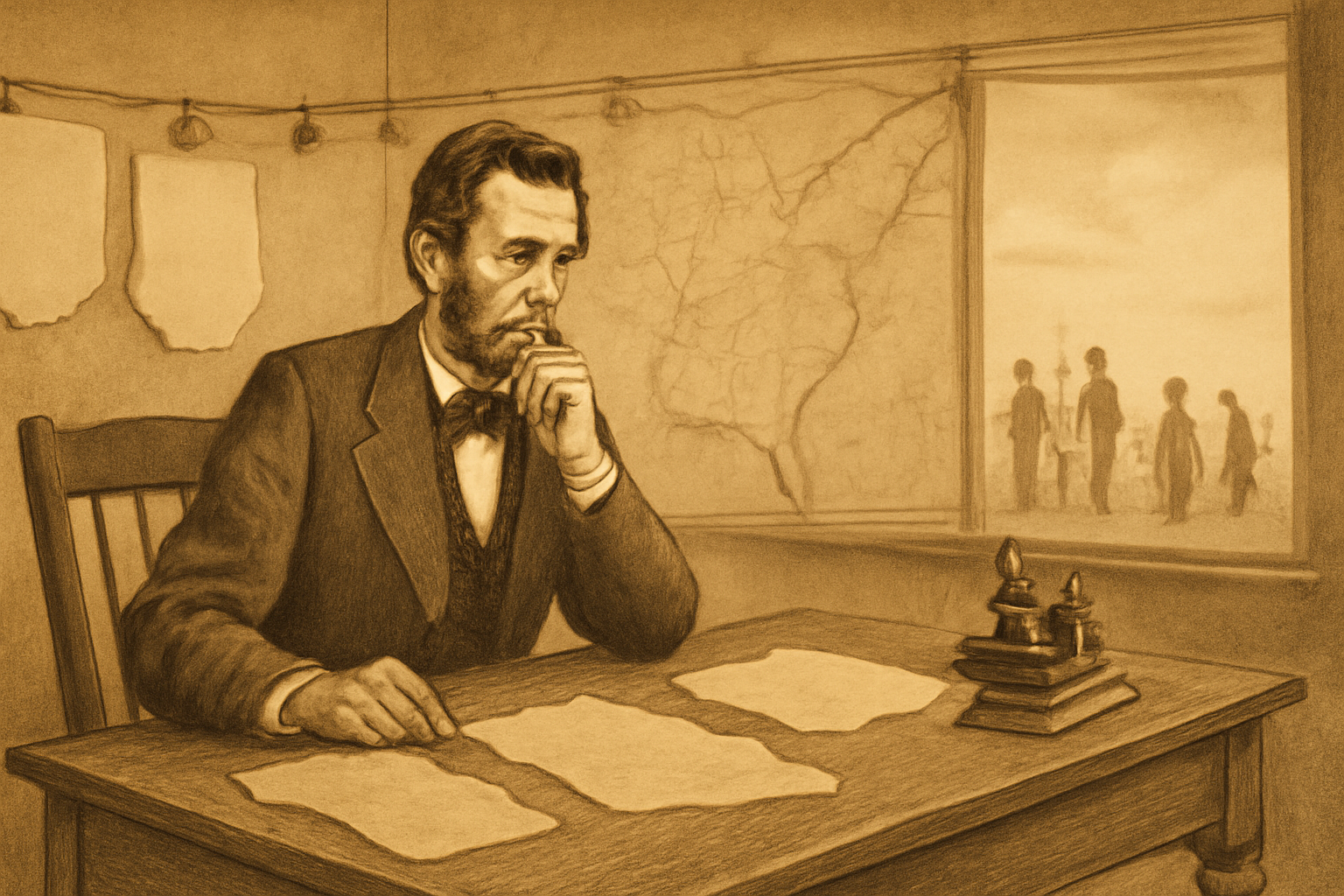
Background
The Emancipation Proclamation grew out of layered pressures—military, political, moral, and social—that intensified as the Civil War unfolded. From 1861 the Union government wrestled with how to restore the nation while confronting an economy and social order built on slavery. Abolitionist agitation in the North, political constraints posed by loyal slaveholding border states, and the practical realities of warfare all shaped policymaking. Enslaved people on the ground exerted agency as well: flight, resistance, and efforts to reach Union lines made clear that slavery was a battlefield fact as much as a moral issue. Military leaders and politicians considered whether emancipation would undercut the Confederacy’s labor base or complicate foreign diplomacy; advocates pressed for emancipation as justice and strategy.
Lincoln navigated these tensions and framed emancipation as a wartime measure within his authority. Historians still dispute the relative weight of Lincoln’s personal calculations, activist pressure, and structural forces; this page keeps those contested strands visible rather than offering a single, settled explanation. The Emancipation Proclamation needs to be read as a wartime measure, a constitutional gamble, and a freedom claim shaped by enslaved people's own actions. Lincoln did not simply announce freedom from above. Enslaved people fled to Union lines, forced commanders to confront slavery as a military problem, and made it harder for the federal government to imagine restoring the Union without touching human bondage. The document's limits are part of its meaning.
It applied to areas in rebellion, not to loyal slave states or some occupied regions, so it did not free every enslaved person immediately. Yet that legal caution also reveals the pressure of war: emancipation became tied to Union military authority, Black enlistment, diplomacy, and the destruction of Confederate labor power.
The Turning Point
On January 1, 1863, Lincoln announced a formal policy shift: the Emancipation Proclamation declared that enslaved people in Confederate-held territory were to be considered free as a measure of war. The document’s legal scope was selective—it did not reach slaveholding areas under Union control—and so its immediate judicial effect was limited. What changed most powerfully was the political and moral framing of the conflict. By tying emancipation to military strategy, federal policy altered commanders’ priorities, encouraged Black men to join Union forces in growing numbers, and provided a new rationale for denying labor and recruits to the rebellion. For Confederate leaders the proclamation posed both a symbolic and practical challenge to the slave system that sustained their war effort.
Lincoln’s move rested on concrete choices—using wartime authority, delimiting geographic scope, and issuing a public declaration—rather than unfolding automatically from prior events. Scholars continue to debate how much the proclamation reflected top-down calculation versus bottom-up pressures from activists and the actions of enslaved people; nevertheless, the proclamation marked a decisive policy pivot made in the midst of armed conflict. The turning point was the shift from preserving the Union while tolerating slavery where it already existed to making slavery's destruction a Union war aim. Once that shift became public policy, the war's moral and political stakes changed for soldiers, enslaved families, abolitionists, border-state politicians, and foreign observers.
Consequences
In the short term, the proclamation made emancipation an explicit aim of Union strategy and helped produce a surge in Black enlistment that altered manpower and morale. It also carried symbolic force: it signaled that the federal government would use its wartime powers to weaken the Confederacy’s social and economic foundations and shifted public and diplomatic conversations about what the war sought to achieve. Legally the proclamation was constrained by its wartime basis and by its exemption of areas under Union control; it did not itself abolish slavery nationwide. Politically and constitutionally, however, it created momentum. Making emancipation federal policy contributed to the conditions under which later, more permanent measures of abolition would be pursued.
Longer-term effects included changes in public expectations about citizenship, rights, and who belonged within the polity, even while implementation and lived experience varied greatly across regions. Interpretations differ on how much the proclamation stemmed from individual decisions versus deeper structural forces, but it undeniably changed what Americans argued about, what soldiers fought for, and what lawmakers later sought to enshrine in law. Its afterlife leads directly to Black military service, the Thirteenth Amendment, Reconstruction, and later arguments over citizenship, labor, voting, and memory. The proclamation should therefore be treated as a door opened under wartime pressure, not the final achievement of freedom.
Interpretation Notes
The debate is not whether the proclamation mattered, but how to read its limits. It did not immediately free every enslaved person, yet it turned Union military power, Black enlistment, enslaved self-emancipation, and the destruction of Confederate labor into one public war aim.
Why Keep Reading
Follow the threads that the proclamation set in motion. Read next about the growing service of Black soldiers and how enlistment reshaped military and political calculations, about the legal and constitutional steps that followed toward permanent abolition, and about how emancipation was lived differently across communities. If you want to see the proclamation’s effects on the ground, look to accounts of those who fled bondage, to military records, and to local records of emancipation’s uneven implementation. Each path returns you to the unresolved question emphasized here: how individual choices by leaders interacted with broader social forces to transform American law and society.
Read next through the Civil War, Black enlistment, the Thirteenth Amendment, Reconstruction, and the Civil Rights Act to see how legal freedom had to become citizenship, protection, and political power.
Reading Path
Follow the story without losing the thread
Before This
- American Civil War BeginsApril 12, 1861
- Darwin Publishes On the Origin of Species1859 CE
- France Abolishes Colonial Slavery1848
After This
- First Transcontinental Railroad CompletedMay 10, 1869
- Paris CommuneMarch-May 1871
- Telephone Patented1876 CE
Same Period
- Seneca Falls ConventionJuly 1848
- Paris CommuneMarch-May 1871
- Darwin Publishes On the Origin of Species1859 CE
Wider Timeline
Mind Map
How to think about Emancipation Proclamation
Military necessity
Emancipation was framed as a wartime measure intended to weaken the Confederacy’s labor base and war effort.
Map Layer
Where this event sits geographically
Gold pins mark the approximate locations of published event pages. This is a schematic locator map, not a historical border map.
Coordinates are approximate and are used to help readers orient themselves before opening a full event page.
References
Where to Check the Facts
- Library of Congress: Civil War and Reconstruction, 1861-1877Primary-source timeline reference for the American Civil War, emancipation, and Reconstruction context.
- U.S. National Archives: Civil WarArchive reference hub for Civil War military records and primary-source teaching materials.