At a Glance
The shape of the event
- Date
- April 1916
- Place
- Dublin
- Type
- Rebellion
Irish republicans launched an armed rebellion in Dublin during World War I, seeking independence from British rule.
April 1916; place the event in Dublin before comparing causes or consequences.
The Easter Rising became a turning point in Irish nationalism and helped lead toward the Irish War of Independence.
Patrick Pearse / James Connolly are the first names or groups to compare before widening the story.
British forces suppressed the rising, but executions of leaders shifted public opinion.
British forces suppressed the rising, but executions of leaders shifted public opinion.
The Easter Rising became a turning point in Irish nationalism and helped lead toward the Irish War of Independence.
If you want to understand how a short, localized rebellion became the seed of a wider independence movement, follow the sequence that links April 1916 to the subsequent years of political realignment and conflict.
Background
By April 1916 Ireland was shaped by long-standing demands for self-government and a surge of organized nationalism. Political movements, cultural associations and paramilitary groups had debated methods for decades—constitutional agitation, cultural revival, and armed preparation all existed alongside one another. The outbreak of World War I in 1914 reframed those debates: some nationalists paused their campaigns, others saw the war as an opportunity to act. Dublin, the island’s political and administrative centre, became the place where choices converged. Leadership came from a mix of figures committed to independence; among them were Patrick Pearse and James Connolly. At the same time, the British authorities in Ireland retained substantial military and police powers.
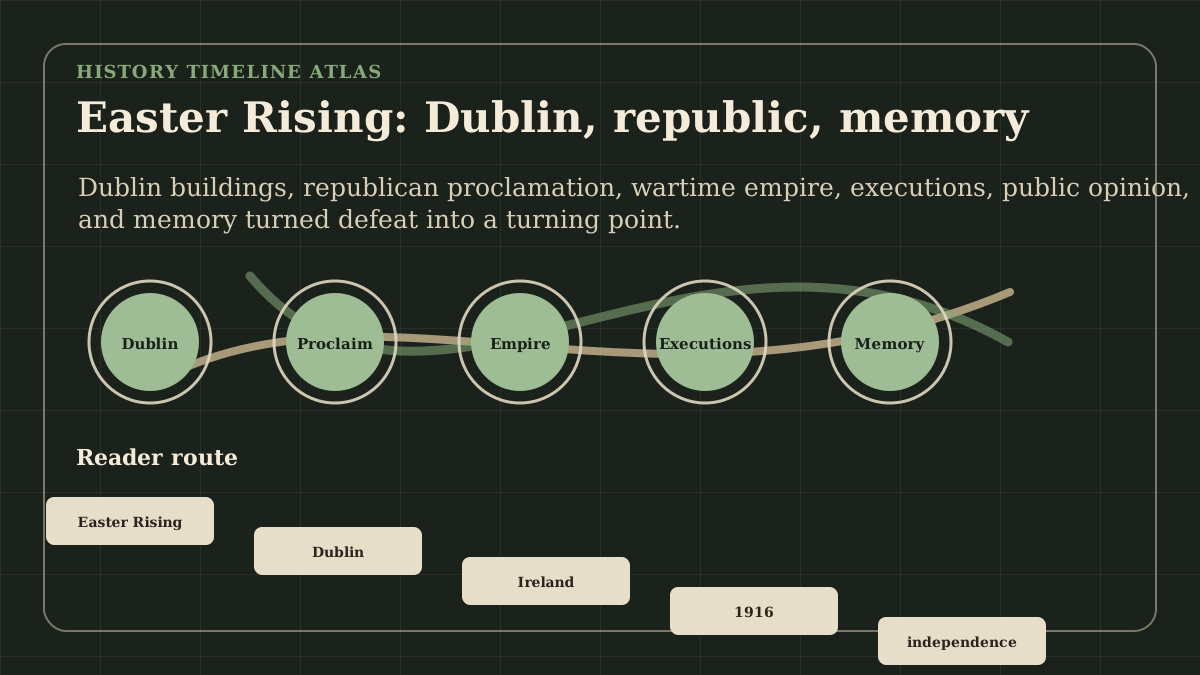
Historians and commentators dispute the balance between individual decisions—of leaders and small groups—and the deeper structural pressures of empire, national identity and wartime strain. This page keeps that dispute visible rather than presenting a single, settled explanation. The Easter Rising gains depth when Dublin is placed inside a wartime empire. Britain was fighting World War I, Irish Home Rule had been delayed, unionist and nationalist paramilitary politics had sharpened before the war, and different Irish communities disagreed over loyalty, autonomy, and republican independence. The rebellion also had a public-theater quality. The General Post Office, the proclamation, uniforms, barricades, and named leaders made a claim to sovereignty visible in the city. Yet the rising was not broadly popular at first.
Many Dublin residents experienced it through danger, disruption, shelling, food shortages, or uncertainty rather than through instant nationalist agreement. The source problem matters because memory changed quickly. A failed rebellion became a foundational story partly because executions, imprisonment, censorship, newspapers, funerals, songs, and later political campaigns reshaped how people interpreted the same week.
The Turning Point
The decisive turn came when insurgents in Dublin moved from planning to public action, seizing strategic points in the city and declaring a republic. Those choices forced a rapid response from British forces, turning a political statement into an armed confrontation. Commanders and rank-and-file participants on both sides made consequential decisions under pressure: rebel leaders committed to holding positions in the hope of inspiring wider action; the authorities prioritized the restoration of order in the capital. Patrick Pearse and James Connolly are named among the leaders associated with the Rising; their presence highlights how individual actors shaped tactics and messaging even as structural forces framed possibilities.
Militarily the rebellion was suppressed by government forces; politically the situation changed elsewhere—once the immediate fighting ended, decisions taken by the state about prosecutions and punishments amplified the event, converting a brief military episode into an enduring political crisis. That sequence—insurrection, suppression, contested state response—marks the turning point that made April 1916 consequential beyond its days of fighting. The turning point was the British response after suppression. Military defeat did not end the political meaning of the rising. The execution of leaders such as Patrick Pearse and James Connolly moved public feeling, creating martyrs and changing the emotional field in which Irish nationalism operated. Timing intensified the effect.
Because the rising occurred during World War I, arguments about treason, sacrifice, empire, self-determination, and military necessity overlapped. A city rebellion became part of a wider crisis in imperial legitimacy.
Consequences
In the short term the Rising was defeated on the ground: British forces reasserted control over Dublin and government authority was restored. But the political aftershocks proved more complex. The state’s legal and disciplinary choices, including the execution of rebel leaders, affected public attitudes in Ireland and beyond; what had been a narrowly confined rebellion became a focal point for debate over legitimacy, sacrifice and national dignity. Over the longer term, April 1916 is widely seen as a turning point in Irish nationalism.
The Rising did not itself establish an independent state, but it altered political dynamics: it intensified support for independence among constituencies that had previously been ambivalent or opposed to armed action, and it fed into a sequence of events and choices that culminated in the later War of Independence. Interpretations differ about how much of this shift was the result of particular decisions by leaders and officials and how much flowed from broader structural changes—economic, social and imperial. This entry preserves those contested readings instead of treating one explanation as definitive, while making clear that the Rising’s legacy helped redraw the political map of Ireland in the decade that followed.
The rising helped prepare the ground for Sinn Fein's later electoral success, the Irish War of Independence, partition, and the creation of new political realities on the island. It did not single-handedly create those outcomes, but it changed the symbols and pressures through which they unfolded. Its memory remains contested because different groups remember different costs. Republican commemoration, unionist fear, civilian suffering, British military records, and family histories do not produce one simple moral script. That contest keeps the event alive as a question about violence, legitimacy, and national origin stories.
Interpretation Notes
The hardest question around Easter Rising is causation. The event had immediate actors, but its meaning also came from institutions, geography, resources, and expectations already present in Western Europe.
Why Keep Reading
If you want to understand how a short, localized rebellion became the seed of a wider independence movement, follow the sequence that links April 1916 to the subsequent years of political realignment and conflict. Read next about the immediate legal and political aftermath in Dublin, how public opinion evolved across Irish communities, and the ways veteran republicans and new political actors translated the Rising’s symbolism into organized campaigns. That chain of developments explains how an event confined to a capital city could reshape the future of a nation. Read the Easter Rising beside World War I, the Russian Revolution, Wilsonian self-determination, Indian nationalism, and later civil-rights routes. The comparison shows how wartime empires faced different challenges from within.
Reading Path
Follow the story without losing the thread
Before This
- Assassination of Archduke Franz FerdinandJune 28, 1914
- Xinhai Revolution1911
- Mexican Revolution Begins1910
After This
- Russian Revolution1917 CE
- Spanish Flu Pandemic1918-1919
- May Fourth Movement1919
Same Period
- Assassination of Archduke Franz FerdinandJune 28, 1914
- Russian Revolution1917 CE
- Treaty of VersaillesJune 28, 1919
Wider Timeline
Mind Map
How to think about Easter Rising
nationalist pressure
Longstanding demands for Irish independence and cultural revival created a political environment conducive to rebellion
Map Layer
Where this event sits geographically
Gold pins mark the approximate locations of published event pages. This is a schematic locator map, not a historical border map.
Coordinates are approximate and are used to help readers orient themselves before opening a full event page.
References
Where to Check the Facts
- Encyclopaedia Britannica: Easter RisingSpecific reference for the 1916 Easter Rising, Dublin insurrection, leaders, executions, and Irish independence context.
- Encyclopaedia BritannicaBackground reference for chronology, names, and historical context.
- WikidataStructured reference for dates, places, alternate names, and entity links.