At a Glance
The shape of the event
- Date
- March 6, 1957
- Place
- Accra
- Type
- Independence
Ghana became independent from British colonial rule, with Kwame Nkrumah framing the new state as part of a broader African liberation project.
March 6, 1957; place the event in Accra before comparing causes or consequences.
The event encouraged other African nationalist movements and made Accra a symbol of decolonization and Pan-African politics.
Kwame Nkrumah are the first names or groups to compare before widening the story.
Ghana became one of the first sub-Saharan African countries to gain independence in the postwar era.
Ghana became one of the first sub-Saharan African countries to gain independence in the postwar era.
The event encouraged other African nationalist movements and made Accra a symbol of decolonization and Pan-African politics.
If this moment intrigues you, follow the path of Ghana’s first years as a state and the wider timelines of African decolonization that it helped to accelerate.
Background
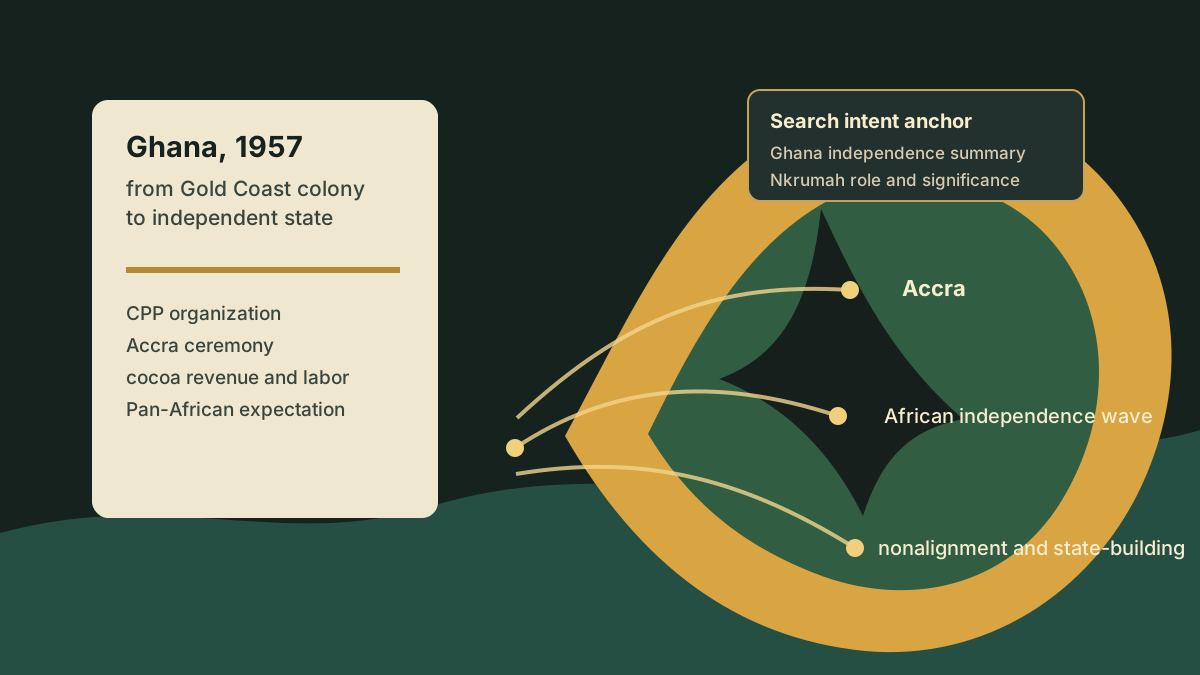
The background to Ghana’s independence stretches beyond one ceremonial day. In the postwar era, the British colonial administration in the Gold Coast governed political and economic life alongside developing local institutions and a growing public sphere. Across West Africa and the continent, nationalist currents were gathering strength: political organizers, urban elites, trade unionists and rural communities each contributed different pressures. Internationally, the idea that imperial control was unsustainable after the Second World War fed public debates about sovereignty and self‑government. Within this mixed setting, there was no single cause that explains independence; rather, the outcome reflected overlapping forces—leadership that articulated a compelling future, logistical preparations for transferring power, popular belief in nationhood, and the survival or adaptation of existing institutions.
Historians still argue about which of these mattered most. The useful debate is not whether these forces mattered, but which combinations of leadership, social pressure and institutional continuity carried the day in Accra. Ghana's independence becomes richer when read as both a local Gold Coast story and a continental signal. The colony had cocoa wealth, educated coastal elites, chiefs with real authority, labor and ex-servicemen's grievances, and a growing press culture. Kwame Nkrumah and the Convention People's Party changed the pace of politics by turning constitutional debate into mass mobilization: rallies, newspapers, youth organizers, and the slogan of self-government now.
British officials did not simply grant independence out of generosity; they responded to pressure, elections, strikes, fiscal realities, and the wider postwar weakening of empire. The Gold Coast also had relatively strong administrative institutions compared with many colonies, which shaped the transfer of power. Independence in 1957 therefore came from negotiation, agitation, institutional readiness, and imperial exhaustion together.
The Turning Point
What shifted on March 6, 1957, was a concrete transfer of authority and a public redefinition of political legitimacy. In Accra, the formal end of British colonial rule transformed the legal status of the territory into an independent state called Ghana. Kwame Nkrumah—already a central political figure—framed that transfer not simply as the end of a colonial relationship but as the beginning of a broader project linking Ghana’s fate to continental liberation. That framing mattered: it set expectations about foreign policy, political rhetoric and national identity from the first hour of independence. Practical decisions also marked the turning point.
Administrators and political leaders confronted choices about which institutions to keep, which officials would stay or go, and how to present the new state to domestic and international audiences. The declaration in Accra thus combined ceremony with concrete governance choices. It was a moment when symbolic authority and daily administration had to be aligned quickly, and when the character of the new state began to be shaped by the priorities voiced at its founding. The decisive turn was the conversion of nationalist energy into electoral legitimacy. Nkrumah's imprisonment, release, electoral victories, and premiership gave the independence movement a public mandate that British officials could not ignore without undermining their own constitutional process. Yet that mandate was not uncontested.
Some chiefs, regional parties, and federalist voices feared that a centralized state led by the CPP would flatten local authority. The independence ceremony in Accra made the change visible, but the deeper transformation lay in who could claim to speak for the nation. The new state had to turn a movement into government, a colony into administration, and anti-colonial language into budgets, schools, roads, and foreign policy.
Consequences
In the near term, independence created a visible example for other nationalist movements across Africa: an unmistakable demonstration that colonial rule could be ended and that a new African state could claim sovereignty in the postwar world. Accra’s prominence grew as a site where visitors, exiles and activists gathered, and the city came to symbolize the larger project of Pan‑African politics that Nkrumah emphasized. Over the longer term, Ghana’s independence influenced debates about leadership and state building across the continent. It raised questions about how newly independent governments would balance revolutionary rhetoric with the administrative realities they inherited.
The event also forced reconsideration of institutions left behind by colonial rule: which would be reformed, which would be retained, and how continuity would shape economic and social policy. Though the immediate effect was celebratory and inspirational, the longer history shows a mixed legacy: Ghana became a reference point for continental aspirations while also exposing the limits and strains of rapid political change. Scholars continue to weigh whether leadership, logistical planning, popular belief or institutional resilience mattered most in shaping outcomes after independence. Ghana's independence had an afterlife far beyond its borders. It encouraged other African nationalists, made Accra a meeting place for Pan-African organizing, and gave decolonization a successful English-speaking African example.
It also exposed the difficulty of turning liberation legitimacy into durable democratic practice. Economic dependence on cocoa, debates over industrialization, regional suspicion, and the pull of one-party politics soon tested the new state. Nkrumah's Ghana sponsored continental unity and anti-colonial causes, but it also centralized power in ways critics saw as authoritarian. That tension makes the page worth reading: independence is not the end of the story but the opening of a harder question about how freedom becomes accountable government.
Interpretation Notes
Ghana Independence can look simple when reduced to one date, but the evidence usually points to a wider setting. The useful debate is which part mattered most: leadership, logistics, belief, social pressure, or the institutions that survived afterward.
Why Keep Reading
If this moment intrigues you, follow the path of Ghana’s first years as a state and the wider timelines of African decolonization that it helped to accelerate. Look next at how Accra became a meeting place for Pan‑African thinkers and visiting delegations, and at the practical challenges of turning a nationalist movement into a governing administration. Reading the sequence of independence events across West Africa will show how ideas and tactics travelled between capitals, and how different choices about institutions and leadership produced divergent national trajectories. These next steps illuminate how a single date fits into a longer, contested process. Read next into Pan-African congresses, decolonization after World War II, Congo's independence crisis, and the Non-Aligned Movement.
Ghana helps connect local nationalist organizing to the larger architecture of postcolonial state-building.
Reading Path
Follow the story without losing the thread
Before This
- Suez Crisis1956 CE
- Bandung ConferenceApril 1955
- Battle of Dien Bien Phu1954 CE
After This
- Guinea Votes No to the French CommunitySeptember 28, 1958
- Congo Independence and Crisis1960 CE
- Tanganyika Gains IndependenceDecember 9, 1961
Same Period
- Fifth Pan-African CongressOctober 1945
- Tanganyika Gains IndependenceDecember 9, 1961
- Indonesia Proclaims IndependenceAugust 17, 1945
Wider Timeline
Mind Map
How to think about Ghana Independence
Colonial governance
British administrative structures and laws that defined the political order before independence
Map Layer
Where this event sits geographically
Gold pins mark the approximate locations of published event pages. This is a schematic locator map, not a historical border map.
Coordinates are approximate and are used to help readers orient themselves before opening a full event page.
References
Where to Check the Facts
- Encyclopaedia Britannica: Kwame NkrumahReference for Nkrumah's role in Ghanaian independence and Pan-African politics.
- Encyclopaedia Britannica: GhanaReference for Ghana's colonial and independence history.