At a Glance
The shape of the event
- Date
- 1996 CE
- Place
- South Africa
- Type
- Truth commission
South Africa's Truth and Reconciliation Commission held public hearings on apartheid-era abuses, linking testimony, amnesty, public memory, and democratic transition.
1996 CE; place the event in South Africa before comparing causes or consequences.
The TRC became a major global reference point for transitional justice, while also raising hard questions about truth, accountability, and repair.
Desmond Tutu / Nelson Mandela / Apartheid survivors are the first names or groups to compare before widening the story.
The commission documented abuses and created a public forum for victims, perpetrators, and the new state to confront apartheid violence.
The commission documented abuses and created a public forum for victims, perpetrators, and the new state to confront apartheid violence.
The TRC became a major global reference point for transitional justice, while also raising hard questions about truth, accountability, and repair.
Follow the TRC into related timelines to see how transitional justice choices reverberate.
Background
South Africa in the mid-1990s carried the weight of decades of legally enforced racial segregation, political repression, and armed struggle under apartheid. The transition to majority rule had been negotiated at the political summit level, producing a new constitution and an elected government that faced pressure to both secure peace and address past wrongs. Many white South Africans feared retribution; many Black South Africans demanded justice, recognition, and material redress. International observers and local activists debated whether trials, reparations, or truth commissions would better serve the fragile transition.
The Truth and Reconciliation Commission (TRC) was created as part of that political compromise: a public, quasi-judicial body designed to document abuses, provide a forum for testimony, and, in some cases, grant amnesty to perpetrators who fully disclosed politically motivated crimes. The TRC’s mandate blended memory and law, setting up an uneasy trade-off between uncovering the past and preserving a peaceful path forward. That tension shaped every hearing. The TRC hearings belong after the legal end of apartheid, when South Africa still had to decide how public truth, amnesty, evidence, grief, and national repair could coexist. Survivors, families, former officials, lawyers, journalists, clergy, and communities made the process more than a state committee.
The hearings also revealed the limits of transition. Testimony could create a record and a moral language, but it could not automatically redistribute land, undo trauma, repair policing, or close economic gaps left by apartheid. That tension keeps the event from becoming a comforting reconciliation slogan.
The Turning Point
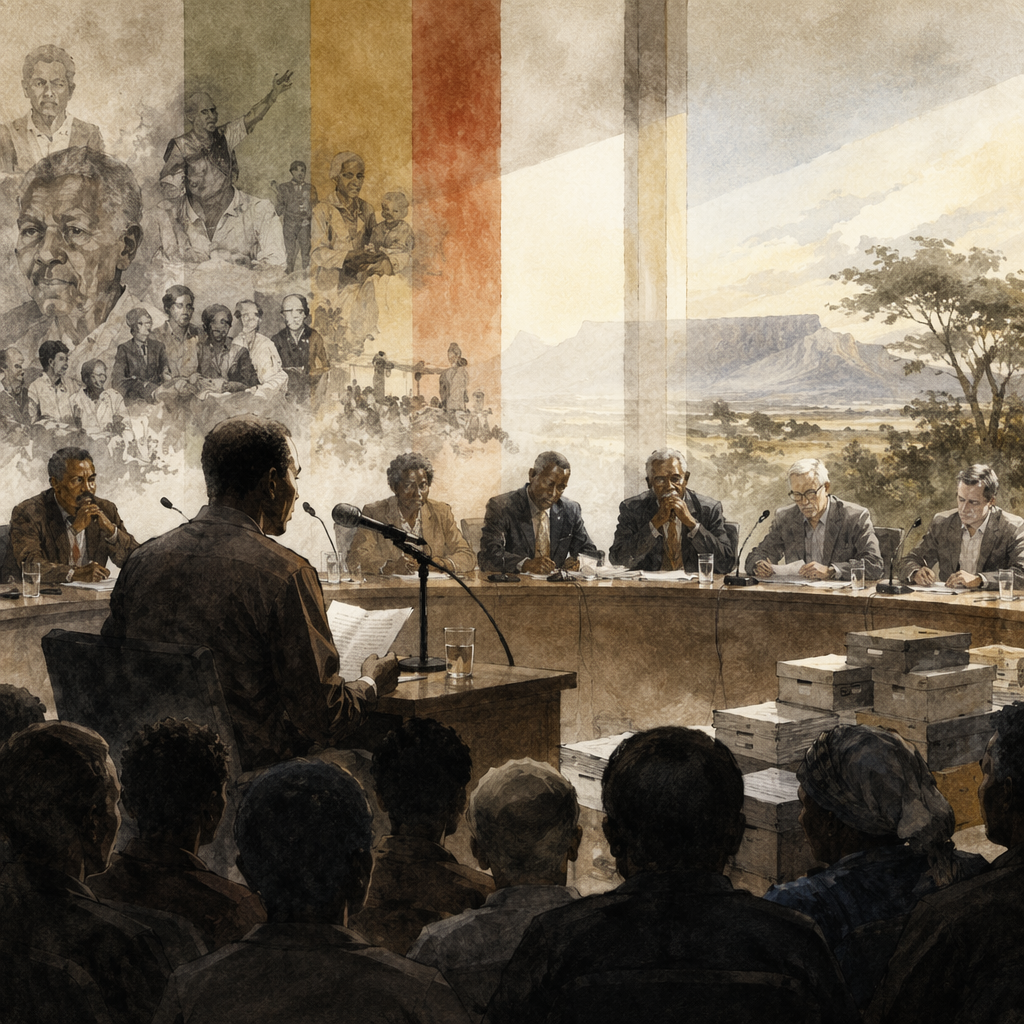
When the TRC moved its work into public hearings in 1996, it turned an institutional mandate into a visible national performance. Desmond Tutu, chairing the commission, insisted that hearings be open and humane: victims could testify without being cross-examined in the adversarial style of criminal trials, and perpetrators could apply for conditional amnesty in return for full disclosure. This design produced several concrete shifts. First, testimonies gave voice to survivors whose suffering had been invisible or denied; their detailed accounts created a public record that could not be easily ignored. Second, the hearings forced perpetrators—members of security forces, political activists, or agents acting in the name of the state—to narrate actions previously concealed behind orders or secrecy.
Third, the state itself, represented by the new democratic leadership including Nelson Mandela’s government, accepted a public forum where past abuses were laid at the feet of a nation trying to redefine itself. The decision to prioritize truth-telling over blanket prosecutions was a political choice: it aimed to stabilize the fragile peace but also opened the country to difficult scenes of confession, pain, and contested interpretations of accountability. In that moment, the TRC transformed abstract commitments to “reconciliation” into specific encounters between those who suffered and those who had caused suffering. The turning point was the decision to make testimony public and to link amnesty to disclosure.
The process converted private suffering and state violence into a national archive, while also exposing disagreement over punishment and forgiveness.
Consequences
In the immediate aftermath, the TRC produced a voluminous record of apartheid-era abuses and created a forum where victims could be heard and perpetrators could explain or confess. The hearings shaped public memory by making certain narratives visible and giving survivors a platform that often translated into moral authority in the wider society. Over the longer term, the TRC became a global reference point for transitional justice: commissions elsewhere studied its methods of public testimony, conditional amnesty, and victim-centred storytelling. Yet the commission also left unresolved questions. Many survivors and critics argued that truth-telling without comprehensive prosecutions or adequate reparations felt incomplete; the promise of material repair and formal accountability remained contested.
Politically, the hearings helped stabilize South Africa’s early democracy by limiting widespread retribution, but they also produced tensions about who counts as accountable and what justice looks like after systemic state violence. The cultural legacy is mixed: the TRC reshaped how South Africa remembers apartheid, but memory has been unevenly institutionalized, contested by social movements and later political debates over inequality, land, and economic justice. The hearings did not close the book; they opened a continuing conversation about how a society remembers, judges, and attempts to repair systemic harm. The afterlife includes reparations debates, human-rights models, criticism from families who wanted prosecution, Tutu's moral authority, and continuing arguments over inequality in post-apartheid South Africa.
Truth became a beginning, not a complete settlement.
Interpretation Notes
South African Truth and Reconciliation Commission Hearings is easy to flatten into one dramatic date. A stronger reading separates immediate action from deeper causes, affected communities, and the memory later states or movements built around the event.
Why Keep Reading
Follow the TRC into related timelines to see how transitional justice choices reverberate. Read on to trace how public testimony fed legal debates about amnesty, how survivors’ accounts informed reparations campaigns, and how later generations debated the TRC’s judgments. The hearings are a hinge: they explain why South African memory politics look the way they do today and why other countries have both emulated and critiqued this model. If you want to understand the practical trade-offs a society makes when it chooses truth over trials, the next entries will show consequences in law, public policy, and everyday life. Read this event with apartheid's fall, Mandela, Desmond Tutu, Soweto, civil rights, Rwanda memory, and human-rights explainers.
That route compares legal transition with social repair.
Reading Path
Follow the story without losing the thread
Before This
- Fall of Apartheid1994
- Nelson Mandela ReleasedFebruary 11, 1990
- Soweto UprisingJune 16, 1976
After This
No direct path yet.
Same Period
- Nelson Mandela ReleasedFebruary 11, 1990
- Fall of Apartheid1994
- Great Zimbabwe Risesc. 1100 CE
Wider Timeline
Mind Map
How to think about South African Truth and Reconciliation Commission Hearings
Apartheid legacy
Decades of segregation, state repression, and politically motivated violence that the TRC sought to document
Map Layer
Where this event sits geographically
Gold pins mark the approximate locations of published event pages. This is a schematic locator map, not a historical border map.
Coordinates are approximate and are used to help readers orient themselves before opening a full event page.
References
Where to Check the Facts
- Encyclopaedia Britannica: Truth and Reconciliation Commission, South AfricaReference for the commission, hearings, and transitional justice role.
- Encyclopaedia Britannica: Desmond TutuReference for Tutu's role and anti-apartheid work.