At a Glance
The shape of the event
- Date
- March 1, 1896
- Place
- Adwa
- Type
- Battle
Ethiopian forces defeated Italy at Adwa, preserving Ethiopian sovereignty during the age of European imperial partition.
March 1, 1896; place the event in Adwa before comparing causes or consequences.
Adwa became a powerful symbol of African sovereignty, anti-colonial resistance, and the limits of European imperial expansion.
Menelik II / Empress Taytu Betul are the first names or groups to compare before widening the story.
Italy recognized Ethiopian independence after a major defeat.
Italy recognized Ethiopian independence after a major defeat.
Adwa became a powerful symbol of African sovereignty, anti-colonial resistance, and the limits of European imperial expansion.
Follow the threads from Adwa into the wider history of late-nineteenth-century Africa: the diplomatic exchanges that framed claims of sovereignty, the internal reforms and regional politics that made Ethiopian mobiliz...
Background
By the last decades of the nineteenth century, European powers were intensifying efforts to claim African territories. Italy, a latecomer to overseas empire-building, sought footholds on the Red Sea and in the Horn of Africa. Across Ethiopia, Menelik II had consolidated authority in the highlands and engaged with foreign diplomats, merchants, and military technologies; Empress Taytu Betul played a central role at court and in national affairs. Those connections brought both new opportunities and new dangers: diplomatic exchanges with Europeans carried ambiguous language about influence and obligation, and foreign ambitions collided with Ethiopia’s insistence on autonomy. At the same time, Ethiopian leaders navigated internal politics, regional alliances, and the practical work of mustering men, supplies, and loyalties.
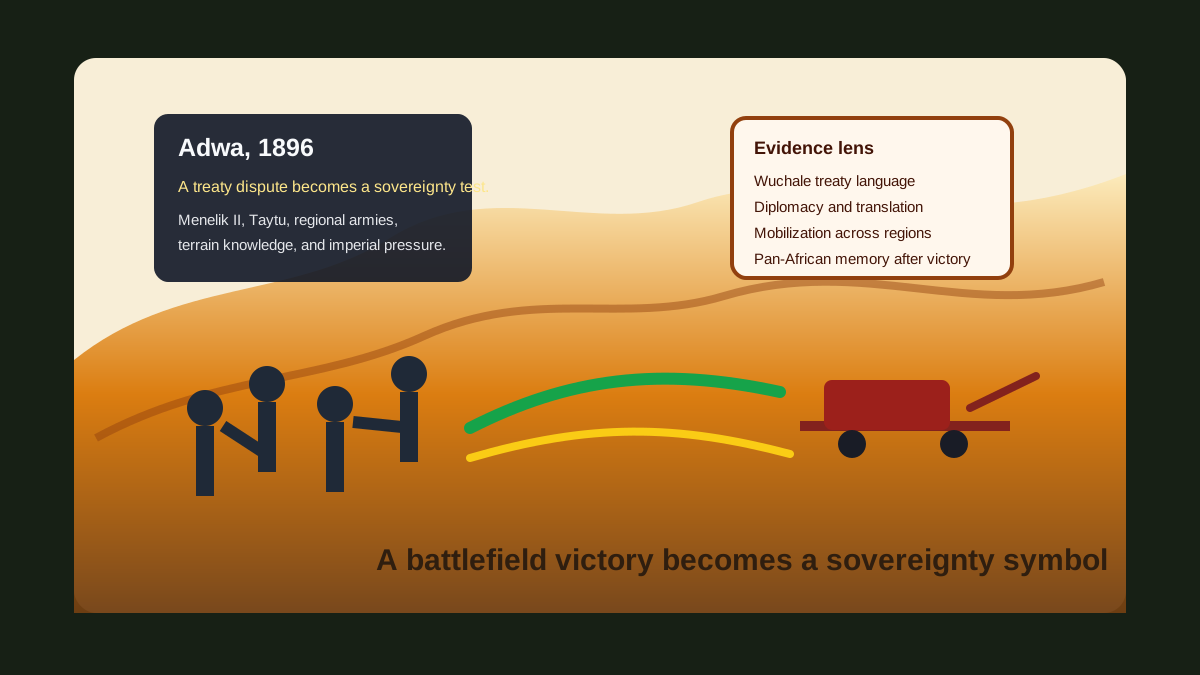
This collision of local sovereignty and overseas expansionism created a fragile, combustible situation. No single factor—ambition, misreading, or military planning—fully explains why the crisis at Adwa happened; rather, it arose where imperial intent met determined resistance and a mobilized state. Adwa should be read as a battle, a diplomatic crisis, and a global symbol. Ethiopia's victory depended on Menelik II's coalition-building, Empress Taytu's role, regional armies, arms acquisition, terrain knowledge, and Italian miscalculation. It was not a miracle outside modern politics; it was statecraft and mobilization under imperial pressure. The Treaty of Wuchale dispute gives the battle its legal edge. Italian claims to a protectorate and Ethiopian rejection of that interpretation turned translation, diplomacy, and sovereignty into military conflict.
The battlefield settled a disagreement about who could speak for Ethiopia to the world.
The Turning Point
On March 1, 1896, at Adwa, the balance shifted from simmering rivalry to decisive confrontation. Italian columns advanced into contested territory with the expectation that their force would impose colonial terms. Ethiopian commanders, led politically by Menelik II and supported by Empress Taytu Betul and regional leaders, rejected submission and brought a larger, more coherently gathered force to the field. The moment of change came in choices—where to concentrate men, how to use the landscape, and whom to trust in the fog of battle. Ethiopian units fought with local knowledge of the terrain and the urgency of defending sovereign rule; Italian troops, despite their training and armaments, encountered difficulties in supply, coordination, and adapting to the environment.
Those operational mismatches mattered on the day. As the fighting unfolded, the Italian attempt to force a political settlement by military means collapsed; defeat on the battlefield became a political defeat as well. The immediate outcome was clear: Ethiopian victory at Adwa ended the campaign and compelled Italy to reassess its claims. The tactical decisions on the ridge turned a contest of imperial designs into a vindication of Ethiopian agency. The turning point was the Ethiopian ability to unite forces and defeat an invading European army in a period usually remembered for the Scramble for Africa. Adwa showed that imperial expansion could be resisted through diplomacy, arms, logistics, and political legitimacy.
Consequences
The immediate consequence of Adwa was diplomatic: in the wake of the defeat, Italy recognized Ethiopian independence, and a colonial project that had aimed to subsume the kingdom was curtailed. For Ethiopia, the victory secured the political borders and sovereignty Menelik II and his court sought, while enhancing the prestige of the monarchy and its leaders. Over the longer term, Adwa assumed an importance that outstripped the battlefield. Across Africa and in diasporic communities, the victory became a potent symbol that imperial conquest was not inevitable; it offered a focal point for anti-colonial imaginations and political rhetoric in the twentieth century.
For European strategists and publics, the defeat at Adwa exposed limits to expansionist assumptions, forcing adjustments in policy and posture. Yet the ways the battle has been remembered and used differ widely: a royal court could emphasize legitimacy and reward, an army might highlight tactics and discipline, religious communities could read providence into the outcome, merchants could note the effect on trade routes, and later nationalist movements would recast Adwa as foundational myth. Those divergent memories mean Adwa functions simultaneously as military event, diplomatic turning point, and political symbol—its meanings shifting with the storytellers and their aims. Its afterlife shaped Ethiopian sovereignty, Pan-African memory, anti-colonial imagination, and Italian colonial planning in the Horn of Africa.
The battle mattered because later readers made it a reference point for dignity and resistance. That memory is powerful precisely because it joins military detail to questions of language, recognition, race, and imperial hierarchy.
Interpretation Notes
Adwa is not only a battlefield victory. It was also a dispute over treaty language, sovereignty, mobilization, arms, terrain, and imperial recognition, which is why later Ethiopian and Pan-African memory made it a symbol of anti-colonial dignity.
Why Keep Reading
Follow the threads from Adwa into the wider history of late-nineteenth-century Africa: the diplomatic exchanges that framed claims of sovereignty, the internal reforms and regional politics that made Ethiopian mobilization possible, and the ripple effects of Adwa on anti-colonial movements and international law. Explore how different communities—military establishments, royal courts, religious institutions, merchants, and later nation-states—have told the story and why those versions matter for politics and memory. Tracing these strands reveals how a single battle became a long-lived argument about power, legitimacy, and the limits of imperial ambition. Read Adwa with the Berlin Conference, Maji Maji, Pan-African Congress, and African decolonization pages to follow resistance from battlefield victory to political memory.
Reading Path
Follow the story without losing the thread
Before This
- German East Africa Established1885 CE
- Berlin Conference1884-1885
- Portuguese Capture Kilwa1505 CE
After This
- Maji Maji Rebellion1905-1907 CE
- Fifth Pan-African CongressOctober 1945
- Ghana IndependenceMarch 6, 1957
Same Period
- Berlin Conference1884-1885
- Kingdom of Kush Risesc. 1070 BCE
- Aksum Adopts Christianity, c. 330: Ezana and the Red Sea Contextc. 330 CE
Wider Timeline
Mind Map
How to think about Battle of Adwa
European imperial pressure
Italy’s colonial ambitions in the Red Sea and Horn of Africa created the external threat that precipitated conflict.
Map Layer
Where this event sits geographically
Gold pins mark the approximate locations of published event pages. This is a schematic locator map, not a historical border map.
Coordinates are approximate and are used to help readers orient themselves before opening a full event page.
References
Where to Check the Facts
- Encyclopaedia Britannica: Battle of AdwaReference for the battle date, Ethiopian victory, and Italian-Ethiopian conflict.
- World History Encyclopedia: Battle of AdwaSupporting reference for military context, Ethiopian leadership, and symbolic memory.