At a Glance
The shape of the event
- Date
- 1789 CE
- Place
- Paris
- Type
- Revolution
Fiscal crisis, social inequality, Enlightenment politics, and popular mobilization pushed France into revolution against the old regime.
1789 CE; place the event in Paris before comparing causes or consequences.
The revolution changed European politics through republicanism, mass citizenship, political violence, and debates over universal rights.
Louis XVI / Maximilien Robespierre are the first names or groups to compare before widening the story.
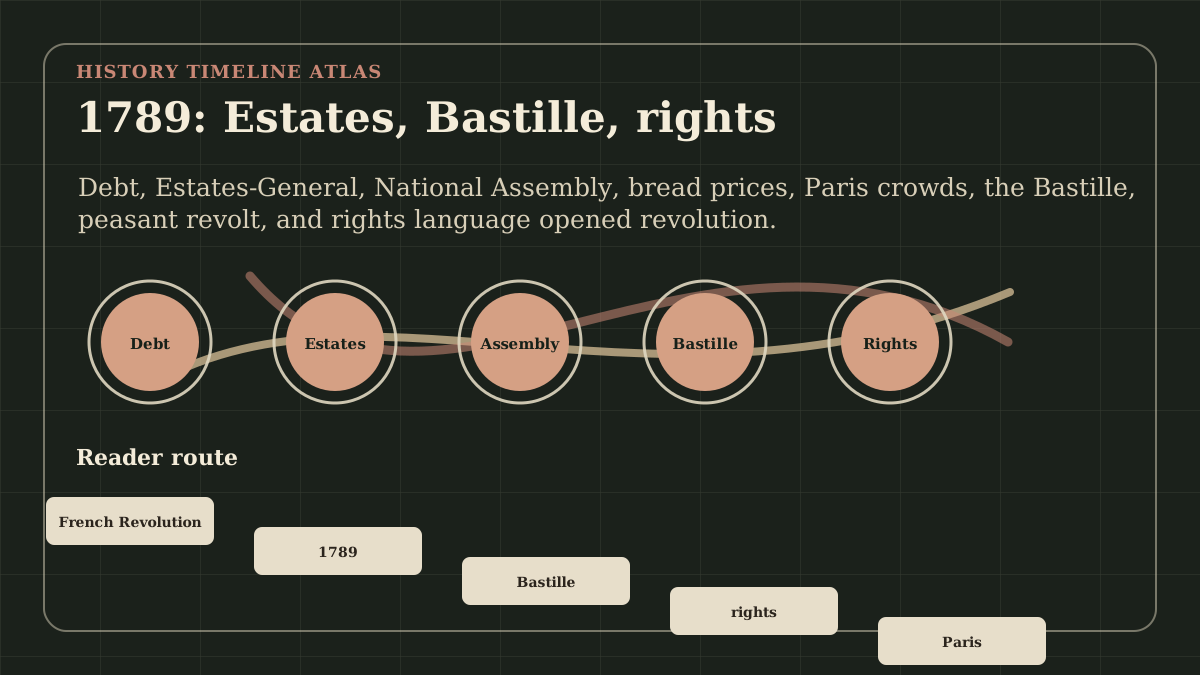
The Estates-General, National Assembly, and storming of the Bastille opened a decade of radical transformation.
The Estates-General, National Assembly, and storming of the Bastille opened a decade of radical transformation.
The revolution changed European politics through republicanism, mass citizenship, political violence, and debates over universal rights.
Follow this thread to see how a parliamentary assertion in 1789 became a crucible for further transformation.
Background
By 1789 France faced a constellation of pressures that together made change more likely than before. The crown’s finances were battered after years of war, leaving Louis XVI’s government unable to service debt without proposals to tax privileged orders. Social inequality was built into law and custom: the clergy and nobility enjoyed exemptions and influence while the Third Estate bore most fiscal burdens and sought legal recognition. Ideas circulating from Enlightenment writers challenged the old basis of authority, insisting on natural rights, legal equality, and consent as sources of legitimate power. At the same time, ordinary people—urban laborers, artisans, provincial notables—had growing expectations of political voice and material relief.
These structural strains mattered deeply, but they did not operate in a vacuum: choices by ministers, by deputies at the Estates-General, and by crowds in Paris could and did alter trajectories. Historians continue to debate how much weight belongs to long-term fiscal and social structures versus contingent political decisions and mobilizations in the spring of 1789. The beginning of the French Revolution should be read as a chain of crises rather than a single Paris crowd scene. Fiscal collapse forced the monarchy to call the Estates-General, but old-regime inequality, bread prices, political pamphlets, Enlightenment language, provincial grievances, noble privilege, and public distrust all shaped what happened next. The institutional story matters.
The Third Estate's claim to represent the nation, the Tennis Court Oath, the formation of the National Assembly, and arguments over voting by order or by head turned a tax crisis into a sovereignty crisis. People were not only asking who should pay; they were asking who had the right to speak for France. Popular action made the revolution irreversible. Paris crowds, the search for weapons, rumors of royal force, the fall of the Bastille, peasant revolts in the countryside, and the Great Fear pushed deputies and the king into decisions they might not have made from debate alone.
The Turning Point
The moment of rupture combined institutional maneuvering with public intervention. Louis XVI’s decision to summon the Estates-General in 1789—calling clergy, nobility, and commons into a single forum—was meant to resolve a fiscal impasse but instead exposed profound disagreements about representation and procedures. Deputies of the Third Estate refused to be confined to a traditional order and declared themselves a National Assembly, asserting that sovereignty lay with the nation rather than the king’s estates. That assertion was a political choice by assembled representatives; it gained force because it resonated with broader popular impatience. When rumours of royal troop movements and of a possible crackdown reached Paris, artisans, shopkeepers, and guardsmen took to the streets.
The storming of the Bastille on 14 July became a concrete emblem: a small military fortress, a public spectacle that combined practical aims (seizing arms and prisoners) with symbolic rejection of arbitrary authority. Key actors—Louis XVI, who hesitated and then accepted new bodies of power; deputies who asserted popular sovereignty; and nascent popular leaders—turned a constitutional crisis into a revolutionary sequence. Maximilien Robespierre did not yet dominate the scene in 1789, but his presence among radical deputies foreshadowed the factional politics and moral intensity that would shape the next decade. None of these choices predetermined every outcome, but together they dismantled old protocols and opened paths for far-reaching political experiment.
The turning point was the merger of representative defiance and street politics in 1789. The National Assembly claimed legitimacy from the nation, while popular mobilization showed that political authority now had to answer to crowds, guardsmen, rumor, hunger, and fear. Another turning point was the abolition of feudal privileges and the Declaration of the Rights of Man and of the Citizen. These measures translated crisis into principles, but they also exposed questions about women, enslaved people in the colonies, religious minorities, property, and who counted as a citizen.
Consequences
In the near term the events of 1789 produced rapid institutional innovation: the Estates-General gave way to the National Assembly, which enacted reforms aimed at legal equality and the abolition of feudal privileges. The storming of the Bastille and the great urban mobilizations undercut the authority of the ancien régime and introduced popular pressure as a decisive factor in politics. Over the longer term the revolution reshaped European politics in several contested but visible ways. It popularized republican ideas and new vocabularies of citizenship: sovereignty derived from the people rather than from dynastic right. Mass political participation—assemblies, clubs, and popular mobilization—became central to political legitimacy and conflict.
Political violence also became a recurring instrument, from localized unrest to organized terror in later years, provoking debates about order, rights, and legitimacy across the continent. The Revolution’s claims about universal rights stimulated reformers and frightened conservatives: monarchies elsewhere faced pressure to limit absolute power or to defend traditional hierarchies. Historians disagree about the balance between structural forces and individual agency in producing these outcomes, but the practical fact remains that the French experience forced other states to confront the questions of representation, citizenship, and how to combine liberty with social stability. The immediate consequence was the collapse of old-regime certainty. The king remained, but monarchy, privilege, church authority, taxation, and noble status could no longer be treated as fixed.
Reform accelerated beyond what many early participants expected. The longer consequence was a new political vocabulary across Europe and the Atlantic world: nation, citizen, rights, constitution, republic, terror, counterrevolution, and mass politics. The same revolution inspired emancipation and reform while also producing violence, war, and authoritarian afterlives.
Interpretation Notes
The hardest question around French Revolution Begins is causation. The event had immediate actors, but its meaning also came from institutions, geography, resources, and expectations already present in Western Europe.
Why Keep Reading
Follow this thread to see how a parliamentary assertion in 1789 became a crucible for further transformation. The next events—debates over a written constitution, the king’s flight and arrest, and the intensifying conflict between moderate and radical deputies—show how revolutionary ideals were contested in practice. Tracing these immediate aftermaths illuminates why early hopes for a limited constitutional monarchy gave way to experiments in republic and popular sovereignty, and why the revolution’s language of rights reverberated through Europe long after the violence subsided. Reading on clarifies both the intentions of key actors and the pressures that drove more extreme measures. Read 1789 beside the Declaration of Independence, Haitian Revolution, execution of Louis XVI, Napoleon, and 1848 revolutions.
That route keeps rights, empire, slavery, war, and mass politics in one frame.
Reading Path
Follow the story without losing the thread
Before This
- Storming of the BastilleJuly 14, 1789
- Declaration of IndependenceJuly 4, 1776
- English Civil War Begins1642 CE
After This
- Haitian Revolution Begins1791 CE
- Haitian Revolution Begins1791 CE
- Execution of Louis XVIJanuary 21, 1793
Same Period
- Declaration of IndependenceJuly 4, 1776
- Haitian Revolution Begins1791 CE
- Storming of the BastilleJuly 14, 1789
Wider Timeline
Mind Map
How to think about French Revolution Begins
Fiscal collapse
Chronic state debt and failed taxation reforms pushed the crown to call the Estates-General.
Map Layer
Where this event sits geographically
Gold pins mark the approximate locations of published event pages. This is a schematic locator map, not a historical border map.
Coordinates are approximate and are used to help readers orient themselves before opening a full event page.
References
Where to Check the Facts
- Encyclopaedia Britannica: French RevolutionReference for French Revolution chronology, causes, political phases, and consequences.
- Encyclopaedia BritannicaBackground reference for chronology, names, and historical context.
- WikidataStructured reference for dates, places, alternate names, and entity links.