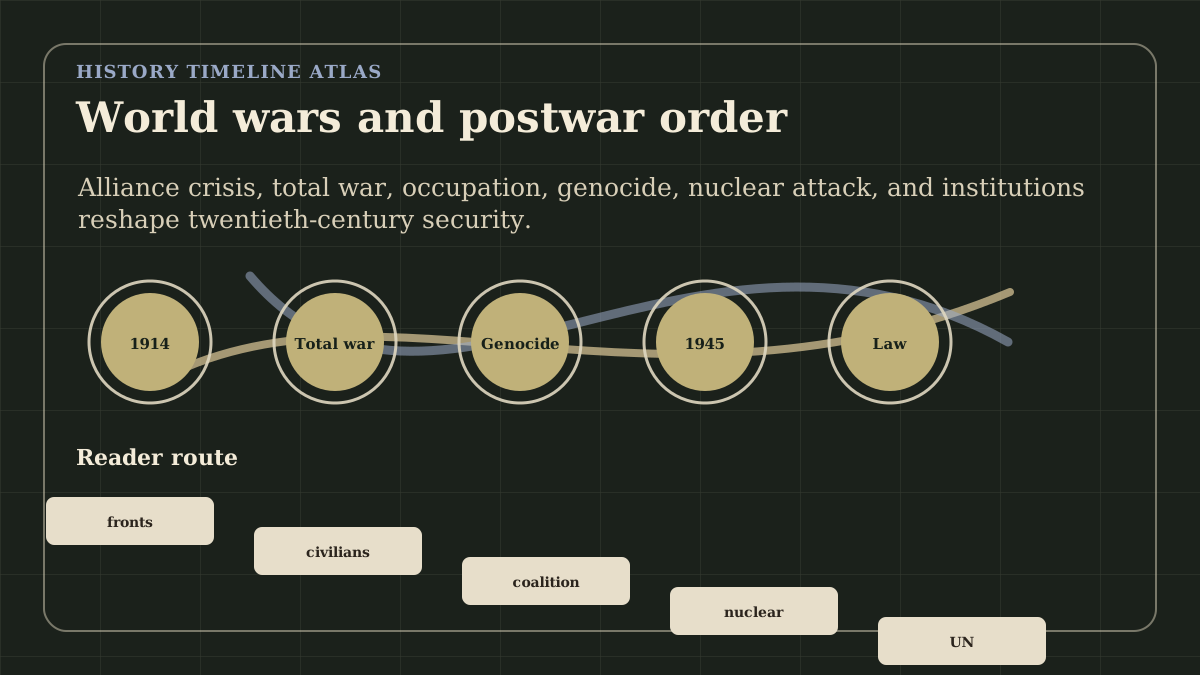
Central Question
How did global war turn into new rules, borders, and institutions?
Start With These Dates
- June 28, 1914Assassination of Archduke Franz Ferdinand
Gavrilo Princip assassinated Archduke Franz Ferdinand in Sarajevo, setting off a diplomatic crisis among Europe's alliance systems.
- September 1914First Battle of the Marne
French and British forces stopped the German advance near the Marne, preventing a quick German victory and helping turn the Western Front into a long war of attrition.
- 1915-1916Gallipoli Campaign
Allied forces attempted to force the Dardanelles and open a route to Russia, but the Gallipoli campaign became a costly failure against Ottoman defenses.
- February-December 1916Battle of Verdun
German forces attacked Verdun in a battle designed around endurance and attrition, while French defense turned the city into a symbol of national resistance.
- May 1942Battle of the Coral Sea
The Battle of the Coral Sea checked Japanese expansion toward Port Moresby and showed how aircraft carriers could decide naval battles without surface fleets directly meeting.
- October 24, 1945United Nations Founded
The United Nations came into force after World War II as states tried to build a stronger framework for peace, security, and cooperation.
- December 10, 1948Universal Declaration of Human Rights
The United Nations General Assembly adopted the Universal Declaration of Human Rights after World War II and the Holocaust.
Sources Used Here
- Imperial War Museums: Second World War
Museum reference for World War II's global scale, occupation, combat, and consequences.
- United States Holocaust Memorial Museum: World War II Key Dates
Reference for World War II chronology, Nazi expansion, occupation, and genocide context.
- United Nations: History of the United Nations
Institutional reference for postwar organization-building after World War II.
A human way into this hub is to hold several unequal scenes together: a Serbian teenager's shot in Sarajevo, a Senegalese or Indian colonial soldier moved by imperial command, an Armenian family facing deportation, a Jewish child in occupied Europe, a Soviet worker city under siege, a Chinese civilian under Japanese attack, and a Japanese family after atomic bombing. Those scenes are not interchangeable; they show why world-war history needs careful comparison rather than a single tragic blur.
The hub also marks debates instead of hiding them. Historians still argue over responsibility in 1914, the failures of Versailles and appeasement, the place of empire in fascist and Allied war aims, the decision to use atomic bombs, and how far 1945 opened decolonization rather than simply ending war.
World Wars and Postwar Order is designed as a route, not a folder. It gathers events that answer related reader questions about power, belief, conflict, exchange, institutions, and memory. The strongest way to read the page is to move from the earliest events toward the later ones, watching how one kind of pressure changes form across different places.
The route currently runs from June 28, 1914 to December 10, 1948. That span lets readers compare immediate turning points with slower consequences: the founding of institutions, the spread of ideas, the shock of war or disease, and the way later societies reused earlier events as warnings, models, or symbols.
Start with Assassination of Archduke Franz Ferdinand, First Battle of the Marne, Gallipoli Campaign, Battle of Verdun, Battle of the Somme and then follow the internal links into people, timelines, years, maps, and source lists. The route structure stays visible when each event explains why it belongs with the others and where the next useful page is.
Compare the events by scale. Some are concentrated moments, such as a battle, proclamation, trial, or publication. Others are long processes, such as a reform movement, pandemic, trade route, or diplomatic order. Reading both types together helps prevent the page from becoming a list of dates.
A useful route keeps uncertainty visible. Historical change rarely has one cause or one clean ending, so the reader can separate background pressure, immediate trigger, turning point, result, and later memory. That pattern is what makes the atlas expandable without making the reader start over each time.
This route is also a comparison tool. After reading one event, compare it with a later event on the same page and ask what changed in scale, language, geography, technology, authority, or public memory. The comparison is often more useful than the individual summary because it reveals the pattern the topic page is built to expose. When a claim feels too neat, open the full event page and check whether the evidence supports one cause, several causes, or a contested interpretation before moving on.
Begin with several scenes at once: a Serbian student in Sarajevo in 1914, a nurse near the Marne, Armenian families facing deportation, Jewish civilians under Nazi occupation, a Soviet worker city turned battlefield, a Japanese city destroyed by atomic fire, and diplomats drafting new rules after catastrophe. The hard question is how two global wars turned violence, diplomacy, economic mobilization, occupation, genocide, and legal imagination into the architecture of the twentieth century.
The first layer is the crisis of the old European order. The assassination of Archduke Franz Ferdinand mattered because alliance systems, imperial rivalry, military planning, nationalism, and Balkan instability had already made diplomacy brittle. The First Battle of the Marne then shows that a quick war became a long war; Gallipoli shows imperial and Ottoman stakes; Verdun and the Somme show attrition; the Zimmermann Telegram shows global diplomacy pulling the United States closer; the armistice shows fighting ending before the settlement was secure.
World War I is the route's first warning about modern state capacity. Governments learned to mobilize men, factories, loans, food, censorship, railroads, colonial troops, medicine, propaganda, and public grief at enormous scale. That capacity did not vanish in 1918. It survived in veterans' politics, reparations, debt, border claims, new states, revolutionary fears, and wounded societies. The route therefore treats the interwar years as an aftermath under pressure rather than as a pause between unrelated wars.
Versailles and the League of Nations give the hub its first postwar-order problem. The Treaty of Versailles tried to punish, secure, compensate, redraw, and stabilize at the same time. The League of Nations tried to make collective security institutional. Both efforts mattered, and both were limited. They show that the postwar order after World War I was not absent; it was contested, underfunded, unevenly enforced, and vulnerable to revisionist politics and economic crisis.
The rise of Nazi Germany belongs here because it turns defeat, grievance, ideology, violence, law, propaganda, and state control into a new path toward war. A thin page might jump from Versailles to Hitler as if one caused the other automatically. This hub has to slow down. Economic collapse, anti-communism, antisemitism, parliamentary crisis, elite bargains, street violence, and the Nazi seizure of institutions all mattered. The route's job is to keep causation layered.
The Munich Agreement and the invasion of Poland show two stages of failed containment. Munich exposes a diplomatic world trying to avoid another war while misreading, tolerating, or accepting expansion. Poland then marks the point where expansion became a European war and where secret agreements, mechanized attack, occupation, and partition remade eastern Europe. These events give readers a better answer to causes-of-World-War-II searches than a single-cause formula.
The war widened through different geographies. Britain made air defense, sea lanes, and public morale central. The Soviet Union made distance, ideology, agriculture, factories, prisoners, starvation, and mass death central. North Africa made Suez, empire, oil routes, desert logistics, and colonial manpower visible. The Pacific made carrier range, island bases, shipbuilding, naval intelligence, and local communities central. A world war hub has to make those theaters speak to each other.
Pearl Harbor, Coral Sea, Midway, Guadalcanal, and Okinawa show that the Pacific War was not an appendix to Europe. The route moves through surprise attack, carrier battle, codebreaking, island campaign, airfields, amphibious war, suicide attacks, civilian suffering, and the approaching question of Japan's defeat. The Pacific route is also imperial history: Japan, China, Southeast Asia, the United States, European colonies, and Pacific Islanders all belonged to the same wartime map.
The Eastern Front is the route's largest human and material battlefield. Operation Barbarossa, Leningrad, Stalingrad, Kursk, and the later Soviet advance show how war of annihilation met industrial capacity, civilian endurance, partisan resistance, state coercion, and immense casualties. This route keeps the Eastern Front central because the outcome of World War II cannot be explained without the scale of Soviet suffering and military resistance.
The Holocaust changes the moral center of the hub. Wannsee, ghettos, deportations, shootings, camps, forced labor, confiscation, collaboration, and Jewish resistance belong inside the war's structure. The Warsaw Ghetto Uprising is not a side story. It forces military chronology and genocide into the same frame. World War II was not only a conflict between armies; it was also a system of occupation and racial murder.
Coalition politics is another spine. The Atlantic Charter gave Allied language to self-determination and future security even before the United States entered the war. Tehran, Yalta, and Potsdam show leaders coordinating victory while bargaining over the world that would follow. Their choices connect military operations to occupation zones, borders, Germany, Japan, Eastern Europe, the United Nations, and the opening tensions of the Cold War.
D-Day, the liberation of Paris, and the Battle of the Bulge give the western-front route a readable arc without letting it dominate the entire hub. Normandy shows planning and coalition logistics. Paris shows liberation as both military event and political restoration. The Bulge shows that victory still had costs and uncertainty. Read beside the Eastern Front and Pacific War, these pages help readers compare fronts rather than rank them simplistically.
The nuclear ending needs careful framing. Hiroshima appears in the route because the atomic bomb transformed the final stage of the war and the memory of 1945. It belongs beside Okinawa, Potsdam, Japan's strategic position, civilian suffering, scientific mobilization, and later arguments over necessity and morality. The evidence route does not settle the debate too quickly; it shows why the debate endures.
Postwar institution-building is not an epilogue; it is part of the route's main answer. The United Nations was built from the failure of earlier collective-security experiments and from wartime coalition politics. Nuremberg translated crimes, documents, testimony, and state violence into a new legal vocabulary. The Universal Declaration of Human Rights widened postwar language into dignity, law, citizenship, and accountability. These pages explain how catastrophe produced new public standards, even when enforcement remained uneven.
Decolonization pressure runs through the route even when the main event is not an independence struggle. Colonial soldiers fought in both world wars. Wartime promises raised expectations. Japanese occupation weakened European prestige in Asia. The Atlantic Charter and United Nations language gave activists new claims. After 1945, India, Indonesia, Ghana, Algeria, Vietnam, and many other movements made it clear that the postwar order would not remain simply a European settlement.
The route also needs a home-front lens. Rationing, women workers, bombing, propaganda, internment, forced labor, scientific research, racial policy, censorship, victory gardens, war bonds, evacuation, and grief made war a social experience. A hub that only follows leaders and fronts will not feel readable. People keep reading when they see how global war entered kitchens, factories, schools, rail stations, camps, hospitals, and families.
Small states and colonized societies also change the route's meaning. Belgium, Serbia, Poland, Korea, China, India, Algeria, Indonesia, Ghana, and many other places show that world war did not simply radiate from great-power capitals. Occupation, recruitment, forced labor, anti-colonial expectation, exile governments, and postwar sovereignty claims made local histories part of the same global structure.
Geography prevents the hub from becoming abstract. Sarajevo, the Marne, Gallipoli, Verdun, the Somme, Versailles, Munich, Warsaw, London, Moscow, Leningrad, Stalingrad, Kursk, Pearl Harbor, Midway, Guadalcanal, El Alamein, Normandy, Paris, the Ardennes, Okinawa, Hiroshima, San Francisco, Nuremberg, and New York all do different explanatory work. The map is not decoration; it shows why distance, supply, borders, islands, ports, and occupation zones changed decisions.
Evidence also varies across the route. A treaty is not read like a battle map. A survivor testimony is not read like a staff memo. A trial record is not read like a propaganda poster. A diplomatic declaration is not read like a casualty list. This hub teaches readers to ask which evidence supports which claim. That matters because public memory around the world wars is crowded with simplified blame, heroism, denial, mourning, and national myth.
The reading path should serve several kinds of readers. A beginner can follow the short route from 1914 to Versailles to Nazi Germany to Poland to Pearl Harbor to Stalingrad to D-Day to Hiroshima to the United Nations. A student can follow causes, total war, genocide, coalition diplomacy, and consequences as separate essay routes. A deeper reader can compare Versailles and Potsdam, League and United Nations, World War I mobilization and World War II annihilation, or Nuremberg and later human-rights claims.
The hub also has to make World War I and World War II comparable without flattening them. World War I shattered confidence in nineteenth-century diplomacy, normalized mass mobilization, and produced peace settlements that mixed self-determination with empire and punishment. World War II radicalized many of those capacities through fascist ideology, racial rule, strategic bombing, genocide, nuclear weapons, and occupation on a wider scale. The comparison helps readers see continuity and difference instead of treating the second war as only a sequel.
Economic history belongs inside the route. War finance, reparations, depression, rationing, lend-lease, industrial conversion, oil, shipping, food, and reconstruction changed what states could do. The Marshall Plan, Bretton Woods, and later recovery questions sit just outside the current node list, but the hub prepares readers for them by making production and finance visible. Without that layer, postwar order looks like a diplomatic design rather than a material rebuilding problem.
Public memory remains contested because every country remembers the world wars through different losses, victories, occupations, silences, and political uses. Verdun, Gallipoli, the Somme, Stalingrad, Pearl Harbor, Warsaw, Normandy, Hiroshima, Nuremberg, and the United Nations do not carry the same emotional weight everywhere. The memory layer matters because readers often arrive with inherited stories before they arrive with evidence.
Another reading path follows law. Versailles, the League, the Atlantic Charter, the United Nations, Nuremberg, and the Universal Declaration of Human Rights form a legal and moral sequence. The sequence is not a straight line of progress. It includes failure, selective enforcement, power politics, colonial contradiction, and arguments over sovereignty. Its importance is that war made legal vocabulary more public: aggression, crimes against humanity, genocide, human rights, collective security, and self-determination became part of ordinary political argument.
The final reason this hub matters is practical. It gives the rest of the atlas a twentieth-century spine. Cold War pages make more sense after Yalta, Potsdam, Hiroshima, and the United Nations. Decolonization pages make more sense after wartime mobilization and anti-imperial language. Science pages make more sense after radar, medicine, computing, and nuclear research. Rights pages make more sense after Nuremberg and the Universal Declaration. The hub is therefore a routing page, not just a summary page.
The hub's central claim is that global war made the modern world by destroying older assumptions and forcing new institutions into being. It changed borders, states, law, technology, memory, racial politics, civilian vulnerability, decolonization, and the meaning of security. That is why this route must be broad and deep: the world wars are not two isolated military episodes. They are the hinge between imperial rivalry, total war, genocide, nuclear politics, international law, and the postwar order.
Read the events in order first; the page is built to reveal change over time.
Ask which pressures existed before the visible turning point and which actors had room to choose.
Follow what changed afterward in institutions, borders, law, belief, or everyday life.
Notice which events became symbols and why later generations kept returning to them.
Separate long pressures, immediate triggers, failed diplomacy, ideological radicalization, economic crisis, military planning, and decisions made by specific leaders.
Read armies beside factories, food, credit, propaganda, forced labor, science, bombing, medicine, transport, and civilian life.
Keep the Holocaust, occupation, Nuremberg, and human-rights language inside the same route rather than treating atrocity and law as separate subjects.
Follow Atlantic Charter, Tehran, Yalta, Potsdam, the United Nations, and Nuremberg to see how wartime cooperation became postwar bargaining.
Use Europe, North Africa, the Atlantic, the Soviet Union, East Asia, Southeast Asia, the Pacific, and the colonial world as connected fronts.
Ask how 1919 and 1945 shaped decolonization, the Cold War, international law, nuclear fear, public memory, and later claims about rights.
Choose a Reading Path
Start With the Timeline
Use the related timeline first when you want a chronological route through the topic.
Start with June 28, 1914: Assassination of Archduke Franz FerdinandOpen a Person Page
Use people pages when the topic is easier to understand through leadership, resistance, reform, or memory.
Start with September 1914: First Battle of the MarneUse Year Pages
Use year pages when you need a fast answer to what changed in a specific year.
Start with 1915-1916: Gallipoli CampaignReturn to the Map
Use the map to keep geography visible while moving between events and regions.
Start with February-December 1916: Battle of VerdunStart With Causes
Read Sarajevo, the Marne, Verdun, the Somme, Versailles, the League, Nazi Germany, Munich, and Poland when the question is why global war returned.
Start with May 1942: Battle of the Coral SeaFollow World War II
Use Britain, Barbarossa, Pearl Harbor, Midway, Leningrad, Stalingrad, El Alamein, Kursk, D-Day, Okinawa, and Hiroshima for the military sequence.
Start with October 24, 1945: United Nations FoundedRead Occupation and Genocide
Move through Wannsee, Warsaw, forced labor, occupation, resistance, liberation, and Nuremberg when the question is moral and legal reckoning.
Start with December 10, 1948: Universal Declaration of Human RightsTrace the Postwar Order
Use Atlantic Charter, Tehran, Yalta, Potsdam, the United Nations, Nuremberg, and the Universal Declaration of Human Rights to follow institution-building.
How the Story Builds
Begin with Assassination of Archduke Franz Ferdinand. The opening event usually shows the pressure that made the route necessary: a crisis of authority, an expanding exchange system, a new technology, a contested idea, or a conflict that older institutions could no longer contain.
Battle of the Coral Sea works as a checkpoint because it lets readers ask what had become irreversible, which actors still had choices, and how the route changed scale between the opening event and the later consequences.
The later edge of the route includes Nuremberg Trials, United Nations Founded, and Universal Declaration of Human Rights. These pages help readers see what survived beyond the first shock: institutions, borders, laws, memories, technologies, movements, or arguments that kept shaping later history.
The route is easier to remember through people and places. Watch figures such as Franz Ferdinand, Gavrilo Princip, Joseph Joffre, Helmuth von Moltke, Winston Churchill, and Mustafa Kemal Ataturk move through settings such as Sarajevo, Marne River, Gallipoli Peninsula, Verdun, and Somme River; that is where large structures become visible as choices, risks, costs, and memories.
World War I turns nationalism, alliance politics, empire, industry, attrition, and diplomacy into a new scale of conflict.
Versailles and the League create institutions and grievances, showing that postwar order can exist and still fail under pressure.
Nazi rule, appeasement, and Poland move the route from interwar crisis into open war and occupation.
Europe, North Africa, the Soviet Union, the Atlantic, East Asia, and the Pacific become linked through logistics, empire, ideology, and coalition strategy.
Holocaust, siege, bombing, forced labor, occupation, resistance, displacement, and civilian death stay central to the war's meaning.
1945 does not close the story; it opens occupation, nuclear politics, the United Nations, Nuremberg, decolonization pressure, and human-rights language.
- Which event in World Wars and Postwar Order feels like the true point of no return, and why might another reader choose a different event?
- What changes if the route is read from the perspective of ordinary people rather than rulers, armies, inventors, reformers, or institutions?
- Which consequence was immediate, and which consequence only became clear decades later?
- Where does the map change the interpretation by showing distance, borders, routes, ports, capitals, or frontiers?
- Which causes of World War I and World War II are long-term pressures, and which are immediate decisions?
- How did the failures of the post-1918 settlement shape the politics that followed without making another war inevitable?
- Why does World War II become misleading if the Holocaust is separated from military occupation and state policy?
- How did coalition diplomacy create both victory and future Cold War tensions?
- What changed when war became a problem of civilians, production, science, law, and memory as much as battlefield success?
- Why did 1945 produce new institutions without resolving empire, nuclear weapons, ideology, or human rights enforcement?
Interactive Timeline
Follow World Wars and Postwar Order by sequence
Assassination of Archduke Franz Ferdinand
Gavrilo Princip assassinated Archduke Franz Ferdinand in Sarajevo, setting off a diplomatic crisis among Europe's alliance systems.
Read the full event pageMap Layer
World Wars and Postwar Order geography
Gold pins mark the approximate locations of published event pages. This is a schematic locator map, not a historical border map.
Coordinates are approximate and are used to help readers orient themselves before opening a full event page.
Route Events
Events in This Topic
Assassination of Archduke Franz Ferdinand
Gavrilo Princip assassinated Archduke Franz Ferdinand in Sarajevo, setting off a diplomatic crisis among Europe's alliance systems.
First Battle of the Marne
French and British forces stopped the German advance near the Marne, preventing a quick German victory and helping turn the Western Front into a long war of attrition.
Gallipoli Campaign
Allied forces attempted to force the Dardanelles and open a path to Russia, but the Gallipoli campaign became a costly failure against Ottoman defenses.
Battle of Verdun
German forces attacked Verdun in a battle designed around endurance and attrition, while French defense turned the city into a symbol of national resistance.
Battle of the Somme
British and French forces attacked along the Somme in one of World War I's largest battles, gaining limited ground at immense human cost.
Zimmermann Telegram
Germany proposed a potential alliance with Mexico if the United States entered World War I, and British interception helped inflame American opinion.
Armistice of 1918
Germany signed an armistice with the Allies, ending the fighting on the Western Front after four years of industrialized warfare.
Treaty of Versailles
The Treaty of Versailles ended formal war between Germany and the Allied powers while assigning responsibility, reparations, and territorial changes.
League of Nations Founded
The League of Nations began as an international organization meant to reduce the chances of future war through collective security and diplomacy.
Rise of Nazi Germany
Adolf Hitler became chancellor and rapidly dismantled democratic institutions, building a racist dictatorship through law, violence, propaganda, and terror.
Munich Agreement
Britain and France accepted Germany's demand for the Sudetenland in an agreement that attempted to avoid war but encouraged further Nazi expansion.
Invasion of Poland
Germany invaded Poland, using speed, air power, and coordinated ground forces to begin the European phase of World War II.
Battle of Britain
The Royal Air Force resisted German air attacks in 1940, preventing Germany from gaining the air superiority needed for an invasion of Britain.
Atlantic Charter
Roosevelt and Churchill issued the Atlantic Charter, linking Allied wartime cooperation to principles about self-determination, trade, security, and a future peace.
Attack on Pearl Harbor
Japanese aircraft attacked the U.S. Pacific Fleet at Pearl Harbor, bringing the United States directly into World War II.
Operation Barbarossa
Nazi Germany invaded the Soviet Union in the largest land campaign of World War II, turning the conflict into a vast war of ideology, occupation, and survival.
Siege of Leningrad Begins
German and Finnish forces cut land paths to Leningrad, beginning a devastating siege that subjected civilians and defenders to hunger, bombardment, cold, and isolation.
Wannsee Conference
Senior Nazi officials met at Wannsee to coordinate the bureaucratic implementation of the so-called Final Solution, linking genocide to administrative planning across occupied Europe.
Battle of the Coral Sea
The Battle of the Coral Sea checked Japanese expansion toward Port Moresby and showed how aircraft carriers could decide naval battles without surface fleets directly meeting.
Battle of Midway
United States naval forces defeated a Japanese carrier attack near Midway, damaging Japan's offensive capacity in the Pacific.
Guadalcanal Campaign Begins
Allied forces landed on Guadalcanal, beginning a hard-fought campaign that contested airfields, sea lanes, supply paths, and island control in the South Pacific.
Second Battle of El Alamein
British-led forces defeated Axis troops at El Alamein, stopping the drive toward Egypt and shifting the North African campaign toward Allied advance.
Battle of Stalingrad
Soviet forces encircled and defeated a German army at Stalingrad after months of brutal urban combat and strategic overreach.
Battle of Kursk
German forces attacked the Kursk salient, but Soviet defenses, intelligence, reserves, and counteroffensives turned the battle into another major Axis defeat on the Eastern Front.
Warsaw Ghetto Uprising
Jewish resistance fighters in the Warsaw Ghetto rose against German deportation and destruction policies despite overwhelming military odds.
Tehran Conference
Roosevelt, Churchill, and Stalin met in Tehran to coordinate Allied strategy, including plans for a western front and discussions that foreshadowed postwar political settlements.
D-Day Landings
Allied forces landed in Normandy in the largest amphibious operation of the war, opening a western front against Nazi Germany.
Liberation of Paris
Paris was liberated after resistance actions, German withdrawal, and Allied entry into the city, turning occupation, national legitimacy, and liberation memory into one public moment.
Battle of the Bulge
Germany launched a surprise offensive through the Ardennes, creating a bulge in Allied lines before U.S. and Allied forces contained and reversed the attack.
Yalta Conference
Allied leaders met at Yalta to discuss military coordination, postwar Europe, Germany, and the emerging international order before the war had fully ended.
Battle of Okinawa
U.S. forces fought Japanese defenders on Okinawa in a destructive campaign that exposed civilians to intense ground combat, bombardment, suicide attacks, and mass death.
Potsdam Conference
Allied leaders met at Potsdam after Germany's defeat to negotiate occupation policy, borders, reparations, Japan, and the unsettled balance of power after the war.
Atomic Bombing of Hiroshima
The United States dropped an atomic bomb on Hiroshima, causing massive civilian destruction and introducing nuclear weapons into war.
End of World War II
World War II ended with the defeat of Nazi Germany and Imperial Japan, closing a global conflict while opening urgent questions of occupation and reconstruction.
Nuremberg Trials
The Allies tried leading Nazi officials at Nuremberg, creating a legal record of aggression, war crimes, and crimes against humanity.
United Nations Founded
The United Nations came into force after World War II as states tried to build a stronger framework for peace, security, and cooperation.
Universal Declaration of Human Rights
The United Nations General Assembly adopted the Universal Declaration of Human Rights after World War II and the Holocaust.
References
Where to Check the Facts
- Imperial War Museums: Second World WarMuseum reference for World War II's global scale, occupation, combat, and consequences.
- United States Holocaust Memorial Museum: World War II Key DatesReference for World War II chronology, Nazi expansion, occupation, and genocide context.
- United Nations: History of the United NationsInstitutional reference for postwar organization-building after World War II.