At a Glance
The shape of the event
- Date
- September 1914
- Place
- Marne River
- Type
- Battle
French and British forces stopped the German advance near the Marne, preventing a quick German victory and helping turn the Western Front into a long war of attrition.
September 1914; place the event in Marne River before comparing causes or consequences.
The battle showed that the war would not be decided by a short campaign, setting conditions for industrialized stalemate on the Western Front.
Joseph Joffre / Helmuth von Moltke are the first names or groups to compare before widening the story.
The German advance toward Paris failed, and both sides began digging into positions that became trench lines.
The German advance toward Paris failed, and both sides began digging into positions that became trench lines.
The battle showed that the war would not be decided by a short campaign, setting conditions for industrialized stalemate on the Western Front.
If the Marne stopped a rapid German victory, the next questions are immediate and unsettling: how did both sides respond to the new stalemate?
Background
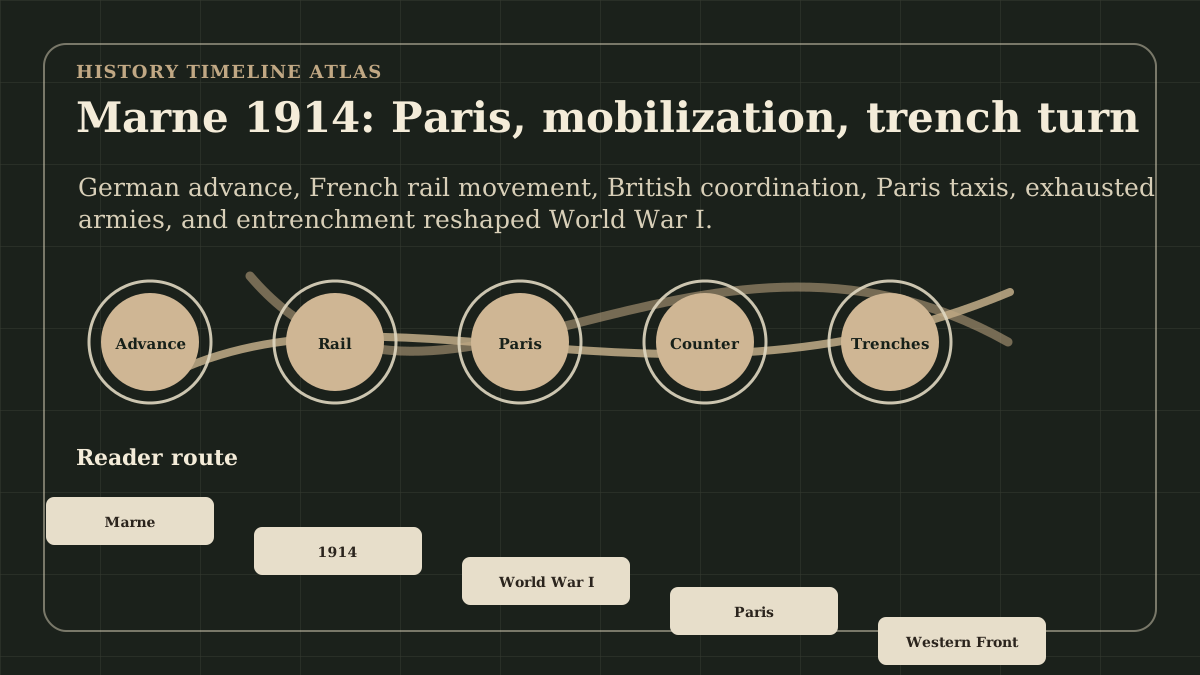
Europe in 1914 arrived at war with plans for quick decisions and high hopes of resolution. Armies moved faster than earlier generations, supplied by rail and directed by new staffs; governments expected battles to decide wars within weeks. When hostilities opened, German forces pushed westward with a campaign designed to deliver a rapid, strategic blow. French and British formations met that advance under enormous pressure, conducting retreats, counter-maneuvers and desperate efforts to hold key routes. Behind every movement were practical problems—timing, communication, supply, exhaustion and the sheer difficulty of coordinating millions of men across varied terrain. At the same time, political stakes were enormous: the fall of Paris would have been both a tactical catastrophe and a symbolic shock.
Historians still disagree about how much the battle reflected single choices by commanders versus deeper structural limits—transport networks, industrial scale, mobilization timetables and the character of modern firepower. This page keeps those contested explanations in view rather than presenting a single, settled account. The First Battle of the Marne should be read as the failure of a short-war timetable. German armies had advanced through Belgium and northern France, French forces had retreated and reorganized, the British Expeditionary Force remained in the field, and Paris faced the danger of encirclement. The battle mattered because a campaign designed for speed met exhaustion, distance, communication problems, and Allied counterattack. Logistics makes the event more vivid.
Railways, marching columns, staff maps, cavalry screens, telephone lines, supply wagons, ammunition, medical care, and famously Paris taxis all belonged to the crisis. The taxis were not the whole battle, but they became a useful symbol of emergency mobilization around the capital. The page should also keep command uncertainty visible. Joffre, Gallieni, the British command, Moltke, and German field commanders all acted with incomplete information. Gaps opened between German armies, opportunities appeared and vanished, and decisions made under strain turned a pursuit into a defensive crisis for the attackers.
The Turning Point
What changed during the First Battle of the Marne was the very possibility of a short war of movement. In the days around the Marne River French and British forces halted the German push toward the French capital, and that failure to reach a quick strategic objective forced an immediate shift in how both sides fought. Joseph Joffre and other Allied leaders found they could blunt the German drive; on the German side Helmuth von Moltke faced the consequences of a stalled advance. The practical result was visible and immediate: the front ceased to be a line of maneuver stretched thinly forward and became an area in which both sides had to consolidate positions.
Commanders who had expected to exploit breakthroughs now had to shore up flanks and hold ground. The change was not purely personal—decisions mattered—but it arrived inside a web of material constraints. Rail timetables, the exhaustion of units, the density of firepower and the geography of the Marne combined with command choices to convert a mobile campaign into a stabilized confrontation. The decisive moment was therefore both human and structural: leaders made choices, but they did so inside limits the armies themselves had created. The turning point was the Allied counterattack against the exposed German flank and the widening gap between German armies.
Once the German advance lost cohesion near the Marne, the possibility of a quick victory in the west weakened. Retreat to the Aisne did not end fighting; it changed the form of the war. The aftermath was as important as the battle itself. Armies tried to outflank each other northward, then dug in. The Western Front became a trench system not because leaders planned stalemate from the start, but because mobility, firepower, manpower, and logistics produced deadlock.
Consequences
The immediate consequence of the battle was simple and stark: the German advance toward Paris failed, and both sides began digging in where they stood. Those early entrenchments hardened into lines that would define the Western Front. In the near term, armies shifted from daily marching and contact fights to fortifying, provisioning and learning how to wage sustained industrial warfare. That change meant a different tempo—fewer grand maneuvers, more attrition, more reliance on artillery, logistics and massed manpower.
Over the longer term the Marne made clear that the war would not be decided by a few decisive thrusts; instead it set conditions for a prolonged industrial stalemate in which victory would depend on the capacity to replace men, materiel and political will. Social and political consequences flowed from that military pivot: societies mobilized at scale, economies reoriented to war production, and the patience of publics was tested month after month. Scholars continue to debate how much the battle’s outcome was driven by individual command decisions versus underlying structural forces—yet whatever the balance, the Marne turned Europe away from a brief war and toward years of attrition.
The immediate consequence was the protection of Paris and the failure of Germany's rapid western victory. The longer consequence was the creation of conditions for industrialized trench warfare, attrition, mass casualties, and a war that pulled empires, colonies, economies, and civilians into years of strain. Marne also shaped memory. French narratives made it a miracle of national survival; military histories made it a case study in planning limits; wider world history sees it as the moment when a European crisis became a long global war. Those readings can coexist if the page keeps both battlefield detail and structural consequence in view.
Interpretation Notes
The hardest question around First Battle of the Marne is causation. The event had immediate actors, but its meaning also came from institutions, geography, resources, and expectations already present in Western Europe.
Why Keep Reading
If the Marne stopped a rapid German victory, the next questions are immediate and unsettling: how did both sides respond to the new stalemate? Follow the aftermath to see how the armies dug in, how tactics and technology adapted, and how commanders tried to regain initiative in an unfamiliar kind of war. Readers who want to understand why World War I settled into static lines should trace the days after the Marne: the formation of trench systems, the changing role of artillery and the next battles that expanded and fixed the Western Front into the long, grinding conflict that defined the next four years.
Read the Marne after Sarajevo and the July Crisis, then continue to Gallipoli, Verdun, the Somme, the Zimmermann Telegram, and 1918. That path shows how one failed quick campaign became a four-year global war of mobilization and endurance.
Reading Path
Follow the story without losing the thread
Before This
- Assassination of Archduke Franz FerdinandJune 28, 1914
- Siege of Vienna1529 CE
- Fall of Constantinople, 1453: Siege Timeline, Causes, AftermathMay 29, 1453
After This
- Gallipoli Campaign1915-1916
- Armenian Genocide Begins, 1915: Deportation, Violence, and Evidence1915 CE
- Battle of VerdunFebruary-December 1916
Same Period
- Gallipoli Campaign1915-1916
- Battle of VerdunFebruary-December 1916
- Battle of the SommeJuly-November 1916
Wider Timeline
Mind Map
How to think about First Battle of the Marne
rapid German push
an early advance aimed at a quick strategic decision toward Paris
Map Layer
Where this event sits geographically
Gold pins mark the approximate locations of published event pages. This is a schematic locator map, not a historical border map.
Coordinates are approximate and are used to help readers orient themselves before opening a full event page.
References
Where to Check the Facts
- National WWI Museum and Memorial: All About WWIMuseum reference hub for World War I chronology, maps, articles, and educational context.
- U.S. National Archives: World War I CentennialArchive reference hub for World War I records, photographs, documents, and educational resources.