At a Glance
The shape of the event
- Date
- 1945-1946
- Place
- Nuremberg
- Type
- War Crimes Trial
The Allies tried leading Nazi officials at Nuremberg, creating a legal record of aggression, war crimes, and crimes against humanity.
1945-1946; place the event in Nuremberg before comparing causes or consequences.
Nuremberg shaped later human rights law, war-crimes prosecution, and debates over justice after mass violence.
Allied prosecutors / Nazi defendants are the first names or groups to compare before widening the story.
Several defendants were convicted, and the trials established precedents for international criminal law.
Several defendants were convicted, and the trials established precedents for international criminal law.
Nuremberg shaped later human rights law, war-crimes prosecution, and debates over justice after mass violence.
Follow this thread to see how the legal categories and courtroom practices born at Nuremberg reappeared in later responses to mass violence and how different societies have tried to translate a verdict into memory, re...
Background
By the end of World War II, the Allies faced a political and moral question: how to respond to the commanders and policymakers who had led Nazi Germany’s campaigns of conquest and the systematic abuses that accompanied them. The decision to hold public trials in Nuremberg reflected practical pressures—finding a venue in the shattered German heartland, showing the world that justice would be pursued—and legal ones: how to describe crimes that crossed borders and moral categories. Allied prosecutors, working in a changing international order, sought to translate acts of aggression and mass violence into charges that a courtroom could hear.
At the same time, the trials were shaped by the wartime alliance itself: the need to demonstrate legitimacy and to balance the competing priorities of attribution, retribution, and reconstruction. Interpretations of Nuremberg have never settled on one story; historians and legal scholars continue to debate how much was decided by discrete individual choices and how much by broader political, military and administrative structures that made mass crime possible. This page presents the context without pretending a single cause explains everything. Nuremberg is strongest when it is read as a court built on the ruins of a war, not as a neat moral ending to World War II.
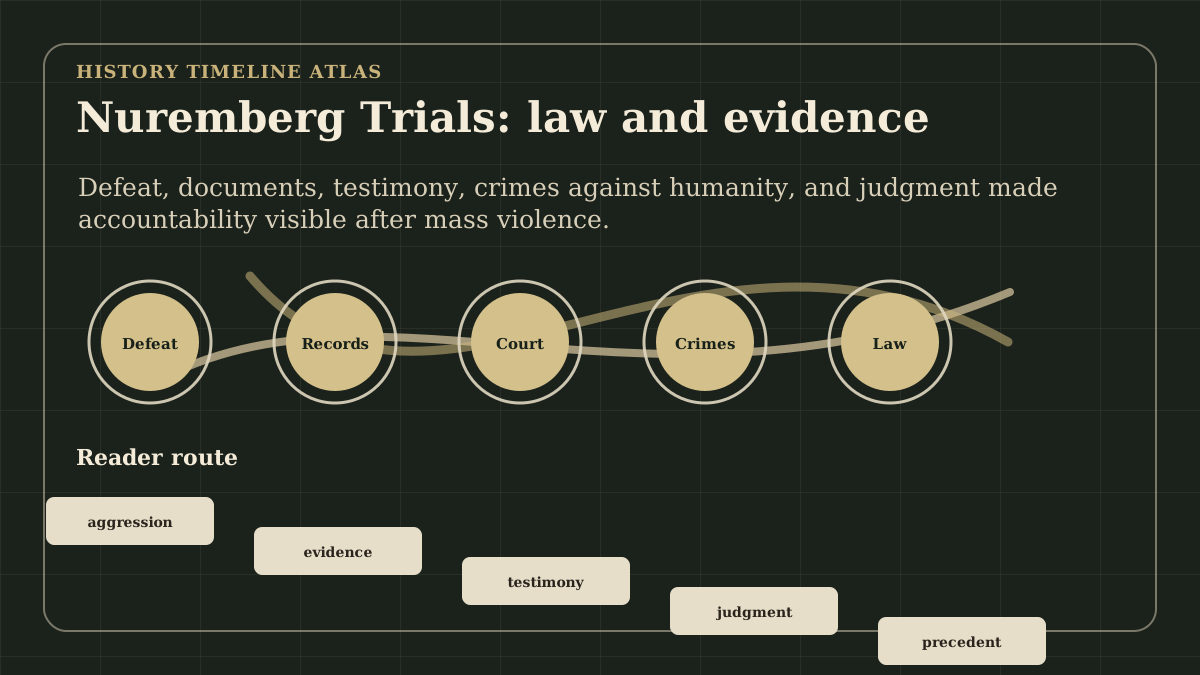
The Allied powers had to decide how to answer aggression, occupation, forced labor, genocide, and state crime without making vengeance the only language available. That problem made procedure matter. Indictments, judges, prosecutors, defense counsel, translators, documents, films, witness statements, and rules of evidence all became part of the historical event. The trial also depended on records the Nazi state had created for its own purposes. Orders, minutes, bureaucratic correspondence, camp evidence, military records, and captured archives helped prosecutors show how mass violence had been organized. That archive layer is why the page should not use a battlefield image as its main visual. Nuremberg was about rooms, files, testimony, categories of crime, and the public conversion of evidence into judgment.
A careful page keeps the limits visible. Nuremberg did not prosecute every perpetrator, heal survivors, remove antisemitism, or prevent later mass violence. It did create a language of crimes against humanity and aggressive war that later courts, human-rights advocates, and critics could reuse. The trials mattered because they made state violence answerable in public, even if the new legal order was partial and politically uneven.
The Turning Point
The decisive change during 1945–1946 was the transformation of wartime outrage into a sustained legal process. Allied prosecutors moved from public denunciation to structured charges, arraigning leading Nazi officials in Nuremberg and asking a tribunal to test those charges against evidence and legal argument. That shift required concrete choices: which defendants to bring forward, what counts as a crime in international terms, and how to present complex chains of command to a court. The trial setting forced actors on both sides into roles that clarified responsibility in new ways. Defendants could answer charges in the presence of the world’s press; prosecutors had to frame aggression, war crimes and crimes against humanity in language the tribunal would accept.
The trials also tested institutional capacities—judges, lawyers, translators, record-keepers—and produced a detailed public record. In short, the turning point was procedural: the Allies converted political judgment into legal procedure, compelling a contested, evidentiary conversation about who did what, under what law, and with what consequences. The turning point was the decision to treat leading Nazi officials as defendants before an international tribunal rather than only as defeated enemies. That choice changed the stage from battlefield victory to legal accountability. It asked judges and prosecutors to name crimes that had crossed borders, targeted civilians, and used state machinery. The courtroom also turned spectators into historical readers.
Film evidence, survivor testimony, captured documents, maps, and translations made the crimes visible to audiences beyond Germany. The page should let readers feel that Nuremberg was not only about verdicts; it was about how a world tried to learn what had happened.
Consequences
In the near term, the Nuremberg Trials produced convictions for several defendants and a voluminous judicial record that catalogued plans, orders and outcomes associated with Nazi rule. The trials set legal precedents: they articulated categories—such as crimes against humanity—that would reappear in later statutes and tribunals. In the longer run, Nuremberg became a touchstone in debates about how to respond to mass violence. Legal institutions, national courts and later international tribunals drew on the trials’ methods and reasoning when they confronted atrocities in other places and eras. At the same time, Nuremberg left unresolved tensions. Critics have questioned selectivity, victor’s justice, and whether legal proceedings can fully address political and social causes that enable mass crime.
Debates continued about the balance between prosecuting individual leaders and addressing the deeper structures—bureaucratic systems, ideological mobilization, economic arrangements—that permitted atrocities. Those disputes are not footnotes: they shape how societies choose accountability mechanisms after mass violence, how histories are written, and how victims and communities reckon with a past that legal verdicts can describe but cannot fully erase. The immediate consequence was a set of convictions, acquittals, sentences, and legal arguments that shaped postwar memory. The longer consequence was a precedent for international criminal law, even though later enforcement remained inconsistent. Genocide, war crimes, command responsibility, and crimes against humanity became categories people could invoke when ordinary national courts were too weak or too compromised.
Nuremberg's afterlife also raises hard questions. Was victor's justice avoidable when the victors ran the court? How should law handle crimes committed through bureaucracy? What does accountability mean for victims when many perpetrators remain outside the dock? Those questions make the page more useful than a simple triumph of justice story.
Interpretation Notes
The memory of Nuremberg Trials often depends on who tells the story. A court, army, religious community, merchant network, or later nation can emphasize different causes and make Nuremberg stand for different lessons.
Why Keep Reading
Follow this thread to see how the legal categories and courtroom practices born at Nuremberg reappeared in later responses to mass violence and how different societies have tried to translate a verdict into memory, reparations and institutional reform. Read next to trace the subsequent international tribunals, national trials, and human-rights instruments that inherited Nuremberg’s burdens and questions—each a new experiment in turning moral outrage into legal remedy while wrestling with the limits of law. Read Nuremberg after the Holocaust, the Warsaw Ghetto Uprising, D-Day, Hiroshima, and the United Nations founding. Then continue to human-rights and genocide-prevention routes. That path turns the trial into a bridge between wartime catastrophe, archival evidence, postwar law, and the unfinished problem of accountability.
Reading Path
Follow the story without losing the thread
Before This
- Atomic Bombing of HiroshimaAugust 6, 1945
- Yalta ConferenceFebruary 1945
- End of World War II1945
After This
- Universal Declaration of Human RightsDecember 10, 1948
- Helsinki Final ActAugust 1, 1975
- Rwandan GenocideApril-July 1994
Same Period
- Universal Declaration of Human RightsDecember 10, 1948
- Protestant Reformation Begins1517 CE
- Rise of Nazi Germany1933 CE
Wider Timeline
Mind Map
How to think about Nuremberg Trials
state policy
Decisions by Nazi leadership to pursue aggressive war and targeted persecution created the need for legal reckoning
Map Layer
Where this event sits geographically
Gold pins mark the approximate locations of published event pages. This is a schematic locator map, not a historical border map.
Coordinates are approximate and are used to help readers orient themselves before opening a full event page.
References
Where to Check the Facts
- National WWI Museum and Memorial: All About WWIMuseum reference hub for World War I chronology, maps, articles, and educational context.
- U.S. National Archives: World War I CentennialArchive reference hub for World War I records, photographs, documents, and educational resources.
- The National WWII Museum: Explore By TopicMuseum reference hub for World War II theaters, battles, home fronts, aftermath, and memory.
- Imperial War Museums: What You Need to Know About the Second World WarMuseum reference for the global war, civilian experience, military fronts, and consequences.
- United Nations: History of the United NationsOfficial institutional reference for United Nations founding, charter drafting, and postwar aims.
- United Nations: Universal Declaration of Human RightsOfficial reference for the Universal Declaration of Human Rights and its global human-rights framework.