At a Glance
The shape of the event
- Date
- June 22, 1941
- Place
- Eastern Front
- Type
- Invasion
Nazi Germany invaded the Soviet Union in the largest land campaign of World War II, turning the conflict into a vast war of ideology, occupation, and survival.
June 22, 1941; place the event in Eastern Front before comparing causes or consequences.
The invasion opened the Eastern Front, where much of the war's military and civilian destruction unfolded.
Adolf Hitler / Joseph Stalin are the first names or groups to compare before widening the story.
German forces advanced rapidly but failed to destroy the Soviet state before winter and strategic overextension set in.
German forces advanced rapidly but failed to destroy the Soviet state before winter and strategic overextension set in.
The invasion opened the Eastern Front, where much of the war's military and civilian destruction unfolded.
Follow the sequence of battles, sieges, and policies that flowed from Barbarossa to see how strategic choices rippled across years.
Background
Operation Barbarossa did not appear from nowhere. By 1941 Nazi Germany had dominated much of continental Europe and faced a Soviet Union whose political system and military capacity were shrouded in both intelligence reports and ideological hostility. Pressures toward invasion included territorial ambition, the quest for resources, and a conviction among top Nazi leaders that the Soviet state was the principal obstacle to German hegemony in Eastern Europe. Joseph Stalin’s Soviet Union, meanwhile, bore the legacies of revolution, rapid industrialisation, purges of military leadership, and the need to buy time to prepare for what many in Moscow feared was an eventual conflict with Germany.
These structural forces—ideology, economic needs, perceived encirclement, and institutional weaknesses—interacted with individual decisions by figures such as Adolf Hitler and senior German commanders. Historians debate their relative weight: some emphasise the impact of Hitler’s choices and the timing he imposed; others point to deeper logistics, production, and strategic limits that would have constrained any German campaign. Both sides misread the other's intentions and capacities: German planners underestimated the Soviet ability to mobilise vast manpower and industry, while Soviet leadership misjudged German operational tempo. Intelligence failures, ideological blindness, and paranoia combined with logistical realities to set a dangerous stage in 1941. This page deliberately keeps these contested interpretations visible rather than settling on a single cause.
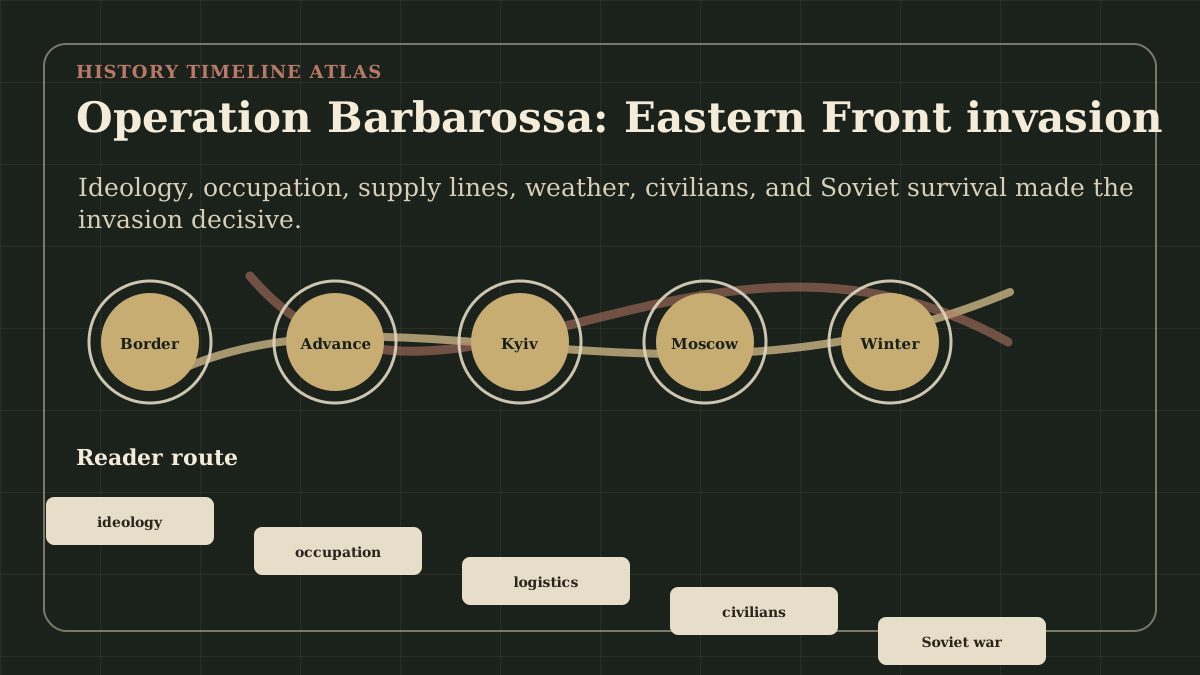
Operation Barbarossa is clearest when it is read as ideology plus logistics. Nazi Germany invaded the Soviet Union with military plans, racial policy, anti-communist aims, occupation assumptions, and economic hunger intertwined. The invasion was not only a campaign for territory; it was a project that connected battlefield movement to mass violence against civilians, prisoners, Jews, and communities marked for exploitation or removal. The map can mislead if it shows only arrows racing east. Behind each arrow were roads, rail gauges, fuel shortages, horse transport, weather, supply columns, partisan resistance, command rivalries, and decisions about occupation.
German forces won huge early encirclements, but the distances, Soviet mobilization, and the failure to destroy state capacity made the war harder than the invaders expected. The Soviet side also needs more than the phrase 'winter stopped Hitler.' Soviet armies suffered catastrophic losses, yet the state relocated industry, mobilized reserves, used harsh discipline, drew on patriotic and anti-fascist language, and kept fighting after disasters. Civilians faced occupation, evacuation, siege, forced labor, hunger, and terror. Barbarossa opened the central killing ground of the European war.
The Turning Point
On 22 June 1941 the invasion itself altered both military rhythm and political calculation. The German high command executed a massive, multi-pronged offensive across the Eastern Front that pushed deep into Soviet territory in the opening weeks. Rapid advances exposed an operational logic: Blitzkrieg-style penetrations aimed to collapse Soviet resistance before logistics, weather, and distance could blunt momentum. Adolf Hitler’s decision to prioritise swift, decisive operations produced astonishing early gains but also stretched supply lines and command control. Joseph Stalin’s initial paralysis and later orders—holding ground, mobilising reserves, and relocating industry—shifted Soviet strategy from the brink of collapse to a determined defense of state survival.
What changed was not just territory on a map but the fundamental nature of the war: what had been a campaign of conquest became an attritional struggle between industrial societies and political systems. The German failure to destroy the Soviet state before winter was decisive in converting operational success into strategic overreach. At the same time, the invasion crystallised brutal policies of occupation and ideological extermination, setting conditions for widespread civilian suffering and resistance. Historians continue to debate whether alternative choices by commanders or different logistical planning could have altered this turning point. The turning point was the failure to convert early operational victories into strategic collapse.
Capturing prisoners and territory did not destroy the Soviet state, and the drive toward Moscow exposed the limits of German logistics, planning assumptions, and political imagination. A second turning point was moral and political. The invasion radicalized the war in Europe by tying military conquest to genocide, starvation policy, anti-partisan warfare, and racial occupation. That makes Barbarossa part of Holocaust history and civilian history, not only military history.
Consequences
Operation Barbarossa’s immediate consequence was the opening of the Eastern Front, which transformed World War II into its most destructive theatre. In the near term German forces gained vast swathes of territory, disrupting Soviet institutions and imposing occupation regimes that prioritised ideological goals alongside military aims. Yet the inability to finish the Soviet state before winter created a military stalemate that exhausted German resources and shifted momentum. For civilians the invasion meant occupation, forced relocations, and policies that targeted perceived racial and political enemies; resistance and survival strategies followed in turn.
Longer-term effects were profound: the Eastern Front absorbed the bulk of Europe's military effort, drained German manpower and materiel, and became the central arena where the fate of Nazi Germany was decided. The rise in total war tactics and the fusion of military objectives with genocidal policies hardened postwar memories and borders across Eastern Europe. Scholars keep contesting how much of this outcome flowed directly from decisions made in 1941 and how much from pre-existing economic and structural limits. What cannot be disputed is that Barbarossa set in train a destructive chain of occupation, partisan warfare, and state mobilisation whose consequences shaped Europe for decades.
The immediate consequence was a vast Eastern Front that absorbed armies, industry, food, transport, and human life on a scale unmatched elsewhere in the war. German plans for a short campaign failed, while Soviet endurance turned the conflict into a long war of attrition. The longer consequence was the shaping of postwar Europe. Battles from Moscow to Stalingrad, Kursk, Warsaw, and Berlin grew from the invasion's failure. Occupation violence, mass death, liberation narratives, Soviet security policy, and Cold War borders all carried the memory of Barbarossa forward.
Interpretation Notes
Operation Barbarossa can look simple when reduced to one date, but the evidence usually points to a wider setting. The useful debate is which part mattered most: leadership, logistics, belief, social pressure, or the institutions that survived afterward.
Why Keep Reading
Follow the sequence of battles, sieges, and policies that flowed from Barbarossa to see how strategic choices rippled across years. Tracking subsequent campaigns on the Eastern Front—the Soviet counteroffensives, the grinding sieges of key cities, the growth of partisan networks, and the interaction between military operations and occupation policies—reveals how early decisions hardened into long-term trajectories. If you want to understand why 1941 mattered to borders, populations, and postwar politics, read next about the crucial campaigns and political responses that tested both Hitler’s and Stalin’s regimes. The timelines and linked entries here unpack the military moves, logistical strains, and human stories that explain how an initial invasion became the decisive axis of the European war.
Read Barbarossa after the Nazi rise, invasion of Poland, and Battle of Britain, then continue to Leningrad, Stalingrad, Kursk, the Holocaust, and the Cold War. That path shows how one invasion connected ideology, military overreach, civilian catastrophe, and postwar order.
Reading Path
Follow the story without losing the thread
Before This
- Attack on Pearl HarborDecember 7, 1941
- Atlantic CharterAugust 14, 1941
- Siege of Leningrad BeginsSeptember 8, 1941
After This
- Battle of MidwayJune 1942
- Battle of Stalingrad1942-1943
- Battle of the Coral SeaMay 1942
Same Period
- Battle of BritainJuly-October 1940
- Battle of MidwayJune 1942
- Battle of Stalingrad1942-1943
Wider Timeline
Mind Map
How to think about Operation Barbarossa
ideology & resources
Territorial ambition and the search for resources pushed Nazi leaders toward an eastern offensive as a strategic priority.
Map Layer
Where this event sits geographically
Gold pins mark the approximate locations of published event pages. This is a schematic locator map, not a historical border map.
Coordinates are approximate and are used to help readers orient themselves before opening a full event page.
References
Where to Check the Facts
- National WWI Museum and Memorial: All About WWIMuseum reference hub for World War I chronology, maps, articles, and educational context.
- U.S. National Archives: World War I CentennialArchive reference hub for World War I records, photographs, documents, and educational resources.
- The National WWII Museum: Explore By TopicMuseum reference hub for World War II theaters, battles, home fronts, aftermath, and memory.
- Imperial War Museums: What You Need to Know About the Second World WarMuseum reference for the global war, civilian experience, military fronts, and consequences.