At a Glance
The shape of the event
- Date
- December 7, 1941
- Place
- Pearl Harbor
- Type
- Military Attack
Japanese aircraft attacked the U.S. Pacific Fleet at Pearl Harbor, bringing the United States directly into World War II.
December 7, 1941; place the event in Pearl Harbor before comparing causes or consequences.
The attack transformed World War II into a fully global conflict and reshaped U.S. military and industrial mobilization.
Franklin D. Roosevelt / Japanese naval commanders are the first names or groups to compare before widening the story.
The United States declared war on Japan, and Germany soon declared war on the United States.
The United States declared war on Japan, and Germany soon declared war on the United States.
The attack transformed World War II into a fully global conflict and reshaped U.S. military and industrial mobilization.
Follow the subsequent timelines to see how a single morning produced cascading decisions.
Background
By late 1941 the Pacific was a zone of growing tension. Colonial empires, regional ambitions, and trade embargoes had produced a fraught atmosphere in which military planners on both sides prepared for confrontation even as diplomats pursued last-minute negotiations. Japan’s leadership weighed options for securing resources and strategic depth in East Asia; American leaders balanced isolationist sentiment at home with mounting concern over Japanese expansion. Naval forces and air arms in the Pacific region were positioned as both deterrent and potential target. Economically and politically, states moved within a constrained set of choices—sanctions, reinforcements, and contingency planning—yet historians debate how much the crisis reflected deliberate intent on a single side versus structural pressures that made armed conflict increasingly likely.
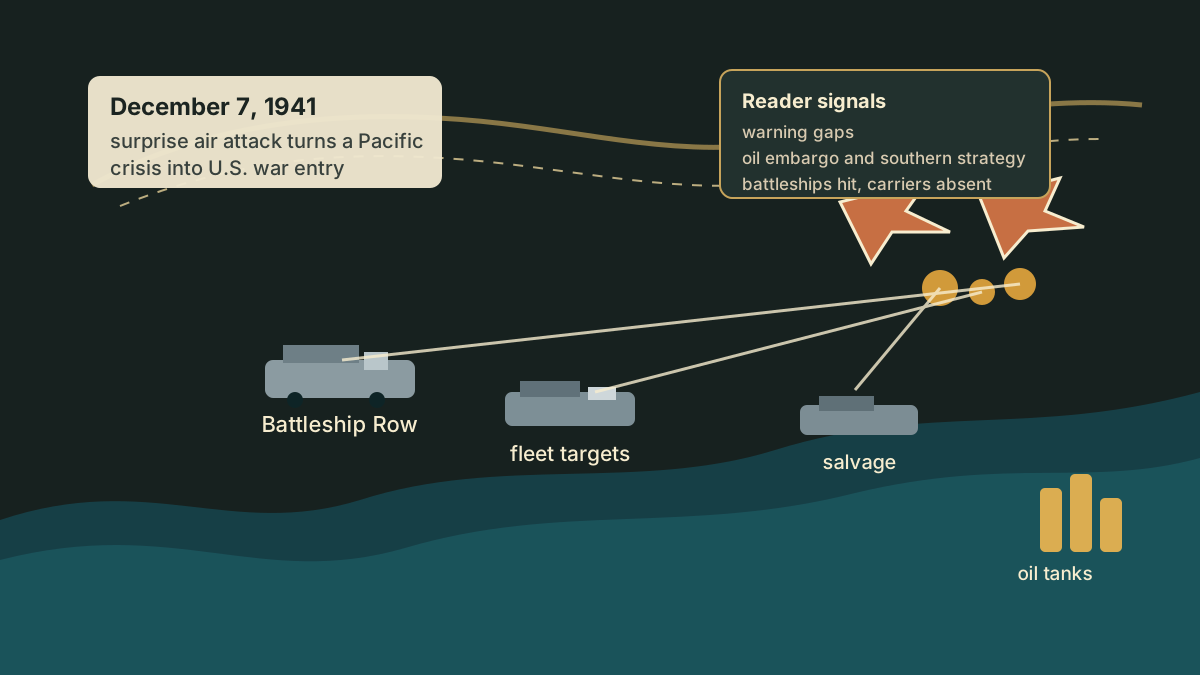
This page keeps those disputes visible: some accounts emphasize particular commands and orders, while others point to broader strategic and economic forces that limited peaceful alternatives. A thicker reading of Pearl Harbor has to keep the Pacific crisis in view. The attack followed Japan's war in China, U. S. restrictions on oil and scrap metal, British and Dutch imperial vulnerabilities in Southeast Asia, and months of negotiations that neither side trusted. Japanese leaders feared that without access to oil, their military options would shrink; U. S. leaders feared that allowing further expansion would make Japan dominant across the western Pacific. The harbor itself mattered because it held battleships, repair yards, fuel storage, airfields, and command networks in one compressed geography.
That made Pearl Harbor both an operational target and a symbol of American reach. The carriers were not in port that morning, a detail that shaped the later Pacific War, but the attack still caused enormous human loss and destroyed the assumption that distance protected the United States from the conflict.
The Turning Point
The attack itself compressed a series of choices into hours. Japanese naval commanders executed an aerial strike that struck the anchored U. S. Pacific Fleet at Pearl Harbor on December 7, 1941. Those commanders chose timing, targets, and methods aimed at crippling the fleet’s ability to respond in the immediate term. On the American side, leaders faced shock, loss, and the urgent need to decide how to respond. President Franklin D. Roosevelt and his advisers moved from stunned assessment to decisive action: the attack removed the political and psychological barriers that had kept the United States from declaring war.
The shift was both personal and institutional—individual commanders and political leaders reacted to a violent assault, while existing military plans and communication networks converted outrage into formal declaration. Interpretations differ over whether the attack was the inevitable outcome of long-term rivalry or the result of specific operational choices; this account preserves both views, showing how concrete decisions on December 7 intersected with larger historical forces. The tactical drama of December 7 should not hide the layered failures around it. Radar sightings, intelligence fragments, diplomatic signals, and assumptions about where Japan would strike all existed before the first bombs fell, but they did not combine into effective readiness.
That is why the event remains so readable: it shows how information can be present without becoming action. The first wave hit airfields and battleships; the second wave deepened the damage; commanders on the ground improvised rescue, firefighting, medical care, and harbor control. In Washington, Roosevelt's administration converted shock into a clear political narrative of attack and response. In Tokyo, planners had achieved surprise but not the larger strategic paralysis they hoped for. The missing carriers, the survival of repair facilities, and the rapid recovery of damaged ships meant the operation created fury without ending American capacity.
Consequences
In the near term the most visible consequence was political and military: the United States declared war on Japan, committing the country to full-scale military engagement. Within days and weeks the conflict expanded as alliances and declarations followed, including Germany’s declaration of war on the United States. These moves converted regional fighting into a global war. Economically and socially, the attack accelerated American mobilization—industry, labor, and government resources were rapidly directed toward wartime production and logistics. Over the longer term the event reshaped international order: it propelled the United States into a central role in global strategy, influenced postwar institutions, and altered naval and air doctrine.
Historians caution against monocausal explanations; the attack was both a catalyst for choices already under consideration and a decisive shock that changed trajectories. How much of the outcome belonged to individual decisions on that day, and how much to broader currents—geopolitics, economic sanctions, imperial ambition—remains a live question, and this entry keeps those uncertainties in view. The consequences also moved beyond battle. Pearl Harbor accelerated the U. S. wartime state: shipyards, aircraft factories, rationing, taxes, military bases, and scientific programs expanded under a sense of emergency. It also produced darker domestic policies, including the forced removal and incarceration of Japanese Americans, which belongs in any honest account of the attack's afterlife. Militarily, the strike pushed U. S.
planners toward carrier warfare, codebreaking, island logistics, and a Pacific strategy built around distance and supply. Public memory often narrows Pearl Harbor to a single morning, but the richer story runs through salvage crews raising ships, families receiving casualty notices, diplomats reframing alliances, and communities arguing over loyalty and rights. The event is powerful because it changed both foreign policy and everyday life.
Interpretation Notes
The memory of Attack on Pearl Harbor often depends on who tells the story. A court, army, religious community, merchant network, or later nation can emphasize different causes and make Pearl Harbor stand for different lessons.
Why Keep Reading
Follow the subsequent timelines to see how a single morning produced cascading decisions. Read the sequence of diplomatic messages, wartime legislation, and naval deployments that turned shock into sustained action. Tracing the immediate aftermath illuminates why the United States prioritized certain theaters, how military strategy adapted to a global war, and how wartime governance transformed American society. If you want to understand the interplay between decisive moments and long-term forces, the next pages—on the U. S. declaration of war, the Pacific campaign, and the home-front mobilization—show those threads unspooling. Read next through Midway, Coral Sea, Guadalcanal, wartime mobilization, and the Japanese American incarceration story.
Those routes show why Pearl Harbor is not just an entry point into World War II, but a hinge connecting military technology, civil liberties, presidential rhetoric, industrial production, and Pacific memory.
Reading Path
Follow the story without losing the thread
Before This
- Operation BarbarossaJune 22, 1941
- Atlantic CharterAugust 14, 1941
- Siege of Leningrad BeginsSeptember 8, 1941
After This
- Battle of MidwayJune 1942
- Battle of Stalingrad1942-1943
- Battle of the Coral SeaMay 1942
Same Period
- Assassination of Archduke Franz FerdinandJune 28, 1914
- Russian Revolution1917 CE
- Treaty of VersaillesJune 28, 1919
Wider Timeline
Mind Map
How to think about Attack on Pearl Harbor
strategic surprise
a surprise air attack that targeted the U.S. Pacific Fleet anchored at Pearl Harbor on December 7, 1941
Map Layer
Where this event sits geographically
Gold pins mark the approximate locations of published event pages. This is a schematic locator map, not a historical border map.
Coordinates are approximate and are used to help readers orient themselves before opening a full event page.
References
Where to Check the Facts
- National WWI Museum and Memorial: All About WWIMuseum reference hub for World War I chronology, maps, articles, and educational context.
- U.S. National Archives: World War I CentennialArchive reference hub for World War I records, photographs, documents, and educational resources.
- The National WWII Museum: Explore By TopicMuseum reference hub for World War II theaters, battles, home fronts, aftermath, and memory.
- Imperial War Museums: What You Need to Know About the Second World WarMuseum reference for the global war, civilian experience, military fronts, and consequences.