Track Ottoman, Austro-Hungarian, Russian, British, French, German, and colonial dimensions instead of reading the war only through western Europe.
Timeline
World War I Timeline: Causes, Major Events, Armistice, Versailles
Start this World War 1 timeline with causes before the shooting: alliances, imperial rivalry, militarized planning, Sarajevo, and the July Crisis. Then follow the Marne, Gallipoli, Verdun, the Somme, U.S. entry, the 1918 Armistice, and Versailles to see how military events, map shifts, and consequences stayed connected.
Timeline Guide
What sequence of events explains the road to World War I, the war itself, and the unsettled peace?
Read this edited guide as a path through dates, places, affected lives, source limits, and contested memory rather than as an exhaustive database.
Start with three layers rather than one cause. The background was empire, alliances, arms races, nationalism, and war planning; the trigger was Sarajevo on 28 June 1914; the contingent decisions came in July, when leaders chose ultimatums, mobilization, and risk.
The first scenes are small enough to picture: a courier carrying a July Crisis message, a French reservist waiting near the Marne, a German or British soldier writing from mud, an Armenian family facing deportation, an Indian or West African soldier serving far from home, and a household measuring food under blockade.
The global war appears through East African campaigns, Arab revolt and Ottoman fronts, Indian Army service, Chinese laborers in Europe, Caribbean volunteers, Australian and New Zealand memory, submarine warfare, blockade, and colonial subjects asking why imperial sacrifice did not bring equal citizenship.
Terms matter. The Armenian genocide is named as genocide; trench stalemate is tied to firepower, logistics, terrain, and command decisions; colonial participation is treated as world history rather than a footnote. Responsibility for war, empire, Ottoman violence, blockade, and postwar settlement must stay tied to named actors and sourced interpretation.
Start With These Dates
- 1774 CETreaty of Kucuk Kaynarca
The Treaty of Kucuk Kaynarca ended a Russo-Ottoman war and gave Russia new leverage around the Black Sea, Crimea, and claims involving Orthodox Christians.
- 1839 CETanzimat Reforms Begin
The Tanzimat reforms began with an imperial reform program that aimed to reorganize Ottoman law, administration, taxation, military service, and subjecthood.
- July 1908Young Turk Revolution
The Young Turk Revolution restored the Ottoman constitution and parliament, challenging Abdulhamid II's autocracy while intensifying debates over empire and nationalism.
- June 28, 1914Assassination of Archduke Franz Ferdinand
Gavrilo Princip assassinated Archduke Franz Ferdinand in Sarajevo, setting off a diplomatic crisis among Europe's alliance systems.
- 1917Mexican Constitution of 1917
Mexico's 1917 constitution embedded revolutionary claims around land, labor, education, church-state relations, and national resources.
- September 1, 1939Invasion of Poland
Germany invaded Poland, using speed, air power, and coordinated ground forces to begin the European phase of World War II.
- October 24, 1945United Nations Founded
The United Nations came into force after World War II as states tried to build a stronger framework for peace, security, and cooperation.
- 1945-1946Nuremberg Trials
The Allies tried leading Nazi officials at Nuremberg, creating a legal record of aggression, war crimes, and crimes against humanity.
Sources Used Here
- The National Archives: First World War
Archive reference for First World War records, chronology, fronts, and public memory.
- Imperial War Museums: First World War
Museum reference for the war's outbreak, global scale, trench warfare, and human consequences.
- United States Holocaust Memorial Museum: The Armenian Genocide
Specialist reference for Armenian Genocide chronology, Ottoman state responsibility, victims, and memory.
- Encyclopaedia Britannica: World War I
Reference for the war's chronology, belligerents, campaigns, armistice, and settlement.
This timeline begins before June 1914 because World War I was not created by one gunshot alone. The assassination in Sarajevo was a trigger, but the field was already shaped by empires under pressure, alliance planning, nationalist movements, military timetables, colonial competition, public anxiety, and memories of earlier defeats. Starting with Ottoman decline and reform helps readers see why the Balkans, the Black Sea, and imperial legitimacy mattered before trench warfare became the dominant image.
The Treaty of Kucuk Kaynarca, Tanzimat reforms, and Young Turk Revolution make the prewar route less western-front centered. They show the Ottoman Empire as a changing political system, not merely a battlefield. Reform, constitutionalism, nationalism, Russian pressure, European diplomacy, and imperial survival all created tensions that later flowed into the war. This frame also prepares readers for Gallipoli, the Armenian Genocide, and the postwar Middle East.
Sarajevo gave the crisis a date and a symbol. The assassination of Archduke Franz Ferdinand mattered because it connected Serbian nationalism, Austro-Hungarian insecurity, German support, Russian calculations, alliance obligations, and diplomatic failure. The value of the timeline is that readers can watch a local act become a continental decision sequence. The war did not begin because every actor wanted exactly the same outcome; it began because leaders made choices inside a narrowing field.
The First Battle of the Marne changed expectations. War plans built around speed met rail mobilization, resistance, exhaustion, and the limits of command. The western front hardened into a longer war than many leaders had imagined. Gallipoli then makes clear that the conflict was never only France and Belgium. It pulled in the Ottoman Empire, imperial troops, naval strategy, the Dardanelles, and later national memories in Turkey, Australia, and New Zealand.
The Armenian Genocide belongs inside the World War I timeline because mass violence against civilians was part of the wartime order, not a separate footnote. From 1915 into 1916, Ottoman authorities deported and massacred Armenian Christians and created conditions in which mass death followed. The wording matters: the violence was not an accidental side effect of battle, and later denial remains part of the memory conflict around the war.
Affected groups keep the war from shrinking into cabinet maps. Front-line soldiers lived with shells, mud, gas, fear, and boredom. Civilians in Belgium, Serbia, eastern Europe, Anatolia, and the Middle East faced invasion, occupation, hunger, deportation, and reprisals. Colonial troops and laborers moved through a war fought in the name of empires that did not grant them equal citizenship. Armenian victims, refugees, prisoners of war, nurses, widows, and disabled veterans make the timeline morally wider than a sequence of battles.
Verdun and the Somme are not interchangeable symbols of suffering. Verdun became a battle of endurance, national memory, artillery, forts, and attrition. The Somme revealed planning failure, industrial firepower, volunteer armies, imperial troops, and the human cost of offensives. Read together, they show the war's central problem: armies could concentrate destructive power more easily than they could restore movement.
The middle of the route shows the war breaking politics open. The Easter Rising, Russian Revolution, Zimmermann Telegram, and Mexican Constitution each sit at a different angle to the conflict. Ireland, Russia, the United States, Mexico, and Germany's diplomacy show that war pressure moved through empires, colonies, revolutionary parties, public opinion, and constitutional dreams. The war was a military struggle and a political accelerator.
The sea and blockade layer adds another kind of pressure. Submarines, mines, merchant shipping, food imports, naval intelligence, and ports connected the Western Front to the Atlantic and North Sea. Civilians could feel naval war through prices, shortages, grief, and propaganda long before they understood strategy. That layer gives the Zimmermann Telegram and American entry a practical setting: communication, shipping, and risk at sea changed diplomatic choices.
The eastern and colonial fronts keep the map open. Russian collapse, Ottoman campaigns, African fighting, Middle Eastern revolt, Indian soldiers, Caribbean volunteers, Chinese laborers, and ANZAC memory all show a war larger than trenches in France. The timeline becomes more useful when a reader can move from Verdun to Gallipoli, from Armenia to May Fourth, and from Versailles to mandates and self-determination disputes.
The armistice did not end the crisis. It stopped fighting on the Western Front, but it left mourning families, disabled veterans, revolution, hunger, debt, border disputes, collapsed empires, and a pandemic world. Spanish flu belongs in the route because soldiers, ships, camps, censorship, public-health capacity, and social disruption connected disease to wartime movement. A history of 1918 without influenza is too narrow.
Versailles, the May Fourth Movement, the League of Nations, and the Slavery Convention show the unsettled peace moving beyond Europe. The treaty punished Germany and redrew politics, but it also disappointed colonized and semi-colonized peoples who heard self-determination language and saw imperial continuity. Chinese protest, international law, minority claims, mandates, and anti-slavery diplomacy all show the peace settlement creating arguments that outlived the conference rooms.
The final nodes show why World War I remains a route into World War II and modern international order. Nazi Germany, Munich, Poland, the United Nations, and Nuremberg are not there to erase the First World War's distinct history. They show consequences and lessons being interpreted, misused, challenged, and rebuilt. The timeline becomes more useful when readers see 1914 to 1945 as connected without pretending the second war was automatic.
The story is strongest when read in layers. First, follow the dates from 1774 CE to 1945-1946. Then read across the event types: treaty, reform proclamation, constitutional revolution, political assassination. The timeline becomes more than chronology when those dates reveal decisions, institutions, violence, reform, and memory.
Mexican Constitution of 1917 sits near the middle of the sequence. Ask what had already become unavoidable by 1917, what actors still believed they could control, and which consequences were already beginning to move beyond the original setting.
The named events are Treaty of Kucuk Kaynarca, Tanzimat Reforms Begin, Young Turk Revolution, Assassination of Archduke Franz Ferdinand, First Battle of the Marne, Gallipoli Campaign. Each one pushes a more precise question: what changed, who benefited, who paid the cost, and what later page explains the aftermath more clearly?
Read the timeline against geography too. Places matter because power moves through corridors, borders, cities, ports, capitals, and frontiers. The map below keeps those distances visible while the event pages explain the human and institutional consequences.
A good timeline has a pulse: pressure, decision, expansion, resistance, and aftermath. When you move through Eighteenth-Century Empires, Nineteenth-Century Ottoman Empire, Late Ottoman Empire, Twentieth Century, and World War I, keep asking whether an event is creating a new problem, revealing a hidden weakness, or making an earlier choice harder to reverse.
The human layer matters because timelines can become too abstract. Figures such as Catherine the Great, Ottoman negotiators, Abdulmecid I, Ottoman reformers, Abdulhamid II, Committee of Union and Progress, and Franz Ferdinand help the sequence feel lived rather than mechanical. Their choices do not explain everything, but they show where institutions, ideas, military systems, social movements, and public fear entered real decisions.
The ending is not only the last date. With closing events such as Munich Agreement, Invasion of Poland, United Nations Founded, and Nuremberg Trials, the reader can ask what remained unsettled: which institutions survived, which arguments continued, which victims or opponents were left outside the official story, and which later crisis reused the same vocabulary.
Read this page once quickly for order, then read it again for contrast. Compare early confidence with later uncertainty, local decisions with global consequences, and visible turning points with slower changes in law, economy, belief, technology, borders, or memory. That second pass is where a timeline becomes an explanation.
Causation in this sequence is layered. One event may supply the trigger, another may reveal an older weakness, and a later event may show the consequence that people at the beginning did not expect. The useful habit is to separate background pressure, immediate decision, turning point, and aftermath before deciding which event matters most.
Consequences are uneven. A political settlement might look successful in one capital while creating resentment elsewhere; a military victory might end a campaign while deepening civilian trauma; a scientific or institutional breakthrough might solve one problem while creating new risks. The timeline is strongest when those mixed outcomes remain visible.
The final pass is comparative. After reading this sequence, open a neighboring topic or person page and ask whether the same pattern appears again. Repetition usually points to a structure; contrast usually points to a historical choice that could have gone another way.
Importance is not the same thing as drama. Some events are remembered because they were spectacular, while others matter because they changed rules, expectations, alliances, legal categories, technologies, or public language. Use the timeline to test both kinds of importance before deciding what belongs at the center of the story.
The page rewards moving outward. A timeline gives order, but the event pages give causes, maps, people, sources, and reading paths. When a date feels too compressed, open the full event page and then return here; the sequence becomes clearer with each pass instead of asking the reader to memorize a list.
Use Verdun and the Somme to ask why industrial armies could kill at scale without easily creating decisive movement.
Follow Versailles, May Fourth, the League, and later fascist revisionism to see why the peace produced both institutions and grievances.
Use World War I as one lens for reading World War I Timeline: Causes, Major Events, Armistice, Versailles, then compare how that lens changes from the opening events to the aftermath.
Treaty of Kucuk Kaynarca gives the opening problem a date and place. Ask what was already unstable before it happened.
Mexican Constitution of 1917 is a compression point: earlier causes are now crowded together with decisions that will shape the sequence's ending.
Follow the path through Kucuk Kaynarca, Istanbul, Ottoman Empire, Sarajevo, Marne River, and Gallipoli Peninsula and ask how distance changed communication, logistics, fear, and control.
Nuremberg Trials works as both an ending and a beginning: it closes one sequence while opening later disputes, institutions, memories, or reforms.
Which conditions existed before the first event, and which later decision turned those conditions into visible historical change?
Who had the power to choose, who had fewer choices, and who is missing when the story is told only through leaders or institutions?
Which facts are date anchors, which are interpretations, and which claims need checking through the event sources before being repeated?
Which linked event, person, year, or topic page would change your interpretation if you read it next?
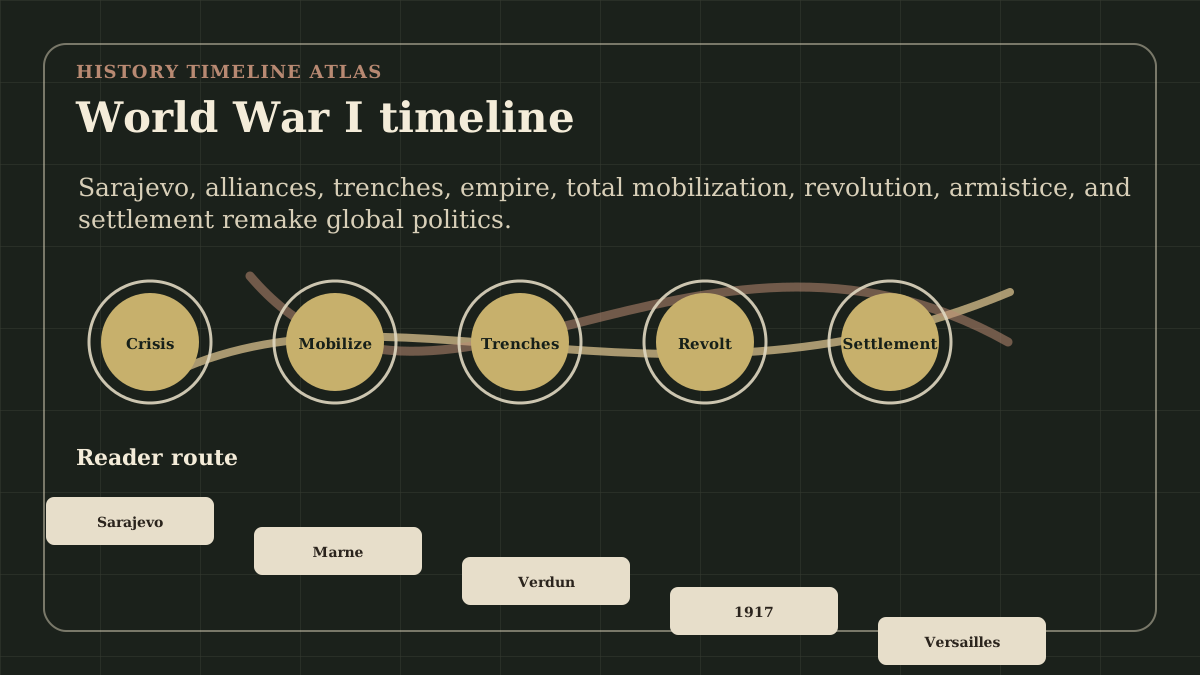
Interactive Timeline
Explore World War I Timeline: Causes, Major Events, Armistice, Versailles by sequence
Treaty of Kucuk Kaynarca
The Treaty of Kucuk Kaynarca ended a Russo-Ottoman war and gave Russia new leverage around the Black Sea, Crimea, and claims involving Orthodox Christians.
Read the full event pageNarrative Stages
Read this timeline in chapters
Imperial Pressure Before 1914
The route begins before Sarajevo because Ottoman decline, reform, nationalism, alliance anxiety, and constitutional politics shaped the crisis field.
- Treaty of Kucuk Kaynarca1774 CE
- Tanzimat Reforms Begin1839 CE
- Young Turk RevolutionJuly 1908
Crisis and Early War
Assassination, mobilization, the Marne, Gallipoli, and genocide show how a European crisis became a continental and imperial catastrophe.
- Assassination of Archduke Franz FerdinandJune 28, 1914
- First Battle of the MarneSeptember 1914
- Gallipoli Campaign1915-1916
- Armenian Genocide Begins, 1915: Deportation, Violence, and Evidence1915 CE
Attrition and Revolutionary Break
Verdun, the Somme, Ireland, Russia, Mexico, and U.S. entry show the war breaking political systems as well as armies.
- Battle of VerdunFebruary-December 1916
- Battle of the SommeJuly-November 1916
- Easter RisingApril 1916
- Russian Revolution1917 CE
- Zimmermann TelegramJanuary 1917
- Mexican Constitution of 19171917
Armistice, Pandemic, and Peace
The end of fighting did not settle the conflict's human or political consequences; influenza, treaties, and protest moved the war into aftermath.
- Armistice of 1918November 11, 1918
- Spanish Flu Pandemic1918-1919
- Treaty of VersaillesJune 28, 1919
- May Fourth Movement1919
- League of Nations FoundedJanuary 10, 1920
- League of Nations Slavery Convention1926
Unsettled Postwar Order
The timeline closes by showing how unresolved peace, fascism, appeasement, invasion, and postwar law kept World War I active in later history.
- Rise of Nazi Germany1933 CE
- Munich AgreementSeptember 1938
- Invasion of PolandSeptember 1, 1939
- United Nations FoundedOctober 24, 1945
- Nuremberg Trials1945-1946
Map Layer
World War I Timeline: Causes, Major Events, Armistice, Versailles geography
Gold pins mark the approximate locations of published event pages. This is a schematic locator map, not a historical border map.
Event location Simplified land areaClick a pin to open the event page
Coordinates are approximate and are used to help readers orient themselves before opening a full event page.
References
Where to Check the Facts
- The National Archives: First World WarArchive reference for First World War records, chronology, fronts, and public memory.
- Imperial War Museums: First World WarMuseum reference for the war's outbreak, global scale, trench warfare, and human consequences.
- United States Holocaust Memorial Museum: The Armenian GenocideSpecialist reference for Armenian Genocide chronology, Ottoman state responsibility, victims, and memory.
- Encyclopaedia Britannica: World War IReference for the war's chronology, belligerents, campaigns, armistice, and settlement.