At a Glance
The shape of the event
- Date
- August 7, 1942
- Place
- Guadalcanal
- Type
- Military Campaign
Allied forces landed on Guadalcanal, beginning a hard-fought campaign that contested airfields, sea lanes, supply routes, and island control in the South Pacific.
August 7, 1942; place the event in Guadalcanal before comparing causes or consequences.
The campaign marked a shift toward sustained Allied offensive operations in the Pacific and exposed the limits of Japanese supply capacity.
U.S. Marines / Japanese forces / Solomon Islanders are the first names or groups to compare before widening the story.
Japan withdrew from Guadalcanal in early 1943 after failing to dislodge Allied forces.
Japan withdrew from Guadalcanal in early 1943 after failing to dislodge Allied forces.
The campaign marked a shift toward sustained Allied offensive operations in the Pacific and exposed the limits of Japanese supply capacity.
The next useful step is to follow the linked events, people, topic routes, and timelines.
Background
After Pearl Harbor and Midway, the Pacific War turned on whether Japan could extend defensive positions and whether the Allies could seize the initiative across vast ocean distances. Before Guadalcanal Campaign Begins, the surrounding world already contained unresolved tensions over authority, resources, belief, strategy, or legitimacy. Those pressures mattered because they shaped what different actors thought was possible. Single-cause explanations flatten the background, which was usually a mix of long-running structures and immediate decisions. The location in South Pacific also matters, because events there connected local choices to wider routes of diplomacy, war, trade, reform, or memory. This context prepares the reader to see the event as part of a sequence rather than as an isolated headline.
Guadalcanal is easier to understand if the reader starts with distance. The campaign sat inside a huge oceanic war where airfields, fuel, destroyers, carriers, disease, night fighting, and supply routes could decide whether infantry could hold ground. The island was not valuable because of territory alone. It mattered because control of an airstrip changed what ships and aircraft could safely do across the South Pacific. Henderson Field gives the campaign its concrete center. Whoever could use the airfield could threaten ships, protect convoys, and make the surrounding sea more dangerous for the other side. That turned jungle fighting, naval battles, and air operations into one system.
Infantry did not fight separately from logistics; they fought inside a struggle over whether supplies could arrive at all. The local setting cannot disappear. Solomon Islanders, coastwatchers, guides, laborers, villages, disease environments, and disrupted communities were part of the campaign's reality. A story that only follows U. S. Marines and Japanese units misses the island world that made observation, movement, survival, and memory possible.
The Turning Point
The landings centered on Henderson Field and triggered months of ground combat, naval battles, night fighting, air attacks, disease, supply shortages, and local disruption. Guadalcanal made logistics as important as battlefield courage. The turning point was not simply that the event occurred, but that it changed the range of options available afterward. People connected to U. S. Marines, Japanese forces, Solomon Islanders acted inside constraints created by earlier conflicts, institutions, and expectations. Some choices were deliberate; others were responses to pressure, fear, opportunity, or failed compromise. The event's form as military campaign also shaped how consequences unfolded.
It made certain outcomes easier to imagine, gave later actors new evidence or symbols to use, and forced communities to adapt to a situation that could no longer be treated as temporary. The turning point was not one clean battle. It was the accumulated failure of Japanese forces to retake the airfield and sustain troops across contested waters. Night naval battles could be dramatic, but the larger pattern was attrition: ships, aircraft, crews, food, medicine, and replacements were consumed faster than Japanese strategy could comfortably absorb. For the Allies, Guadalcanal proved that initiative in the Pacific could be seized and held, but only through costly coordination.
Landings, air cover, naval screening, engineering, medical work, and supply discipline all had to work together. The campaign turned offensive ambition into a hard lesson in ocean logistics.
Consequences
Japan withdrew from Guadalcanal in early 1943 after failing to dislodge Allied forces. The campaign marked a shift toward sustained Allied offensive operations in the Pacific and exposed the limits of Japanese supply capacity. The immediate result mattered, but the longer effect came from how later people interpreted and reused the event. Some consequences were institutional: laws, borders, offices, alliances, or systems of rule changed. Others were social or cultural: public memory, political language, religious identity, or expectations about power shifted. Read the event on two clocks at once. One clock follows the immediate aftermath; the other follows the slower movement of influence into later crises, reforms, debates, and historical comparisons.
The campaign also widened the human frame of the Pacific War. U. S. Marines and Japanese troops dominate many accounts, but Solomon Islanders, coastwatchers, laborers, medical staff, and local communities lived inside the disruption. Guadalcanal therefore belongs with Coral Sea and Midway as a turning point in initiative, and with later island campaigns as evidence that Pacific victory was slow, costly, and logistical. Guadalcanal also changed expectations. After it, Allied planners could imagine a chain of advances across the Pacific, while Japanese planners had to confront the limits of defending far-flung positions under air and sea pressure. The campaign did not end the Pacific War. It showed what the rest of the war would demand.
Interpretation Notes
The campaign is often remembered as a Marine battlefield, but its meaning also depends on naval attrition, air control, local island communities, disease, and the geography of supply.
Why Keep Reading
The next useful step is to follow the linked events, people, topic routes, and timelines. Guadalcanal Campaign Begins becomes clearer when it is compared with what came before and after it, especially events in Twentieth Century and related pages about World War II and Pacific War. The map helps locate the event, the mind map separates causes from effects, and the source list gives readers a way to check the factual spine. Keep reading to see whether this event was a beginning, a turning point, an ending, or a symbol that later generations kept reworking. Read Guadalcanal after Pearl Harbor and Midway, then continue to island campaigns, Okinawa, Hiroshima, and Japan's surrender.
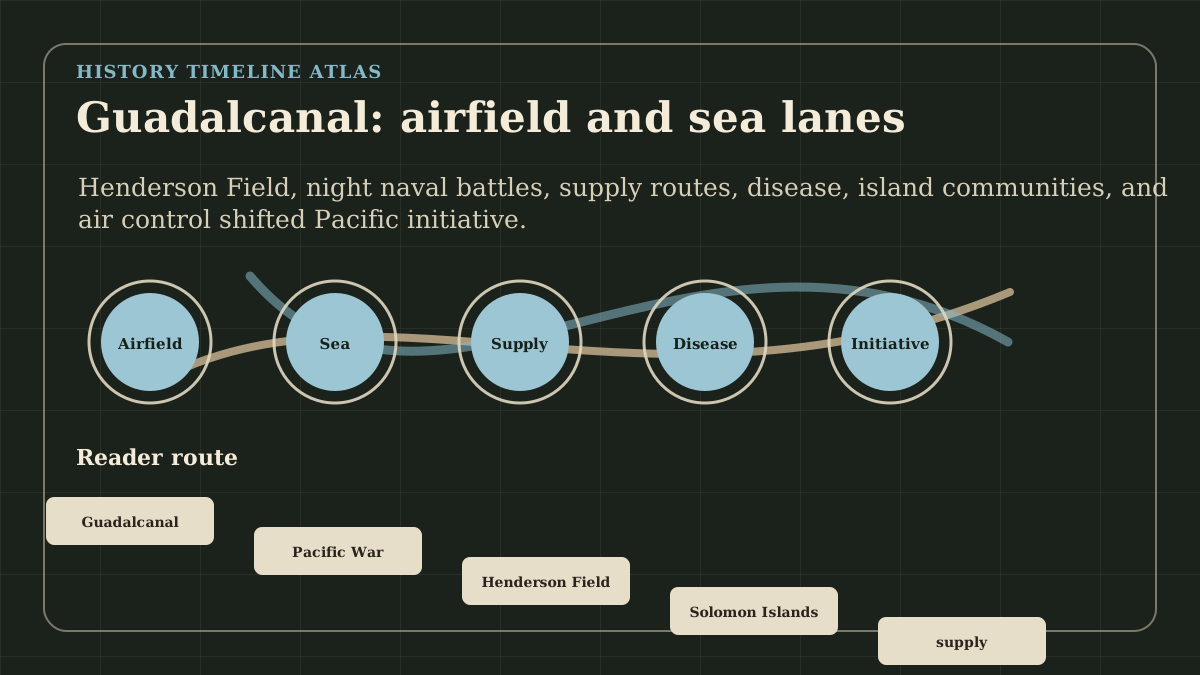
The route shows how initiative, logistics, and civilian danger shaped the Pacific War.
Reading Path
Follow the story without losing the thread
Before This
- Battle of MidwayJune 1942
- Battle of Stalingrad1942-1943
- Battle of the Coral SeaMay 1942
After This
- Warsaw Ghetto UprisingApril-May 1943
- Battle of KurskJuly 5-August 23, 1943
- Tehran ConferenceNovember 28-December 1, 1943
Same Period
- Assassination of Archduke Franz FerdinandJune 28, 1914
- Russian Revolution1917 CE
- Treaty of VersaillesJune 28, 1919
Wider Timeline
Mind Map
How to think about Guadalcanal Campaign Begins
Pressure
After Pearl Harbor and Midway, the Pacific War turned on whether Japan could extend defensive positions and whether the Allies could seize the initiative across vast ocean distances.
Map Layer
Where this event sits geographically
Gold pins mark the approximate locations of published event pages. This is a schematic locator map, not a historical border map.
Coordinates are approximate and are used to help readers orient themselves before opening a full event page.
References
Where to Check the Facts
- Encyclopaedia Britannica: Battle of GuadalcanalReference for Guadalcanal's chronology and strategic meaning.
- Imperial War Museums: War in the PacificMuseum reference for Pacific War context and island campaigns.
- National WWI Museum and Memorial: All About WWIMuseum reference hub for World War I chronology, maps, articles, and educational context.
- U.S. National Archives: World War I CentennialArchive reference hub for World War I records, photographs, documents, and educational resources.
- The National WWII Museum: Explore By TopicMuseum reference hub for World War II theaters, battles, home fronts, aftermath, and memory.
- Imperial War Museums: What You Need to Know About the Second World WarMuseum reference for the global war, civilian experience, military fronts, and consequences.