At a Glance
The shape of the event
- Date
- June 28, 1914
- Place
- Sarajevo
- Type
- Political Assassination
Gavrilo Princip assassinated Archduke Franz Ferdinand in Sarajevo, setting off a diplomatic crisis among Europe's alliance systems.
June 28, 1914; place the event in Sarajevo before comparing causes or consequences.
The assassination exposed how nationalism, militarism, imperial rivalry, and alliance commitments could turn crisis into world war.
Franz Ferdinand / Gavrilo Princip are the first names or groups to compare before widening the story.
Austria-Hungary confronted Serbia, and escalation led to a continent-wide war.
Austria-Hungary confronted Serbia, and escalation led to a continent-wide war.
The assassination exposed how nationalism, militarism, imperial rivalry, and alliance commitments could turn crisis into world war.
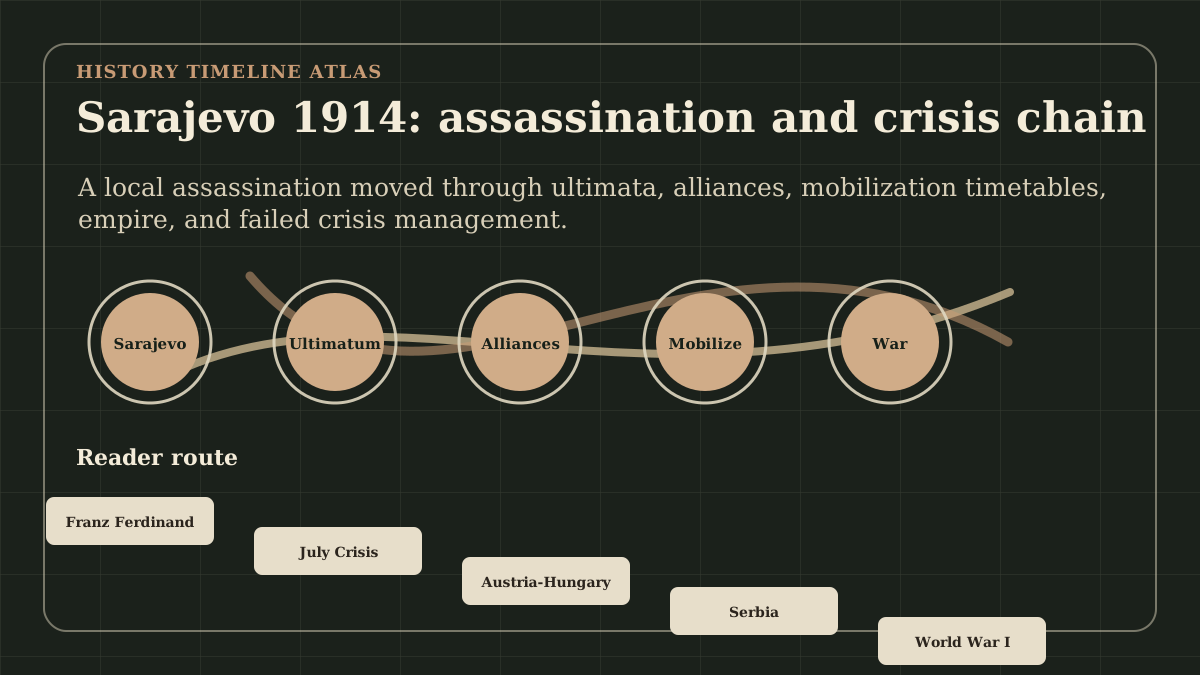
Follow the threads from Sarajevo into the wider story: how did alliance systems actually operate in the weeks after June 1914?
Background
The assassination happened against a backdrop of mounting pressures across the Balkans and Europe. For decades the region known loosely as the Balkans had been a zone of competing ambitions: neighbouring states, imperial authorities and local national movements jostled over territory, identity and political influence. Across Europe, militaries had grown in size and profile; political leaders made plans that assumed allies would back them in crisis. Imperial rivalry — rival claims, colonial competition and contested prestige — sharpened diplomats' calculations. Nationalist movements grasped for recognition and change, sometimes by parliamentary means, sometimes by violence. These factors did not make war inevitable on their own, but they created a fragile environment in which a single outbreak of violence could be amplified.
Historians continue to debate whether the decisive cause was the choices of individuals or the larger structures of alliances and empires. This account keeps both levels visible: individual actions took place inside a landscape already charged by long-standing tensions. The Sarajevo assassination matters because a local act of political violence moved into an international system already primed for escalation. Bosnia-Herzegovina, Serbian nationalism, Austro-Hungarian insecurity, imperial prestige, military planning, and alliance expectations all shaped what governments thought the murder meant. Franz Ferdinand's death did not mechanically cause World War I. The page becomes stronger when it separates trigger from cause.
The assassination created a crisis; the crisis became a world war because leaders chose ultimata, mobilization, and risk inside a system that rewarded speed and punished hesitation. Sarajevo also keeps imperial borderlands visible. The event was not only a story about capitals in Vienna, Berlin, St. Petersburg, Paris, and London. It began in a multiethnic imperial province where local grievances, youth radicalism, police weakness, and symbolic violence met wider power politics.
The Turning Point
The assassination itself altered the immediate diplomatic arithmetic. Gavrilo Princip’s action in Sarajevo converted a political murder into a crisis that required responses from governments with linked commitments. Austria-Hungary, confronted with the death of a prominent imperial figure, faced a choice: treat the murder as a criminal matter, seek a negotiated de-escalation, or press for punitive action against the state actors it identified with the perpetrators. Those choices mattered because European capitals were not isolated; alliance commitments and mutual expectations meant any hard line could prompt countermeasures. The assassination forced concrete choices from rulers, diplomats and military planners: how firmly to press demands, how quickly to mobilise forces, and whether to count on allies’ support.
In short, a violent decision by a single actor translated into diplomatic pressures that tested alliances and provoked a chain of reactions. That chain turned local violence into a contest among empires seeking to defend honour, territory and influence. The turning point was the July Crisis. Diplomatic time narrowed as Austria-Hungary considered punishment, Germany offered backing, Serbia weighed survival, Russia saw Balkan influence and Slavic politics, and other powers read mobilization as threat. The assassination became dangerous because it entered decision chains. Ultimatum language mattered. A document could look like diplomacy while being designed to be unacceptable or humiliating.
That is why the page belongs in a timeline about war origins: written demands, not only bullets, helped move Europe toward conflict.
Consequences
In the near term, Austria-Hungary confronted Serbia, using the assassination as the basis for demands and diplomatic pressure. That confrontation triggered a cascade of consultations, ultimatums and mobilisations among the European powers. What began as a crisis over one murder widened because states operated inside alliance networks and carried plans that could be activated quickly. Over the following weeks, what had been bilateral tensions escalated into declarations and preparations that pulled more nations into conflict. In the longer view, the assassination exposed how nationalism, militarism, imperial rivalry and binding alliance commitments could combine to transform a single crisis into a continent-wide war.
It also left a legacy of contested explanations: some historians emphasise the contingent actions of individuals and decision-makers, while others stress structural forces — the weight of military plans, diplomatic entanglements and competing empires. Both perspectives matter. The assassination was not the sole cause of the war, but it was the dramatic trigger that made underlying dynamics visible and deadly, reshaping Europe’s political map and the lives of millions in ways that echoed through the twentieth century. The immediate consequence was escalation from murder to war. The longer consequence was that millions of soldiers and civilians paid for decisions made by governments interpreting danger through honor, alliance, empire, and mobilization timetables. The assassination also created a memory problem.
Because the first scene is dramatic, it can overshadow the slower causes of war. A good reading path returns from Sarajevo to militarism, imperial rivalry, nationalism, alliance structures, and domestic politics, then comes back to the assassination as the moment those pressures found a spark.
Interpretation Notes
Assassination of Archduke Franz Ferdinand can look simple when reduced to one date, but the evidence usually points to a wider setting. The useful debate is which part mattered most: leadership, logistics, belief, social pressure, or the institutions that survived afterward.
Why Keep Reading
Follow the threads from Sarajevo into the wider story: how did alliance systems actually operate in the weeks after June 1914? Which diplomatic moments transformed a crisis into general war? Explore the political history of the Balkans to understand why the region was so volatile, and read about the competing visions within Vienna and Belgrade that shaped responses. Tracing the decisions, timetables and communications that followed the assassination reveals how close contingency and structural momentum can be — and why studying the immediate aftermath helps explain the scale of what followed. Read Sarajevo before the July Crisis, World War I timeline, Versailles, Russian Revolution, and World War II comparison pages.
That path shows how one crisis opened a chain of war, revolution, peace settlement, and later instability.
Reading Path
Follow the story without losing the thread
Before This
- First Battle of the MarneSeptember 1914
- Xinhai Revolution1911
- Mexican Revolution Begins1910
After This
- Armenian Genocide Begins, 1915: Deportation, Violence, and Evidence1915 CE
- Gallipoli Campaign1915-1916
- Battle of VerdunFebruary-December 1916
Same Period
- Russian Revolution1917 CE
- Treaty of VersaillesJune 28, 1919
- Wall Street Crash of 1929October 1929
Wider Timeline
Mind Map
How to think about Assassination of Archduke Franz Ferdinand
Nationalism
Local nationalist movements in the Balkans increased tensions with imperial authorities
Map Layer
Where this event sits geographically
Gold pins mark the approximate locations of published event pages. This is a schematic locator map, not a historical border map.
Coordinates are approximate and are used to help readers orient themselves before opening a full event page.
References
Where to Check the Facts
- Encyclopaedia Britannica: Franz FerdinandBiographical reference for Franz Ferdinand, the Sarajevo assassination, Austria-Hungary, and dynastic politics.
- Encyclopaedia Britannica: Gavrilo PrincipBiographical reference for Princip, Sarajevo, Serbian nationalism, and the assassination.
- National WWI Museum and Memorial: All About WWIMuseum reference for the assassination, alliance politics, militarism, nationalism, and World War I chronology.
- Encyclopaedia Britannica: World War IReference for the July Crisis, alliance escalation, and the war's broader causes.
- U.S. National Archives: World War I CentennialArchive reference hub for World War I records, photographs, documents, and educational resources.