Compare revolution, armed struggle, protest, diplomacy, conference politics, and institution-building.
Timeline
Decolonization and Global South Timeline
A route through anti-colonial resistance, postwar independence, Bandung, African institutions, civil wars, liberation movements, apartheid, genocide, and transitional justice.
Timeline Guide
How did anti-colonial struggle, Bandung, Cold War pressure, postcolonial crisis, and human-rights memory create the Global South route?
Read this edited guide as a path through dates, places, affected lives, source limits, and contested memory rather than as an exhaustive database.
This route begins with crowded political rooms, not abstract independence: Manchester delegates arguing over labor and empire in 1945, Indonesian youth defending a proclamation, Indian families facing Partition, Algerian villagers living through counterinsurgency, and Bandung translators trying to make many anti-colonial languages share a table. Decolonization was lived through prisons, farms, borders, ballots, armies, schools, and exile.
Bandung and the Global South were never a single mind. Leaders disagreed over communism, nonalignment, economic planning, race, religion, border conflicts, and how much to trust older imperial powers or new superpowers. Naming those divisions makes the route more honest and more readable.
The route also keeps postcolonial power uneven. Women organizers, rural workers, ethnic minorities, opposition parties, and border communities could be pushed aside by new national elites. Latin American dependency debates, Nasser's Suez politics, Algeria's war, and Indonesia's revolution show that anti-imperial politics had many regional routes, not one script.
This timeline begins before the twentieth century because decolonization has older roots in slavery, empire, rebellion, and racial hierarchy. Haiti, the Java War, Indian rebellion, and Philippine Revolution show that anti-colonial struggle did not suddenly appear after World War II. The postwar wave gained speed because older grievances met new international conditions.
Start With These Dates
- 1791 CEHaitian Revolution Begins
The Haitian Revolution began as enslaved people and free people of color challenged plantation slavery, French colonial power, and racial hierarchy in Saint-Domingue.
- 1825 CEJava War Begins
The Java War began as Prince Diponegoro and supporters challenged Dutch colonial power, court politics, land pressure, taxation, and religious grievances.
- 1857-1858 CEIndian Rebellion of 1857
Soldiers and civilians across parts of north India rose against East India Company rule, producing a major rebellion that transformed British governance of India.
- 1896-1898 CEPhilippine Revolution
The Philippine Revolution challenged Spanish colonial rule through nationalist organization, armed revolt, reformist memory, and competing visions of independence.
- December 9, 1961Tanganyika Gains Independence
Tanganyika became independent from British rule, with Julius Nyerere and TANU turning nationalist organization into a new East African state.
- 1994Fall of Apartheid
South Africa held its first fully democratic elections, ending apartheid rule and bringing Nelson Mandela to the presidency.
- April-July 1994Rwandan Genocide
Extremist forces in Rwanda organized mass killing of Tutsi civilians and moderate Hutu during a rapid genocide that unfolded over roughly one hundred days.
- 1996 CESouth African Truth and Reconciliation Commission Hearings
South Africa's Truth and Reconciliation Commission held public hearings on apartheid-era abuses, linking testimony, amnesty, public memory, and democratic transition.
Sources Used Here
- Encyclopaedia Britannica: Algerian War
Reference for the 1954-1962 war for Algerian independence from France.
- Encyclopaedia Britannica: African Union
Reference for the Organization of African Unity, its 1963 founding, and the later African Union.
- Official African Union: OAU Charter
Official reference for the 1963 OAU Charter and the continental institution's founding framework.
- Official United Nations: Rwanda genocide historical background
Institutional reference for the 1994 genocide against the Tutsi in Rwanda and UN memory work.
- UNESCO: General History of Africa
African-history reference project for reading decolonization through African scholarship, regional diversity, culture, and postcolonial memory.
World War II and its aftermath changed the scale. The Fifth Pan-African Congress, Indonesian independence, Indian independence, Mau Mau, Algeria, Dien Bien Phu, and Ghana show different forms of anti-colonial action: organizing, mass politics, rural revolt, guerrilla war, diplomacy, and negotiated transfer. No single model explains all of them.
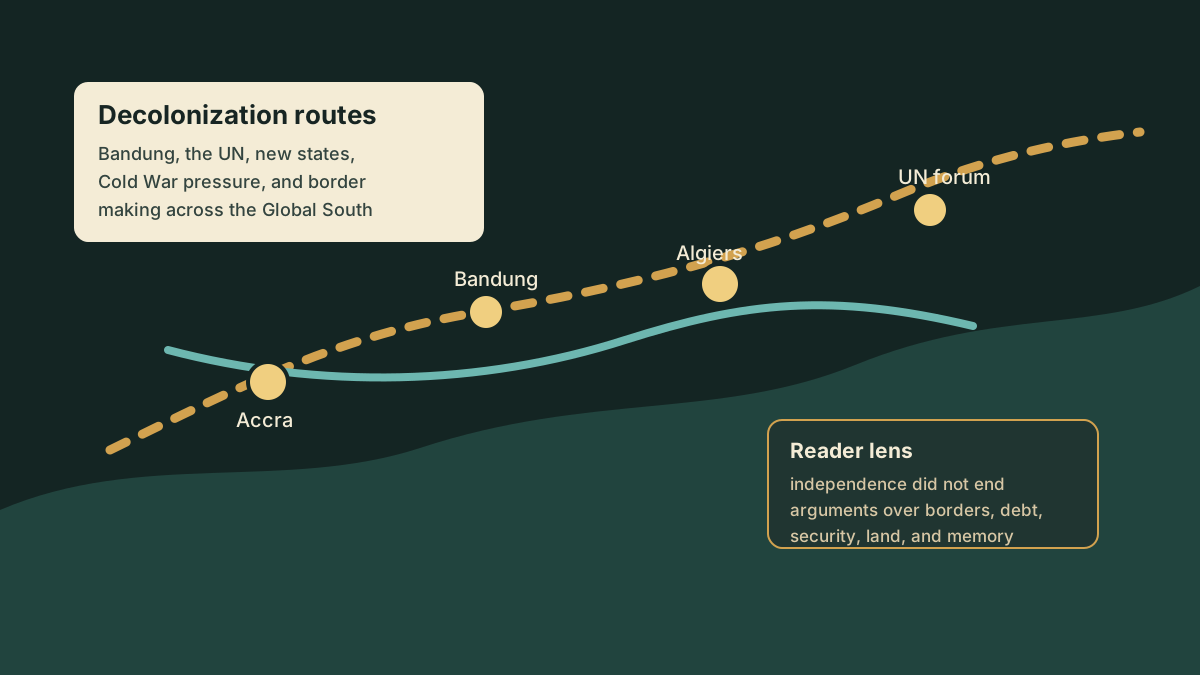
Bandung is the route's symbolic center. It gave Asian and African leaders a stage for sovereignty, racial equality, economic development, anti-colonial solidarity, and nonalignment. The conference did not erase rival interests, but it created a political language in which newly independent and colonized peoples could imagine themselves as a collective world force.
The post-independence section keeps the route honest. Congo, OAU, Biafra, Bangladesh, Angola, and Vietnam show that sovereignty could be fragile, violent, and entangled with Cold War rivalry. Independence did not automatically settle borders, armies, minorities, federal questions, resource control, or outside intervention.
The human-rights and memory chapter follows Soweto, apartheid's end, Rwanda, and the South African Truth and Reconciliation Commission. These nodes ask what happens after formal liberation when public violence, racial rule, genocide, and testimony remain. The route's endpoint is therefore not simply independence; it is the problem of justice after power changes.
The timeline is intentionally global but not vague. It links Caribbean slavery, South Asian empire, Southeast Asian nationalism, African liberation, Middle Eastern canals, Cold War war zones, and human-rights institutions through a shared question: how do people turn domination into claims for sovereignty, dignity, and repair?
Actor visibility is uneven across the route. Leaders such as Sukarno, Nehru, Nasser, Nkrumah, Lumumba, and Mandela matter, but the route also depends on peasants, students, workers, refugees, women organizers, soldiers, prisoners, and survivors. A Global South timeline becomes thin when it turns every movement into a portrait of one leader.
The route ends with a work queue rather than a closed story. Algeria, Kenya, Congo, Angola, Bangladesh, Rwanda, and South Africa all show unresolved afterlives: memory, archives, reparations, borders, language, violence, and development. Decolonization remains part of the present because its institutions and wounds remain active.
This route needs Bandung to feel like a hinge rather than a decorative conference date. Earlier revolts made imperial rule vulnerable; World War II damaged European prestige and opened international forums; Asian and African leaders then turned scattered anti-colonial arguments into a shared public language. Bandung did not create agreement on every problem. It created a stage where sovereignty, racial equality, economic development, and nonalignment could be spoken together.
A stronger reading keeps anti-colonial methods separate. Haiti used revolution against slavery and empire. Java and Maji Maji show rural revolt under colonial pressure. India used mass politics, negotiation, imprisonment, and partition-era crisis. Algeria and Vietnam used armed struggle. Ghana turned electoral and diplomatic pressure into independence. Reading them as one identical liberation script loses the hard question: why did each imperial setting produce a different route to freedom?
Cold War pressure is the route's second engine. New states and liberation movements could sometimes use superpower rivalry to gain weapons, recognition, or diplomatic attention, yet that same rivalry could harden civil wars and make outside intervention more likely. Congo, Vietnam, Angola, Bangladesh, and Biafra show local actors making choices inside international pressure rather than simply being moved by Washington, Moscow, London, Paris, or Beijing.
The state-building chapter prevents a romantic ending. Independence changed flags, embassies, and legal status, but governments still faced borders inherited from empire, army loyalties, language policy, development planning, resource control, regional inequality, refugees, and ethnic fear. The OAU, ASEAN, Arusha, and postwar institutions matter because they reveal leaders trying to make sovereignty practical after the ceremony.
The human-rights layer gives the timeline its moral afterlife. Soweto, apartheid's end, Rwanda, and the South African TRC show that liberation language can coexist with state violence, racial rule, genocide, and difficult testimony. The route therefore asks readers to hold two truths together: decolonization was a real transformation, and many people lived through new forms of insecurity after formal empire ended.
A map-based route follows ports, prisons, plantations, villages, capitals, conference halls, refugee corridors, and courtrooms. These places change the feeling of the chronology. Bandung and Addis Ababa show diplomacy; Algiers and Dien Bien Phu show war; Accra and Dar es Salaam show state-building; Kigali and Johannesburg show memory work after violence. The same timeline can be read through roads, borders, speeches, archives, and survivor testimony.
For a quick route, follow Haiti, India, Bandung, Ghana, Congo, the OAU, Vietnam, Angola, Soweto, Rwanda, and the TRC. For a deeper route, add Java, Maji Maji, the Philippine Revolution, Mau Mau, Algeria, Tanganyika, Biafra, Bangladesh, ASEAN, Mandela, and apartheid's end. The payoff is a Global South timeline that feels like a contested political world, not a label placed over unrelated events.
The story is strongest when read in layers. First, follow the dates from 1791 CE to 1996 CE. Then read across the event types: revolution, anti-colonial war, rebellion, revolution. The timeline becomes more than chronology when those dates reveal decisions, institutions, violence, reform, and memory.
Tanganyika Gains Independence sits near the middle of the sequence. Ask what had already become unavoidable by December 9, 1961, what actors still believed they could control, and which consequences were already beginning to move beyond the original setting.
The named events are Haitian Revolution Begins, Java War Begins, Indian Rebellion of 1857, Philippine Revolution, Maji Maji Rebellion, Fifth Pan-African Congress. Each one pushes a more precise question: what changed, who benefited, who paid the cost, and what later page explains the aftermath more clearly?
Read the timeline against geography too. Places matter because power moves through corridors, borders, cities, ports, capitals, and frontiers. The map below keeps those distances visible while the event pages explain the human and institutional consequences.
A good timeline has a pulse: pressure, decision, expansion, resistance, and aftermath. When you move through Age of Revolutions, Nineteenth-Century Colonialism, British Empire, Revolutionary and Colonial World, and Colonial Africa, keep asking whether an event is creating a new problem, revealing a hidden weakness, or making an earlier choice harder to reverse.
The human layer matters because timelines can become too abstract. Figures such as Toussaint Louverture, Enslaved rebels, Prince Diponegoro, Dutch colonial forces, Bahadur Shah II, Rani Lakshmibai, and Sepoy rebels help the sequence feel lived rather than mechanical. Their choices do not explain everything, but they show where institutions, ideas, military systems, social movements, and public fear entered real decisions.
The ending is not only the last date. With closing events such as Eritrea Becomes Independent, Fall of Apartheid, Rwandan Genocide, and South African Truth and Reconciliation Commission Hearings, the reader can ask what remained unsettled: which institutions survived, which arguments continued, which victims or opponents were left outside the official story, and which later crisis reused the same vocabulary.
Read this page once quickly for order, then read it again for contrast. Compare early confidence with later uncertainty, local decisions with global consequences, and visible turning points with slower changes in law, economy, belief, technology, borders, or memory. That second pass is where a timeline becomes an explanation.
Causation in this sequence is layered. One event may supply the trigger, another may reveal an older weakness, and a later event may show the consequence that people at the beginning did not expect. The useful habit is to separate background pressure, immediate decision, turning point, and aftermath before deciding which event matters most.
Consequences are uneven. A political settlement might look successful in one capital while creating resentment elsewhere; a military victory might end a campaign while deepening civilian trauma; a scientific or institutional breakthrough might solve one problem while creating new risks. The timeline is strongest when those mixed outcomes remain visible.
The final pass is comparative. After reading this sequence, open a neighboring topic or person page and ask whether the same pattern appears again. Repetition usually points to a structure; contrast usually points to a historical choice that could have gone another way.
Importance is not the same thing as drama. Some events are remembered because they were spectacular, while others matter because they changed rules, expectations, alliances, legal categories, technologies, or public language. Use the timeline to test both kinds of importance before deciding what belongs at the center of the story.
The page rewards moving outward. A timeline gives order, but the event pages give causes, maps, people, sources, and reading paths. When a date feels too compressed, open the full event page and then return here; the sequence becomes clearer with each pass instead of asking the reader to memorize a list.
Ask when superpower rivalry opened space for local actors and when it made new states more vulnerable.
Independence pages need to be read beside civil war, secession, language politics, and federal disputes.
Rwanda and the South African TRC keep memory, testimony, accountability, and repair inside the route.
Compare revolution, rural revolt, mass civil resistance, electoral negotiation, guerrilla war, international lobbying, and truth-commission testimony as different tools.
Track what changed after independence: borders, armies, schools, language policy, resource ownership, party systems, and the ability to keep civilians safe.
Use Bandung as the hinge, then read backward to Haiti, India, Algeria, and Ghana and forward to Congo, Vietnam, Angola, Rwanda, and South Africa.
Haitian Revolution Begins gives the opening problem a date and place. Ask what was already unstable before it happened.
Tanganyika Gains Independence is a compression point: earlier causes are now crowded together with decisions that will shape the sequence's ending.
Follow the path through Saint-Domingue, Java, Meerut, Delhi, Kanpur, Lucknow, and North India, Philippines, German East Africa, and Manchester and ask how distance changed communication, logistics, fear, and control.
South African Truth and Reconciliation Commission Hearings works as both an ending and a beginning: it closes one sequence while opening later disputes, institutions, memories, or reforms.
Which conditions existed before the first event, and which later decision turned those conditions into visible historical change?
Who had the power to choose, who had fewer choices, and who is missing when the story is told only through leaders or institutions?
Which facts are date anchors, which are interpretations, and which claims need checking through the event sources before being repeated?
Which linked event, person, year, or topic page would change your interpretation if you read it next?
Interactive Timeline
Explore Decolonization and Global South Timeline by sequence
Haitian Revolution Begins
The Haitian Revolution began as enslaved people and free people of color challenged plantation slavery, French colonial power, and racial hierarchy in Saint-Domingue.
Read the full event pageNarrative Stages
Read this timeline in chapters
Older Anti-Colonial Roots
Haiti, Java, India, Maji Maji, and the Philippine Revolution show that postwar decolonization drew on longer histories of revolt, slavery, empire, and racial hierarchy.
- Haitian Revolution Begins1791 CE
- Java War Begins1825 CE
- Indian Rebellion of 18571857-1858 CE
- Maji Maji Rebellion1905-1907 CE
- Philippine Revolution1896-1898 CE
Postwar Breakthrough and Bandung
Pan-African organizing, Indonesian and Indian independence, Mau Mau, Algeria, Dien Bien Phu, Bandung, and Ghana turned anti-colonial claims into a global public language.
- Fifth Pan-African CongressOctober 1945
- Indonesia Proclaims IndependenceAugust 17, 1945
- Indian Independence and PartitionAugust 1947
- Mau Mau Uprising Begins1952 CE
- Algerian War BeginsNovember 1954
- Battle of Dien Bien Phu1954 CE
- Bandung ConferenceApril 1955
- Ghana IndependenceMarch 6, 1957
Sovereignty Under Pressure
Congo, Tanganyika, the OAU, Vietnam, Biafra, ASEAN, and Bangladesh reveal the difficulty of making independence durable inside Cold War and postcolonial constraints.
- Congo Independence and Crisis1960 CE
- Tanganyika Gains IndependenceDecember 9, 1961
- Organization of African Unity FoundedMay 25, 1963
- Vietnam War Escalation1965
- Nigerian Civil War Begins1967 CE
- ASEAN FoundedAugust 8, 1967
- Bangladesh Liberation War1971 CE
Liberation War and Apartheid Crisis
Angola, Saigon, Soweto, Mandela's release, and apartheid's fall connect decolonization to armed liberation, youth protest, and negotiated transition.
- Angola Gains IndependenceNovember 11, 1975
- Fall of SaigonApril 30, 1975
- Soweto UprisingJune 16, 1976
- Nelson Mandela ReleasedFebruary 11, 1990
- Fall of Apartheid1994
Genocide, Testimony, and Memory
Rwanda and the TRC make the route end with public memory, survivor testimony, justice, and repair rather than with independence ceremonies alone.
- Rwandan GenocideApril-July 1994
- South African Truth and Reconciliation Commission Hearings1996 CE
Map Layer
Decolonization and Global South Timeline geography
Gold pins mark the approximate locations of published event pages. This is a schematic locator map, not a historical border map.
Event location Simplified land areaClick a pin to open the event page
Coordinates are approximate and are used to help readers orient themselves before opening a full event page.
References
Where to Check the Facts
- Encyclopaedia Britannica: Algerian WarReference for the 1954-1962 war for Algerian independence from France.
- Encyclopaedia Britannica: African UnionReference for the Organization of African Unity, its 1963 founding, and the later African Union.
- Official African Union: OAU CharterOfficial reference for the 1963 OAU Charter and the continental institution's founding framework.
- Official United Nations: Rwanda genocide historical backgroundInstitutional reference for the 1994 genocide against the Tutsi in Rwanda and UN memory work.
- UNESCO: General History of AfricaAfrican-history reference project for reading decolonization through African scholarship, regional diversity, culture, and postcolonial memory.
- South African History Online: Liberation HistoryAfrican public-history reference for apartheid, liberation movements, township politics, memory, and South African transition.
- Encyclopaedia Britannica: Southeast Asian historyReference for regional chronology, maritime exchange, colonial rule, nationalism, and modern state formation.
- Encyclopaedia Britannica: Sultanate of MalaccaReference for Malacca as a major Malay port-polity and commercial center before Portuguese conquest.
- Official UNESCO World Heritage Centre: AngkorInstitutional reference for the Angkor landscape, Khmer capitals, reservoirs, temples, and regional setting.
- Official ASEAN: About ASEANOfficial institutional reference for ASEAN's 1967 founding and regional-cooperation frame.