At a Glance
The shape of the event
- Date
- September 28, 1958
- Place
- Conakry
- Type
- Referendum and independence
Guinea rejected continued membership in the French Community and chose immediate independence, making Francophone West African decolonization visible as a public vote rather than a uniform handover.
September 28, 1958; place the event in Conakry before comparing causes or consequences.
The vote gives the route a concrete Francophone West African case about sovereignty, aid, punishment, party power, and the pace of decolonization.
Ahmed Sekou Toure / Guinean voters are the first names or groups to compare before widening the story.
Guinea became independent in 1958 and faced a sharp break with France.
Guinea became independent in 1958 and faced a sharp break with France.
The vote gives the route a concrete Francophone West African case about sovereignty, aid, punishment, party power, and the pace of decolonization.
Following Guinea’s 1958 vote opens a way into the wider story of how empire ended in Francophone West Africa.
Background
By 1958, France was trying to hold together a far‑flung empire under new constitutional language. The French Community was presented as a modern partnership, promising shared institutions and continued aid to territories from North and West Africa to the Pacific. In Francophone West Africa, this offer came after decades of centralized rule, unequal citizenship, and limited local autonomy. Many African leaders recognized that the Community’s promise of evolution toward self‑government could also function as a brake, slowing full independence in the name of gradual reform. In Guinea, trade unions and nationalist politicians had already spent years demanding more control over local resources and political life.
Ahmed Sékou Touré emerged from this setting as a powerful figure: a union leader who treated workplace struggles and anti‑colonial politics as part of the same fight. Yet Guinean opinion was not monolithic. Some feared that a break with France would bring economic isolation, disrupted administration, and uncertainty for those employed in colonial structures. Others were wary of what rapid sovereignty might mean for internal party power. Paris, for its part, wanted to avoid another violent rupture after experiences elsewhere. The referendum offered a way to claim democratic legitimacy for continued association, while making the alternative—immediate independence—seem risky and abrupt. Different territories across Francophone West Africa weighed these pressures against local histories of organizing, patronage, and expectation.
The Turning Point
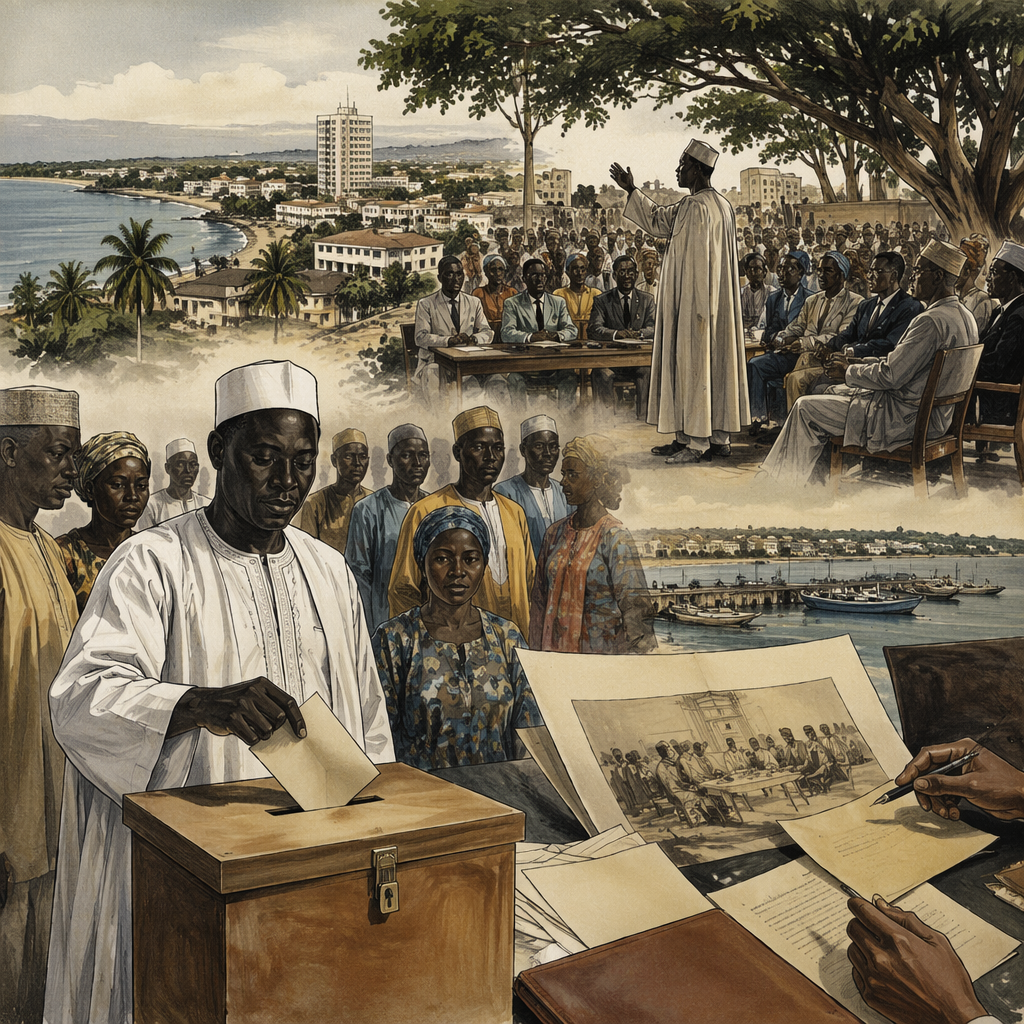
The turning point came on 28 September 1958, when Guinean voters were asked to approve or reject the new French constitution and its Community. On paper, this was a legalistic step in founding the Fifth Republic. On the ground in Conakry and beyond, it unfolded as a direct choice over sovereignty. Ahmed Sékou Touré and his allies campaigned openly for a "no" vote, arguing that real dignity required an immediate break rather than a rebranded dependency. Their stance framed the referendum not as a technical question of institutional design, but as a test of whether Guineans would govern themselves.
Party organization, trade‑union networks, and local committees turned the constitutional referendum into a mass political moment, where villagers, market traders, civil servants, and students debated what independence might actually mean in their daily lives. French authorities promoted the "yes" option as the reasonable path, highlighting aid, administrative continuity, and the dangers of isolation. The design of the referendum, however, made the stakes unmistakable: rejection of the constitution meant rejecting the Community and opting for immediate independence. When the votes were counted, Guinea’s "no" marked a sudden departure from the gradualist track Paris preferred.
With that act, a territory at the edge of the Atlantic declared that the future of Francophone West Africa did not have to follow a single timetable or script imposed from the metropole.
Consequences
In the short term, Guinea’s decision produced a sharp break with France. The choice of independence in 1958 was followed by a rapid unwinding of administrative, technical, and financial ties that had shaped daily life. French officials, teachers, and experts left. Supplies, budgetary support, and access to certain networks were abruptly reduced or reconfigured. For ordinary Guineans, the first years of sovereignty were marked by both exhilaration and disruption, as the new state scrambled to replace systems previously managed or funded from Paris. The vote also transformed Guinea’s internal politics. Sékou Touré’s leadership, forged in labor struggles and confirmed in the referendum, became central to the new state.
Party structures that had mobilized people to say "no" now helped define who spoke for the nation, how dissent would be treated, and which communities benefited from the revolutionary moment. Independence did not dissolve questions of power; it relocated them. Across Francophone West Africa, Guinea’s stance was closely watched. Other territories remained within the French Community while negotiating their own paths, but Guinea’s abrupt exit showed that a different route was possible—and that it carried costs. The event became a reference point in debates about aid, punishment, and political courage. Later states and movements recalled the 1958 vote as a symbol: for some, of principled self‑assertion; for others, of the risks of going too fast.
Over time, the referendum has been remembered less as a single dramatic day and more as a moment where long‑running struggles over sovereignty and dependence suddenly became visible to the world.
Interpretation Notes
Guinea Votes No to the French Community is easy to flatten into one dramatic date. A stronger reading separates immediate action from deeper causes, affected communities, and the memory later states or movements built around the event.
Why Keep Reading
Following Guinea’s 1958 vote opens a way into the wider story of how empire ended in Francophone West Africa. This was not a neat sequence of flags being lowered and raised on fixed dates. It was a series of negotiations, experiments, and calculated risks by leaders and communities weighing dignity against material security. By tracing what neighboring territories did with the same French Community framework—who stayed, who left later, and why—you can see how different visions of sovereignty competed within a shared colonial legacy. Reading on also helps place Guinea’s choice alongside other routes out of empire: negotiated transitions, armed struggles, and quiet administrative handovers.
The map that follows is not just about borders changing color, but about how people tried to shape the terms of their own future while old powers set the conditions.
Reading Path
Follow the story without losing the thread
Before This
- Ghana IndependenceMarch 6, 1957
- Algerian War BeginsNovember 1954
- Mau Mau Uprising Begins1952 CE
After This
- Tanganyika Gains IndependenceDecember 9, 1961
- Mozambique Gains IndependenceJune 25, 1975
- Falklands War1982
Same Period
- Fifth Pan-African CongressOctober 1945
- Ghana IndependenceMarch 6, 1957
- Tanganyika Gains IndependenceDecember 9, 1961
Wider Timeline
Mind Map
How to think about Guinea Votes No to the French Community
French Community offer
France’s 1958 constitutional project framed continued association as modern partnership, while limiting the speed of full sovereignty.
Map Layer
Where this event sits geographically
Gold pins mark the approximate locations of published event pages. This is a schematic locator map, not a historical border map.
Coordinates are approximate and are used to help readers orient themselves before opening a full event page.
References
Where to Check the Facts
- Encyclopaedia Britannica: GuineaReference for Guinea's 1958 independence and political context.