At a Glance
The shape of the event
- Date
- August 17, 1945
- Place
- Jakarta
- Type
- Independence proclamation
Sukarno and Mohammad Hatta proclaimed Indonesian independence after Japan's surrender, opening a revolutionary struggle against the return of Dutch colonial rule.
August 17, 1945; place the event in Jakarta before comparing causes or consequences.
The proclamation anchors Southeast Asian decolonization and connects World War II, nationalism, colonial return, and revolutionary state formation.
Sukarno / Mohammad Hatta are the first names or groups to compare before widening the story.
Indonesia entered a period of revolution and diplomacy before international recognition of independence.
Indonesia entered a period of revolution and diplomacy before international recognition of independence.
The proclamation anchors Southeast Asian decolonization and connects World War II, nationalism, colonial return, and revolutionary state formation.
This proclamation sits at the intersection of wartime collapse, anti-colonial politics, and the messy work of making a state.
Background
For decades the Indonesian archipelago had been administered as a colonial possession; Dutch rule shaped its politics, economy, and social hierarchies. World War II ruptured that order. Japan’s occupation displaced Dutch authority, uprooted economies, and accelerated political change by disrupting colonial institutions and exposing new political actors. During the war years Indonesian nationalists organized, negotiated, and debated what self-government might mean; leaders such as Sukarno and Mohammad Hatta emerged as public figures who could speak to broad audiences. Japan’s sudden surrender in August 1945 created an immediate power vacuum across Southeast Asia: occupying forces were nominally defeated, European colonial administrations were weakened, and returning imperial powers faced logistical and political obstacles.
In Indonesia this vacuum collided with long-standing demands for sovereignty, wartime experience of mobilization, and fears among colonizers about losing their prewar status. At the same time, local communities were not monolithic: religious leaders, regional elites, urban workers, and younger activists had different visions and priorities. That mix of structural change, organized nationalism, and fragmented local interests made August 1945 a volatile moment—one where a bold public declaration could crystallize political claims even as many practical questions about governance, security, and recognition remained unresolved. Indonesia's proclamation of independence came in the unstable days after Japan's surrender.
Sukarno, Hatta, youth activists, Japanese occupation structures, Dutch colonial expectations, local committees, armed groups, and regional communities all shaped what independence could mean before it was internationally secured. The proclamation was short, but the struggle was not. It opened a revolution involving diplomacy, armed conflict, social change, competing visions of the republic, and a Dutch attempt to restore colonial authority.
The Turning Point
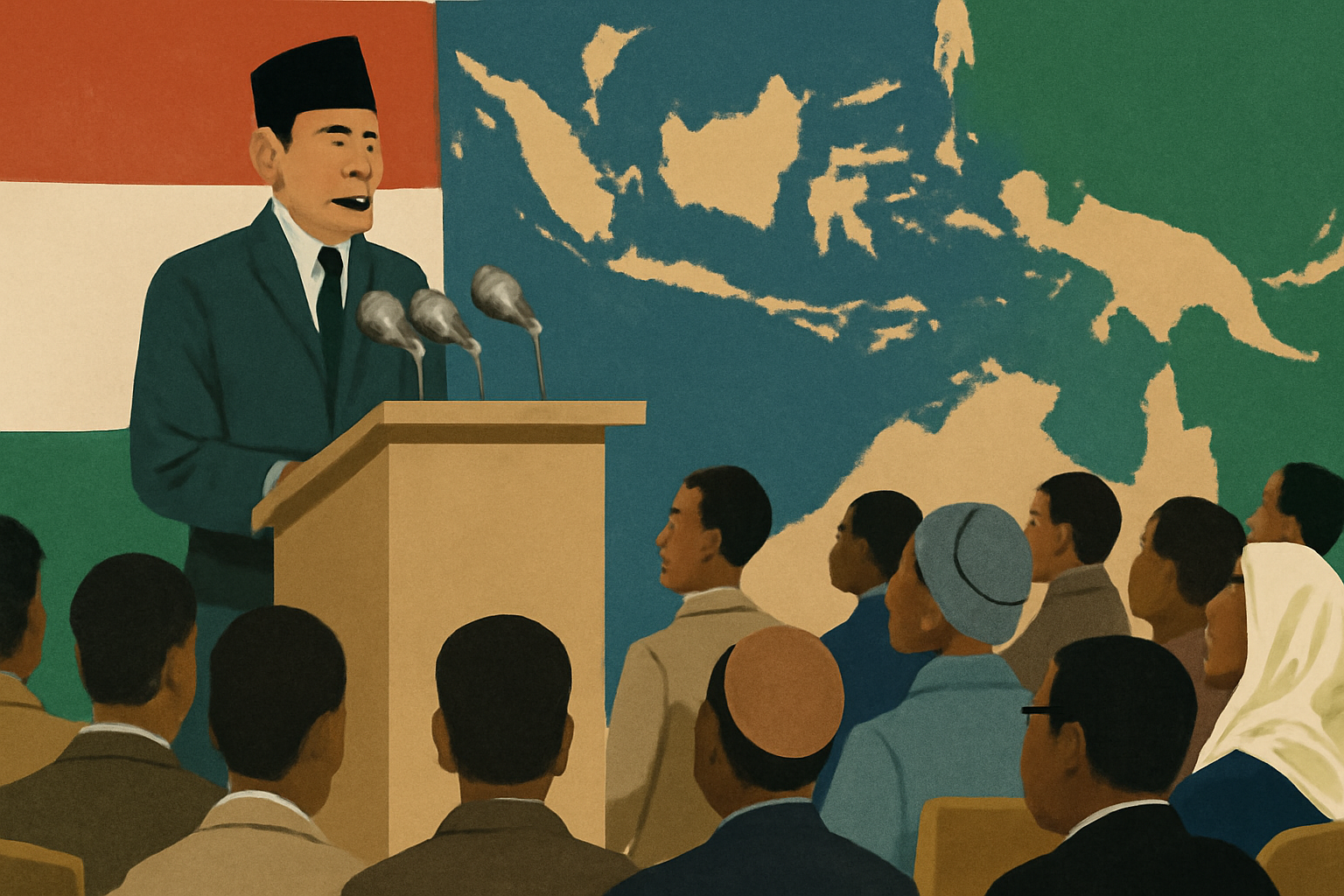
On the morning of 17 August 1945 in Jakarta, Sukarno and Mohammad Hatta made a public, political decision that reframed the possibilities on the ground: they proclaimed Indonesian independence. That choice was not merely symbolic. By announcing sovereignty in the immediate wake of Japan’s surrender, they converted widespread nationalist aspiration into an explicit claim to statehood and thereby forced other actors to respond—local administrators, returning colonial authorities, Allied commanders, and ordinary Indonesians. The proclamation narrowed the field of acceptable outcomes: it signaled that negotiations would need to begin from a claim to independent statehood rather than a restoration of prewar arrangements.
Sukarno and Hatta’s act also created an organizing point for a diffuse independence movement, giving political legitimacy to groups that would resist Dutch efforts to reimpose control. Yet the proclamation was only the opening move. It depended on mobilization, political coordination, and contested violence that followed. Leaders had to balance diplomatic outreach with preparation for defensive and offensive measures as the Dutch sought to reclaim territory. The decision on 17 August thus shifted the conflict from latent disagreement into an active struggle over the form and sovereignty of the Indonesian state—turning an immediate political gamble into a sustained revolutionary campaign.
Consequences
In the months and years after the proclamation, Indonesia entered a period of revolution and diplomacy. The declaration did not produce immediate international recognition or a stable government; instead it marked the start of a contested process in which armed struggle, negotiation, and international pressure all played parts. Dutch authorities sought to reassert colonial control, provoking military confrontations and political resistance across the archipelago. Indonesian leaders pursued both diplomatic channels and mobilization of popular support to defend the claim made on 17 August. Over time that struggle compelled outside powers to face a changed political landscape in Southeast Asia: the interplay of World War II’s disruptions, metropolitan exhaustion, and sustained nationalist commitment made simple colonial restoration increasingly untenable.
In the long term, the proclamation became an anchor in regional decolonization: it exemplified how wartime ruptures and organized nationalist movements could translate into new states. It also shaped Indonesian memory and statecraft—political rituals, anniversaries, and the centrality of Sukarno and Hatta in national narratives grew out of this moment. At the same time, careful study reminds us that the proclamation is not the whole story; communities experienced the revolution unevenly, and the path to internationally recognized independence relied on protracted struggle, negotiation, and shifting global politics. The consequences ran through the Indonesian National Revolution, international mediation, Dutch recognition, debates over federalism, and the challenge of governing an archipelago with diverse political and social worlds.
The event matters because declaration became statehood only through struggle.
Interpretation Notes
Indonesia Proclaims Independence is easy to flatten into one dramatic date. A stronger reading separates immediate action from deeper causes, affected communities, and the memory later states or movements built around the event.
Why Keep Reading
This proclamation sits at the intersection of wartime collapse, anti-colonial politics, and the messy work of making a state. Follow the next chapters to learn how diplomacy and armed resistance interacted in the Indonesian National Revolution, how Sukarno and Mohammad Hatta navigated domestic factions and foreign pressure, and how international actors confronted decolonization in Southeast Asia. Tracing the aftermath clarifies why recognition came only after prolonged negotiation and why memories of 17 August were shaped into national ritual. If you want to understand how a single public act grew into a new state—and how that state’s founders managed power, unity, and legitimacy—read on through timelines of battles, conferences, and diplomatic bargaining that followed.
Continue to Japanese occupation, decolonization, Bandung, ASEAN, and Cold War Southeast Asia to follow Indonesia's path from colony to regional power.
Reading Path
Follow the story without losing the thread
Before This
- Atomic Bombing of HiroshimaAugust 6, 1945
- Yalta ConferenceFebruary 1945
- End of World War II1945
After This
- Mau Mau Uprising Begins1952 CE
- Battle of Dien Bien Phu1954 CE
- Algerian War BeginsNovember 1954
Same Period
- Fifth Pan-African CongressOctober 1945
- Ghana IndependenceMarch 6, 1957
- Tanganyika Gains IndependenceDecember 9, 1961
Wider Timeline
Mind Map
How to think about Indonesia Proclaims Independence
Power vacuum
Japan's surrender in August 1945 removed occupying authority and created the immediate opening for a public declaration of independence.
Map Layer
Where this event sits geographically
Gold pins mark the approximate locations of published event pages. This is a schematic locator map, not a historical border map.
Coordinates are approximate and are used to help readers orient themselves before opening a full event page.
References
Where to Check the Facts
- Encyclopaedia Britannica: Indonesia, toward independenceReference for Indonesian nationalism, proclamation, and revolution.
- Encyclopaedia Britannica: SukarnoBiographical reference for Sukarno and Indonesian independence.
- National WWI Museum and Memorial: All About WWIMuseum reference hub for World War I chronology, maps, articles, and educational context.
- U.S. National Archives: World War I CentennialArchive reference hub for World War I records, photographs, documents, and educational resources.
- The National WWII Museum: Explore By TopicMuseum reference hub for World War II theaters, battles, home fronts, aftermath, and memory.
- Imperial War Museums: What You Need to Know About the Second World WarMuseum reference for the global war, civilian experience, military fronts, and consequences.