At a Glance
The shape of the event
- Date
- April 1955
- Place
- Bandung
- Type
- Conference
Asian and African leaders met at Bandung to discuss anti-colonial solidarity, racial equality, economic cooperation, sovereignty, and alternatives to Cold War bloc politics.
April 1955; place the event in Bandung before comparing causes or consequences.
The conference gives the atlas a bridge between decolonization, Cold War diplomacy, race, sovereignty, and the political imagination of the Global South.
Sukarno / Jawaharlal Nehru / Gamal Abdel Nasser are the first names or groups to compare before widening the story.
Bandung became a symbol of Afro-Asian solidarity and helped shape later nonaligned politics.
Bandung became a symbol of Afro-Asian solidarity and helped shape later nonaligned politics.
The conference gives the atlas a bridge between decolonization, Cold War diplomacy, race, sovereignty, and the political imagination of the Global South.
Follow the threads from Bandung to see how language, ritual and diplomacy became tools of statecraft across the Global South.
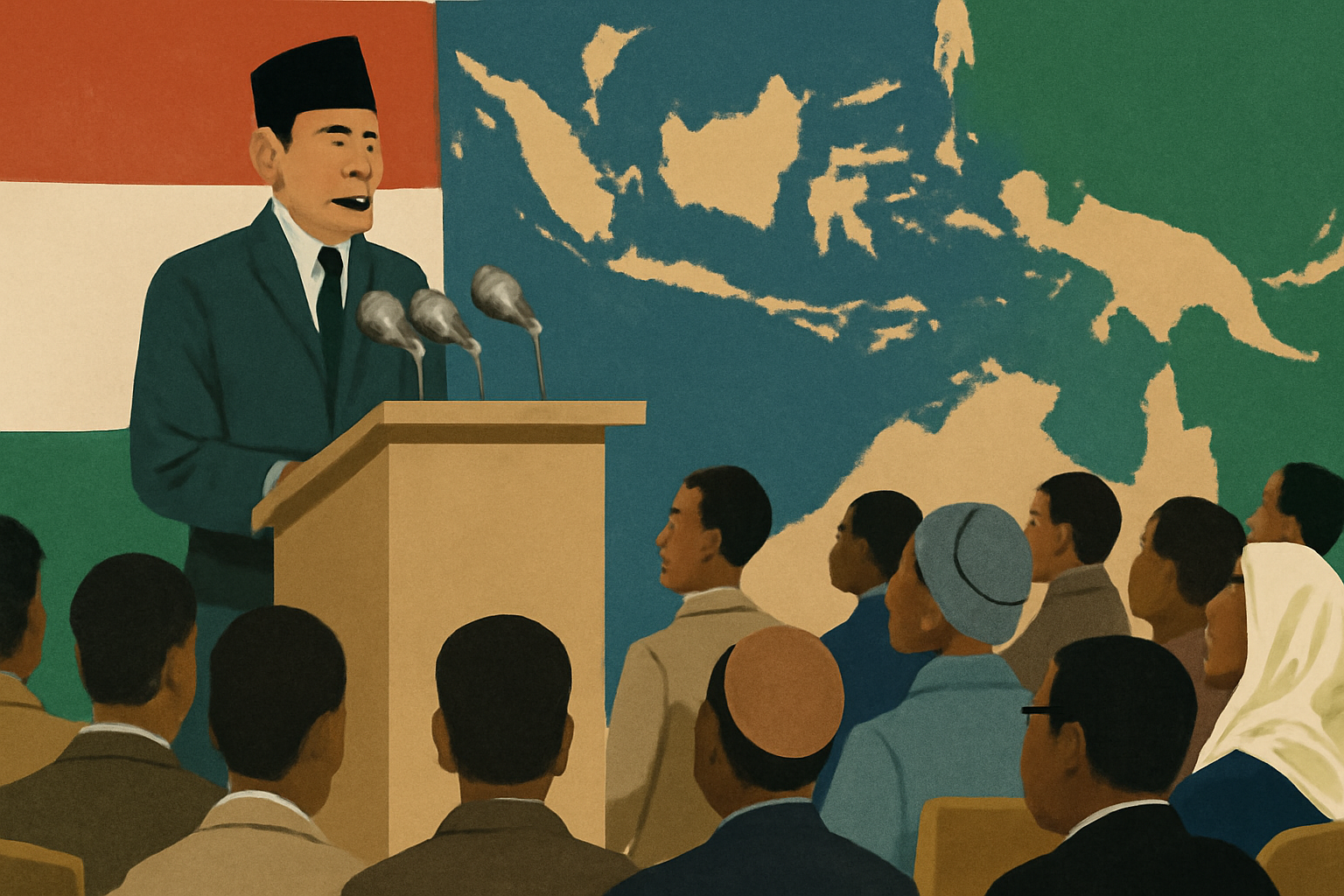
Background
In the decade after World War II, a wave of decolonization reshaped political geography across Asia and Africa. Former colonies and protectorates navigated the practical burdens of sovereignty—nation-building, economic development, and diplomatic recognition—while imperial structures, racial hierarchies and Cold War rivalries still constrained choices. States newly independent or fighting for independence looked for strategies that would secure dignity and room to maneuver without becoming pawns in the competition between Washington and Moscow. Against that background, Bandung opened as a practical attempt to translate shared grievances into collective leverage. Its organisers and attendees came from different histories and political styles: revolutionary republics, parliamentary states, monarchies and liberation movements.
They arrived with overlapping priorities—racial equality, economic cooperation, respect for sovereignty—and with different calculations about how to pursue them. Some sought firm political declarations; others prioritized technical agreements on trade or cultural exchange. The conference thus sat at the intersection of moral claims and diplomatic calculation. It was not a single cause that brought the meeting into being but a cluster of pressures: the urgency of decolonisation, the desire to reshape global norms on race and sovereignty, and the strategic choice to explore alternatives to alignment with either Cold War bloc. Bandung made decolonization visible as diplomacy.
Leaders from 29 Asian and African governments gathered to discuss sovereignty, racial equality, economic development, anti-colonial solidarity, and the danger of being forced into Cold War blocs. The conference did not create a single unified program. Participants brought different regimes, ideologies, conflicts, and priorities. Its importance lies in the public assertion that formerly colonized and still-colonized societies could speak as makers of world order.
The Turning Point
During the weeks in Bandung, the conference shifted a scattered set of complaints into a visible, coordinated political posture. Leaders from across Asia and Africa met face-to-face; among them Sukarno, Jawaharlal Nehru and Gamal Abdel Nasser stood out for the tone they struck. They did not create a new bloc so much as demonstrate a shared vocabulary—anti-colonial solidarity, racial equality, economic cooperation, and a refusal to be reduced to Cold War proxies. Delegations made strategic choices: to foreground sovereignty and mutual respect, to present economic cooperation as an alternative to dependency, and to insist on equal treatment in international forums. Those choices mattered because they produced a public identity for what would later be called the Global South.
Bandung turned private calculations about survival and influence into collective statements with diplomatic force. The conference also drew a line between immediate practical steps—technical cooperation, cultural exchanges, joint communiqués—and longer-term political projects such as imagining a nonaligned path between the superpowers. That separation is important: the meeting was both an event of policy-making and an act of symbolic self-definition that others could invoke, reinterpret, or build upon in subsequent years. It shifted how leaders framed sovereignty in diplomatic exchanges and gave activists and states a reference point for future cooperation.
Consequences
In the near term, Bandung produced practical networks and a set of public declarations that amplified demands for respect, equality and economic collaboration among Asian and African governments. For many participants it offered a diplomatic space to press for recognition, technical cooperation and a firmer stance against racial discrimination. The conference’s immediate outputs mattered as signals: they changed the language of international diplomacy and made visible alliances that had previously been diffuse. Over the longer term, Bandung endured less as a single policy program than as a symbol and a template. It became shorthand for Afro-Asian solidarity and helped shape later nonaligned politics, providing leaders and movements with a vocabulary and a set of precedents to draw upon.
The event therefore functions as a bridge in historical analysis—linking decolonization, Cold War diplomacy, race, sovereignty and the political imagination of the Global South. At the same time, historians warn against flattening Bandung into one dramatic date: the conference’s meanings were contested, reshaped by national governments and social movements, and woven into different memories and policy trajectories. Its real consequence was both practical and interpretive: new diplomatic habits and a sustainable idea that others would repeatedly invoke, adapt, and contest. The consequences included momentum for Non-Aligned politics, stronger Afro-Asian networks, and a diplomatic language used by later independence movements. Bandung matters because it changed who appeared on the global stage, even when unity remained difficult.
Interpretation Notes
Bandung Conference is easy to flatten into one dramatic date. A stronger reading separates immediate action from deeper causes, affected communities, and the memory later states or movements built around the event.
Why Keep Reading
Follow the threads from Bandung to see how language, ritual and diplomacy became tools of statecraft across the Global South. Tracing what participants did next—how they negotiated trade, culture, and alliances—reveals the practical work that turned a conference into sustained politics. Banding together also shaped individual careers and national stories: the way Sukarno, Nehru and Nasser used the forum affected later choices at home and abroad. If you want to understand decolonization not as a single rupture but as a series of diplomatic experiments and memory projects, move on to timelines of post-1955 nonalignment, regional cooperation, and later Afro-Asian meetings. Each step shows how ideas from Bandung were adapted, contested, and institutionalised.
Continue to Ghana independence, Suez, OAU, Non-Aligned Movement, civil rights, and Global South routes.
Reading Path
Follow the story without losing the thread
Before This
- Battle of Dien Bien Phu1954 CE
- Algerian War BeginsNovember 1954
- Mau Mau Uprising Begins1952 CE
After This
- Suez Crisis1956 CE
- Ghana IndependenceMarch 6, 1957
- Congo Independence and Crisis1960 CE
Same Period
- Battle of Dien Bien Phu1954 CE
- Congo Independence and Crisis1960 CE
- Angola Gains IndependenceNovember 11, 1975
Wider Timeline
Mind Map
How to think about Bandung Conference
Decolonization pressures
Newly independent states sought diplomatic strategies to secure sovereignty, development, and recognition in a world still structured by imperialism.
Map Layer
Where this event sits geographically
Gold pins mark the approximate locations of published event pages. This is a schematic locator map, not a historical border map.
Coordinates are approximate and are used to help readers orient themselves before opening a full event page.
References
Where to Check the Facts
- Encyclopaedia Britannica: Bandung ConferenceReference for the conference, participants, and significance.
- Encyclopaedia Britannica: African UnionReference for the Organization of African Unity, its 1963 founding, and the later African Union.
- Office of the Historian: Bandung ConferenceOfficial diplomatic-history reference for Bandung, Afro-Asian cooperation, and Cold War context.
- UNESCO Memory of the World: Asian-African Conference ArchivesInstitutional reference for the Asian-African Conference archives and public memory of Bandung.
- Encyclopaedia Britannica: Non-Aligned MovementReference for later nonalignment and the political afterlife of Afro-Asian cooperation.
- U.S. National Archives: The Cold WarArchive reference hub for Cold War records, federal documentation, and research guidance.
- Office of the Historian: The Early Cold War, 1945-1952Official diplomatic history reference for early Cold War foreign-policy context.