At a Glance
The shape of the event
- Date
- 1967 CE
- Place
- Nigeria and Biafra
- Type
- Civil war outbreak
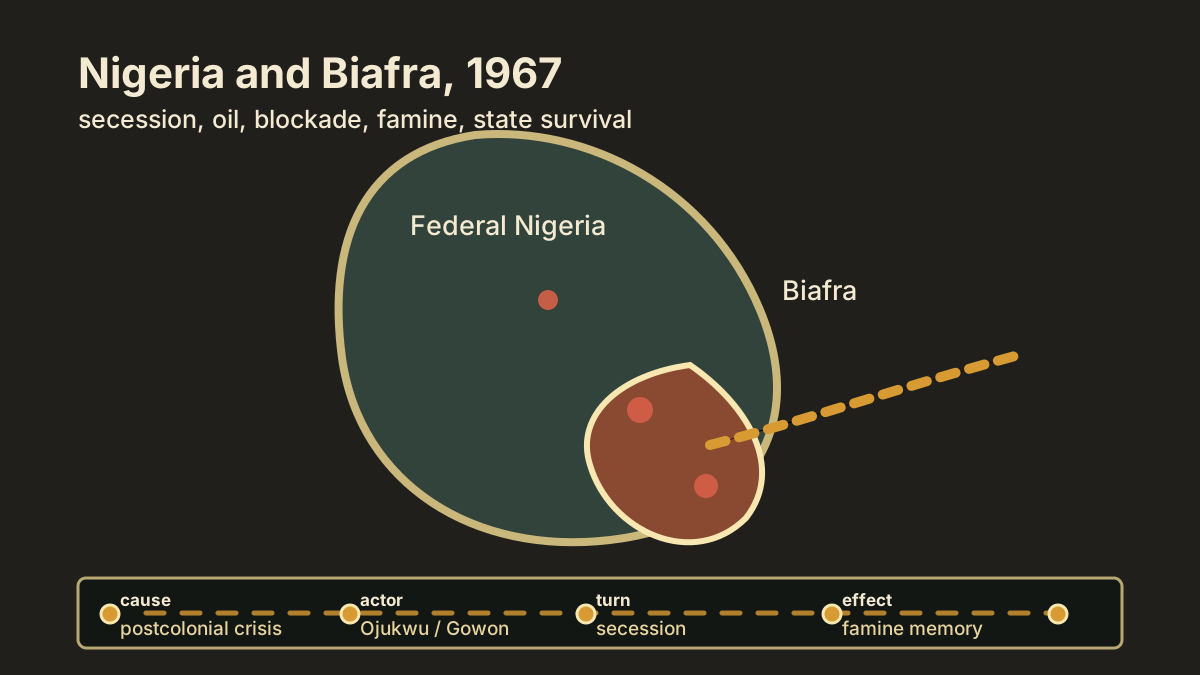
The Nigerian Civil War began after Biafra declared secession, turning ethnic violence, federal power, oil, famine, and postcolonial state survival into a brutal conflict.
1967 CE; place the event in Nigeria and Biafra before comparing causes or consequences.
The war shows that independence did not settle questions of federalism, resource control, ethnic security, and national belonging.
Chukwuemeka Odumegwu Ojukwu / Yakubu Gowon are the first names or groups to compare before widening the story.
Nigeria defeated Biafra in 1970, but the war left deep human loss and a lasting memory of famine and state violence.
Nigeria defeated Biafra in 1970, but the war left deep human loss and a lasting memory of famine and state violence.
The war shows that independence did not settle questions of federalism, resource control, ethnic security, and national belonging.
Follow the unfolding timeline to see how the war’s opening moves set patterns that lasted through 1970 and beyond: where military campaigns focused, which regions bore the brunt of displacement, and how international...
Background
Independence from colonial rule did not erase the rivalries and uncertainties that colonial borders had left behind. In Nigeria, pressures accumulated around competing claims to authority, the control of newly valuable oil resources, and fears about security among different communities. Political institutions were young and brittle; military and civilian leaders both faced the challenge of keeping a diverse country intact. Ethnic violence that had flared before 1967 exposed social fractures and turned politics into a matter of life and death for many citizens. Against this background, leaders such as Chukwuemeka Odumegwu Ojukwu and Yakubu Gowon emerged as central figures: Ojukwu became the face of secession for Biafra, while Gowon led the federal government determined to preserve Nigeria’s territorial integrity.
These twin pressures—popular fear on the ground and strategic choices by leaders—meant that a single decision could tip localized conflict into national war. The war’s outbreak was not inevitable in a mechanical sense, but it was the predictable consequence of unresolved questions about federalism, resource control, and belonging in a newly independent state. The Nigerian Civil War began from a postcolonial crisis that cannot be explained by one ethnic label. Colonial boundaries, regional party systems, coups in 1966, counter-coups, massacres of Igbo people in the north, disputes over federalism, oil, military authority, and the Eastern Region's declaration of Biafra all converged. Readers need that layered causation because the war is often simplified into tribe versus tribe.
It was also a struggle over whether a new postcolonial state could survive secession and whether minority communities inside the claimed territories would be protected.
The Turning Point
The decisive change in 1967 was the formal turn from fractured violence into organized, state-versus-state conflict when Biafra declared secession and the federal government responded as a sovereign authority. Chukwuemeka Odumegwu Ojukwu’s declaration crystallized a political project rooted in protecting a population that saw itself threatened; it converted local insecurity into a claim for independence. Yakubu Gowon, leading the federal side, faced a comparable imperative: to enforce the constitution and maintain a country rich in contested resources. The choices made by both leaders—Ojukwu’s commitment to secession and Gowon’s military suppression of that claim—rewrote the terms of confrontation. Control of territory and of oil-producing areas became immediate military objectives.
Civilian life was reshaped by sieges, blocked supply lines and restricted humanitarian access that turned political struggle into a crisis of subsistence for many. In short, the turning point was not only a proclamation or a military order; it was the conversion of political disagreement into strategic effort to secure populations, resources and legitimacy through force. The turning point came when negotiation failed and Biafra's declaration of independence became war. Chukwuemeka Odumegwu Ojukwu framed secession as protection after massacres and distrust of the federal government. Yakubu Gowon framed federal action as defense of Nigerian unity. Both sides mobilized legitimacy, fear, and military force. The conflict quickly became more than a constitutional dispute.
Blockade, famine, propaganda, oil strategy, foreign sympathy, and humanitarian activism made Biafra one of the defining crises of the late 1960s.
Consequences
In the near term the conflict hardened into a multi-year war that ended with the defeat of Biafra in 1970, but that legal and military outcome did not erase the human toll or the memories it left behind. The fighting produced widespread displacement, suffering and a powerful image of famine and denied relief that entered national and international consciousness. Politically, the federal victory reasserted central control and delayed open secessionist challenges, but it did not settle the underlying disputes over power, resources and security.
Over the longer term, the war shaped Nigeria’s governance, civil–military relations and foreign aid responses: it influenced how subsequent leaders handled federalism, how communities remembered victimhood or betrayal, and how humanitarian organizations think about access in wartime. The conflict remains a reference point for discussions about resource control, ethnic protection and the limits of postcolonial state-building. Its legacy is ambivalent—the legal reunification of the country alongside a lasting memory of famine, state violence and unresolved grievances that continue to inform politics and identity. The war killed and displaced vast numbers of people and left deep memories of famine, state violence, and contested nationhood. It also shaped humanitarian media: images of starving children circulated globally and influenced later aid politics.
Nigeria survived as one state, but survival did not erase questions about federal balance, oil revenue, military rule, and ethnic security. A responsible historical account names the suffering without turning it into spectacle and explains why the war remains politically sensitive.
Interpretation Notes
Nigerian Civil War Begins is easy to flatten into one dramatic date. A stronger reading separates immediate action from deeper causes, affected communities, and the memory later states or movements built around the event.
Why Keep Reading
Follow the unfolding timeline to see how the war’s opening moves set patterns that lasted through 1970 and beyond: where military campaigns focused, which regions bore the brunt of displacement, and how international actors responded to a humanitarian crisis framed by politics and oil. Reading the biographies and decisions of figures like Ojukwu and Gowon clarifies how personal authority and institutional weakness interacted. Tracing the conflict’s aftermath shows why questions of federalism, resource control and belonging remain central to Nigeria’s politics today—and why a single date of secession cannot contain the war’s causes or consequences. Read next through decolonization, Ghana independence, African postcolonial state-building, oil politics, and humanitarian crisis pages.
Nigeria and Biafra help readers see how independence could leave unresolved questions about borders, resources, citizenship, and coercion.
Reading Path
Follow the story without losing the thread
Before This
- Arusha Declaration1967 CE
- Organization of African Unity FoundedMay 25, 1963
- Ghana IndependenceMarch 6, 1957
After This
- Eritrea Becomes IndependentMay 24, 1993
- Rwandan GenocideApril-July 1994
Same Period
- Arusha Declaration1967 CE
- Organization of African Unity FoundedMay 25, 1963
- Eritrea Becomes IndependentMay 24, 1993
Wider Timeline
Mind Map
How to think about Nigerian Civil War Begins
Secession declared
Biafra’s formal break from Nigeria in 1967 transformed political disagreement into open conflict.
Map Layer
Where this event sits geographically
Gold pins mark the approximate locations of published event pages. This is a schematic locator map, not a historical border map.
Coordinates are approximate and are used to help readers orient themselves before opening a full event page.
References
Where to Check the Facts
- Encyclopaedia Britannica: Nigerian Civil WarReference for the war, causes, belligerents, and death toll debates.
- Encyclopaedia Britannica: BiafraReference for the secessionist state and war context.