At a Glance
The shape of the event
- Date
- April-July 1994
- Place
- Rwanda
- Type
- Genocide
Extremist forces in Rwanda organized mass killing of Tutsi civilians and moderate Hutu during a rapid genocide that unfolded over roughly one hundred days.
April-July 1994; place the event in Rwanda before comparing causes or consequences.
The genocide remains central to human-rights law, memory, international failure, postcolonial state violence, and the politics of justice.
Tutsi civilians / Hutu extremist leaders / Rwandan Patriotic Front are the first names or groups to compare before widening the story.
More than 800,000 people were killed, the Rwandan Patriotic Front took power, and the region faced refugee and justice crises.
More than 800,000 people were killed, the Rwandan Patriotic Front took power, and the region faced refugee and justice crises.
The genocide remains central to human-rights law, memory, international failure, postcolonial state violence, and the politics of justice.
Follow the timelines that bracket the 1994 killings to see how long-term pressures met fast-moving decisions: study the rise of extremist networks in the late 1980s and early 1990s, the military campaigns of the Rwand...
Background
Rwanda in the late 20th century carried the weight of multiple pressures that made large-scale violence possible without explaining it entirely. Colonial administrations had imposed and hardened categories of identity that later politics exploited; after independence, competing elites used those categories to consolidate power. Economic strain, land scarcity, and the aftermath of earlier political conflict heightened social tensions while political leaders mobilized supporters around ethnic difference. From these conditions, extremist networks emerged within the Hutu political landscape and built alliances with parts of the state and local authorities. At the same time, the Rwandan Patriotic Front, a predominantly Tutsi-led rebel movement, pressed a military and political challenge to the government, feeding a climate of fear and brinkmanship.
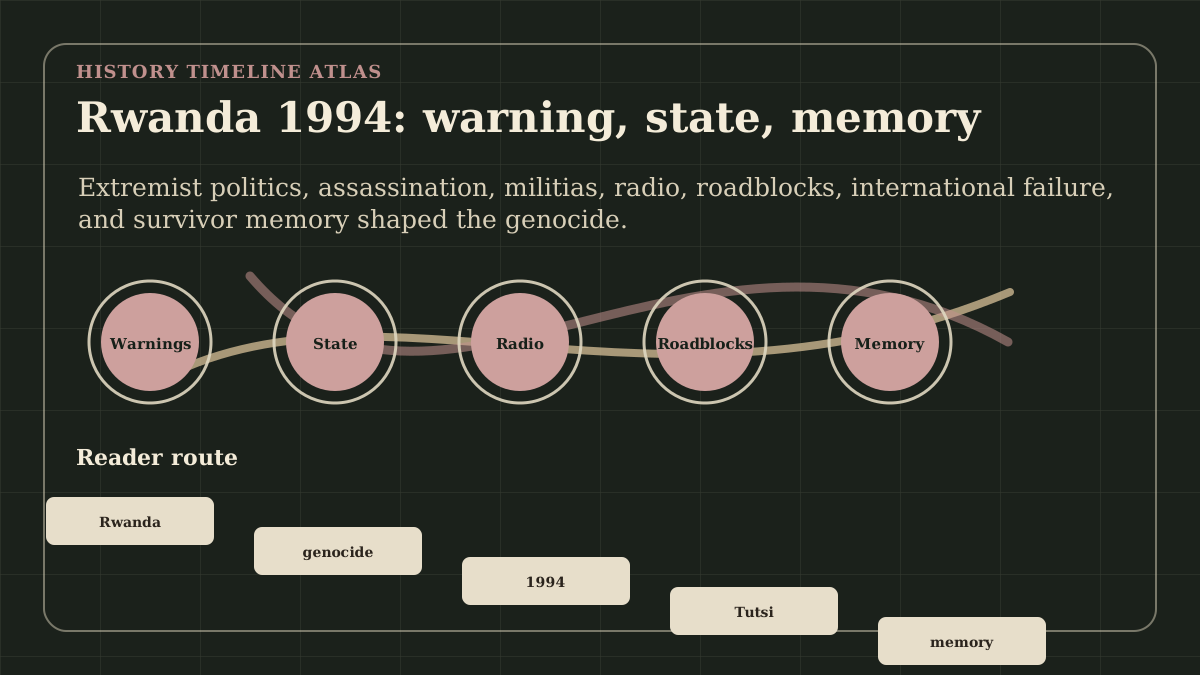
These overlapping pressures—historical classifications, contemporary political competition, insecurity, and the presence of an armed insurgency—created a context in which calls to eliminate perceived enemies could find rapid and widespread implementation by organized actors. The Rwandan Genocide requires careful, direct language because the event was organized mass murder, not a sudden eruption of timeless ethnic hatred. Extremist politics, civil war, propaganda, militia organization, state structures, identity documents, fear, and international failure all shaped the catastrophe. The assassination of President Juvenal Habyarimana was the immediate trigger, but planning and incitement already mattered. Radio broadcasts, roadblocks, local officials, militia networks, and lists helped turn ideology into coordinated killing. The page must keep organization visible because organization is what makes the genocide historically legible.
Ordinary places became sites of danger. Roads, churches, schools, administrative offices, neighborhoods, and refugee routes were pulled into violence. That geography matters because genocide was not only ordered from above; it required local participation, coercion, fear, opportunism, and the destruction of social trust.
The Turning Point
What changed in the spring of 1994 was not only the occurrence of violence but a deliberate escalation in scale and organization. Extremist leaders within the Hutu political sphere moved from threatening rhetoric to coordinated action: networks of local officials, militias, and security forces together implemented a program of targeted killing aimed primarily at Tutsi civilians and Hutu identified as moderates. This was not spontaneous mob violence alone but a campaign with direction, reach, and speed that overwhelmed existing institutions of protection. In response, the Rwandan Patriotic Front continued its military campaign and rapidly seized territory, ultimately taking power.
Those choices—by extremist leaders to organize mass killing, by local actors who carried out attacks, and by the Rwandan Patriotic Front to press its advance—transformed political crisis into catastrophe. Simultaneously, the speed of events compressed decision-making, closed off avenues for restraint, and produced the large, concentrated loss of life that defines the period. The turning point was the speed with which state and militia structures moved after the assassination. Violence became systematic because armed groups, officials, media, and local networks pushed people into categories of killer, target, bystander, rescuer, or fugitive. International hesitation deepened the catastrophe. The United Nations, major powers, and outside observers failed to respond with the speed and clarity needed.
That failure belongs inside the event because genocide prevention depends on naming, evidence, political will, and action.
Consequences
In the immediate aftermath, more than 800,000 people were killed, and the Rwandan Patriotic Front established control of the state. Large numbers of people fled their homes, creating refugee movements across the region and urgent humanitarian crises. The violence left deep social ruptures: survivors and entire communities had to confront loss, displacement, and the question of how to rebuild civic life. Internationally, the genocide became a focal point for debates about human-rights obligations and the responsibility of outside powers to prevent or halt mass atrocities, generating inquiries into diplomatic and humanitarian responses.
Over the long term, the event shaped the politics of justice and memory—prompting domestic and international efforts to prosecute perpetrators, while also producing contested narratives about responsibility and rebuilding. The genocide’s legacy continues to influence scholarship and policy on postcolonial state violence, transitional justice, and how societies remember mass crimes; its echoes affect regional stability and the politics of reconciliation to this day. The human consequence was catastrophic loss, trauma, displacement, and survivor memory. The political consequence included the RPF victory, refugee crises, regional wars, trials, gacaca courts, memorialization, and long debates over justice, reconciliation, and responsibility. For readers, the page is also a warning about explanation. Naming political organization does not reduce victims to numbers or remove moral responsibility.
It helps explain how propaganda, state capacity, fear, and impunity can turn social division into planned destruction.
Interpretation Notes
Rwandan Genocide is easy to flatten into one dramatic date. A stronger reading separates immediate action from deeper causes, affected communities, and the memory later states or movements built around the event.
Why Keep Reading
Follow the timelines that bracket the 1994 killings to see how long-term pressures met fast-moving decisions: study the rise of extremist networks in the late 1980s and early 1990s, the military campaigns of the Rwandan Patriotic Front, and the international diplomatic responses in real time. Each strand—political mobilization, military strategy, humanitarian reaction, and the subsequent justice processes—illuminates a different piece of how the genocide unfolded and why its consequences still matter. Understanding those linked events helps explain not only what happened during those hundred days but how societies attempt to reckon with and prevent such violence afterward. Read this page beside postcolonial Africa, human-rights history, South Africa's Truth and Reconciliation Commission, and genocide prevention debates.
The route connects violence, memory, justice, and the limits of international response.
Reading Path
Follow the story without losing the thread
Before This
- Helsinki Final ActAugust 1, 1975
- Arusha Declaration1967 CE
- Nigerian Civil War Begins1967 CE
After This
No direct path yet.
Same Period
- Nuremberg Trials1945-1946
- Universal Declaration of Human RightsDecember 10, 1948
- Swahili Coast City-States Risec. 900 CE
Wider Timeline
Mind Map
How to think about Rwandan Genocide
Identity politics
Historical classification and political manipulation of ethnic categories that contributed to exclusionary practices
Map Layer
Where this event sits geographically
Gold pins mark the approximate locations of published event pages. This is a schematic locator map, not a historical border map.
Coordinates are approximate and are used to help readers orient themselves before opening a full event page.
References
Where to Check the Facts
- Encyclopaedia Britannica: Rwanda genocide of 1994Reference for the genocide, dates, perpetrators, victims, and death toll.
- Official United Nations: Rwanda genocide outreach programmeOfficial reference for genocide memory, prevention, and UN framing.
- Official UN International Criminal Tribunal for Rwanda: The GenocideOfficial tribunal reference for the 1994 genocide, crimes, and accountability context.
- U.S. National Archives: The Cold WarArchive reference hub for Cold War records, federal documentation, and research guidance.
- Office of the Historian: The Early Cold War, 1945-1952Official diplomatic history reference for early Cold War foreign-policy context.
- United Nations: Universal Declaration of Human RightsOfficial reference for the Universal Declaration of Human Rights and its global human-rights framework.