At a Glance
The shape of the event
- Date
- 1967 CE
- Place
- Arusha
- Type
- Policy declaration
Tanzania's Arusha Declaration set out a socialist and self-reliance program that linked rural development, public ownership, equality, and postcolonial legitimacy.
1967 CE; place the event in Arusha before comparing causes or consequences.
The event lets readers ask how newly independent states tried to turn sovereignty into social transformation, not only flag independence.
Julius Nyerere are the first names or groups to compare before widening the story.
The declaration became the ideological foundation for ujamaa policies and Tanzania's distinctive development path.
The declaration became the ideological foundation for ujamaa policies and Tanzania's distinctive development path.
The event lets readers ask how newly independent states tried to turn sovereignty into social transformation, not only flag independence.
Follow this thread to see how words on a declaration shaped lives on the ground: how cooperative villages were organized, how public ownership was administered, and how ordinary Tanzanians responded.
Background
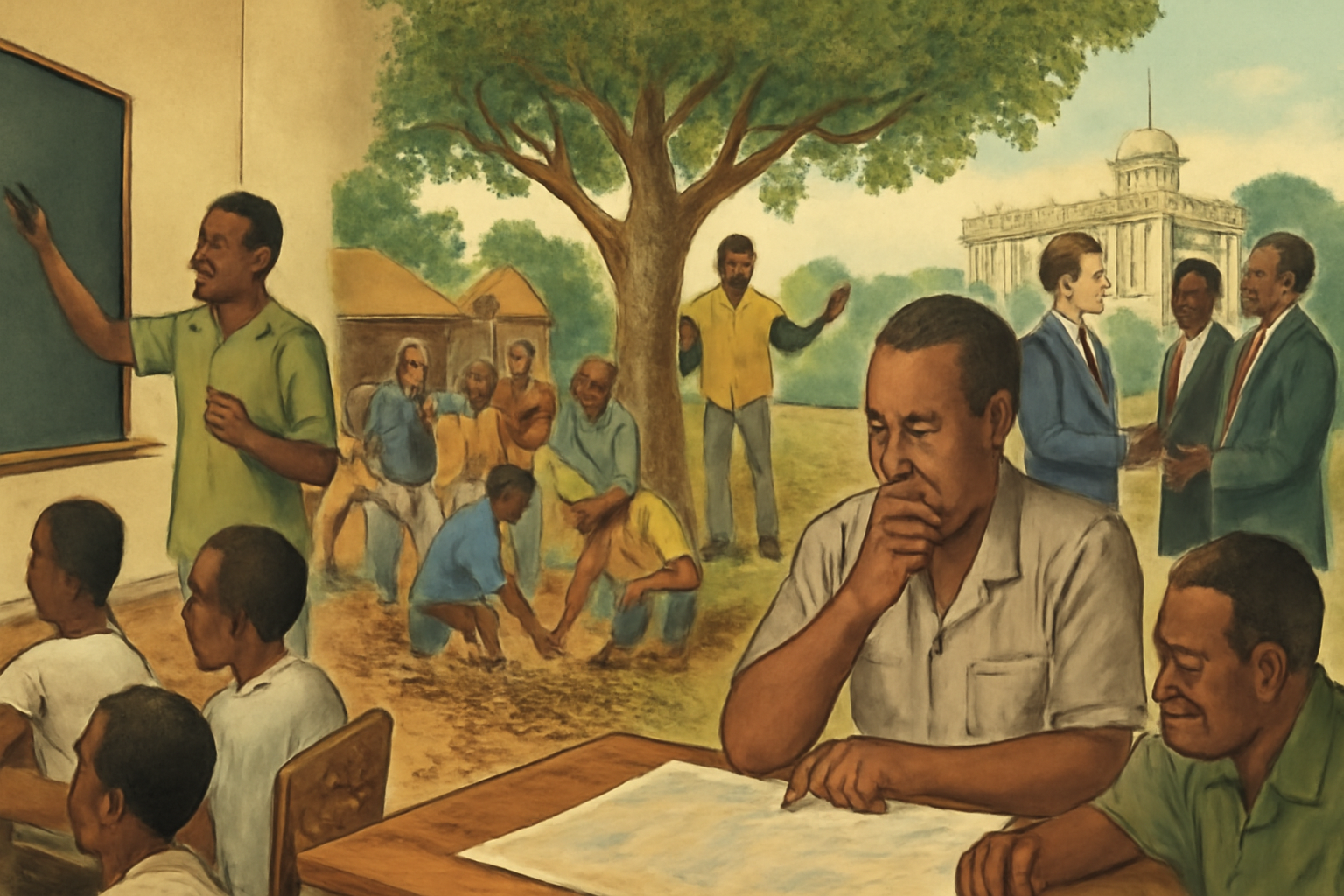
Tanzania’s Arusha Declaration emerged in a decade when many African nations were forging postcolonial identities and institutions. The new state faced an urgent set of pressures: a largely rural population, weak industrial bases, colonial patterns of land and capital ownership, and the political need to bind diverse communities to a single national project. Julius Nyerere and his ruling party sought answers in ideas that became known as African socialism or ujamaa. Those ideas rejected both unregulated capitalism associated with former colonial powers and the imported models of rapid industrialization championed elsewhere. Instead, the emphasis fell on self-reliance, cooperative forms of rural life, and state ownership of key resources as instruments of equality and legitimacy.
These were not neutral technical measures but political choices meant to transform relationships—between citizens and the state, between town and countryside, and between newly sovereign governments and the memory of colonial rule. The declaration did not invent those pressures, but it tried to order them into a coherent program. A richer Arusha page begins with the problem Nyerere was trying to solve: independence had changed the flag, but it had not automatically changed land, schools, health care, rural poverty, dependence on export crops, or bargaining power in the world economy. Tanzania's leaders faced the hard question of how a poor state could build legitimacy without simply copying either capitalist dependency or centralized industrial models from elsewhere.
Ujamaa was not only a slogan about villages. It drew on familyhood, anti-colonial dignity, moral discipline, public leadership, and the belief that development needed social trust rather than private accumulation alone. The Leadership Code mattered because it tried to make elite behavior part of development policy: leaders were expected to avoid using office for personal enrichment. The international layer also matters. Tanzania sat inside Cold War aid competition, liberation struggles in southern Africa, debates over nonalignment, and pressure from donors and export markets. Self-reliance sounded domestic, but it was also a strategy for surviving an unequal global economy.
The Turning Point
The Arusha Declaration was a turning point in tone and policy. Announced by Julius Nyerere in Arusha in 1967, it translated broad ideals into a public declaration of aims and responsibilities: the state would promote public ownership where appropriate, encourage cooperative rural development, and place equality and self-reliance at the center of national policy. Politically, it marked a move from merely asserting independence to prescribing how that independence should be used. Concrete actors—party leaders, civil servants, and local officials—were tasked with reshaping land use, production, and administration to fit ujamaa principles. The declaration created new expectations of state action and citizen obligation; it reframed development as a moral and political project, not only an economic one.
That reframing forced choices: which sectors to nationalize, how to mobilize rural populations, how to balance voluntary cooperation with directive planning. Those choices altered bureaucratic priorities and everyday governance, setting a distinct course for Tanzania’s postcolonial state. The turning point was the movement from national aspiration to state program. The declaration gave officials, party cadres, teachers, cooperative organizers, and local administrators a shared language for nationalization, rural development, and moral citizenship. It also made disagreement harder to treat as merely technical, because development now carried ideological meaning. Villagization later became the most visible test. In official language, cooperative villages promised services, solidarity, and planning.
In many local experiences, the process could involve pressure, disruption, resettlement, and conflict over whether participation was truly voluntary. That tension belongs at the center of the page because it separates the ideals of Arusha from the uneven practice of implementation.
Consequences
In the near term, the declaration became the ideological foundation for ujamaa policies and the government’s distinctive development path. It shaped legislation, administrative campaigns, and public rhetoric that prioritized cooperative villages, communal planning, and public ownership in strategic sectors. In the longer term, the Arusha Declaration left a complex legacy. It provided a language and a set of institutions through which Tanzanians debated state responsibility, social equality, and economic strategy. For some, ujamaa represented a genuine attempt to align national sovereignty with popular welfare; for others, it revealed limits in implementation, tensions with local custom, and trade-offs between central planning and grassroots agency.
The declaration also entered memory and historiography as a symbol—easy to reduce to a single dramatic date but richer when understood across time. Its consequences therefore include both policy outcomes and enduring questions about how newly independent states sought to convert the fact of sovereignty into meaningful social transformation. The declaration gave Tanzania a distinctive postcolonial identity. It shaped education, leadership ethics, nationalization, rural planning, and a public language of equality that many citizens still remember with seriousness. It also generated economic strains, administrative overreach, and debates over whether state direction could deliver prosperity at the scale promised. The longer legacy is not a simple failure or success.
Arusha remains a reference point for questions about corruption, social welfare, rural development, African socialism, donor dependency, and the moral purpose of the state. Readers can use the page to ask how newly independent countries turned sovereignty into policy, and why the results were so difficult to control.
Interpretation Notes
Arusha Declaration is easy to flatten into one dramatic date. A stronger reading separates immediate action from deeper causes, affected communities, and the memory later states or movements built around the event.
Why Keep Reading
Follow this thread to see how words on a declaration shaped lives on the ground: how cooperative villages were organized, how public ownership was administered, and how ordinary Tanzanians responded. Examining the policies that flowed from Arusha reveals not only administrative experiments but also clashes of expectation, adaptations by communities, and the later political debates that reinterpreted ujamaa in memory and policy. If you want to understand how postcolonial ideals were tested in practice, the next entries explore the practical rollout of village programs, the debates inside the ruling party, and the lived experience of rural and urban households. Read Arusha beside Ghana's independence, Bandung, African decolonization, the OAU, villagization debates, and later structural adjustment.
That path shows how postcolonial development moved between ideals, institutions, global pressure, and village-level experience.
Reading Path
Follow the story without losing the thread
Before This
- Nigerian Civil War Begins1967 CE
- Organization of African Unity FoundedMay 25, 1963
- Tanganyika Gains IndependenceDecember 9, 1961
After This
- Eritrea Becomes IndependentMay 24, 1993
- Rwandan GenocideApril-July 1994
Same Period
- Organization of African Unity FoundedMay 25, 1963
- Nigerian Civil War Begins1967 CE
- Eritrea Becomes IndependentMay 24, 1993
Wider Timeline
Mind Map
How to think about Arusha Declaration
rural majority
A largely rural population made rural development central to national strategy
Map Layer
Where this event sits geographically
Gold pins mark the approximate locations of published event pages. This is a schematic locator map, not a historical border map.
Coordinates are approximate and are used to help readers orient themselves before opening a full event page.
References
Where to Check the Facts
- Encyclopaedia Britannica: Julius NyerereReference for Nyerere's leadership and socialist policy direction.
- Encyclopaedia Britannica: Tanzania, political developmentReference for Tanzania's independence-era political development.
- Encyclopaedia Britannica: Arusha DeclarationReference for the 1967 declaration, Nyerere, African socialism, self-reliance, and policy direction.
- Encyclopaedia Britannica: ujamaaReference for ujamaa, villagization, socialist policy, and Tanzanian development debates.
- Julius Nyerere Resource: Arusha Declaration ten years afterPrimary public statement for the declaration's self-reliance language and later defense of its aims.