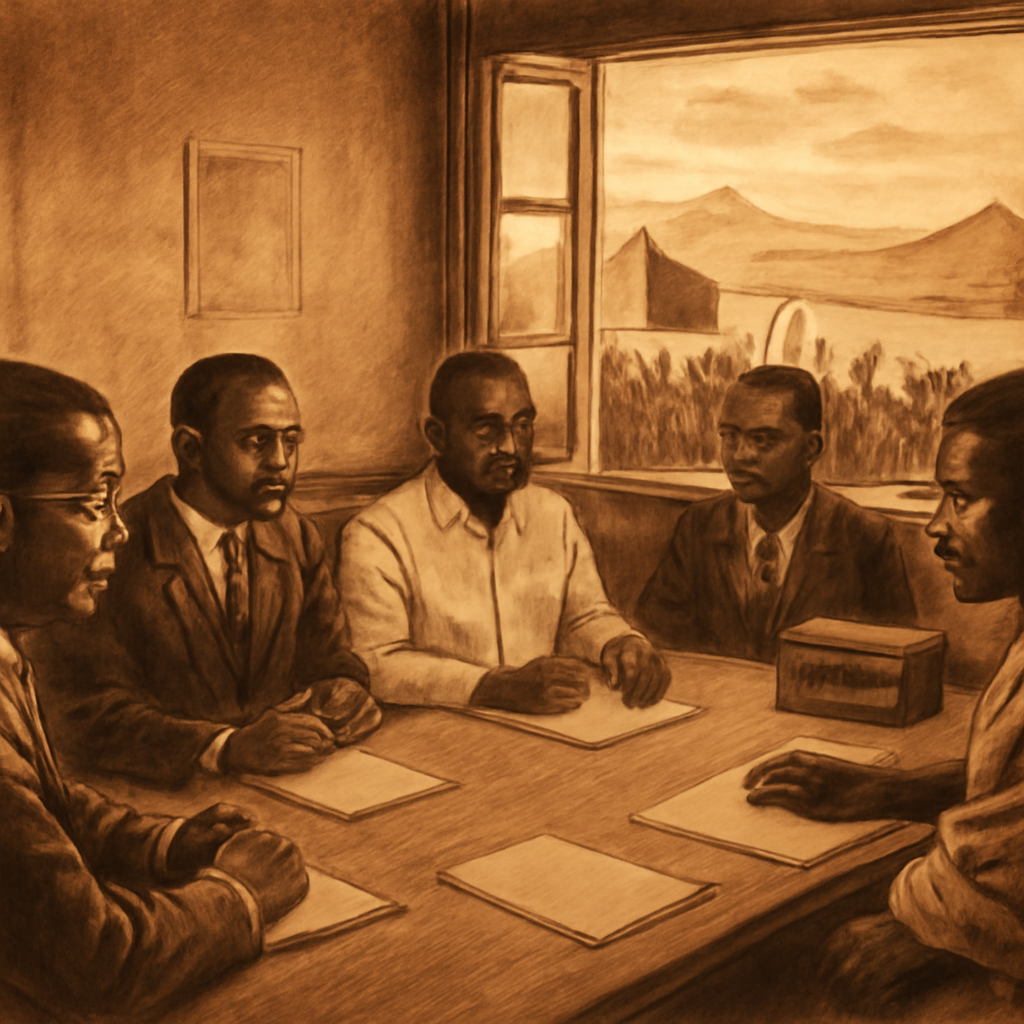
Central Question
How did African decolonization move from anti-colonial struggle to institutions, civil wars, apartheid resistance, genocide memory, and transitional justice?
Start With These Dates
- October 1945Fifth Pan-African Congress
The Fifth Pan-African Congress gathered activists who linked anti-colonial demands, labor politics, diaspora organizing, and future African independence movements.
- 1952 CEMau Mau Uprising Begins
The Mau Mau uprising began in British Kenya amid grievances over land dispossession, labor, political exclusion, emergency rule, and colonial violence.
- November 1954Algerian War Begins
The Algerian War began as the FLN launched an armed struggle against French rule, turning settler colonialism, nationalism, torture, and state violence into a global crisis.
- April 1955Bandung Conference
Asian and African leaders met at Bandung to discuss anti-colonial solidarity, racial equality, economic cooperation, sovereignty, and alternatives to Cold War bloc politics.
- 1967 CENigerian Civil War Begins
The Nigerian Civil War began after Biafra declared secession, turning ethnic violence, federal power, oil, famine, and postcolonial state survival into a brutal conflict.
- April-July 1994Rwandan Genocide
Extremist forces in Rwanda organized mass killing of Tutsi civilians and moderate Hutu during a rapid genocide that unfolded over roughly one hundred days.
- 1996 CESouth African Truth and Reconciliation Commission Hearings
South Africa's Truth and Reconciliation Commission held public hearings on apartheid-era abuses, linking testimony, amnesty, public memory, and democratic transition.
Sources Used Here
- Encyclopaedia Britannica: Algerian War
Reference for the 1954-1962 war for Algerian independence from France.
- Encyclopaedia Britannica: African Union
Reference for the Organization of African Unity, its 1963 founding, and the later African Union.
- Official African Union: OAU Charter
Official reference for the 1963 OAU Charter and the continental institution's founding framework.
- Official United Nations: Rwanda genocide historical background
Institutional reference for the 1994 genocide against the Tutsi in Rwanda and UN memory work.
- UNESCO: General History of Africa
African-history reference project for reading decolonization through African scholarship, regional diversity, culture, and postcolonial memory.
African Decolonization and Postcolonial States is designed as a route, not a folder. It gathers events that answer related reader questions about power, belief, conflict, exchange, institutions, and memory. The strongest way to read the page is to move from the earliest events toward the later ones, watching how one kind of pressure changes form across different places.
The route currently runs from October 1945 to 1996 CE. That span lets readers compare immediate turning points with slower consequences: the founding of institutions, the spread of ideas, the shock of war or disease, and the way later societies reused earlier events as warnings, models, or symbols.
Start with Fifth Pan-African Congress, Ghana Independence, Guinea Votes No to the French Community, Mau Mau Uprising Begins, Algerian War Begins and then follow the internal links into people, timelines, years, maps, and source lists. The route structure stays visible when each event explains why it belongs with the others and where the next useful page is.
Compare the events by scale. Some are concentrated moments, such as a battle, proclamation, trial, or publication. Others are long processes, such as a reform movement, pandemic, trade route, or diplomatic order. Reading both types together helps prevent the page from becoming a list of dates.
A useful route keeps uncertainty visible. Historical change rarely has one cause or one clean ending, so the reader can separate background pressure, immediate trigger, turning point, result, and later memory. That pattern is what makes the atlas expandable without making the reader start over each time.
This route is also a comparison tool. After reading one event, compare it with a later event on the same page and ask what changed in scale, language, geography, technology, authority, or public memory. The comparison is often more useful than the individual summary because it reveals the pattern the topic page is built to expose. When a claim feels too neat, open the full event page and check whether the evidence supports one cause, several causes, or a contested interpretation before moving on.
African decolonization is not one neat independence parade. This route links Pan-African organizing, rural rebellion, liberation war, diplomacy, crisis, civil war, apartheid resistance, genocide, and transitional justice. Ghana, Mau Mau, Algeria, Congo, OAU, Biafra, Angola, Soweto, Rwanda, and South Africa each ask a different question about what freedom meant after formal empire weakened.
The first tension is between sovereignty and capacity. Congo in 1960 and Nigeria in 1967 show that a flag and government did not automatically settle army loyalty, federal balance, mineral politics, ethnic security, borders, or foreign intervention. Angola shows another version of the problem, where liberation movements entered independence through Cold War patronage and armed rivalry.
The second tension is memory and justice. Soweto, apartheid's end, Rwanda, and South Africa's truth commission reveal that postcolonial history includes schools, language, race, testimony, mass violence, courts, public grief, and unresolved repair. The route is built so readers can move from anti-colonial victory to the harder question of what kind of state and society follows victory.
The route begins with Pan-Africanism because independence was imagined before it was achieved. Conferences, newspapers, students, trade unionists, exiles, soldiers, churches, and intellectual networks helped turn separate colonial grievances into a language of shared freedom. That language did not erase local differences, but it created a public vocabulary for sovereignty, racial equality, and continental dignity. Readers need that opening to understand why Ghana's independence felt larger than one national event.
Rural rebellion belongs beside constitutional nationalism. Mau Mau, Algeria, and other liberation struggles show that empire often rested on land seizure, forced labor, settler privilege, police power, and legal categories that peaceful petition could not easily undo. Armed struggle did not mean one thing everywhere. It could be guerrilla war, rural oath-taking, urban bombing, counterinsurgency, detention, torture, exile, and negotiations conducted under military pressure.
Ghana and Algeria make a useful contrast. Ghana's route foregrounds party organization, mass politics, constitutional negotiation, and the symbolic power of becoming independent in 1957. Algeria's route foregrounds settler colonialism, war, torture, migration, French domestic crisis, and the cost of sovereignty after a long military struggle. Reading them together keeps decolonization from becoming one model copied across a continent.
Congo shows how quickly sovereignty could be pulled apart by army mutiny, provincial secession, mineral wealth, foreign intervention, United Nations action, and Cold War suspicion. The page matters because it reveals a cruel gap between legal independence and effective control over territory, security, and resources. It also teaches readers to watch corporations, embassies, soldiers, and international institutions as actors in postcolonial state formation.
The Organization of African Unity gives the route an institutional layer. It promised solidarity, anti-colonial support, border stability, and collective voice, yet it also had to operate among states with different regimes, interests, capacities, and fears of secession. The OAU matters because decolonization was not only national. It required arguments over borders inherited from empire, diplomatic recognition, liberation movements, apartheid, and noninterference.
Biafra and Angola make postcolonial crisis impossible to ignore. Biafra raises questions about federalism, ethnic fear, oil, famine images, humanitarian politics, and the limits of state unity. Angola shows liberation movements entering independence through Cold War patronage, civil war, and external armies. These events do not cancel the achievements of decolonization; they show how difficult it was to make sovereignty secure under intense internal and external pressure.
Southern Africa gives the route a longer ending. Soweto, apartheid's end, and the Truth and Reconciliation Commission show students, townships, labor, international sanctions, armed struggle, negotiations, testimony, and public memory. Apartheid was a racial state inside a formally independent country, so its defeat belongs to decolonization even though its timeline differs from Ghana or Algeria. The route becomes clearer when readers treat liberation as a set of overlapping struggles.
Rwanda requires careful placement. It is not a simple consequence of decolonization, but colonial categories, postcolonial state power, regional war, propaganda, militia organization, international failure, and survivor testimony all belong in the wider history of states after empire. The route helps readers avoid both fatalism and oversimplification. Genocide was made through institutions, choices, fear, and organized violence, not through timeless hatred.
The source trail is explicit. Independence speeches show public ideals; colonial files show surveillance and repression; liberation songs and memoirs show movement culture; United Nations records show diplomacy; famine photographs show humanitarian politics; court records and testimony show violence and memory. Each source can illuminate one part of the route while hiding another. A careful reader asks who produced the record and for what audience.
Visuals for this hub connect institutions with people. A map of independence dates is useful, but not enough. The route also needs refugee movement, resource regions, liberation-war zones, apartheid townships, OAU diplomacy, and court or testimony settings. Good visual structure helps readers understand that decolonization was a continent-scale process lived through villages, mines, schools, borders, prisons, and negotiating rooms.
The final synthesis is that African decolonization was a struggle over the meaning of freedom after empire. Sometimes freedom meant a flag; sometimes land; sometimes school language; sometimes majority rule; sometimes protection from army violence; sometimes testimony after atrocity. The hub sends readers onward to specific event pages with that question in mind: which kind of freedom is being claimed, and which institution stands in the way?
The route also needs to distinguish settler colonialism from other imperial structures. Kenya, Algeria, Rhodesia, South Africa, and Portuguese Africa faced different versions of land seizure, racial law, labor coercion, and political exclusion than colonies governed mainly through indirect rule or commercial extraction. That difference helps explain why some struggles became especially violent and why land remained such a powerful postcolonial question.
Urban history matters too. Accra, Algiers, Leopoldville, Lagos, Luanda, Johannesburg, Soweto, and Kigali were not just backdrops for national politics. Cities concentrated schools, newspapers, unions, migrants, police, prisons, parties, rumors, and crowds. Decolonization often became visible in streets, stadiums, courts, townships, and administrative offices before it became a treaty or flag ceremony. The hub helps readers see those urban stages.
The Cold War belongs in the route, but it should not swallow African agency. Superpowers, former colonial states, Cuba, China, the United Nations, companies, and banks all shaped choices, yet African leaders, parties, soldiers, workers, students, religious figures, and local communities made their own calculations. A good reading path asks how external pressure changed options without turning African actors into puppets.
Economy and development give the postcolonial section its daily stakes. New states had to manage schools, roads, health systems, export crops, mines, currencies, debt, food prices, and expectations raised by liberation movements. The promise of freedom was often measured in jobs, land, safety, language, and dignity. This is why independence celebration and development frustration belong in the same route.
The hub's emotional structure is honest: hope, violence, institution-building, disappointment, repair, and unresolved struggle appear together. A reader can admire anti-colonial courage while also seeing why independence did not automatically create justice. That balance makes the route more credible and gives people a reason to continue into individual event pages rather than leaving with a slogan.
The route serves several reader questions at once without becoming scattered. A student asking what caused African decolonization needs empire, war, labor, racism, and nationalist organization. A reader asking what happened after independence needs armies, borders, resources, debt, Cold War pressure, schools, and memory. A visitor asking why apartheid or Rwanda belongs here needs the longer question of how postcolonial states handled race, citizenship, and violence.
The closing reading path is comparative. Start with Ghana for negotiated independence, Algeria for liberation war, Congo for state crisis, OAU for continental diplomacy, Angola for Cold War entanglement, Soweto for anti-apartheid youth politics, Rwanda for organized mass violence, and the TRC for testimony after state crime. That path turns a broad topic into a sequence of problems readers can actually follow.
That comparison also protects the page from a shallow continent-wide summary. Africa's decolonization was made in specific languages, regions, economies, prisons, farms, mines, churches, schools, parties, and families. The hub earns its scale only when it keeps those local settings visible while explaining the continental pattern.
African decolonization becomes more compelling when independence is treated as the start of harder questions, not the end of colonial history. Mau Mau, Algeria, Ghana, Guinea, Congo, the OAU, Biafra, Angola, Soweto, Rwanda, and South Africa's truth commission connect liberation, state-building, border inheritance, Cold War pressure, resource politics, memory, and repair.
The route needs both celebration and friction. Independence movements created new flags, governments, parties, schools, diplomatic claims, and development plans, but they also inherited extractive economies, colonial boundaries, regional inequalities, armies, settler violence, and external pressure. Nkrumah, Nyerere, Lumumba, Mandela, activists, students, soldiers, refugees, and survivors entered the postcolonial state from unequal positions.
Bandung and the OAU make African history global without removing local detail. New states spoke through conferences, UN votes, liberation committees, sanctions, and nonalignment, while local conflicts over land, ethnicity, labor, oil, language, and memory shaped what sovereignty meant in practice. The hub becomes richer when readers can follow both the diplomatic stage and the village, mine, prison, school, or hearing room.
Read the events in order first; the page is built to reveal change over time.
Ask which pressures existed before the visible turning point and which actors had room to choose.
Follow what changed afterward in institutions, borders, law, belief, or everyday life.
Notice which events became symbols and why later generations kept returning to them.
Compare constitutional nationalism, rural uprising, guerrilla war, diplomatic pressure, and mass protest as different liberation methods.
Ask how armies, borders, mineral wealth, federalism, and foreign intervention shaped new states after independence.
Use Rwanda and the South African TRC to follow truth, accountability, testimony, and public memory after violence.
Follow Pan-African organizing and the OAU to see how independence became a diplomatic and continental problem, not only a national one.
Watch how minerals, oil, inherited borders, secession fears, and foreign intervention shaped Congo, Biafra, and Angola.
Compare independence ceremonies, armed struggle, party formation, development planning, civil war, and truth commissions as connected stages.
Choose a Reading Path
Start With the Timeline
Use the related timeline first when you want a chronological route through the topic.
Start with October 1945: Fifth Pan-African CongressOpen a Person Page
Use people pages when the topic is easier to understand through leadership, resistance, reform, or memory.
Start with 1952 CE: Mau Mau Uprising BeginsUse Year Pages
Use year pages when you need a fast answer to what changed in a specific year.
Start with November 1954: Algerian War BeginsReturn to the Map
Use the map to keep geography visible while moving between events and regions.
Start with April 1955: Bandung ConferenceStart With Pan-Africanism
Use conferences, newspapers, students, and exiles to see how a shared language of anti-colonial freedom formed before independence.
Start with 1967 CE: Nigerian Civil War BeginsCompare Independence Paths
Read Ghana beside Algeria to compare constitutional nationalism, party organization, settler colonialism, and war.
Start with April-July 1994: Rwandan GenocideFollow State Crisis
Move through Congo, Biafra, and Angola when the question is how sovereignty met armies, resources, secession, and Cold War pressure.
Start with 1996 CE: South African Truth and Reconciliation Commission HearingsEnd With Justice
Use Soweto, Rwanda, apartheid's end, and the TRC to ask what repair, testimony, and public memory can and cannot do.
How the Story Builds
Begin with Fifth Pan-African Congress. The opening event usually shows the pressure that made the route necessary: a crisis of authority, an expanding exchange system, a new technology, a contested idea, or a conflict that older institutions could no longer contain.
Nigerian Civil War Begins works as a checkpoint because it lets readers ask what had become irreversible, which actors still had choices, and how the route changed scale between the opening event and the later consequences.
The later edge of the route includes Fall of Apartheid, Rwandan Genocide, and South African Truth and Reconciliation Commission Hearings. These pages help readers see what survived beyond the first shock: institutions, borders, laws, memories, technologies, movements, or arguments that kept shaping later history.
The route is easier to remember through people and places. Watch figures such as Kwame Nkrumah, Jomo Kenyatta, W. E. B. Du Bois, Ahmed Sekou Toure, and Guinean voters move through settings such as Manchester, Accra, Conakry, Kenya, and Algeria; that is where large structures become visible as choices, risks, costs, and memories.
Pan-African networks and Ghana's independence show freedom becoming a public language before it became a settled institutional reality.
Mau Mau and Algeria reveal land, settler rule, counterinsurgency, detention, diplomacy, and the high cost of armed liberation.
Congo, Biafra, and Angola show that armies, resources, borders, and foreign patrons could fracture new states.
The OAU stage turns liberation into institutional work over recognition, borders, noninterference, and anti-apartheid pressure.
Soweto, Rwanda, and the TRC ask how societies remember violence and whether public truth can support justice.
- Which event in African Decolonization and Postcolonial States feels like the true point of no return, and why might another reader choose a different event?
- What changes if the route is read from the perspective of ordinary people rather than rulers, armies, inventors, reformers, or institutions?
- Which consequence was immediate, and which consequence only became clear decades later?
- Where does the map change the interpretation by showing distance, borders, routes, ports, capitals, or frontiers?
- Why did some independence movements become wars while others became negotiated transfers?
- How did Cold War pressure change postcolonial state formation?
- What did Pan-African institutions promise that individual states could not solve alone?
- When does public memory help repair violence, and when does it hide unresolved power?
- How should readers compare a formal independence date with the longer struggle to control land, armies, schools, and resources?
- Which source types make ordinary Africans visible beside presidents, parties, armies, and diplomats?
- Why did independence leave some colonial structures intact?
- How did African states use international institutions while facing local crises of land, resources, and memory?
Interactive Timeline
Follow African Decolonization and Postcolonial States by sequence
Fifth Pan-African Congress
The Fifth Pan-African Congress gathered activists who linked anti-colonial demands, labor politics, diaspora organizing, and future African independence movements.
Read the full event pageMap Layer
African Decolonization and Postcolonial States geography
Gold pins mark the approximate locations of published event pages. This is a schematic locator map, not a historical border map.
Coordinates are approximate and are used to help readers orient themselves before opening a full event page.
Route Events
Events in This Topic
Fifth Pan-African Congress
The Fifth Pan-African Congress gathered activists who linked anti-colonial demands, labor politics, diaspora organizing, and future African independence movements.
Mau Mau Uprising Begins
The Mau Mau uprising began in British Kenya amid grievances over land dispossession, labor, political exclusion, emergency rule, and colonial violence.
Algerian War Begins
The Algerian War began as the FLN launched an armed struggle against French rule, turning settler colonialism, nationalism, torture, and state violence into a global crisis.
Bandung Conference
Asian and African leaders met at Bandung to discuss anti-colonial solidarity, racial equality, economic cooperation, sovereignty, and alternatives to Cold War bloc politics.
Ghana Independence
Ghana became independent from British colonial rule, with Kwame Nkrumah framing the new state as part of a broader African liberation project.
Guinea Votes No to the French Community
Guinea rejected continued membership in the French Community and chose immediate independence, making Francophone West African decolonization visible as a public vote rather than a uniform handover.
Congo Independence and Crisis
Congo's independence from Belgium quickly became a crisis involving army mutiny, Katanga secession, Cold War pressure, UN intervention, and Lumumba's removal.
Organization of African Unity Founded
Independent African states founded the Organization of African Unity to support sovereignty, anti-colonial struggle, cooperation, and continental diplomacy.
Nigerian Civil War Begins
The Nigerian Civil War began after Biafra declared secession, turning ethnic violence, federal power, oil, famine, and postcolonial state survival into a brutal conflict.
Angola Gains Independence
Angola became independent from Portugal after the Carnation Revolution, but liberation movements and Cold War patrons quickly pushed the country into civil war.
Mozambique Gains Independence
Mozambique became independent from Portugal after years of FRELIMO guerrilla struggle and the Carnation Revolution in Lisbon changed the political ground of the Portuguese empire.
Soweto Uprising
Students in Soweto protested apartheid education policy and the use of Afrikaans in schools, triggering state violence and a wider crisis of legitimacy.
Nelson Mandela Released
Nelson Mandela was released from prison after twenty-seven years, signaling a new phase in negotiations to end apartheid in South Africa.
Eritrea Becomes Independent
After a long war linked to Ethiopian imperial and military rule, Eritreans voted overwhelmingly for independence in a UN-observed referendum.
Fall of Apartheid
South Africa held its first fully democratic elections, ending apartheid rule and bringing Nelson Mandela to the presidency.
Rwandan Genocide
Extremist forces in Rwanda organized mass killing of Tutsi civilians and moderate Hutu during a rapid genocide that unfolded over roughly one hundred days.
South African Truth and Reconciliation Commission Hearings
South Africa's Truth and Reconciliation Commission held public hearings on apartheid-era abuses, linking testimony, amnesty, public memory, and democratic transition.
References
Where to Check the Facts
- Encyclopaedia Britannica: Algerian WarReference for the 1954-1962 war for Algerian independence from France.
- Encyclopaedia Britannica: African UnionReference for the Organization of African Unity, its 1963 founding, and the later African Union.
- Official African Union: OAU CharterOfficial reference for the 1963 OAU Charter and the continental institution's founding framework.
- Official United Nations: Rwanda genocide historical backgroundInstitutional reference for the 1994 genocide against the Tutsi in Rwanda and UN memory work.
- UNESCO: General History of AfricaAfrican-history reference project for reading decolonization through African scholarship, regional diversity, culture, and postcolonial memory.
- South African History Online: Liberation HistoryAfrican public-history reference for apartheid, liberation movements, township politics, memory, and South African transition.