Ask how plantations, ports, ships, and laws converted violence into profit.
Timeline
Atlantic Slavery and Abolition Timeline
A route through Atlantic forts, forced migration, resistance, legal cases, Haiti, abolition laws, emancipation, Brazil, and international anti-slavery law.
Timeline Guide
How did forced migration, plantation power, Black resistance, abolition law, and contested freedom reshape the Atlantic world?
Read this edited guide as a path through dates, places, affected lives, source limits, and contested memory rather than as an exhaustive database.
Content advisory and age guidance: this timeline discusses kidnapping, racial slavery, shipboard death, family separation, sexual and plantation violence, legal coercion, and resistance. It is written for secondary-school readers and older learners; younger readers need adults to scaffold the hardest material.
Begin with two short quotations and a clear boundary. Equiano's 1789 narrative includes the line "the last friend, death," and Douglass's 1852 speech asks, "What, to the American slave, is your Fourth of July?" Those are direct quotations from named abolitionist texts; Tubman's rescue work is described through historical paraphrase rather than quoted speech here.
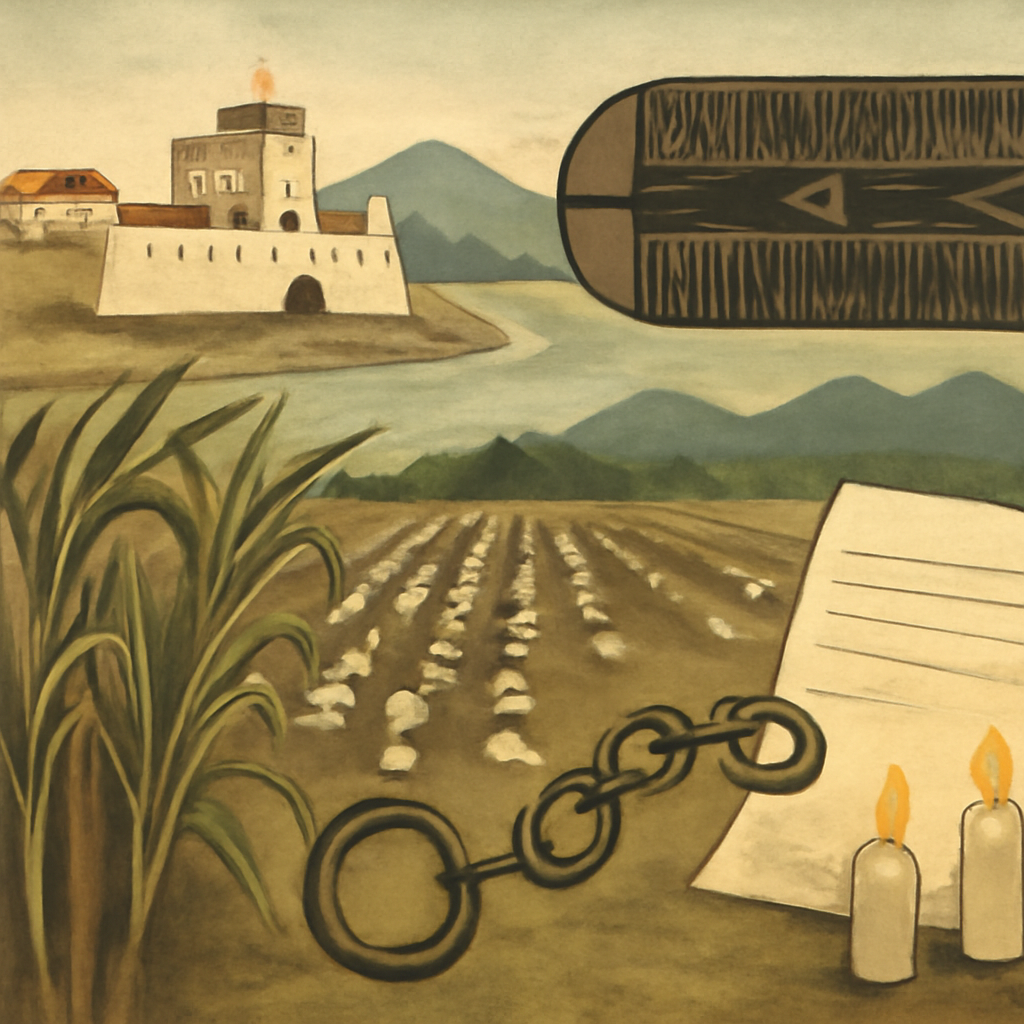
Before the map opens, picture specific places: a person pushed toward an African coast, a family broken by sale, a ship hold where sickness and fear spread, a rice field in South Carolina, a courtroom where captives insisted they were not property, and a Brazilian household facing freedom without land or repair.
Start with dates the reader can hold, but keep each date local. 1482: Elmina Castle anchors Portuguese presence on the Gold Coast. c. 1500: forced Atlantic movement expands through several African coastal zones and European empires. 1739: Stono reveals armed resistance in British South Carolina rice country. 1772: Somerset tests slavery in English law. 1781: Zong turns murder into a British insurance dispute tied to Jamaica. 1791: Saint-Domingue becomes revolution in the French Caribbean. 1807: Britain abolishes the trade across its empire. 1848: France abolishes slavery in its colonies. 1865: the United States ratifies the Thirteenth Amendment after civil war. 1886: Cuba ends legal slavery in the Spanish Caribbean. 1888: Brazil ends legal slavery in the last major slaveholding society in the Americas. 1926: League of Nations treaty language widens the story into international anti-slavery law.
Start With These Dates
- 1482Elmina Castle Established
Portuguese traders established Elmina Castle on the Gold Coast, linking West African commerce to expanding Atlantic routes.
- 1492 onwardColumbian Exchange Begins
After sustained transatlantic contact, plants, animals, pathogens, people, and forced labor systems moved across the Atlantic with world-changing consequences.
- 16th centuryAtlantic Slave Trade Expands
The Atlantic slave trade expanded as European colonial demand, coastal trade networks, African political conflicts, and plantation economies became violently connected.
- 1713Asiento System Expands
The asiento system contracted the supply of enslaved Africans to Spanish America, showing how European diplomacy and commerce organized forced migration.
- 1848France Abolishes Colonial Slavery
The French Second Republic abolished slavery in French colonies and possessions, making emancipation part of the revolutionary upheaval of 1848.
- June 16, 1976Soweto Uprising
Students in Soweto protested apartheid education policy and the use of Afrikaans in schools, triggering state violence and a wider crisis of legitimacy.
- April-July 1994Rwandan Genocide
Extremist forces in Rwanda organized mass killing of Tutsi civilians and moderate Hutu during a rapid genocide that unfolded over roughly one hundred days.
- 1996 CESouth African Truth and Reconciliation Commission Hearings
South Africa's Truth and Reconciliation Commission held public hearings on apartheid-era abuses, linking testimony, amnesty, public memory, and democratic transition.
Sources Used Here
- Encyclopaedia Britannica: Transatlantic slave trade
Reference for the forced migration system, Atlantic routes, and slavery's global consequences.
- Gilder Lehrman Institute: Olaudah Equiano, 1789
Primary-source teaching reference for Equiano's abolitionist narrative and remembered Middle Passage experience.
- Official database: Slave Voyages
Reference database for transatlantic slave trade routes, voyages, forced migration, and estimates.
- The National Archives: British transatlantic slave trade records
Official research guide reference for British slave-trade records and digitised legislation including the Abolition of the Slave Trade Act 1807 and Slavery Abolition Act 1833.
- Official archive: Emancipation Proclamation
Reference for the United States Emancipation Proclamation and its legal setting.
The first scenes are concrete: an Atlantic fort, a kidnapped person marched toward the coast, a ship hold, a plantation ledger, the Zong case turned into insurance language, a Haitian insurgent, and a freed family still facing racial law. Historians describe Atlantic slavery as forced labor, property law, racial hierarchy, and organized violence against people.
African-side nuance matters. Elmina, Kongo and Angola routes, Bonny, Whydah, the Bight of Benin, the Gold Coast, inland wars, kidnapping, debt, diplomacy, coastal brokers, rulers, merchants, and victimized communities do not form one single story. Portuguese, Spanish, British, French, Dutch, Caribbean, Cuban, Brazilian, and North American systems also differed in law, crop regimes, emancipation timing, and racial afterlife.
African political actors appear in different positions. Some Kongo, Dahomey, Asante, Bonny, Whydah, and Luanda-linked rulers or brokers mediated trade, some communities resisted raids or fled, some captives came from wars they did not choose, and some coastal societies were reshaped by European and American plantation demand. Naming raiders, brokers, states, merchants, and victim communities separately prevents a false sentence in which Africa acts as one person.
European empires entered the trade differently. Portuguese forts and Angola routes mattered early; Spanish America used contracts such as the asiento; Dutch merchants and colonies tied finance, shipping, Caribbean plantations, and Guiana/Suriname labor regimes into the system; British ships and colonies later became central to both slave trading and abolition politics. These differences do not soften the shared violence. They make the map more accurate.
A single Atlantic timeline has limits. It can connect forts, ships, plantations, courts, revolts, and abolition laws, but it cannot make Senegambia, Kongo, Angola, Jamaica, Saint-Domingue, Cuba, Brazil, Suriname, Charleston, London, Paris, and Lisbon feel the same. Regional variation is part of the argument, not extra detail.
Debate belongs in the open without becoming an excuse. Historians disagree over how to weigh African political participation, European and American plantation demand, capitalist profit, law, religion, shipboard resistance, and enslaved people's own action. A stronger reading holds those questions together: African polities had histories and choices, Atlantic demand drove scale and profit, and Black resistance made slavery harder to govern.
Source anchors stay close to the biggest claims. When the page names roughly 12.5 million Africans forced aboard transatlantic slave ships and about 10.7 million surviving to disembarkation, that claim comes from Slave Voyages and related database work. The National Archives anchors the U.S. importation ban, Emancipation Proclamation, and Thirteenth Amendment; Legifrance anchors France's 1848 abolition decree; Yale's Cuban slavery collection anchors Cuba's 1886 abolition date; official treaty records anchor the 1926 Slavery Convention; Britannica and national reference sources help check Britain and Brazil.
Start in the hold of a ship and in the court papers that tried to make murder sound commercial. The Zong case, Equiano's printed testimony, Stono, Haiti, Amistad, emancipation, Brazil, and the Slavery Convention show how forced migration connected African societies, European empires, American plantations, maritime finance, racial law, and modern human-rights language.
The opening chapter follows institutions of violence. Forts, ships, contracts, insurance, plantations, and colonial law turned human beings into property and labor power. That structure matters because it explains both the scale of the system and the difficulty of ending it. The Atlantic slave trade was not only cruelty; it was cruelty organized through commerce, law, and empire.
Resistance runs through the whole route. Enslaved people resisted through revolt, escape, shipboard rebellion, legal claims, religion, family, maroon communities, and revolution. Stono, Haiti, Amistad, and countless less famous acts prevent abolition from becoming a story of benevolent legislators alone. Freedom was forced onto the political agenda by people inside the system.
Abolition appears as a sequence of partial victories. Britain ended the slave trade before slavery; the United States banned importation while domestic slavery expanded; Haiti made emancipation revolutionary; Brazil abolished slavery late; international conventions later turned slavery into a treaty problem. Each step changed the law while leaving other forms of coercion and inequality in place.
The route closes by linking past and afterlife. Diaspora memory, civil rights, decolonization, reparations debates, and modern anti-trafficking language all inherit parts of this history. A timeline that ends at abolition misses the long struggle over what freedom actually meant.
The geography of the route makes the violence legible. West and West-Central African societies, coastal forts, Atlantic ships, Caribbean plantations, North American law, Brazilian mining and agriculture, British Parliament, United States courts, and international conventions all appear because the system operated through connected places. No single port or legislature can explain the whole structure.
The reader path also separates legal change from lived change. Ending a trade did not restore families; ending slavery did not guarantee land, wages, safety, citizenship, or political power. That distinction is the reason the timeline links rebellion, court cases, emancipation, abolition, civil rights, decolonization, and human-rights language instead of stopping at one heroic date.
For readers, the most important habit is to ask who is speaking in each source. A shipping ledger, an abolitionist pamphlet, a court transcript, a plantation record, and a survivor's memory reveal different parts of the system. Reading them together keeps the page from sounding like a detached economic summary.
Start with named lives as well as systems. Olaudah Equiano's published account, the Haitian revolutionary leadership of Toussaint Louverture, maroon communities in Jamaica, and Harriet Tubman's later rescue work all show that Atlantic slavery was lived, resisted, narrated, and remembered by people who refused the categories imposed on them. The route uses those names as entry points, not as substitutes for millions whose names were not preserved.
Begin with lives, then move into ledgers, ports, and law. That order matters because Atlantic slavery produced records that can make violence look administrative. Equiano, Zong case papers, Haitian revolutionary memory, and voyage data have to sit beside one another so no single archive gets to control the story.
This route treats Atlantic slavery as a governing structure of the modern world. It included African political disruption, coastal forts, forced marches, ships, insurance, credit, plantation discipline, legal categories, racial ideology, naval patrols, abolitionist networks, and survivor memory. The timeline becomes more legible when Elmina, slave voyages, Haiti, British law, United States emancipation, Brazil, and international conventions appear as connected parts of one structure.
The scale must be named with caution. Slave Voyages and related database work estimate that roughly 12.5 million Africans were forced aboard transatlantic slave ships and about 10.7 million survived the Middle Passage to disembarkation. Those numbers are estimates built from incomplete shipping records, port data, and archival recovery, so the page treats them as a sober range rather than as a final count of suffering.
The Atlantic was not one uniform slavery zone. Caribbean plantations, Brazilian mining and sugar, North American plantation slavery, Spanish American legal categories, and African coastal politics each created different patterns of labor, mortality, resistance, family life, and emancipation. A serious timeline keeps those differences visible while still showing the oceanic system that tied ports, credit, ships, law, and plantations together.
Regional difference changes the reading path. In the Caribbean, sugar plantations often created brutal mortality and a constant demand for new forced labor. In Brazil, slavery stretched across sugar, mining, ports, households, and later coffee. In the United States, a legally protected domestic slave trade expanded even after transatlantic importation ended. In Spanish America, slavery mixed with caste law, urban work, manumission practices, and regional variation. One Atlantic system produced several local regimes.
A few human cases can carry the reader through the structure. Equiano's narrative shows how memory, print, and abolition politics made an enslaved life speak into public debate. The Zong massacre shows how insurance and law could expose the commercial logic of murder. The Amistad case shows captives using courtroom procedure against the trade that had trapped them. Haiti shows enslaved and formerly enslaved people turning resistance into revolution and state formation.
The dated spine stays visible. Elmina shows fifteenth-century Portuguese presence on the West African coast; the asiento shows imperial contract and monopoly; the eighteenth-century voyage database shows the system at scale; Stono, Zong, Haiti, British abolition, Amistad, the U.S. Civil War, the Thirteenth Amendment, Brazilian abolition, and the 1926 Slavery Convention show that resistance and law moved in stages rather than in one clean moral awakening.
African contexts belong inside the explanation. African states, merchants, captives' home societies, wars, diplomacy, debt, and coastal brokerage shaped the trade before captives reached Atlantic ships. That does not spread responsibility evenly or soften European and American demand; it prevents a false two-part map in which Europe acts and Africa only receives harm. Indigenous displacement in the Americas also sits beside plantation expansion because land seizure and coerced labor often reinforced each other.
Ports and polities make the African side legible. Elmina, Bonny, Whydah, Luanda, Kongo, Dahomey, Asante, and many smaller coastal and inland communities entered the trade from different positions. Some rulers and brokers profited, many captives were seized through war or raiding, and European and American plantation demand kept the oceanic system profitable. That complexity matters because it gives Africa political history without dissolving responsibility for Atlantic slavery into vague shared guilt.
African slavery and the Atlantic slave trade also need separation. Many African societies had systems of dependency, captivity, pawnship, domestic slavery, military slavery, and incorporation before Atlantic demand expanded. The oceanic trade changed scale, incentives, violence, gender ratios, export logic, and racialized inheritance in the Americas. West Central Africa, the Bight of Benin, the Bight of Biafra, the Gold Coast, and Senegambia did not experience that pressure in one identical way.
Violence had institutions. A fort was not only a building; it was a node in trade, diplomacy, confinement, accounting, and empire. A ship was not only transport; it was a mobile prison and commercial instrument. A plantation was not only a farm; it was a labor regime backed by law, punishment, debt, and race. These details keep the page from flattening slavery into an abstract moral category.
Primary voices must be used carefully because no single survivor can stand for everyone. Equiano's 1789 narrative gives one remembered account of kidnapping, sale, shipboard terror, and public argument in print. Royal Museums Greenwich preserves Zong case documents that show murder entering court language as an insurance dispute. Reading those voices beside database estimates keeps the page from becoming either only testimony or only numbers.
A few dated voices sharpen the chronology. In 1789 Equiano remembered wishing for "the last friend, death" during the Middle Passage. In 1783 Granville Sharp's papers around the Zong case helped turn a shipboard killing into abolitionist evidence. In Saint-Domingue, enslaved insurgents and free people of color forced French revolutionary language to face its exclusions. These voices do not soften the system; they make its paperwork answer to human experience.
Resistance runs through every chapter. Revolt, escape, slowdowns, family preservation, religion, maroon communities, shipboard rebellion, legal testimony, literacy, petitioning, and revolution all changed the political field. The route gives Stono, Haiti, Amistad, and emancipation law their own places because freedom was not handed down by legislators alone. Enslaved and formerly enslaved people made slavery harder to govern.
Abolition was uneven because the system had many parts. Ending the British slave trade did not end slavery across the empire. Ending United States importation did not end domestic sale. Emancipation in law did not guarantee land, wages, safety, citizenship, voting rights, or protection from new forms of coercion. Brazil's late abolition and international anti-slavery law show how long the legal afterlife remained.
The diaspora frame gives readers a way to follow consequences after abolition. Families were separated and remade across the Atlantic; religion, music, language, foodways, political thought, and memory crossed violent routes. Later civil rights, decolonization, anti-apartheid, genocide memory, and reparations debates draw from this history without being reducible to it. The route keeps slavery's afterlife visible without turning every later rights struggle into the same story.
Source awareness matters sharply here. Shipping databases, court records, abolitionist pamphlets, government archives, plantation documents, newspaper reports, and family memory do not speak from the same position. Some records were produced by the system that harmed people. Others were produced by reformers, officials, courts, or descendants. A trustworthy page lets readers feel those differences rather than smoothing them away.
For a quick route, follow Elmina, transatlantic voyages, Stono, Zong, Haiti, British abolition, Amistad, the Civil War, emancipation, the Thirteenth Amendment, Brazil, and the Slavery Convention. For a deeper route, add the asiento, United States importation law, Pan-African Congress, civil rights, Soweto, Rwanda, the TRC, Bandung, and the United Nations to see how slavery entered later global rights language.
The story is strongest when read in layers. First, follow the dates from 1482 to 1996 CE. Then read across the event types: fortified trading post, biological and commercial exchange, forced migration system, trade contract. The timeline becomes more than chronology when those dates reveal decisions, institutions, violence, reform, and memory.
France Abolishes Colonial Slavery sits near the middle of the sequence. Ask what had already become unavoidable by 1848, what actors still believed they could control, and which consequences were already beginning to move beyond the original setting.
The named events are Elmina Castle Established, Columbian Exchange Begins, Atlantic Slave Trade Expands, Asiento System Expands, Stono Rebellion, Somerset Case. Each one pushes a more precise question: what changed, who benefited, who paid the cost, and what later page explains the aftermath more clearly?
Read the timeline against geography too. Places matter because power moves through corridors, borders, cities, ports, capitals, and frontiers. The map below keeps those distances visible while the event pages explain the human and institutional consequences.
A good timeline has a pulse: pressure, decision, expansion, resistance, and aftermath. When you move through Atlantic World, Early Modern Atlantic, Early Modern Atlantic World, and Atlantic Slavery, keep asking whether an event is creating a new problem, revealing a hidden weakness, or making an earlier choice harder to reverse.
The human layer matters because timelines can become too abstract. Figures such as Portuguese traders, Akan coastal communities, Indigenous communities, Atlantic colonizers, African captives, European traders, and African political elites help the sequence feel lived rather than mechanical. Their choices do not explain everything, but they show where institutions, ideas, military systems, social movements, and public fear entered real decisions.
The ending is not only the last date. With closing events such as Civil Rights Act of 1964, Soweto Uprising, Rwandan Genocide, and South African Truth and Reconciliation Commission Hearings, the reader can ask what remained unsettled: which institutions survived, which arguments continued, which victims or opponents were left outside the official story, and which later crisis reused the same vocabulary.
Read this page once quickly for order, then read it again for contrast. Compare early confidence with later uncertainty, local decisions with global consequences, and visible turning points with slower changes in law, economy, belief, technology, borders, or memory. That second pass is where a timeline becomes an explanation.
Causation in this sequence is layered. One event may supply the trigger, another may reveal an older weakness, and a later event may show the consequence that people at the beginning did not expect. The useful habit is to separate background pressure, immediate decision, turning point, and aftermath before deciding which event matters most.
Consequences are uneven. A political settlement might look successful in one capital while creating resentment elsewhere; a military victory might end a campaign while deepening civilian trauma; a scientific or institutional breakthrough might solve one problem while creating new risks. The timeline is strongest when those mixed outcomes remain visible.
The final pass is comparative. After reading this sequence, open a neighboring topic or person page and ask whether the same pattern appears again. Repetition usually points to a structure; contrast usually points to a historical choice that could have gone another way.
Importance is not the same thing as drama. Some events are remembered because they were spectacular, while others matter because they changed rules, expectations, alliances, legal categories, technologies, or public language. Use the timeline to test both kinds of importance before deciding what belongs at the center of the story.
The page rewards moving outward. A timeline gives order, but the event pages give causes, maps, people, sources, and reading paths. When a date feels too compressed, open the full event page and then return here; the sequence becomes clearer with each pass instead of asking the reader to memorize a list.
Compare rebellion, revolution, court cases, and political campaigning.
Track the difference between ending trade, ending slavery, and making freedom livable.
Use later rights and human-rights pages to follow slavery's afterlife.
Follow forts, ship holds, ledgers, insurance, plantation rules, courts, patrols, and treaties as the infrastructure of slavery.
Separate the end of the trade, the end of legal slavery, citizenship, land access, voting rights, and repair in public memory.
Start with forced migration, move through resistance and abolition law, then read civil rights and human-rights pages as afterlife.
Elmina Castle Established gives the opening problem a date and place. Ask what was already unstable before it happened.
France Abolishes Colonial Slavery is a compression point: earlier causes are now crowded together with decisions that will shape the sequence's ending.
Follow the path through Elmina, Atlantic World, Atlantic Africa, Spanish Atlantic, South Carolina, and London and ask how distance changed communication, logistics, fear, and control.
South African Truth and Reconciliation Commission Hearings works as both an ending and a beginning: it closes one sequence while opening later disputes, institutions, memories, or reforms.
Which conditions existed before the first event, and which later decision turned those conditions into visible historical change?
Who had the power to choose, who had fewer choices, and who is missing when the story is told only through leaders or institutions?
Which facts are date anchors, which are interpretations, and which claims need checking through the event sources before being repeated?
Which linked event, person, year, or topic page would change your interpretation if you read it next?
Interactive Timeline
Explore Atlantic Slavery and Abolition Timeline by sequence
Elmina Castle Established
Portuguese traders established Elmina Castle on the Gold Coast, linking West African commerce to expanding Atlantic paths.
Read the full event pageNarrative Stages
Read this timeline in chapters
Forts, Voyages, and Atlantic Expansion
Elmina, the Columbian Exchange, slave voyages, and the asiento show how forced migration became tied to ports, ships, contracts, plantations, and empire.
- Elmina Castle Established1482
- Columbian Exchange Begins1492 onward
- Atlantic Slave Trade Expands16th century
- Asiento System Expands1713
Resistance and Revolutionary Freedom
Stono, Somerset, Zong, Haiti, and Haitian revolutionary struggle show Black resistance, legal pressure, public scandal, and revolution changing the political field.
- Stono Rebellion1739
- Somerset Case1772
- Zong Massacre1781
- Haitian Revolution Begins1791 CE
- Haitian Revolution Begins1791 CE
Abolition Law and Emancipation
British and United States laws, Amistad, civil war, emancipation, the Thirteenth Amendment, and Brazil show abolition as a long sequence of partial legal changes.
International Law and Rights Afterlife
The Slavery Convention, Pan-African Congress, civil rights, Bandung, and the UN connect abolition to global rights language and diaspora politics.
- League of Nations Slavery Convention1926
- Fifth Pan-African CongressOctober 1945
- Civil Rights Act of 1964July 2, 1964
- Bandung ConferenceApril 1955
- United Nations FoundedOctober 24, 1945
Memory, Apartheid, and Mass Violence
Soweto, Rwanda, and the TRC place slavery's afterlife beside anti-apartheid struggle, genocide memory, testimony, and repair.
- Soweto UprisingJune 16, 1976
- Rwandan GenocideApril-July 1994
- South African Truth and Reconciliation Commission Hearings1996 CE
Map Layer
Atlantic Slavery and Abolition Timeline geography
Gold pins mark the approximate locations of published event pages. This is a schematic locator map, not a historical border map.
Event location Simplified land areaClick a pin to open the event page
Coordinates are approximate and are used to help readers orient themselves before opening a full event page.
References
Where to Check the Facts
- Encyclopaedia Britannica: Transatlantic slave tradeReference for the forced migration system, Atlantic paths, and slavery's global consequences.
- Gilder Lehrman Institute: Olaudah Equiano, 1789Primary-source teaching reference for Equiano's abolitionist narrative and remembered Middle Passage experience.
- Official database: Slave VoyagesReference database for transatlantic slave trade paths, voyages, forced migration, and estimates.
- The National Archives: British transatlantic slave trade recordsOfficial research guide reference for British slave-trade records and digitised legislation including the Abolition of the Slave Trade Act 1807 and Slavery Abolition Act 1833.
- Official archive: Emancipation ProclamationReference for the United States Emancipation Proclamation and its legal setting.
- Legifrance: French abolition decree, 1848Official legal reference for the 1848 abolition of slavery in French colonies and possessions.
- Gilder Lehrman Institute: Frederick Douglass, 1852Primary-source teaching reference for Douglass's abolitionist Fourth of July address.
- Yale Archives: Cuban slavery collectionArchival reference for Cuban slavery and the 1886 abolition date.
- Encyclopaedia Britannica: William WilberforceBiographical reference for Wilberforce, parliamentary abolitionism, the 1807 slave-trade abolition, and the 1833 slavery abolition act.
- Encyclopaedia Britannica: Slavery Abolition ActReference for British abolition of slavery in much of the empire.