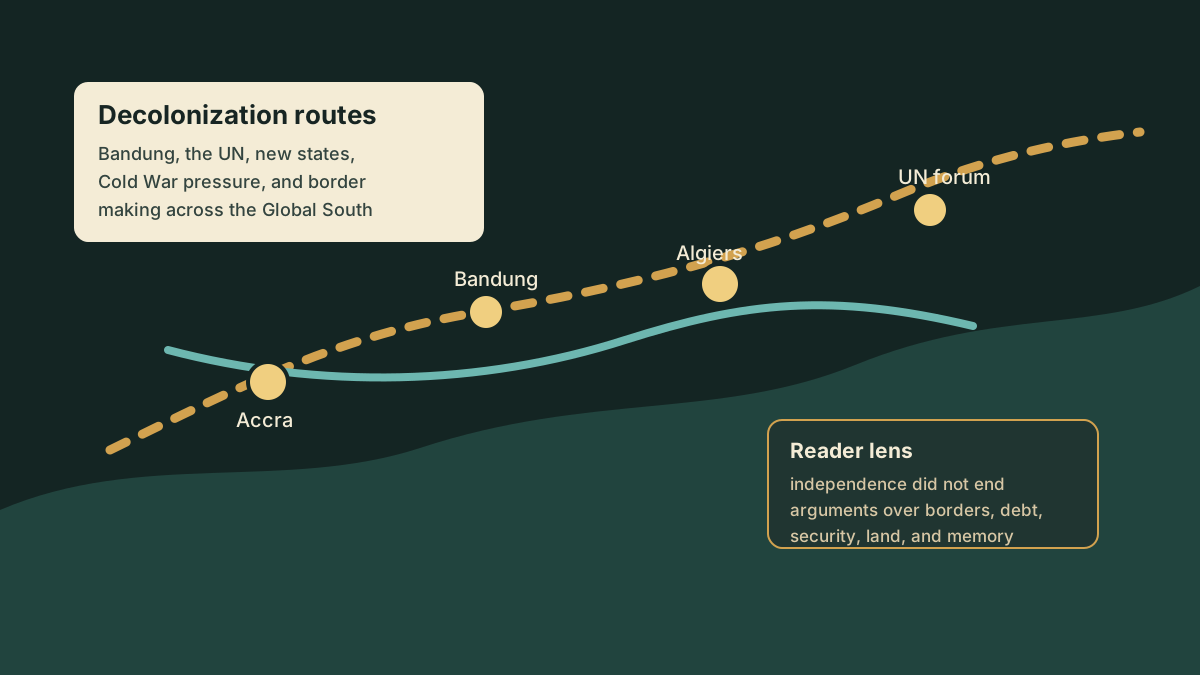
Central Question
How did anti-colonial movements, Cold War pressures, Afro-Asian diplomacy, civil wars, and human-rights debates create the political language of the Global South?
Start With These Dates
- 1791 CEHaitian Revolution Begins
The Haitian Revolution began as enslaved people and free people of color challenged plantation slavery, French colonial power, and racial hierarchy in Saint-Domingue.
- 1857-1858 CEIndian Rebellion of 1857
Soldiers and civilians across parts of north India rose against East India Company rule, producing a major rebellion that transformed British governance of India.
- 1896-1898 CEPhilippine Revolution
The Philippine Revolution challenged Spanish colonial rule through nationalist organization, armed revolt, reformist memory, and competing visions of independence.
- August 17, 1945Indonesia Proclaims Independence
Sukarno and Mohammad Hatta proclaimed Indonesian independence after Japan's surrender, opening a revolutionary struggle against the return of Dutch colonial rule.
- March 6, 1957Ghana Independence
Ghana became independent from British colonial rule, with Kwame Nkrumah framing the new state as part of a broader African liberation project.
- May 24, 1993Eritrea Becomes Independent
After a long war linked to Ethiopian imperial and military rule, Eritreans voted overwhelmingly for independence in a UN-observed referendum.
- April-July 1994Rwandan Genocide
Extremist forces in Rwanda organized mass killing of Tutsi civilians and moderate Hutu during a rapid genocide that unfolded over roughly one hundred days.
Sources Used Here
- Encyclopaedia Britannica: Algerian War
Reference for the 1954-1962 war for Algerian independence from France.
- Encyclopaedia Britannica: African Union
Reference for the Organization of African Unity, its 1963 founding, and the later African Union.
- Official African Union: OAU Charter
Official reference for the 1963 OAU Charter and the continental institution's founding framework.
- Official United Nations: Rwanda genocide historical background
Institutional reference for the 1994 genocide against the Tutsi in Rwanda and UN memory work.
- UNESCO: General History of Africa
African-history reference project for reading decolonization through African scholarship, regional diversity, culture, and postcolonial memory.
Decolonization and the Global South is designed as a route, not a folder. It gathers events that answer related reader questions about power, belief, conflict, exchange, institutions, and memory. The strongest way to read the page is to move from the earliest events toward the later ones, watching how one kind of pressure changes form across different places.
The route currently runs from 1791 CE to April-July 1994. That span lets readers compare immediate turning points with slower consequences: the founding of institutions, the spread of ideas, the shock of war or disease, and the way later societies reused earlier events as warnings, models, or symbols.
Start with Haitian Revolution Begins, Indian Rebellion of 1857, Philippine Revolution, Indonesia Proclaims Independence, Indian Independence and Partition and then follow the internal links into people, timelines, years, maps, and source lists. The route structure stays visible when each event explains why it belongs with the others and where the next useful page is.
Compare the events by scale. Some are concentrated moments, such as a battle, proclamation, trial, or publication. Others are long processes, such as a reform movement, pandemic, trade route, or diplomatic order. Reading both types together helps prevent the page from becoming a list of dates.
A useful route keeps uncertainty visible. Historical change rarely has one cause or one clean ending, so the reader can separate background pressure, immediate trigger, turning point, result, and later memory. That pattern is what makes the atlas expandable without making the reader start over each time.
This route is also a comparison tool. After reading one event, compare it with a later event on the same page and ask what changed in scale, language, geography, technology, authority, or public memory. The comparison is often more useful than the individual summary because it reveals the pattern the topic page is built to expose. When a claim feels too neat, open the full event page and check whether the evidence supports one cause, several causes, or a contested interpretation before moving on.
Decolonization and the Global South is the bridge route that keeps Haiti, India, Indonesia, Vietnam, Africa, Bangladesh, Angola, apartheid, Rwanda, and Bandung in one frame. The page is not claiming these cases were the same. It gives readers a way to compare slavery, colonial law, settler rule, peasant resistance, party organization, armed struggle, international conferences, and postcolonial state crises.
Bandung gives the hub its vocabulary. Leaders from Asia and Africa used the conference to speak about sovereignty, racial equality, anti-colonial solidarity, economic development, and room for maneuver in a Cold War world. That language did not solve the practical problems of state-building, but it changed how newly independent and not-yet-independent peoples imagined their collective place in world politics.
The route stays honest by following independence into harder aftermaths. Congo, Biafra, Angola, Bangladesh, Rwanda, and apartheid's end show that decolonization could produce new flags and still leave questions of borders, language, minorities, armed movements, justice, and public memory unresolved. A strong Global South route therefore pairs liberation with the difficult work of making sovereignty livable.
The route begins with Haiti because the modern language of freedom was tested by enslaved and colonized people long before twentieth-century independence ceremonies. Haiti exposed the contradiction between European rights language and plantation slavery. It also frightened slaveholding and imperial powers. Starting there makes the Global South route deeper: anti-colonial politics did not begin only with post-1945 diplomacy.
India and Indonesia show how mass politics, war, occupation, negotiation, and partition shaped Asian decolonization. India makes nonviolent mobilization, constitutional argument, and partition violence visible at once. Indonesia shows how Japanese occupation, youth movements, armed struggle, diplomacy, Dutch attempts to return, and island geography complicated independence. Together they prevent the route from treating decolonization as either purely peaceful or purely military.
Vietnam gives the route its Cold War edge. Anti-colonial struggle there moved through French colonial rule, Japanese occupation, communist organization, peasant mobilization, Dien Bien Phu, partition, U.S. escalation, and reunification. That sequence shows how decolonization and Cold War rivalry overlapped without becoming the same thing. Local revolutionary goals, superpower strategy, regional fears, and global media all shaped the conflict.
Africa gives the route several different answers to colonial rule. Ghana foregrounds party organization and symbolic continental leadership. Algeria foregrounds settler colonialism and liberation war. Congo foregrounds state fragility, minerals, secession, and foreign intervention. Angola foregrounds Cold War-backed civil war after Portuguese empire weakened. South Africa foregrounds racial state power, sanctions, protest, negotiation, and truth-telling after apartheid.
Bangladesh belongs here because it shows that decolonization's afterlife could fracture postcolonial states. The conflict was about language, democracy, representation, military rule, regional inequality, refugees, and international diplomacy. It complicates any simple map where colonial exit creates stable nations. The Global South route becomes more useful when it follows sovereignty into the conflicts that redefined it.
Bandung matters because it turned separate struggles into a visible diplomatic claim. Leaders spoke about anti-colonialism, racial equality, economic development, cultural respect, and nonalignment, but they also represented states with different interests, ideologies, and vulnerabilities. The conference is powerful precisely because it was both an aspiration and a negotiation. It offered language for solidarity while revealing how difficult solidarity would be.
Economic sovereignty is one of the route's hardest questions. New states inherited export dependence, debt, land inequality, weak industrial bases, foreign companies, infrastructure built for extraction, and development promises that were hard to fulfill. Political independence did not automatically mean control over prices, mines, ports, currencies, food systems, or loans. Readers need that economic layer to understand why postcolonial disappointment appears so often in the route.
The route also follows international law and institutions. The United Nations, nonaligned diplomacy, liberation committees, human-rights language, sanctions, refugee law, and development agencies all became arenas where newly independent states made claims. International institutions could amplify voices that empire had marginalized, but they could also preserve unequal power through vetoes, aid conditions, debt rules, and selective enforcement.
Memory and justice give the route a human ending. Rwanda, apartheid's end, truth commissions, genocide memory, disappeared persons, refugee testimony, and museum debates show that liberation does not close history. Societies have to decide what to remember, what to prosecute, what to forgive, what to repair, and whose suffering becomes public. Those questions connect the route to rights movements and modern humanitarian language.
The source trail is wide. Independence speeches show ambition; revolutionary newspapers show mobilization; colonial archives show surveillance; diplomatic communiques show strategy; oral histories show lived experience; photographs show public emotion and humanitarian crisis; court records and truth-commission testimony show violence; economic data shows dependency. Each source family changes the story's center of gravity.
Visuals for this route work best when they show connections rather than a row of flags. A map of colonial empires, a Bandung seating map, refugee-flow maps, resource-region maps, liberation-war zones, and courtroom or testimony scenes each reveal a different layer. The route becomes clearer when visuals show how sovereignty moved through conferences, borders, mines, camps, schools, ports, and families.
The route gives readers a structure for common searches: decolonization timeline, Bandung Conference significance, Global South meaning, causes of decolonization, effects of colonialism, and postcolonial state crisis. The canonical answer is not one cause. It combines war exhaustion, anti-colonial organizing, racial politics, economic extraction, Cold War rivalry, international law, and local movements.
The final reading path moves from enslaved revolution to Asian and African independence, then to Bandung, Cold War conflict, state crisis, apartheid, Rwanda, and truth-telling. That path keeps hope and difficulty together. It treats the Global South not as a passive region but as a set of actors who changed world politics while facing inherited structures that independence alone could not dissolve.
Migration belongs inside the route because decolonization moved people as well as borders. Partition refugees, Algerians in France, Caribbean migrants in Britain, Vietnamese refugees, Palestinians in wider decolonization debates, Mozambican and Angolan war refugees, South Asian workers in the Gulf, and postcolonial students in metropolitan universities all show that empire's end did not end movement. Migration carried memory, labor, remittances, politics, and new claims over citizenship.
Culture and education also shaped the Global South. Universities, writers, films, liberation songs, newspapers, radio broadcasts, student unions, and translation networks helped people imagine common struggles. The route is stronger when it includes how ideas traveled outside formal diplomacy. A poem, speech, school curriculum, or song could connect local suffering to anti-colonial solidarity in ways that treaties could not.
The route also explains why the term Global South is useful and limited. It can name shared experiences of empire, economic inequality, racial hierarchy, and development struggle, but it can also hide differences among oil states, island states, socialist states, monarchies, military regimes, democracies, and stateless peoples. The hub uses the term as a comparison tool, not as a claim that all cases are the same.
Affected groups change from page to page. Enslaved people, peasants, workers, students, soldiers, refugees, ethnic minorities, women organizers, political prisoners, diplomats, and families rebuilding after violence all enter the route differently. Naming them keeps the route from becoming only a sequence of leaders and conferences. It makes sovereignty a lived condition rather than a legal abstraction.
The most important internal link is from liberation to aftermath. A visitor reading Haiti can move to Atlantic slavery and revolutions. A visitor reading Bandung can move to Cold War and decolonization pages. A visitor reading Rwanda or South Africa can move to rights, justice, and memory. Those paths make the site structure intelligible to readers and search engines without splitting one broad search intent into many thin pages.
The closing synthesis is a question of unfinished power. Decolonization changed flags, law, and international voice, but it did not automatically control markets, armies, borders, languages, memories, or development choices. The route keeps those unfinished problems visible so readers understand why Global South history continues after independence day.
A final comparison helps the route breathe. Haiti, India, Indonesia, Ghana, Algeria, Vietnam, Bangladesh, Angola, South Africa, and Rwanda all changed world politics in different ways. Their shared value is not sameness. Their value is that each case reveals a different pressure point in the struggle to make sovereignty real.
Read the events in order first; the page is built to reveal change over time.
Ask which pressures existed before the visible turning point and which actors had room to choose.
Follow what changed afterward in institutions, borders, law, belief, or everyday life.
Notice which events became symbols and why later generations kept returning to them.
Compare revolt, mass protest, armed struggle, diplomacy, conference politics, and international law as tools of liberation.
Ask when superpowers supported independence language, when they undermined it, and when local actors used rivalry for leverage.
Follow civil war, partition, institution-building, truth commissions, and genocide memory as part of decolonization's afterlife.
Ask how debt, ports, mines, export crops, companies, currencies, and development plans limited or expanded postcolonial freedom.
Use Bandung, the United Nations, nonalignment, sanctions, and human-rights language to see how new states entered global politics.
Choose a Reading Path
Start With the Timeline
Use the related timeline first when you want a chronological route through the topic.
Start with 1791 CE: Haitian Revolution BeginsOpen a Person Page
Use people pages when the topic is easier to understand through leadership, resistance, reform, or memory.
Start with 1857-1858 CE: Indian Rebellion of 1857Use Year Pages
Use year pages when you need a fast answer to what changed in a specific year.
Start with 1896-1898 CE: Philippine RevolutionReturn to the Map
Use the map to keep geography visible while moving between events and regions.
Start with August 17, 1945: Indonesia Proclaims IndependenceStart With Haiti
Read Haiti as an early test of freedom language, slavery, colonial fear, and revolutionary state-making.
Start with March 6, 1957: Ghana IndependenceMove Through Asian Independence
Use India, Indonesia, Vietnam, and Bangladesh to compare mass politics, war, partition, language, and Cold War pressure.
Start with May 24, 1993: Eritrea Becomes IndependentCompare African Paths
Use Ghana, Algeria, Congo, Angola, South Africa, and Rwanda to see negotiated independence, liberation war, state crisis, and memory.
Start with April-July 1994: Rwandan GenocideRead the Diplomatic Layer
Use Bandung, the United Nations, nonalignment, sanctions, and truth commissions to follow claims made beyond national borders.
How the Story Builds
Begin with Haitian Revolution Begins. The opening event usually shows the pressure that made the route necessary: a crisis of authority, an expanding exchange system, a new technology, a contested idea, or a conflict that older institutions could no longer contain.
Ghana Independence works as a checkpoint because it lets readers ask what had become irreversible, which actors still had choices, and how the route changed scale between the opening event and the later consequences.
The later edge of the route includes Soweto Uprising, Eritrea Becomes Independent, and Rwandan Genocide. These pages help readers see what survived beyond the first shock: institutions, borders, laws, memories, technologies, movements, or arguments that kept shaping later history.
The route is easier to remember through people and places. Watch figures such as Toussaint Louverture, Enslaved rebels, Bahadur Shah II, Rani Lakshmibai, Sepoy rebels, and Jose Rizal move through settings such as Saint-Domingue, Meerut, Delhi, Kanpur, Lucknow, and North India, Philippines, Jakarta, and South Asia; that is where large structures become visible as choices, risks, costs, and memories.
Haiti shows enslaved and colonized people forcing universal freedom language to confront plantation power.
India, Indonesia, and Vietnam connect protest, occupation, armed struggle, negotiation, and state-building.
Bandung and nonalignment turn separate independence struggles into a shared claim for sovereignty and respect.
Congo, Biafra, Angola, and Bangladesh show that borders, armies, resources, and representation remained contested.
Apartheid's end, Rwanda, and truth commissions ask how public memory, accountability, and repair follow political rupture.
- Which event in Decolonization and the Global South feels like the true point of no return, and why might another reader choose a different event?
- What changes if the route is read from the perspective of ordinary people rather than rulers, armies, inventors, reformers, or institutions?
- Which consequence was immediate, and which consequence only became clear decades later?
- Where does the map change the interpretation by showing distance, borders, routes, ports, capitals, or frontiers?
- Why is Haiti a useful starting point for a much later Global South route?
- What did Bandung make visible that a normal Cold War timeline hides?
- When did anti-colonial solidarity survive national interests, and when did it fracture?
- How does the route change if the endpoint is justice rather than independence?
- Why did political independence so often leave economic dependence unresolved?
- Which institutions allowed newly independent states to speak globally, and which institutions limited them?
Interactive Timeline
Follow Decolonization and the Global South by sequence
Haitian Revolution Begins
The Haitian Revolution began as enslaved people and free people of color challenged plantation slavery, French colonial power, and racial hierarchy in Saint-Domingue.
Read the full event pageMap Layer
Decolonization and the Global South geography
Gold pins mark the approximate locations of published event pages. This is a schematic locator map, not a historical border map.
Coordinates are approximate and are used to help readers orient themselves before opening a full event page.
Route Events
Events in This Topic
Haitian Revolution Begins
The Haitian Revolution began as enslaved people and free people of color challenged plantation slavery, French colonial power, and racial hierarchy in Saint-Domingue.
Indian Rebellion of 1857
Soldiers and civilians across parts of north India rose against East India Company rule, producing a major rebellion that transformed British governance of India.
Philippine Revolution
The Philippine Revolution challenged Spanish colonial rule through nationalist organization, armed revolt, reformist memory, and competing visions of independence.
Indonesia Proclaims Independence
Sukarno and Mohammad Hatta proclaimed Indonesian independence after Japan's surrender, opening a revolutionary struggle against the return of Dutch colonial rule.
Indian Independence and Partition
British India became independent as India and Pakistan, while partition produced mass migration, communal violence, and unresolved border questions.
Mau Mau Uprising Begins
The Mau Mau uprising began in British Kenya amid grievances over land dispossession, labor, political exclusion, emergency rule, and colonial violence.
Algerian War Begins
The Algerian War began as the FLN launched an armed struggle against French rule, turning settler colonialism, nationalism, torture, and state violence into a global crisis.
Battle of Dien Bien Phu
Viet Minh forces defeated the French at Dien Bien Phu, collapsing France's military position in Indochina and reshaping Cold War Southeast Asia.
Bandung Conference
Asian and African leaders met at Bandung to discuss anti-colonial solidarity, racial equality, economic cooperation, sovereignty, and alternatives to Cold War bloc politics.
Ghana Independence
Ghana became independent from British colonial rule, with Kwame Nkrumah framing the new state as part of a broader African liberation project.
Guinea Votes No to the French Community
Guinea rejected continued membership in the French Community and chose immediate independence, making Francophone West African decolonization visible as a public vote rather than a uniform handover.
Congo Independence and Crisis
Congo's independence from Belgium quickly became a crisis involving army mutiny, Katanga secession, Cold War pressure, UN intervention, and Lumumba's removal.
Organization of African Unity Founded
Independent African states founded the Organization of African Unity to support sovereignty, anti-colonial struggle, cooperation, and continental diplomacy.
Bangladesh Liberation War
Bengali nationalists fought for independence after political crisis and military repression in East Pakistan, leading to the creation of Bangladesh.
Angola Gains Independence
Angola became independent from Portugal after the Carnation Revolution, but liberation movements and Cold War patrons quickly pushed the country into civil war.
Mozambique Gains Independence
Mozambique became independent from Portugal after years of FRELIMO guerrilla struggle and the Carnation Revolution in Lisbon changed the political ground of the Portuguese empire.
Soweto Uprising
Students in Soweto protested apartheid education policy and the use of Afrikaans in schools, triggering state violence and a wider crisis of legitimacy.
Eritrea Becomes Independent
After a long war linked to Ethiopian imperial and military rule, Eritreans voted overwhelmingly for independence in a UN-observed referendum.
Rwandan Genocide
Extremist forces in Rwanda organized mass killing of Tutsi civilians and moderate Hutu during a rapid genocide that unfolded over roughly one hundred days.
References
Where to Check the Facts
- Encyclopaedia Britannica: Algerian WarReference for the 1954-1962 war for Algerian independence from France.
- Encyclopaedia Britannica: African UnionReference for the Organization of African Unity, its 1963 founding, and the later African Union.
- Official African Union: OAU CharterOfficial reference for the 1963 OAU Charter and the continental institution's founding framework.
- Official United Nations: Rwanda genocide historical backgroundInstitutional reference for the 1994 genocide against the Tutsi in Rwanda and UN memory work.
- UNESCO: General History of AfricaAfrican-history reference project for reading decolonization through African scholarship, regional diversity, culture, and postcolonial memory.
- South African History Online: Liberation HistoryAfrican public-history reference for apartheid, liberation movements, township politics, memory, and South African transition.
- Encyclopaedia Britannica: Southeast Asian historyReference for regional chronology, maritime exchange, colonial rule, nationalism, and modern state formation.
- Encyclopaedia Britannica: Sultanate of MalaccaReference for Malacca as a major Malay port-polity and commercial center before Portuguese conquest.
- Official UNESCO World Heritage Centre: AngkorInstitutional reference for the Angkor landscape, Khmer capitals, reservoirs, temples, and regional setting.
- Official ASEAN: About ASEANOfficial institutional reference for ASEAN's 1967 founding and regional-cooperation frame.