At a Glance
The shape of the event
- Date
- 1839 CE
- Place
- Guangzhou
- Type
- War
Disputes over opium smuggling, trade access, and imperial authority escalated into war between Qing China and Britain.
1839 CE; place the event in Guangzhou before comparing causes or consequences.
The conflict weakened Qing sovereignty and marked a new phase of foreign pressure in China.
Lin Zexu / Queen Victoria are the first names or groups to compare before widening the story.
British victory led to the Treaty of Nanjing and new treaty-port arrangements.
British victory led to the Treaty of Nanjing and new treaty-port arrangements.
The conflict weakened Qing sovereignty and marked a new phase of foreign pressure in China.
Read next through the Treaty of Nanjing, Taiping Rebellion, Self-Strengthening, and later treaty-port pages to follow how one war reshaped law, commerce, and reform debates.
Background
The Canton system had long regulated foreign trade through designated merchants, controlled access, and Qing legal authority. British merchants wanted more open markets, while the East India Company's role in opium from India and private smuggling networks helped create a damaging flow of narcotics into China. Silver outflows, official corruption, addiction, and social harm alarmed Qing officials. Lin Zexu's campaign against opium was therefore both moral and administrative: he sought to defend law, fiscal order, and imperial authority. British officials and merchants, however, framed restrictions and seizures as threats to property, trade, and diplomatic standing. The two sides did not share a legal vocabulary for resolving the dispute. Opium tied together several empires and economies.
Indian production under British imperial influence supplied a commodity that private traders could move into China despite Qing bans. British demand for tea, silk, and porcelain created trade imbalances that opium sales helped offset. Chinese officials saw the results in silver outflow, addiction, corruption, and weakening administrative credibility. Lin Zexu's famous letter to Queen Victoria, whether or not it functioned diplomatically as later memory imagines, captures the moral argument: why should one country profit from a substance it restricted at home while damaging another society abroad? That question made the crisis ethical as well as commercial.
The Turning Point
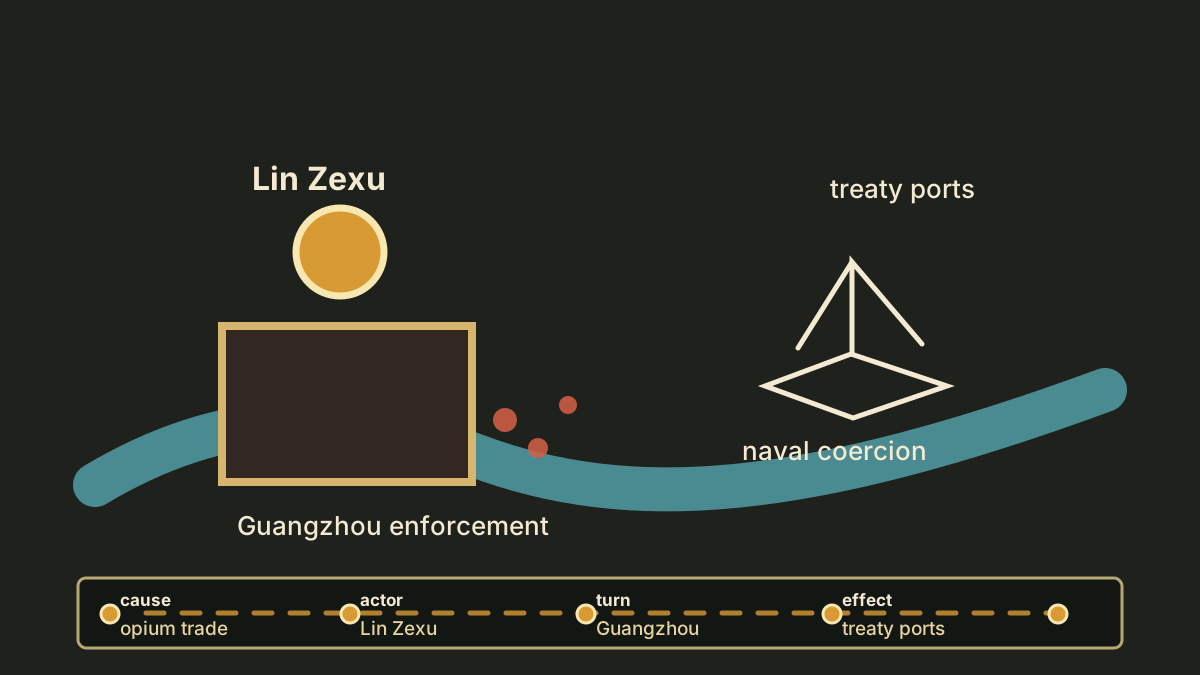
The turning point came when enforcement became international crisis. Lin's pressure on foreign merchants at Guangzhou, including the surrender and destruction of opium stocks, asserted that Qing law applied to the trade. Britain responded with naval force, using steam power, shipboard artillery, and expeditionary capacity to attack along the coast and rivers. This shift exposed a deep asymmetry: Qing officials had moral and legal arguments, but Britain possessed a military system designed to compel access. The conflict moved from smuggling suppression to coercive diplomacy, and coastal cities became the places where global power entered everyday life. Guangzhou became the pressure point because it was where the Canton system, foreign merchants, Chinese officials, and maritime trade met face to face.
Lin's demand for surrender of opium stocks challenged the assumption that foreign traders could evade Qing law through distance, custom, or diplomatic ambiguity. Britain's response changed the scale of the conflict. Naval attacks along the coast and rivers showed that industrial and imperial power could bypass older rules of regulated trade. The war was therefore a contest over jurisdiction: who could punish smuggling, protect property, define lawful commerce, and enforce settlement terms.
Consequences
The war led to defeat for Qing China and the Treaty of Nanjing in 1842, which opened treaty ports, ceded Hong Kong, and imposed indemnities. Later agreements expanded extraterritorial privileges and foreign access. The consequences were profound: Chinese sovereignty was limited in key coastal spaces, treaty-port communities grew, and other powers learned that force could extract concessions. Yet the war should not be reduced to inevitable Western victory or Qing weakness alone. It emerged from choices by officials, merchants, naval commanders, and courts inside a changing global economy. It also became a lasting symbol in Chinese historical memory of humiliation, resistance, and the need for state strengthening. The Treaty of Nanjing and related settlements did more than open trade.
They created a new legal geography in which treaty ports, consular authority, indemnities, and territorial cession limited Qing sovereignty. Hong Kong's cession became one of the most visible symbols, but the everyday consequences also unfolded in customs houses, warehouses, missionary stations, courts, and merchant communities. The war helped produce a nineteenth-century pattern in which foreign powers pressed for most-favored-nation clauses, expanded access, and legal privileges. It also forced Chinese officials and thinkers to confront the military and institutional gap with industrial powers. A final layer is the moral asymmetry of the opium trade. British arguments often used the language of property and commercial access, but the commodity at the center of the dispute was illegal and socially destructive in China.
Qing enforcement had its own limits and contradictions, including corruption and uneven local capacity, yet Lin Zexu's campaign rested on a recognizable claim: a state had the right to stop a harmful trade on its own soil. The war's outcome showed that in the nineteenth-century imperial order, moral and legal arguments could be overwhelmed by naval coercion.
Interpretation Notes
The memory of First Opium War Begins often depends on who tells the story. A court, army, religious community, merchant network, or later nation can emphasize different causes and make Guangzhou stand for different lessons.
Why Keep Reading
Read next through the Treaty of Nanjing, Taiping Rebellion, Self-Strengthening, and later treaty-port pages to follow how one war reshaped law, commerce, and reform debates. The Opium War is a key atlas hinge because it links commodity trade, addiction, imperial law, industrial naval power, and modern Chinese historical memory. Continue to Treaty of Nanjing, Taiping Rebellion, Self-Strengthening, Sino-Japanese War, and 1911 Revolution. The Opium War is not the whole story of modern China, but it is a hinge where trade, law, memory, and military technology begin reshaping the Qing world. Evidence note: strong coverage should combine Qing memorials, Lin Zexu's anti-opium campaign, British parliamentary debate, merchant records, naval reports, treaty texts, and Chinese historical memory.
Each source reveals a different layer: moral argument, commercial pressure, military coercion, diplomatic language, and later national interpretation. That mix helps readers see why the war cannot be reduced to one villain or one cause, while still naming the brutal fact that British force imposed terms favorable to the opium-linked trading system. Reader bridge: the best follow-up is to track how a port dispute became a treaty system. That path moves from Guangzhou enforcement to coastal war, then to Nanjing, Hong Kong, treaty ports, consular law, and later reform debates inside Qing China.
Reading Path
Follow the story without losing the thread
Before This
- British Slavery Abolition Act1833
- Battle of WaterlooJune 18, 1815
- Britain Abolishes the Slave Trade1807
After This
- Treaty of Nanjing1842
- Revolutions of 18481848 CE
- Bowring Treaty with Siam1855 CE
Same Period
- Industrial Revolution Beginsc. 1760 CE
- Battle of WaterlooJune 18, 1815
- Revolutions of 18481848 CE
Wider Timeline
Mind Map
How to think about First Opium War Begins
Opium smuggling
Narcotics commerce, silver outflows, and corruption created fiscal and social pressure in Qing China.
Map Layer
Where this event sits geographically
Gold pins mark the approximate locations of published event pages. This is a schematic locator map, not a historical border map.
Coordinates are approximate and are used to help readers orient themselves before opening a full event page.
References
Where to Check the Facts
- Encyclopaedia Britannica: Opium WarsSpecific reference for the First Opium War, trade conflict, Qing-British tensions, and treaty consequences.
- Encyclopaedia BritannicaBackground reference for chronology, names, and historical context.
- WikidataStructured reference for dates, places, alternate names, and entity links.