At a Glance
The shape of the event
- Date
- 1842
- Place
- Nanjing
- Type
- Treaty
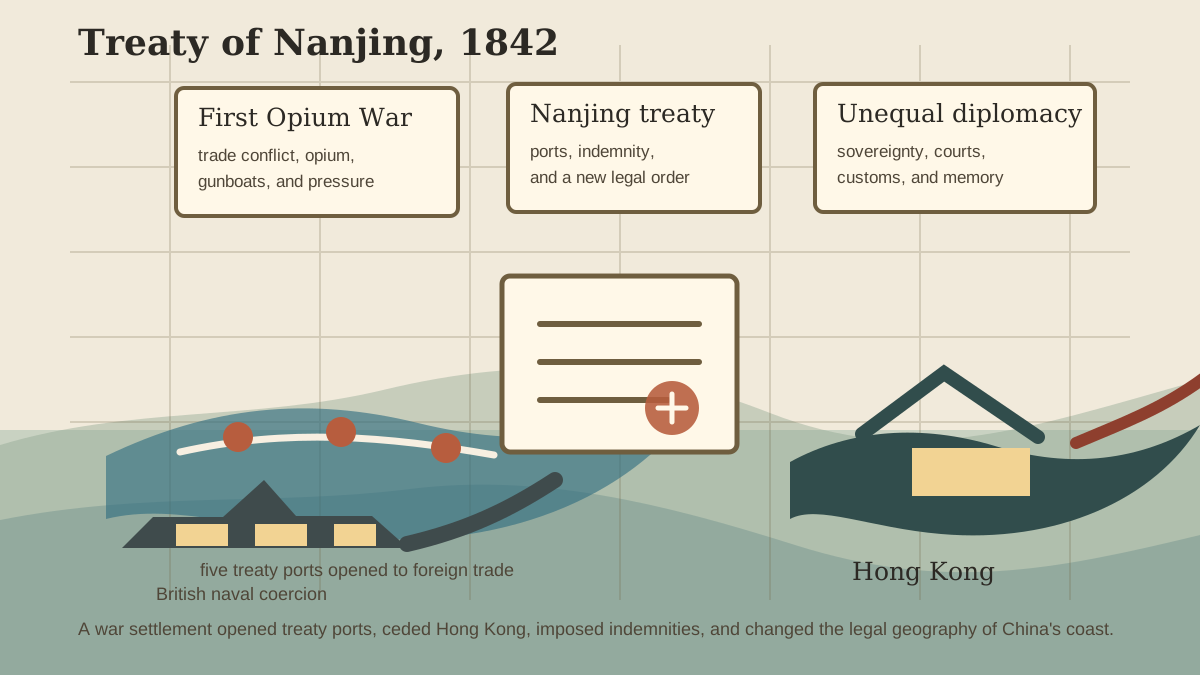
The Treaty of Nanjing ended the First Opium War and forced Qing China into treaty-port concessions, indemnities, and Hong Kong's cession.
1842; place the event in Nanjing before comparing causes or consequences.
The event links East Asian history to imperial pressure, trade, sovereignty, and treaty-port urbanism.
Qing negotiators / British diplomats are the first names or groups to compare before widening the story.
Unequal treaty relations reshaped China's nineteenth-century foreign relations.
Unequal treaty relations reshaped China's nineteenth-century foreign relations.
The event links East Asian history to imperial pressure, trade, sovereignty, and treaty-port urbanism.
Follow the Treaty of Nanjing into the stories it began rather than ended.
Background
Throughout the years before 1842, pressure built along several fault lines. Britain’s merchants sought wider access to Chinese markets and remedies for trading setbacks; Qing officials confronted local social strains, fiscal shortfalls, and the practical limits of imperial institutions in policing commerce and opium supply. Diplomatic channels frayed as merchants, consuls and naval commanders moved into one another’s domains: disputes over tariffs, trade practices, and criminal jurisdiction repeatedly escalated from negotiation to naval action. The First Opium War brought those tensions to a head, producing a situation in which British negotiators sought decisive legal guarantees and territorial leverage, and Qing negotiators faced the immediate reality of military defeat and the need to preserve core authority. Yet no single explanation suffices.
Economic motives, imperial ambition, local resistance to opium, and the uneven technologies of sea power all mattered at different scales. Local communities — from Canton guilds to riverboat crews and dockside laborers — experienced change differently from imperial records, and their responses would shape urban life in the treaty ports. A fuller Treaty of Nanjing page needs to begin with the Qing court's problem of control. The opium trade was not only a moral scandal; it drained silver, empowered smuggling networks, tested coastal officials, and exposed the gap between imperial law and maritime commerce. British merchants framed the crisis as access and diplomatic equality, while Chinese officials saw contraband, disorder, and a threat to sovereignty.
Naval power changed the negotiating room. Steamships, gunboats, coastal bombardment, and movement along rivers allowed Britain to put pressure on cities and supply lines in ways the Qing state struggled to match. The treaty was therefore not a neutral bargain between equal parties. It was diplomacy under military compulsion.
The Turning Point
In Nanjing the calculus of coercion turned into legal commitments. British diplomats presented terms that translated battlefield advantage into concrete demands: designated ports were to be opened to foreign trade, a financial indemnity was required, and Hong Kong Island was to be ceded to British control. Qing negotiators faced stark choices—seek a protracted military resistance that risked further devastation, or accept terms that would preserve the dynasty’s remaining administrative authority and bring an end to active hostilities. The signing formalized a new baseline of interaction: diplomacy would now be backed by treaty law that favored the British side, and Chinese officials found themselves negotiating not merely over goods but over jurisdiction, residency, and the spatial ordering of ports and cities.
These decisions set in motion administrative arrangements that produced foreign enclaves, altered who could live and work where, and established financial claims against the Qing state. The moment reconfigured sovereignty. The turning point was the conversion of defeat into a new treaty order. Opening five ports, fixing indemnities, and ceding Hong Kong gave British merchants protected entry points and gave British officials leverage over future negotiations. Later agreements would add most-favored-nation treatment and extraterritorial privileges, deepening the asymmetry that Nanjing began. For port communities, the change was spatial. Foreign residence, warehouses, consulates, customs routines, shipping lanes, interpreters, and legal disputes rearranged urban life. A treaty written by diplomats became visible in streets, docks, courts, and waterfront labor.
Consequences
In the wake of the Treaty of Nanjing the immediate map of authority along China’s coast changed. Ports that had been closed or tightly regulated became entry points for foreign merchants; Hong Kong Island entered a new imperial orbit under British control; and the Qing state was obliged to meet financial demands that constrained its options. Those near-term effects created a new institutional and urban order: customs offices, foreign settlements, altered policing arrangements, and shifting patterns of labor and residence. Over the long nineteenth century these arrangements multiplied. The treaty became a template—one among several unequal agreements—that bound China into a system of regulated trade and diplomatic inequality, and that made treaty-port urbanism a central feature of modern Chinese cities.
Yet the consequences were uneven. Some local elites adapted, profited, or used new channels to press their interests; many communities experienced dislocation and legal marginalization. Interpretations of the treaty differ depending on the evidence one centers—state records, local memories, archaeology, law and labor histories often tell divergent stories—so the Treaty of Nanjing anchors ongoing debates about sovereignty, commerce and memory across East Asia rather than closing them. The treaty's afterlife became part of what Chinese historians and political memory call the unequal treaty system. It did not cause every later crisis by itself, but it set a precedent: foreign military pressure could produce legal privileges inside Qing territory. That precedent shaped later conflicts, reform debates, anti-foreign movements, and nationalist language.
Hong Kong also gives the event a long clock. What began as a wartime cession became a colonial port, a commercial hub, a migration point, and eventually a central symbol in arguments over sovereignty and return. Reading Nanjing well means following both the immediate war settlement and the much longer urban and political history that grew from it.
Interpretation Notes
Interpretations of Treaty of Nanjing depend on whose evidence is centered: rulers and official records, affected communities, oral memory, archaeology, law, diplomacy, labor, and later public memory do not always tell the same story.
Why Keep Reading
Follow the Treaty of Nanjing into the stories it began rather than ended. Read next about the development of the treaty ports and Hong Kong’s transformation into a colonial entrepôt to see how law, architecture and daily life shifted under new authorities. Trace how subsequent agreements built on the 1842 settlement, and how Chinese reformers, merchants and ordinary people responded in politics, commerce and culture. These threads show why a single treaty mattered: it became an organizing frame for decades of confrontation, accommodation and urban change. Read this page with the First Opium War, Hong Kong, treaty ports, the Taiping and Self-Strengthening era, and later Chinese nationalism.
The sequence shows how one coerced agreement became a structure people lived inside, profited from, resisted, and remembered.
Reading Path
Follow the story without losing the thread
Before This
After This
- Indian Rebellion of 18571857-1858 CE
- Meiji Restoration1868 CE
- Second Battle of El AlameinOctober 23-November 11, 1942
Same Period
- Qin Unification of China221 BCE
- First Opium War Begins1839 CE
- Meiji Restoration1868 CE
Wider Timeline
Mind Map
How to think about Treaty of Nanjing
trade pressure
British commercial demands and disputes over trade practices pushed diplomacy toward confrontation
Map Layer
Where this event sits geographically
Gold pins mark the approximate locations of published event pages. This is a schematic locator map, not a historical border map.
Coordinates are approximate and are used to help readers orient themselves before opening a full event page.
References
Where to Check the Facts
- Cambridge University Press: The Cambridge History of ChinaSpecialist scholarly synthesis for Chinese dynastic, imperial, revolutionary, and Mao-era historical interpretation.
- Cambridge University Press: The Cambridge History of JapanSpecialist scholarly synthesis for Japanese state formation, Meiji transformation, imperial expansion, and modern political change.
- Harvard University Press: A New History of KoreaKorean-history scholarship reference for long Korean chronology, institutions, cultural history, colonial pressure, and modern change.
- Oxford Research Encyclopedia of Asian History: Meiji RevolutionPeer-reviewed reference for Meiji transformation as revolution, state centralization, social change, and contested modernization.
- Encyclopaedia Britannica: Ming dynastyReference for Ming restoration, government, maritime activity, and culture.
- Encyclopaedia Britannica: Qing dynastyReference for Qing conquest, imperial expansion, crisis, and reform.
- Official UNESCO World Heritage Centre: Historic Monuments of Ancient KyotoInstitutional reference for Kyoto's long capital history, court culture, temples, and urban memory.
- Official archive: Columbia Asia for Educators: Treaty of Nanjing excerptsPrimary-source teaching excerpt for the Treaty of Nanjing, treaty-port coercion, indemnity, and legal-commercial pressure after the Opium War.
- National Archives of Japan: Constitution of Japan and Meiji constitutional holdingsJapanese archival reference for Meiji constitutional state-building, imperial rescripts, and the legal language of modern reform.
- National Diet Library: Modern Japan in Archives - Japan's Annexation of KoreaJapanese archive reference for the 1910 annexation of Korea and the documentary trail behind Japanese colonial rule.
- National Institute of Korean History: Annals of the Choson DynastyKorean institutional reference for Joseon court records, dynastic governance, and Korean historical specificity inside the East Asia path.
- U.S. Office of the Historian: English translation of the 1910 Korea annexation treatyDiplomatic-document reference for treaty language around Japan's annexation of Korea and international reporting of colonial transition.
- Official archive: UK National Archives: May Fourth Movement 1919Primary-source archive material for May Fourth diplomacy, national equality language, and post-World War I Chinese protest context.
- Official archive: Hong Kong Basic Law official English textOfficial legal text for the Hong Kong handover framework, rights language, political structure, and sovereignty after 1997.