Historical Role
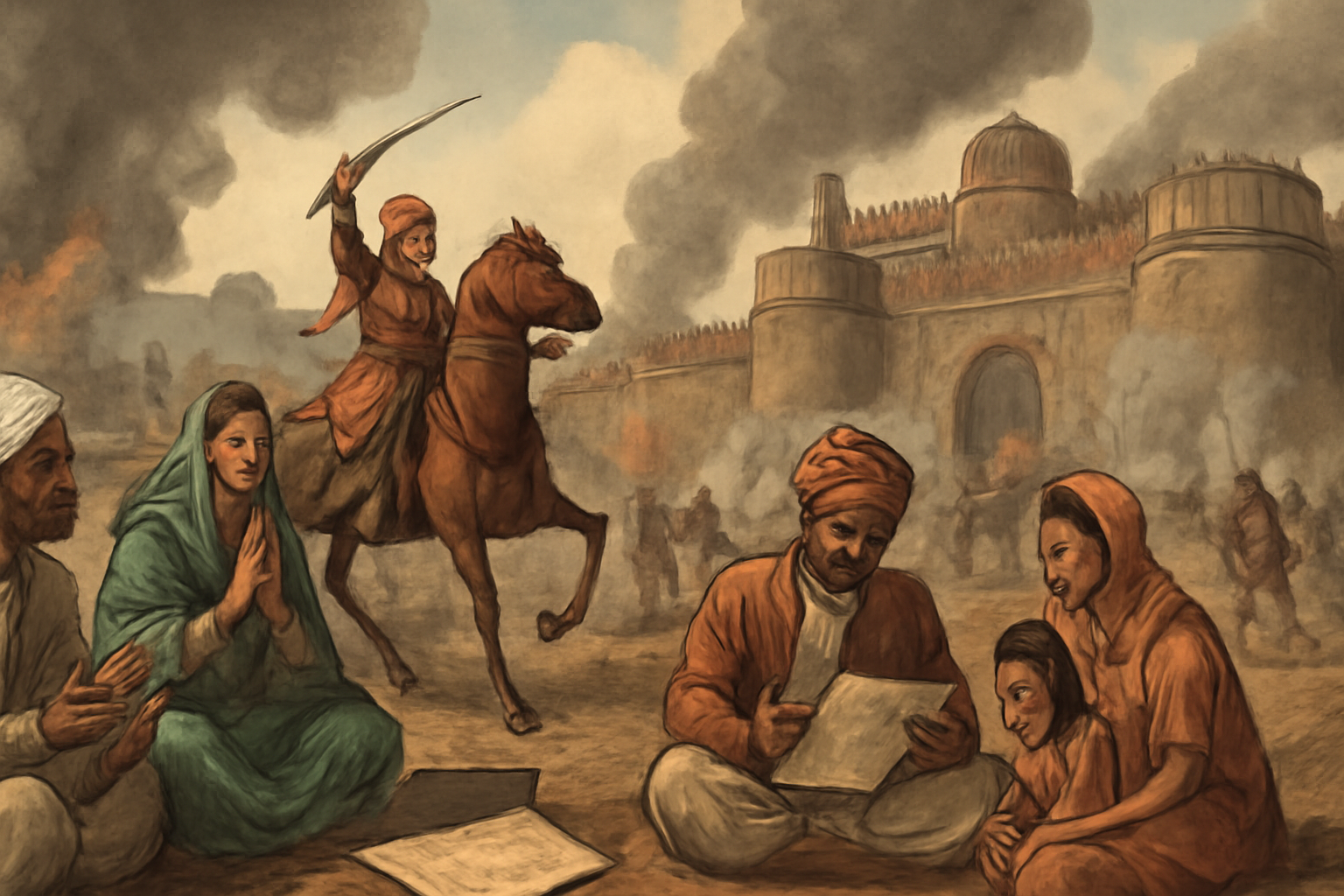
Rani Lakshmibai gives the atlas a biography where sovereignty, gender, colonial law, rebellion, and memory meet. Her role in 1857 cannot be understood only as battlefield courage. It belongs to the annexation of Jhansi, disputes over succession, the Doctrine of Lapse, Company power, princely politics, military revolt, and wider anger at British rule in north and central India.
Jhansi matters because it keeps the story concrete. A kingdom's legal status, a ruler's household, local soldiers, court officials, townspeople, and surrounding alliances all became part of a crisis that was larger than one city but still lived through local fear and choice. Lakshmibai's leadership emerged inside that pressure, not outside it as legend alone.
Her afterlife is part of the history. Nationalist memory, poetry, schoolbooks, gendered symbolism, colonial descriptions, and regional pride all shaped the image of the warrior queen. A strong page lets readers admire the force of that memory while asking what it simplifies about 1857: different rebels had different aims, civilians suffered, and Company violence and rebel violence both shaped the conflict.
The succession dispute keeps law from looking neutral. Lakshmibai's adopted son, British refusal to recognize the claim to rule, petitions, residency politics, and the language of lapse turned a family and court question into a sovereignty crisis. Company officials described policy as order, but to Jhansi it could mean the erasure of a dynasty, revenue base, and political future.
The rebellion made her choices dangerous in several directions. Sepoy revolt, local violence, British suspicion, rival claimants, neighboring powers, and the need to defend Jhansi placed Lakshmibai inside a rapidly shifting field. Her leadership has to be read through siege, negotiation, accusation, escape, alliance, and battlefield command rather than through one heroic pose.
Gwalior and her death gave later memory a dramatic ending, but the surrounding war still matters. Soldiers, civilians, servants, commanders, women in households, British troops, Indian allies of the Company, and displaced residents all moved through the conflict. A fuller biography lets readers see why 1857 became both a rebellion against colonial rule and a human catastrophe.
The archive is uneven. British reports often framed Lakshmibai through suspicion, gender anxiety, or rebel violence, while Indian nationalist memory later elevated her into a symbol of fearless resistance. Reading both traditions carefully gives the biography more authority: the historical person is not identical to the colonial accusation or to the later patriotic icon.
Rani Lakshmibai helps connect individual action with wider historical change in Jhansi and colonial India. The biography works best when it keeps the surrounding world visible: authority, conflict, belief, reform, or discovery moved through decisions made under pressure.
The related events show how roles such as Queen of Jhansi, Rebellion leader can be read through dates, places, institutions, and consequences rather than through reputation alone. The biography explains why this person matters, while the linked events explain what changed around them.
A richer reading starts with the limits around the person. Some figures acted through offices, armies, courts, laboratories, churches, parties, ships, trade networks, or protest movements; others became important because later communities turned their lives into symbols. The page therefore asks what this person could actually change, what was already moving before them, and which consequences later readers attached to the name.
Read the biography against absence as well. Many lives around Rani Lakshmibai are less visible in the record: opponents, collaborators, family members, workers, soldiers, students, subjects, victims, translators, scribes, or local communities. Keeping those surrounding people in view makes the page less like a name card and more like an entry point into historical systems.
Rani Lakshmibai also works as a navigation point. Open the linked event pages to see where the biography becomes chronology, then use the topic routes to test whether the same pattern appears beyond one life. That extra step matters because historical importance is rarely contained inside a single decision; it usually spreads through institutions, witnesses, opponents, imitators, and later arguments over memory.
Sources and Method
Source method: read Rani Lakshmibai through the Indian Rebellion of 1857, Jhansi, Company annexation, gendered memory, and South Asian anti-colonial routes rather than treating the page as a single heroic anecdote.
Evidence Notes
How Sensitive Claims Are Sourced
- 1
Jhansi, succession, and Company power
The biography links Lakshmibai's role to disputed sovereignty, British annexation policy, local court politics, and the larger crisis of Company rule.
- 2
Rebellion and later nationalist memory
The page keeps later memory visible because Lakshmibai became a symbol of resistance, gendered courage, and anti-colonial nationalism after the events of 1857.
Why This Person Matters
Rani Lakshmibai matters because the connected events make a larger historical pattern easier to follow. The page links biography to consequences so readers can move from a life story into the wider atlas, compare the person with contemporaries, and understand why later memory kept returning to this figure. Rani Lakshmibai matters because her life turns the Indian Rebellion of 1857 into a focused question about sovereignty, gender, law, empire, and memory. The biography helps readers understand why a local ruler became a much larger symbol of anti-colonial resistance.
What changes when Lakshmibai is read not only as a warrior queen, but as a ruler caught inside annexation, rebellion, gendered memory, and imperial law?
How to Read This Life
Rani Lakshmibai is easiest to understand when the biography is read beside Indian Rebellion of 1857. Those events show the historical setting in motion: dates, places, institutions, conflict, and consequences give the life a structure that a short biography alone cannot provide.
The surrounding route crosses British Empire and locations such as Meerut, Delhi, Kanpur, Lucknow, and North India. That matters because influence rarely stays inside one person. It moves through offices, armies, movements, laws, texts, speeches, institutions, and later memory.
A useful reading path starts with the role labels, then opens the event pages to see what changed, and finally compares this person with other actors facing similar pressures.
For readers who arrive on a biography first, this page is meant to become a doorway rather than a stop. Read one paragraph for the answer, then use the turning points, topic routes, and event links to test whether the person's reputation matches the wider evidence.
Read Rani Lakshmibai beside the Indian Rebellion of 1857, British East India Company rule, Plassey, South Asia, and later independence routes. That path connects local sovereignty to imperial expansion.
Then compare her with Micaela Bastidas, Queen Liliuokalani, Elizabeth Cady Stanton, and anti-colonial leaders where available. The comparison asks how women entered political memory through law, rebellion, monarchy, organizing, and symbol.
Read Rani Lakshmibai through the roles of Queen of Jhansi, Rebellion leader rather than as reputation alone.
Place the biography inside Jhansi and colonial India and the wider events linked below.
Ask which choices were personal and which were constrained by institutions or crisis.
Follow how later memory simplified, contested, or reused this person's role.
Start with Jhansi, succession, annexation, and Company authority before reading battlefield memory.
Ask why later memory made Lakshmibai a symbol of courage, motherhood, rule, and resistance.
Place her role inside the wider 1857 crisis without assuming every participant wanted the same future.
Legacy, Limits, and Memory
A useful biography keeps scale in view. Rani Lakshmibai mattered because individual choices met a wider structure: institutions, enemies, allies, audiences, technologies, beliefs, and inherited conflicts. The related event pages help separate personal agency from conditions that no single person controlled.
Memory is part of the biography too. Later readers often simplify a figure into a hero, villain, founder, reformer, conqueror, prophet, scientist, or symbol. Those labels can be helpful, but they become misleading when they hide conflict, compromise, exclusion, uncertainty, or the experiences of people outside the main biography.
For the next step, compare this life with a topic route rather than stopping at the name. If the same pattern appears across several figures, the reader has found a historical structure; if this person breaks the pattern, the contrast is usually where the most interesting question begins.
The main risk is romance without structure. Lakshmibai's courage matters, but it becomes historically stronger when readers see annexation policy, succession law, Company rule, soldiers, civilians, and local politics around her.
A second risk is treating 1857 as one unified national war in modern terms. The rebellion gathered many grievances and actors; Lakshmibai's story shows connection without erasing diversity of motive.
Turning Points to Read Next
Indian Rebellion of 1857
Soldiers and civilians across parts of north India rose against East India Company rule, producing a major rebellion that transformed British governance of India.
Related Timeline
- 1857-1858 CEIndian Rebellion of 1857
Soldiers and civilians across parts of north India rose against East India Company rule, producing a major rebellion that transformed British governance of India.
References
Where to Check the Facts
- Encyclopaedia Britannica: Rani LakshmibaiBiographical reference for Lakshmibai's role in the 1857 rebellion and later memory.
- Encyclopaedia Britannica: Indian Rebellion of 1857Reference for the rebellion's wider setting.