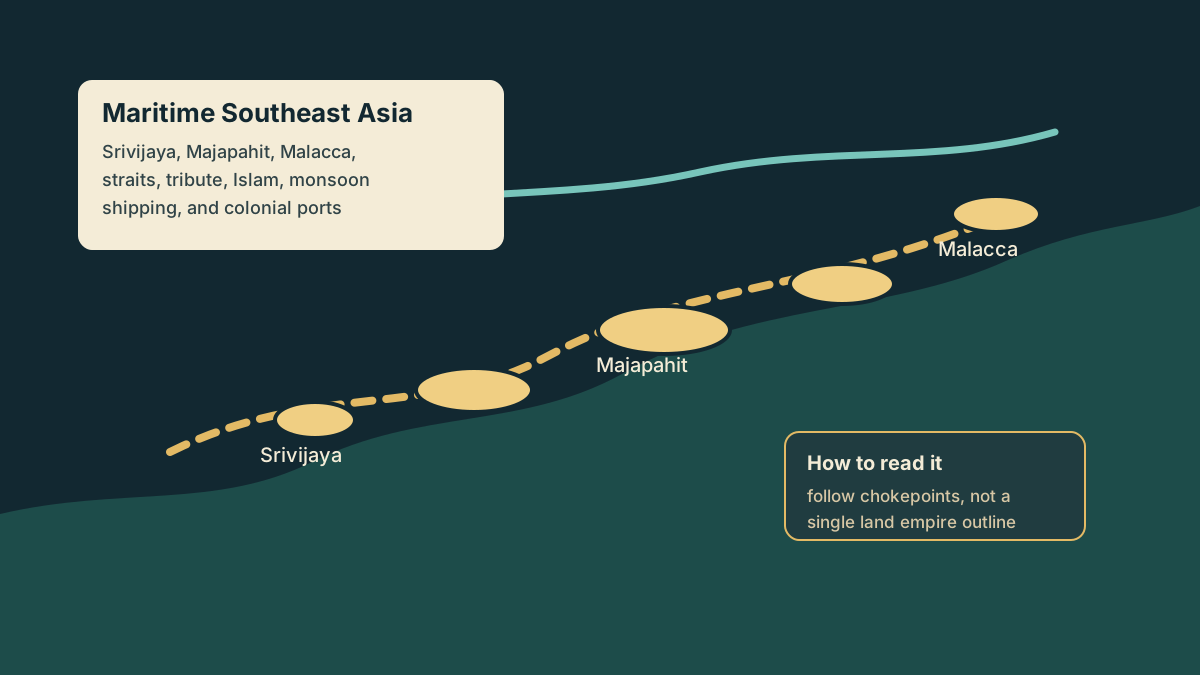
Follow Malacca, Batavia, Manila, and other nodes as political institutions as much as commercial places.
Timeline
Southeast Asia Maritime and Modern Timeline
A route through early mainland and island state formation, port-polities, colonial companies, resistance, revolution, independence, Cold War conflict, and ASEAN regionalism.
Timeline Guide
How did Southeast Asia move from port-polities and mainland kingdoms to colonial companies, national revolutions, Cold War conflict, and ASEAN?
Read this edited guide as a path through dates, places, affected lives, source limits, and contested memory rather than as an exhaustive database.
This timeline treats Southeast Asia as a region with its own historical engines: straits, river deltas, monsoons, rice plains, islands, uplands, port cities, temples, courts, and migrant communities. It begins with older cultural and maritime systems so the region is not introduced only when European companies arrive.
The early nodes show multiple forms of state formation. Funan and Srivijaya make river and sea routes visible. Bagan and Angkor show Buddhist kingship, water control, temple landscapes, and agrarian authority. Ayutthaya and Majapahit add mainland and island-world scales. These states were not copies of India or China; they translated outside ideas into local political and environmental settings.
Malacca is the timeline's maritime hinge. It shows how a port could become powerful by hosting merchants, protecting passage, collecting duties, managing diplomatic ties, and connecting Islamic, Malay, Chinese, Indian, and wider Indian Ocean worlds. The Portuguese conquest of Malacca then marks a new phase: armed European power entered an already sophisticated Asian trading system.
The colonial-company chapter follows the VOC, Batavia, the Philippines, Java War, and Siam's treaty diplomacy. It asks readers to compare direct conquest, chartered-company rule, missionary and galleon networks, treaty pressure, and local resistance. Southeast Asia did not experience one colonial model; it experienced several overlapping forms of coercion and negotiation.
Start With These Dates
- c. 600 BCEDong Son Culture Flourishes
Dong Son culture flourished around the Red River region, known especially for bronze drums, craft production, wet-rice agriculture, and exchange networks.
- c. 100 CEFunan Maritime Network Rises
Funan emerged around lower Mekong trade routes, linking mainland Southeast Asia to wider Indian Ocean commerce, ports, ritual power, and political consolidation.
- c. 650 CESrivijaya Maritime Empire Rises
Srivijaya rose around Sumatran waterways and sea lanes, using control of maritime routes, diplomacy, and Buddhist networks to shape regional power.
- 802 CEAngkor Empire Founded in 802: Jayavarman II and the Long Buildout
The traditional 802 foundation date points to Jayavarman II and a remembered claim to Khmer sovereignty, but Angkor's power developed through temples, reservoirs, labor, sacred geography, and repeated political consolidation.
- 1602 CEDutch East India Company Founded
The Dutch East India Company was founded as a chartered corporation with commercial and political powers in Asian trade.
- August 8, 1967ASEAN Founded
ASEAN was founded by Indonesia, Malaysia, the Philippines, Singapore, and Thailand to promote cooperation, development, and regional stability during the Cold War.
- April 30, 1975Fall of Saigon
North Vietnamese forces captured Saigon, ending the Vietnam War and marking the collapse of the U.S.-backed South Vietnamese state.
- March 11, 2020COVID-19 Pandemic Declared
The World Health Organization characterized COVID-19 as a pandemic after the virus spread across continents and strained public-health systems.
Sources Used Here
- Encyclopaedia Britannica: Southeast Asian history
Reference for regional chronology, maritime exchange, colonial rule, nationalism, and modern state formation.
- Encyclopaedia Britannica: Sultanate of Malacca
Reference for Malacca as a major Malay port-polity and commercial center before Portuguese conquest.
- Official UNESCO World Heritage Centre: Angkor
Institutional reference for the Angkor landscape, Khmer capitals, reservoirs, temples, and regional setting.
- Official ASEAN: About ASEAN
Official institutional reference for ASEAN's 1967 founding and regional-cooperation frame.
The twentieth-century section connects nationalism and war. The Philippine Revolution, Indonesian independence, Dien Bien Phu, Vietnam escalation, Saigon, and Bandung show anti-colonial politics moving through writing, armed struggle, Japanese occupation, Cold War aid, peasant mobilization, diplomacy, and international recognition.
ASEAN gives the route a different ending from war. Regionalism did not erase disputes, but it created a durable institution after decades of colonialism, occupation, revolution, and Cold War insecurity. That makes the timeline useful for readers who want to know how Southeast Asia became not only a battlefield or trade route, but also a diplomatic region.
The source lens matters. Inscriptions, temple archaeology, Chinese records, Malay texts, colonial archives, revolutionary proclamations, photographs, diplomatic documents, and oral memories all preserve different voices. A port merchant, a monk, a court official, a plantation worker, a guerrilla fighter, and a diplomat are not equally visible in every source type.
The timeline is built for movement. A reader can enter through Angkor, Malacca, the VOC, the Philippines, Indonesia, Vietnam, Bandung, or ASEAN and still find a path through the whole region. That path is what makes the page more than a date list.
This route makes Southeast Asia visible as a maker of world history rather than a corridor between larger neighbors. Deltas, straits, uplands, monsoon winds, rice plains, volcanic islands, temple landscapes, port cities, and migrant communities all shaped political possibility. That geographic variety matters because a mainland court, a maritime port, a highland community, and an island trading center did not face the same problems.
The early sequence is about local translation. Dong Son, Funan, Srivijaya, Angkor, Pagan, Ayutthaya, Majapahit, and Malacca adapted outside ideas without being copies of India, China, or Islamicate worlds. Sanskrit, Buddhism, Islam, court ritual, trade law, and writing moved into local landscapes where rulers had to manage water, rice, ports, tribute, merchants, temples, and military rivals. The region's power came from adaptation, not imitation.
Malacca gives the route a clear maritime hinge. Its power grew from location, customs, diplomacy, Muslim merchant networks, Malay court authority, and the ability to make strangers trust a port. The Portuguese conquest matters because armed European intervention entered an already complex commercial world. It did not create Southeast Asian trade; it tried to redirect and tax a world of exchange that already had its own rules.
Company and colonial rule took multiple forms. Spanish galleon and mission systems in the Philippines, Dutch chartered-company rule around Batavia, plantation and forced-labor pressure in the Netherlands Indies, and treaty diplomacy in Siam each reshaped sovereignty differently. This variety keeps the timeline from becoming a single colonial template. Some places faced direct conquest; others negotiated unequal treaties; still others became battlegrounds for rival imperial systems.
Nationalism and decolonization require a regional reading. The Philippine Revolution, Indonesian proclamation, Dien Bien Phu, and Bandung show print culture, exile, revolutionary organizations, Japanese occupation, guerrilla war, peasant mobilization, diplomacy, and Asian-African solidarity. Independence was not simply the end of European rule. It created struggles over armies, borders, language, economic control, and who could claim to represent the people.
The Cold War chapter keeps Southeast Asia's agency visible. Vietnam was not only a superpower battlefield; it was also a decolonization struggle, a national division, a peasant war, an ideological conflict, and a regional crisis. ASEAN then offers a different answer to insecurity: institutional cooperation among states with different political systems and unresolved disputes. Regionalism did not erase conflict, but it changed how governments imagined stability.
COVID-19 closes the current route with a modern vulnerability rather than a triumph. Public health, tourism, labor migration, ports, border controls, supply chains, and state capacity all reappeared as historical forces. Ending this way reminds readers that maritime and mainland connection still carry risk as well as opportunity.
The reader can move through the page by geography or by problem. A port-route reading follows Srivijaya, Malacca, Batavia, Manila, Bandung, and ASEAN. A mainland-route reading follows Dong Son, Funan, Angkor, Ayutthaya, Siam, Vietnam, and COVID-era state capacity. A resistance-route reading follows Java, the Philippines, Indonesia, Vietnam, Bandung, and Saigon. The route is long because the region is not one story.
The story is strongest when read in layers. First, follow the dates from c. 600 BCE to March 11, 2020. Then read across the event types: cultural and technological development, maritime trade network, maritime empire, state formation. The timeline becomes more than chronology when those dates reveal decisions, institutions, violence, reform, and memory.
Dutch East India Company Founded sits near the middle of the sequence. Ask what had already become unavoidable by 1602 CE, what actors still believed they could control, and which consequences were already beginning to move beyond the original setting.
The named events are Dong Son Culture Flourishes, Funan Maritime Network Rises, Srivijaya Maritime Empire Rises, Angkor Empire Founded in 802: Jayavarman II and the Long Buildout, Pagan Kingdom Founded, Chola Raid on Srivijaya. Each one pushes a more precise question: what changed, who benefited, who paid the cost, and what later page explains the aftermath more clearly?
Read the timeline against geography too. Places matter because power moves through corridors, borders, cities, ports, capitals, and frontiers. The map below keeps those distances visible while the event pages explain the human and institutional consequences.
A good timeline has a pulse: pressure, decision, expansion, resistance, and aftermath. When you move through Early Southeast Asia and Medieval Southeast Asia, keep asking whether an event is creating a new problem, revealing a hidden weakness, or making an earlier choice harder to reverse.
The human layer matters because timelines can become too abstract. Figures such as Dong Son communities, Funan rulers and merchants, Srivijayan rulers, maritime merchants, Jayavarman II, Burmese rulers, and Buddhist monastic communities help the sequence feel lived rather than mechanical. Their choices do not explain everything, but they show where institutions, ideas, military systems, social movements, and public fear entered real decisions.
The ending is not only the last date. With closing events such as Vietnam War Escalation, ASEAN Founded, Fall of Saigon, and COVID-19 Pandemic Declared, the reader can ask what remained unsettled: which institutions survived, which arguments continued, which victims or opponents were left outside the official story, and which later crisis reused the same vocabulary.
Read this page once quickly for order, then read it again for contrast. Compare early confidence with later uncertainty, local decisions with global consequences, and visible turning points with slower changes in law, economy, belief, technology, borders, or memory. That second pass is where a timeline becomes an explanation.
Causation in this sequence is layered. One event may supply the trigger, another may reveal an older weakness, and a later event may show the consequence that people at the beginning did not expect. The useful habit is to separate background pressure, immediate decision, turning point, and aftermath before deciding which event matters most.
Consequences are uneven. A political settlement might look successful in one capital while creating resentment elsewhere; a military victory might end a campaign while deepening civilian trauma; a scientific or institutional breakthrough might solve one problem while creating new risks. The timeline is strongest when those mixed outcomes remain visible.
The final pass is comparative. After reading this sequence, open a neighboring topic or person page and ask whether the same pattern appears again. Repetition usually points to a structure; contrast usually points to a historical choice that could have gone another way.
Importance is not the same thing as drama. Some events are remembered because they were spectacular, while others matter because they changed rules, expectations, alliances, legal categories, technologies, or public language. Use the timeline to test both kinds of importance before deciding what belongs at the center of the story.
The page rewards moving outward. A timeline gives order, but the event pages give causes, maps, people, sources, and reading paths. When a date feels too compressed, open the full event page and then return here; the sequence becomes clearer with each pass instead of asking the reader to memorize a list.
Ask how Buddhism, Islam, law, trade practices, and colonial institutions were adapted inside local societies.
Compare Java, the Philippines, Indonesia, Vietnam, and Bandung as different anti-colonial routes.
ASEAN turns the route from conflict and decolonization toward institutional cooperation.
Use Angkor, deltas, straits, ports, and monsoons to see water as infrastructure for farming, trade, diplomacy, and war.
Compare Spanish, Dutch, Portuguese, British treaty, French, Japanese wartime, and U.S.-linked pressures without flattening the region into one model.
For a fast route, follow Angkor, Malacca, VOC, Philippine Revolution, Indonesia, Dien Bien Phu, Bandung, Vietnam, ASEAN, and COVID-19.
Dong Son Culture Flourishes gives the opening problem a date and place. Ask what was already unstable before it happened.
Dutch East India Company Founded is a compression point: earlier causes are now crowded together with decisions that will shape the sequence's ending.
Follow the path through Red River Delta, Mekong Delta, Palembang, Angkor region, Bagan, and Palembang and the Strait of Malacca and ask how distance changed communication, logistics, fear, and control.
COVID-19 Pandemic Declared works as both an ending and a beginning: it closes one sequence while opening later disputes, institutions, memories, or reforms.
Which conditions existed before the first event, and which later decision turned those conditions into visible historical change?
Who had the power to choose, who had fewer choices, and who is missing when the story is told only through leaders or institutions?
Which facts are date anchors, which are interpretations, and which claims need checking through the event sources before being repeated?
Which linked event, person, year, or topic page would change your interpretation if you read it next?
Interactive Timeline
Explore Southeast Asia Maritime and Modern Timeline by sequence
Dong Son Culture Flourishes
Dong Son culture flourished around the Red River region, known especially for bronze drums, craft production, wet-rice agriculture, and exchange networks.
Read the full event pageNarrative Stages
Read this timeline in chapters
Deltas, Temples, and Port-Polities
Bronze cultures, river networks, Buddhist kingship, reservoirs, and maritime empires show state formation before European company power.
Straits, Courts, and Early Global Contact
Ayutthaya, Majapahit, Malacca, Zheng He, and Portuguese conquest show the region's ports adapting to diplomacy, Islam, commerce, and armed intrusion.
- Ayutthaya Kingdom Founded1351 CE
- Majapahit Empire Peaksc. 1350 CE
- Malacca Sultanate Risesc. 1400 CE
- Zheng He's First Indian Ocean Voyage1405 CE
- Malacca Falls to the Portuguese1511 CE
Company Rule and Treaty Pressure
Spanish, Dutch, and treaty-based systems show colonial power arriving through several models rather than one regional script.
- Spanish Colonization of the Philippines Begins1565 CE
- Dutch East India Company Founded1602 CE
- Batavia Founded1619 CE
- Java War Begins1825 CE
- Bowring Treaty with Siam1855 CE
War, Nationalism, and Decolonization
Revolution, World War II, Indonesian independence, Dien Bien Phu, and Bandung connect local nationalism to imperial crisis and Asian-African solidarity.
- Philippine Revolution1896-1898 CE
- Battle of the Coral SeaMay 1942
- Indonesia Proclaims IndependenceAugust 17, 1945
- Battle of Dien Bien Phu1954 CE
- Bandung ConferenceApril 1955
Cold War, ASEAN, and Shared Vulnerability
Vietnam, ASEAN, Saigon, and COVID-19 place conflict, regional institution-building, and public-health interdependence in one modern frame.
- Vietnam War Escalation1965
- ASEAN FoundedAugust 8, 1967
- Fall of SaigonApril 30, 1975
- COVID-19 Pandemic DeclaredMarch 11, 2020
Map Layer
Southeast Asia Maritime and Modern Timeline geography
Gold pins mark the approximate locations of published event pages. This is a schematic locator map, not a historical border map.
Event location Simplified land areaClick a pin to open the event page
Coordinates are approximate and are used to help readers orient themselves before opening a full event page.
References
Where to Check the Facts
- Encyclopaedia Britannica: Southeast Asian historyReference for regional chronology, maritime exchange, colonial rule, nationalism, and modern state formation.
- Encyclopaedia Britannica: Sultanate of MalaccaReference for Malacca as a major Malay port-polity and commercial center before Portuguese conquest.
- Official UNESCO World Heritage Centre: AngkorInstitutional reference for the Angkor landscape, Khmer capitals, reservoirs, temples, and regional setting.
- Official ASEAN: About ASEANOfficial institutional reference for ASEAN's 1967 founding and regional-cooperation frame.