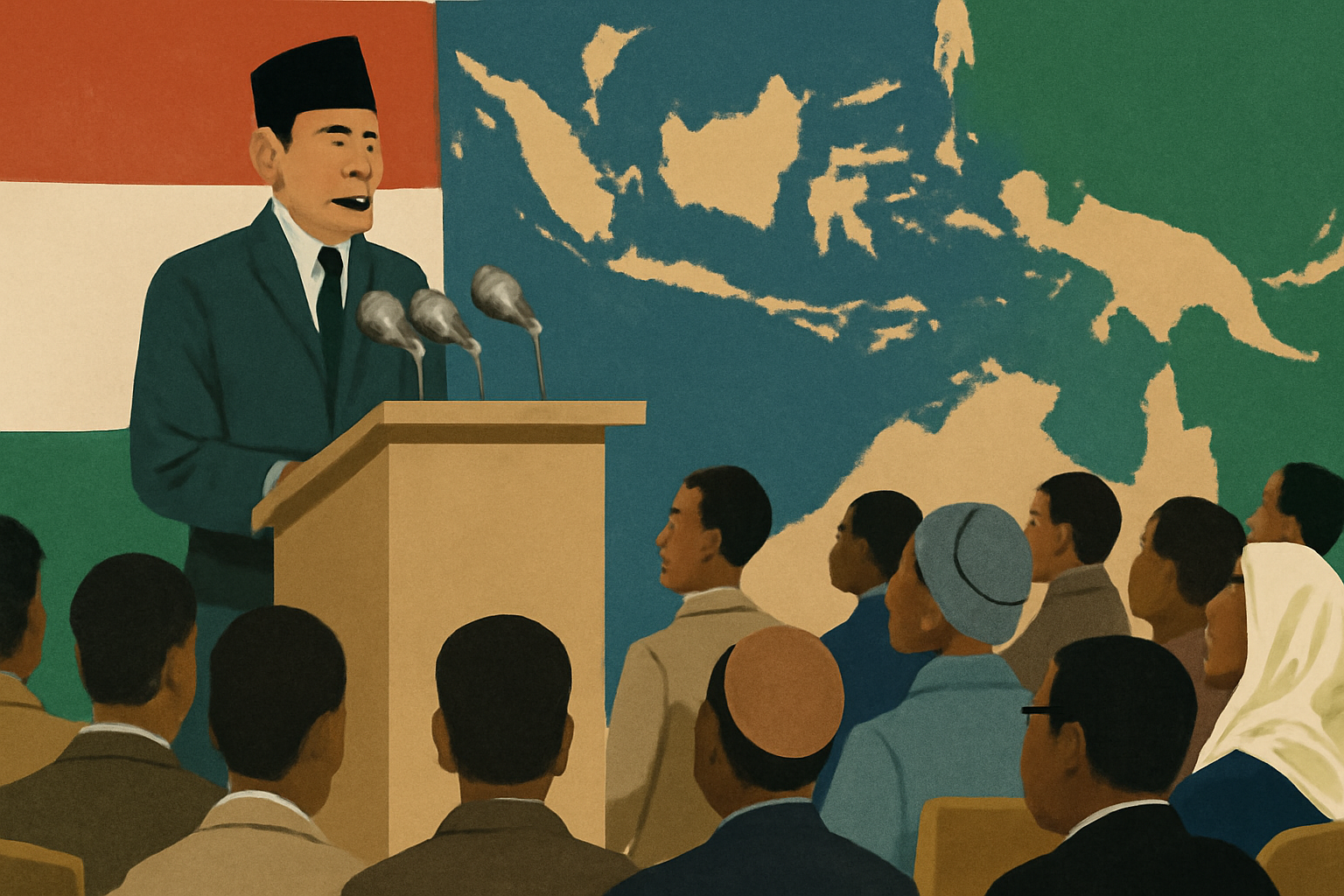
Historical Role
Sukarno gives the atlas a biography about anti-colonial nationalism, wartime rupture, revolutionary state formation, and postcolonial diplomacy. His importance begins before the 1945 proclamation, in a Dutch colonial world shaped by education, party organizing, imprisonment, exile, Islam, socialism, nationalism, and debates over how an archipelago could imagine itself as one nation.
The Japanese occupation changed the political field. It weakened Dutch authority, created new institutions and mobilization channels, empowered and constrained Indonesian nationalists, and left violence and hardship that cannot be separated from the independence moment. Sukarno's proclamation in August 1945 therefore belongs to a contested transition, not a simple handover.
Bandung in 1955 extends the biography beyond Indonesia. Sukarno helped turn postcolonial sovereignty into a public diplomatic stage where Asian and African leaders argued against colonialism, racial hierarchy, and great-power domination. The later Guided Democracy period adds complexity: charismatic anti-imperial leadership could mobilize unity while narrowing pluralism and deepening political strain.
The archipelago problem gives the biography its practical difficulty. Java, Sumatra, Sulawesi, Bali, Kalimantan, eastern islands, Muslim organizations, secular nationalists, communists, soldiers, youth groups, regional leaders, and former colonial institutions all had to be pulled into a national frame. Sukarno's speeches mattered because they gave unity a language, but unity also required administration, revenue, military command, compromise, and coercion.
The Cold War layer makes his career more than a domestic story. Sukarno tried to keep Indonesia from becoming merely a pawn of older powers, yet foreign aid, party rivalry, army politics, anti-communism, anti-imperial rhetoric, and economic strain narrowed his room to maneuver. The biography becomes richer when Bandung's confident internationalism is read beside the later instability that made postcolonial pluralism hard to sustain.
The end of his rule gives readers a final caution. Economic crisis, confrontation politics, army influence, communist and anti-communist mobilization, and mass violence around 1965-1966 made the promise of revolutionary unity collapse into a brutal transition. Sukarno's career therefore links liberation charisma to the danger of unresolved institutional conflict.
Sukarno helps connect individual action with wider historical change in Indonesia. The biography works best when it keeps the surrounding world visible: authority, conflict, belief, reform, or discovery moved through decisions made under pressure.
The related events show how roles such as Indonesian nationalist, President can be read through dates, places, institutions, and consequences rather than through reputation alone. The biography explains why this person matters, while the linked events explain what changed around them.
A richer reading starts with the limits around the person. Some figures acted through offices, armies, courts, laboratories, churches, parties, ships, trade networks, or protest movements; others became important because later communities turned their lives into symbols. The page therefore asks what this person could actually change, what was already moving before them, and which consequences later readers attached to the name.
Read the biography against absence as well. Many lives around Sukarno are less visible in the record: opponents, collaborators, family members, workers, soldiers, students, subjects, victims, translators, scribes, or local communities. Keeping those surrounding people in view makes the page less like a name card and more like an entry point into historical systems.
Sukarno also works as a navigation point. Open the linked event pages to see where the biography becomes chronology, then use the topic routes to test whether the same pattern appears beyond one life. That extra step matters because historical importance is rarely contained inside a single decision; it usually spreads through institutions, witnesses, opponents, imitators, and later arguments over memory.
Sources and Method
Source method: read Sukarno through Indonesian independence, Japanese occupation, Dutch colonialism, Bandung, and Southeast Asian history. The page keeps anti-colonial charisma, state-building, diplomacy, and authoritarian drift in the same frame.
Evidence Notes
How Sensitive Claims Are Sourced
- 1
Independence after occupation and empire
The biography treats the 1945 proclamation as a moment shaped by Japanese occupation, Dutch colonial collapse, youth pressure, revolutionary uncertainty, and the fight to make independence real.
- 2
Bandung and Global South diplomacy
Bandung anchors Sukarno's international role because it made anti-colonial sovereignty, Asian-African solidarity, and nonalignment visible on a global stage.
Why This Person Matters
Sukarno matters because the connected events make a larger historical pattern easier to follow. The page links biography to consequences so readers can move from a life story into the wider atlas, compare the person with contemporaries, and understand why later memory kept returning to this figure. Sukarno matters because his life connects Indonesian nationalism, Japanese occupation, revolutionary independence, Asian-African diplomacy, Cold War nonalignment, and the fragility of postcolonial democracy. The biography helps readers see decolonization as both liberation and state-building difficulty.
How did Sukarno turn Indonesian nationalism into statehood and global anti-colonial diplomacy, and why did that same charisma struggle to sustain plural politics?
How to Read This Life
Sukarno is easiest to understand when the biography is read beside Indonesia Proclaims Independence, Bandung Conference. Those events show the historical setting in motion: dates, places, institutions, conflict, and consequences give the life a structure that a short biography alone cannot provide.
The surrounding route crosses Decolonization, Decolonization and Cold War and locations such as Jakarta, Bandung. That matters because influence rarely stays inside one person. It moves through offices, armies, movements, laws, texts, speeches, institutions, and later memory.
A useful reading path starts with the role labels, then opens the event pages to see what changed, and finally compares this person with other actors facing similar pressures.
For readers who arrive on a biography first, this page is meant to become a doorway rather than a stop. Read one paragraph for the answer, then use the turning points, topic routes, and event links to test whether the person's reputation matches the wider evidence.
Read Sukarno beside Indonesian independence, Bandung, ASEAN, decolonization, Cold War, and Southeast Asian maritime routes. That path keeps the archipelago, diplomacy, and postcolonial state-building connected.
Then compare him with Nehru, Nasser, Ho Chi Minh, Nkrumah, and Mujibur Rahman where available. The comparison asks how anti-colonial leaders turned public legitimacy into institutions under Cold War pressure.
Read Sukarno through the roles of Indonesian nationalist, President rather than as reputation alone.
Place the biography inside Indonesia and the wider events linked below.
Ask which choices were personal and which were constrained by institutions or crisis.
Follow how later memory simplified, contested, or reused this person's role.
Ask how islands, languages, religions, parties, and colonial institutions became one national project.
Use Japanese wartime rule to understand both opportunity and violence behind the 1945 proclamation.
Read diplomacy as a way for new states to challenge colonial hierarchy and Cold War blocs.
Legacy, Limits, and Memory
A useful biography keeps scale in view. Sukarno mattered because individual choices met a wider structure: institutions, enemies, allies, audiences, technologies, beliefs, and inherited conflicts. The related event pages help separate personal agency from conditions that no single person controlled.
Memory is part of the biography too. Later readers often simplify a figure into a hero, villain, founder, reformer, conqueror, prophet, scientist, or symbol. Those labels can be helpful, but they become misleading when they hide conflict, compromise, exclusion, uncertainty, or the experiences of people outside the main biography.
For the next step, compare this life with a topic route rather than stopping at the name. If the same pattern appears across several figures, the reader has found a historical structure; if this person breaks the pattern, the contrast is usually where the most interesting question begins.
The main risk is stopping at independence. Sukarno's historical importance includes the harder post-1945 questions of unity, party conflict, army power, economic stress, and the limits of charismatic rule.
A second risk is writing Bandung as a photo opportunity. It was also a claim that newly independent states could speak about world order rather than merely enter an order designed by older powers.
Turning Points to Read Next
Indonesia Proclaims Independence
Sukarno and Mohammad Hatta proclaimed Indonesian independence after Japan's surrender, opening a revolutionary struggle against the return of Dutch colonial rule.
Bandung Conference
Asian and African leaders met at Bandung to discuss anti-colonial solidarity, racial equality, economic cooperation, sovereignty, and alternatives to Cold War bloc politics.
Related Timeline
- August 17, 1945Indonesia Proclaims Independence
Sukarno and Mohammad Hatta proclaimed Indonesian independence after Japan's surrender, opening a revolutionary struggle against the return of Dutch colonial rule.
- April 1955Bandung Conference
Asian and African leaders met at Bandung to discuss anti-colonial solidarity, racial equality, economic cooperation, sovereignty, and alternatives to Cold War bloc politics.
References
Where to Check the Facts
- Encyclopaedia Britannica: SukarnoBiographical reference for Sukarno and Indonesian independence.
- Encyclopaedia Britannica: Southeast Asian historyReference for regional chronology, maritime exchange, colonial rule, nationalism, and modern state formation.