At a Glance
The shape of the event
- Date
- 1917 CE
- Place
- Petrograd
- Type
- Revolution
War, hunger, strikes, and political collapse brought down the Romanov monarchy and opened the way for Bolshevik seizure of power.
1917 CE; place the event in Petrograd before comparing causes or consequences.
The revolution created the Soviet state and reshaped twentieth-century ideology, diplomacy, and social policy.
Vladimir Lenin / Nicholas II are the first names or groups to compare before widening the story.
Russia left imperial rule and entered revolutionary civil conflict.
Russia left imperial rule and entered revolutionary civil conflict.
The revolution created the Soviet state and reshaped twentieth-century ideology, diplomacy, and social policy.
If you want to follow how the revolution unfolded into governance and conflict, read the timelines of the provisional authorities, the Bolshevik consolidation of power, and the civil war that followed.
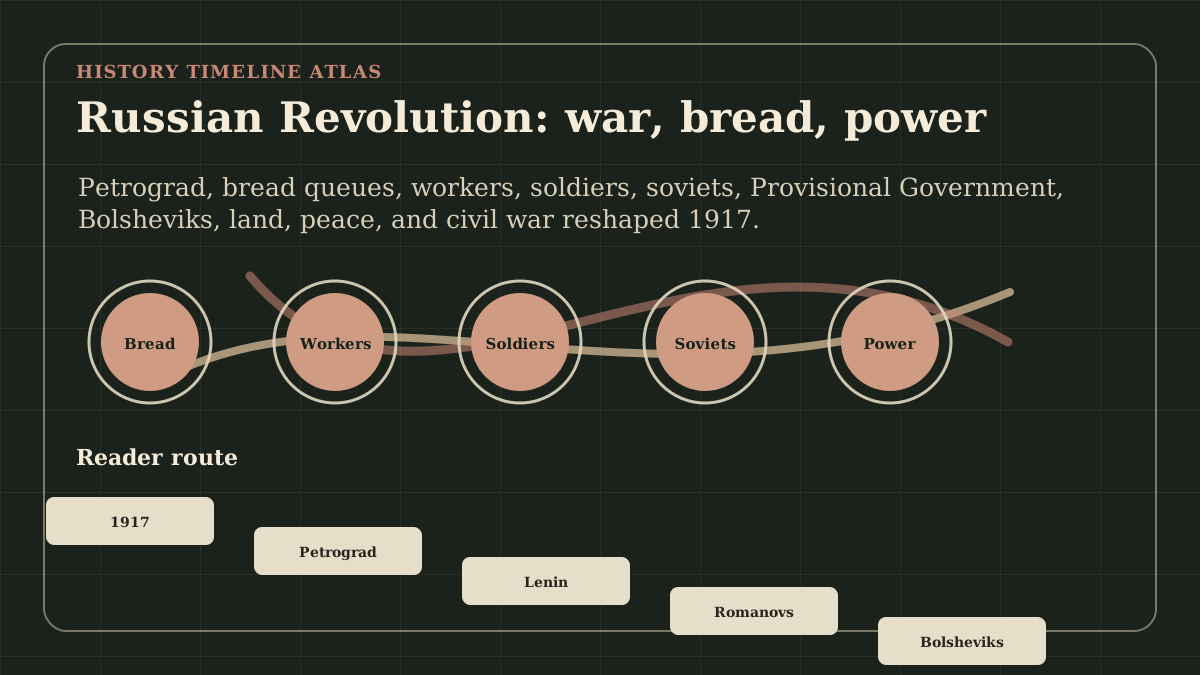
Background
For decades before 1917, the Russian Empire had been a vast, autocratic polity ruled by the Romanov dynasty. Rapid industrial growth had produced large urban working classes, while the majority rural population lived under uneven land relations and periodic hardship. The pressures that built toward revolution combined long-term social tensions with an immediate shock: participation in World War I. Military defeats, logistical breakdowns, and the enormous demands of sustaining a modern war strained supplies and finances. In Petrograd the city’s factories and docks were crucial nodes of production and of grievance; strikes and demonstrations were increasingly frequent. Political life, meanwhile, showed signs of pluralization—liberal reformers, socialists of different stripes, and conservative forces all jostled for influence.
Historians disagree about proportions: some emphasize structural forces—war, economic stress, and social change—while others underline the effect of choices by key individuals and contingencies on the streets. This page keeps those debates visible: the revolution was neither inevitable nor solely the result of a single leader’s plan. The Russian Revolution becomes richer when 1917 is not treated as one sudden Bolshevik event. War losses, food shortages, inflation, strikes, peasant anger, military breakdown, and distrust of the Romanov monarchy created a crisis before Lenin returned to Russia. February and October were connected, but they were not the same moment. Petrograd gives the revolution its human texture.
Bread queues, women workers, soldiers refusing orders, factory committees, street demonstrations, soviets, newspapers, and rumors all shaped the collapse of authority. The capital mattered because ordinary pressure and institutional failure met there in public. The months after the monarchy fell are essential. The Provisional Government claimed authority, soviets claimed revolutionary legitimacy, soldiers wanted peace, peasants wanted land, workers wanted control, national minorities wanted recognition, and parties competed over what revolution should mean. Dual power made politics urgent and unstable.
The Turning Point
The decisive change in 1917 came when public unrest and institutional breakdown shifted from episodic protest to a genuine contest for state power. The Romanov monarchy, long the axis of imperial authority, could no longer command loyalty across key institutions. In Petrograd, strikes and mass demonstrations intersected with soldiers’ refusals to fire on crowds and with the paralysis of administrative organs, producing a political vacuum. Into that vacuum stepped organized parties with rival programs. Vladimir Lenin and the Bolshevik leadership pressed for immediate transfer of power to workers’ and soldiers’ councils (soviets), arguing that the moment required bold, centralized action. Other socialist groups favored coalition government or gradual reform.
The decisive choices were both collective and individual: mass refusals to obey orders, the willingness of soldiers and sailors to side with protesters, tactical decisions by Bolshevik leaders to seize buildings and communication centers, and the inability of the monarchy’s supporters to mount a coherent defense. Those moves changed the balance on the streets and in the halls of power. What had begun as social breakdown and political collapse in 1917 crystallized into a seizure of state power by a faction that had prepared to act when institutions faltered. The first turning point was the February collapse of the monarchy. Once soldiers joined demonstrators and elites lost confidence in Nicholas II, the old regime could not govern.
That opened the revolution rather than settling it. The second turning point was the Bolshevik seizure of power in October. Promises of peace, land, and bread gained force because the existing government could not end the war or stabilize the state. The event changed a broad revolutionary crisis into a struggle over socialist rule and civil war.
Consequences
In the immediate aftermath, imperial rule in Russia ended and the country plunged into revolutionary civil conflict. The fall of the Romanovs removed the established axis of authority, while competing visions for Russia’s future—continued war versus immediate peace, land redistribution versus property protections, centralized control versus plural governance—led to armed struggle and political realignment. Longer-term, the events of 1917 provided the foundation for the Soviet state and for a distinctive set of ideological and policy experiments that influenced social policy, diplomacy, and global politics throughout the twentieth century. Governments, movements, and ideologues around the world read the Russian example with keen interest: some saw a model for radical social change, others a warning about authoritarianism and violence.
At the same time, caution is warranted: the revolution’s outcomes were not predetermined. Structural pressures made upheaval likely, yet contingent decisions by leaders, the behavior of armed forces, and local social dynamics shaped the form and timing of those outcomes. The contested nature of explanation—whether emphasis falls on deeper forces or on the choices of individuals—remains central to understanding both the immediate consequences and their long shadow. The immediate consequences included withdrawal from World War I negotiations, civil war, political repression, land redistribution struggles, and the creation of new institutions of party power. The longer consequence was the Soviet state, which reshaped global ideology, diplomacy, labor politics, anti-colonial movements, and twentieth-century conflict.
The revolution's memory is contested because it can be read as liberation, coup, social explosion, state collapse, or the beginning of authoritarian rule. A strong page lets those interpretations sit beside the concrete pressures of war, hunger, land, and power.
Interpretation Notes
Russian Revolution raises a debate about scale: did the decisive change come from the visible revolution, or from older pressures around Russia and Socialism that had already narrowed what people could do?
Why Keep Reading
If you want to follow how the revolution unfolded into governance and conflict, read the timelines of the provisional authorities, the Bolshevik consolidation of power, and the civil war that followed. Tracking those sequences shows how revolutionary promises met the practical demands of running a state—and how policy choices on land, peace, and labor escalated into armed confrontation. Exploring the international response also helps explain why the Russian Revolution mattered globally: it altered alliances, inspired movements abroad, and reshaped diplomatic assumptions. These linked events illuminate how a single year of rupture can produce decades of consequence. Read the Russian Revolution after World War I and before the Treaty of Versailles, Stalin, the Cold War, and decolonization routes.
That path shows how a wartime state crisis became a global ideological force.
Reading Path
Follow the story without losing the thread
Before This
- Zimmermann TelegramJanuary 1917
- Battle of VerdunFebruary-December 1916
- Battle of the SommeJuly-November 1916
After This
- Armistice of 1918November 11, 1918
- Spanish Flu Pandemic1918-1919
- Treaty of VersaillesJune 28, 1919
Same Period
- Assassination of Archduke Franz FerdinandJune 28, 1914
- Treaty of VersaillesJune 28, 1919
- Wall Street Crash of 1929October 1929
Wider Timeline
Mind Map
How to think about Russian Revolution
War strain
World War I placed huge logistical and human pressures on the empire, producing shortages and demoralization that fueled unrest.
Map Layer
Where this event sits geographically
Gold pins mark the approximate locations of published event pages. This is a schematic locator map, not a historical border map.
Coordinates are approximate and are used to help readers orient themselves before opening a full event page.
References
Where to Check the Facts
- National WWI Museum and Memorial: All About WWIMuseum reference hub for World War I chronology, maps, articles, and educational context.
- U.S. National Archives: World War I CentennialArchive reference hub for World War I records, photographs, documents, and educational resources.
- Encyclopaedia Britannica: Russian RevolutionReference for Russian Revolution chronology, political actors, and consequences.