At a Glance
The shape of the event
- Date
- 1918-1919
- Place
- Global
- Type
- Pandemic
An influenza pandemic spread across a world already disrupted by war, killing millions and exposing the limits of public health systems.
1918-1919; place the event in Global before comparing causes or consequences.
The pandemic became a key case for understanding disease mobility, wartime censorship, public health, and global vulnerability.
Global civilians and soldiers are the first names or groups to compare before widening the story.
Communities faced mass illness, death, quarantine measures, and social strain during and after World War I.
Communities faced mass illness, death, quarantine measures, and social strain during and after World War I.
The pandemic became a key case for understanding disease mobility, wartime censorship, public health, and global vulnerability.
Follow related events to see how the pandemic connects to the First World War’s logistics, to the emergence of modern public health, and to local stories of care and civic action.
Background
By 1918 the globe was marked by unprecedented movement and strain. World War I had drawn millions of men across oceans and continents, concentrated them in camps and trenches, and accelerated transport networks that connected cities and colonies. Public-health systems varied enormously; some localities had rudimentary surveillance and few hospital beds, others had recently professionalised health services but lacked capacity for mass outbreaks. Wartime priorities shaped what governments reported and what the press could publish: censorship and morale concerns sometimes delayed or muffled information about disease. Social conditions—crowding, malnutrition, disrupted labour and care networks—heightened vulnerability for many civilians as well as soldiers. Yet no single background factor explains the pandemic’s course.
Historians and epidemiologists continue to debate the relative weight of troop movements, viral biology, urban infrastructure, and local decision-making. This page keeps those disagreements visible: the pandemic emerged where structural pressures and individual actions intersected, not from one single cause. A stronger influenza page has to name the pandemic without repeating the old mistake in its nickname. 'Spanish flu' did not mean the disease began in Spain. Neutral Spain's press reported outbreaks more openly than many wartime states, so the label reflected visibility, censorship, and rumor as much as origin. The disease moved through a world already organized for mass movement.
Military camps, troop ships, rail hubs, colonial labor routes, crowded factories, refugee movements, and victory gatherings put bodies into close contact. Public health was local and uneven: one city might close schools early while another kept parades, theaters, churches, and workplaces open until hospitals were already overwhelmed. The mortality pattern gave the pandemic its shock. Many influenza outbreaks hit the very young and very old hardest, but 1918 also killed large numbers of young adults. Physicians, nurses, families, undertakers, volunteers, and local officials confronted a crisis whose biological speed outpaced both medical knowledge and administrative capacity.
The Turning Point
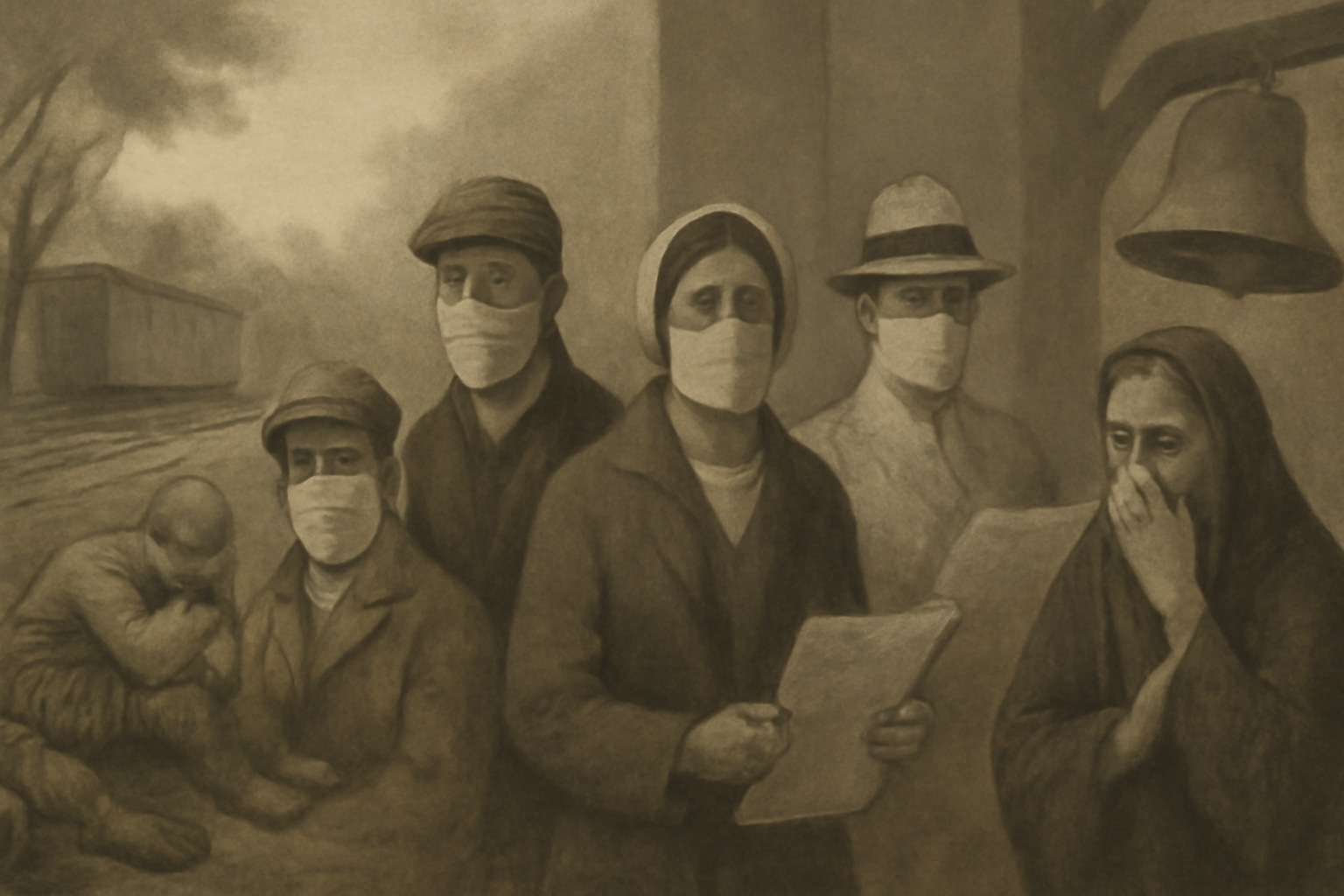
The pandemic’s decisive moment came as a convergence of human decisions and biological force. Military authorities, facing operational demands, moved and concentrated troops across ports, transports and front lines; medical officers within those forces tried to balance combat readiness against mounting illness. Local health boards and city officials made rapid, consequential choices—closing schools and theatres in some places, imposing quarantines and mask orders in others, while other communities delayed restrictive steps to avoid panic or economic disruption. Hospitals, both military and civilian, suddenly filled beyond capacity; volunteers and overstretched nurses provided improvised care under dire conditions. Censorship policies in wartime governments shaped public knowledge, in some instances limiting frank reporting and complicating coordinated responses.
Where officials enforced early isolation and transparent communication, outbreaks could be blunted; where movement continued and information flowed poorly, infection spread faster. The international transport and communication networks that sustained war also amplified the influenza agent’s reach. In short, the turning point was not a single event but a pattern of wartime movements and administrative choices colliding with a highly transmissible disease. The turning point was the severe wave of late 1918. Earlier illness had warned observers that influenza was moving, but the autumn wave made the scale impossible to ignore. Barracks, ships, ports, schools, factories, and households became transmission spaces, and decisions about closures or public gatherings could shape local death curves.
The contrast between cities became part of the historical lesson. Philadelphia's Liberty Loan parade is often remembered as a warning about mass gatherings during outbreak conditions, while St. Louis is often cited for earlier layered closures. The comparison is useful not because any city had perfect knowledge, but because timing, trust, and coordination mattered.
Consequences
In the near term, communities endured waves of illness, cascading absenteeism, and increased mortality that compounded wartime suffering. Civic life was interrupted: funerals and markets altered, schools and workplaces closed temporarily, and local economies strained under care burdens and lost labour. Public institutions faced legitimacy tests as citizens judged official responses. In the longer view, the pandemic became a central case for understanding disease mobility and the limits of existing public-health systems. Medical practitioners and administrators documented patterns of spread and experimented with non-pharmaceutical measures—quarantine, isolation, masking—that informed later practice. The experience exposed how wartime censorship and military priorities could impair civilian health responses, prompting debate about transparency and information-sharing in crises.
Scholars disagree about how much the pandemic reshaped broader political or social trajectories, but it unquestionably influenced the development of epidemiology, public-health surveillance and hospital planning in the interwar years. The pandemic’s memory also influenced later responses to infectious threats, offering lessons about preparedness, the social costs of containment, and the fragility of communities under multiple stresses. The immediate consequences were intimate: orphaned children, exhausted nurses, improvised wards, shortened funerals, disrupted work, and families mourning in communities already worn down by war. In India and other colonized regions, mortality was especially devastating, reminding readers that pandemic history is also a history of empire, poverty, nutrition, and administrative neglect. The longer afterlife was strangely quiet in public memory.
World War I ceremonies, demobilization, political upheaval, and private grief often overshadowed the pandemic, even though it killed on a global scale. That silence is itself historically important: societies can live through catastrophe without building a shared language for it. For modern readers, the page should not become a simple checklist of lessons. It is a case study in communication, trust, local authority, unequal vulnerability, non-pharmaceutical intervention, and the danger of treating disease as secondary to political or military priorities.
Interpretation Notes
Spanish Flu Pandemic can look simple when reduced to one date, but the evidence usually points to a wider setting. The useful debate is which part mattered most: leadership, logistics, belief, social pressure, or the institutions that survived afterward.
Why Keep Reading
Follow related events to see how the pandemic connects to the First World War’s logistics, to the emergence of modern public health, and to local stories of care and civic action. Tracing troop movements, censorship decisions, and municipal responses illuminates the mechanisms that let disease spread—and the small, often improvisatory measures that slowed it. If you want to understand how societies manage sudden medical crises while balancing social order and individual freedoms, the timelines that link 1914–1920 reveal consequential choices and contested interpretations worth following. Read this page beside World War I logistics, public health, smallpox vaccination, colonial labor systems, and later pandemic histories. That route connects disease to movement, empire, war, information, and the everyday labor of care.
Reading Path
Follow the story without losing the thread
Before This
- Armistice of 1918November 11, 1918
- Russian Revolution1917 CE
- Zimmermann TelegramJanuary 1917
After This
- Treaty of VersaillesJune 28, 1919
- Women's Suffrage in the United StatesAugust 18, 1920
- Wall Street Crash of 1929October 1929
Same Period
- Assassination of Archduke Franz FerdinandJune 28, 1914
- Russian Revolution1917 CE
- Treaty of VersaillesJune 28, 1919
Wider Timeline
Mind Map
How to think about Spanish Flu Pandemic
troop movements
concentration and transport of soldiers across borders accelerated spread
Map Layer
Where this event sits geographically
Gold pins mark the approximate locations of published event pages. This is a schematic locator map, not a historical border map.
Coordinates are approximate and are used to help readers orient themselves before opening a full event page.
References
Where to Check the Facts
- National WWI Museum and Memorial: All About WWIMuseum reference hub for World War I chronology, maps, articles, and educational context.
- U.S. National Archives: World War I CentennialArchive reference hub for World War I records, photographs, documents, and educational resources.
- Encyclopaedia Britannica: Black DeathReference for plague chronology, transmission debates, mortality, and social consequences.
- CDC: 1918 Pandemic H1N1 VirusPublic-health reference for the 1918 influenza pandemic and modern pandemic framing.