At a Glance
The shape of the event
- Date
- 1868 CE
- Place
- Kyoto and Tokyo
- Type
- Political Transformation
The Tokugawa shogunate collapsed and imperial rule was restored in a political settlement that launched intense state-led modernization.
1868 CE; place the event in Kyoto and Tokyo before comparing causes or consequences.
The restoration helped Japan become a major industrial and imperial power by the early twentieth century.
Emperor Meiji are the first names or groups to compare before widening the story.
Japan reorganized government, military, industry, education, and foreign policy.
Japan reorganized government, military, industry, education, and foreign policy.
The restoration helped Japan become a major industrial and imperial power by the early twentieth century.
Follow the Meiji Restoration into the subsequent decades to see how policy translated into factories, schools, and fleets.
Background
For more than two centuries the Tokugawa shogunate had organized political life around regional lords, established social hierarchies, and managed foreign contact in ways that suited a largely agrarian order. By the mid-nineteenth century that order was under strain: local debts, shifting commercial networks, and the circulation of new ideas made old arrangements brittle. Across East Asia and beyond, rival states were demonstrating different paths to power—industrialized, centralized, and rapidly expanding their reach. In Japan these pressures produced a crowded field of responses. Some actors sought adaptation within existing institutions; others argued for radical change. The collapse of the shogunate did not happen in isolation.
It followed years of political negotiation, regional maneuvering, and an accumulated sense among many leaders that the country needed a different institutional architecture if it was to survive and compete. Historians still debate how much of the outcome came from deliberate choices by individuals, and how much from deeper structural forces that made change almost inevitable. This page keeps those tensions visible rather than settling the question. The Meiji Restoration was not simply Japan choosing modernization. It followed the crisis of Tokugawa authority under foreign pressure, unequal treaties, internal domain politics, samurai discontent, and debates over how to preserve independence in an imperial world. The slogan of restoring imperial rule hid a complicated coalition.
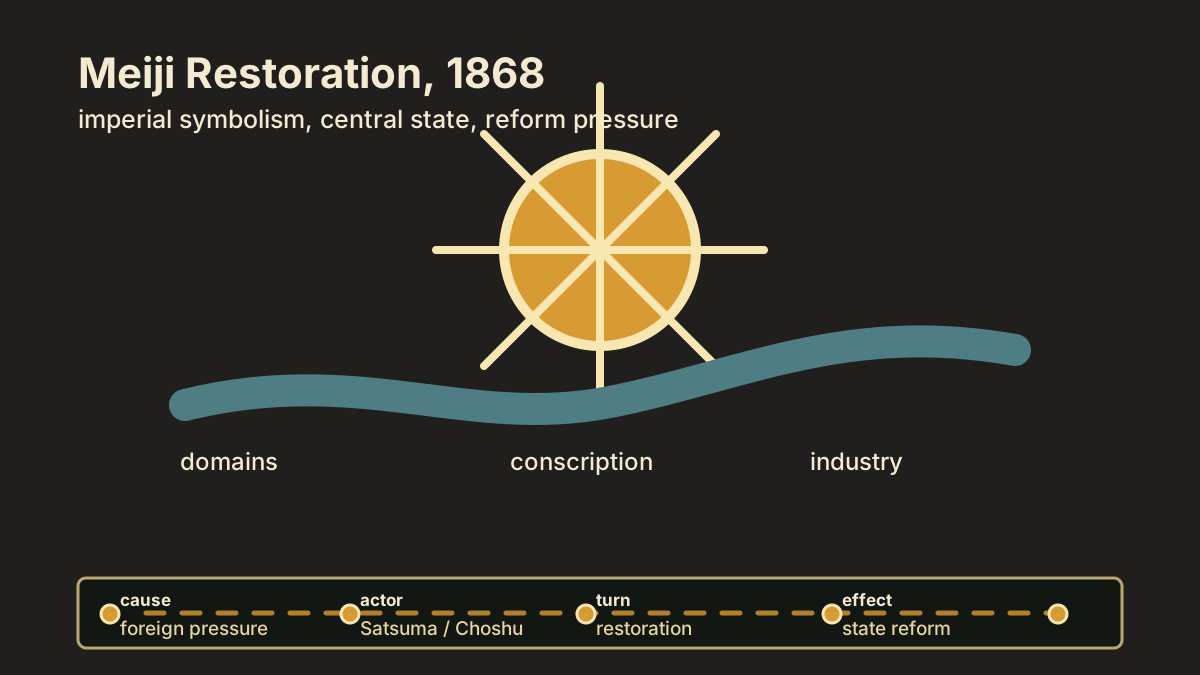
Leaders from domains such as Satsuma and Choshu used the emperor's authority to replace the shogunate, but the new order quickly became a centralized reform state rather than a return to ancient politics.
The Turning Point
The decisive moment of 1868 was less a single battle than a rapid reordering of authority: the shogunate’s hold on national governance ended, and imperial rule was formally restored under Emperor Meiji. Kyoto, the imperial city, and the new political center in what became Tokyo became the nodes through which decisions flowed. Restoration meant a political settlement in which sovereignty was recast; power was rearticulated from feudal networks toward centralized institutions. That settlement carried choices with tangible effects: leaders opted to concentrate policymaking authority in national bodies rather than in competing regional domains; they prioritized building institutions able to project power outward and to mobilize resources inward.
Those choices directed energies into reorganizing fiscal systems, assembling a new kind of military capacity, and creating administrative structures for education and industry. The settlement was not uniform or uncontested—local actors resisted, negotiated, and adapted—but it set a clear trajectory. Emperor Meiji served as the public center of legitimacy for a project that would be carried out by officials, military figures, entrepreneurs, and educators who turned the rhetorical restoration of the throne into practical programs of state-led modernization. The turning point was the transfer of political legitimacy from the Tokugawa shogunate to a new imperial government capable of remaking institutions. That shift enabled land-tax reform, conscription, school systems, industrial policy, legal change, and military modernization.
It also created losers: former samurai privileges were dismantled, local autonomy narrowed, and ordinary people faced new taxes and obligations. The Restoration was therefore both revolutionary and conservative, using imperial symbolism to justify rapid state-building.
Consequences
In the near term the Meiji Restoration produced rapid institutional change: government administration was reconfigured, military organization was remade, and attention turned to developing industry and education under national guidance. Those reforms were directed toward making Japan capable of defending itself and asserting interests abroad. Over the following decades these efforts accumulated into a vastly different national profile. By the early twentieth century Japan had become a major industrial and imperial power—a transformation rooted in the decisions and investments set in motion from 1868. The restoration also carried social costs and contradictions: centralization disrupted older elites and local practices, and rapid modernization produced dislocation and uneven benefits across society.
Internationally, the restored imperial state pursued a foreign policy that projected influence beyond the home islands. Interpretations of these outcomes remain contested. Some scholars emphasize the strategic choices of leaders and the decisive moments that opened paths to power; others point to long-term structural pressures—economic change, information flows, and global military competition—that made such a transformation likely. The history of 1868 is best read as a convergence of agency and structure, where dramatic decisions met pre-existing forces to produce a durable national shift. Meiji reforms helped Japan avoid colonization and become an imperial power in its own right. Industrialization, constitutional politics, military expansion, and empire in Korea, Taiwan, and beyond all grew from the new state's capacity.
A simple success story misses the darker side of the same state-building capacity. The same reforms that built schools, factories, and railways also strengthened coercive institutions and expansionist ambitions. Meiji Japan shows how defensive modernization can become imperial power.
Interpretation Notes
Meiji Restoration raises a debate about scale: did the decisive change come from the visible political transformation, or from older pressures around Japan and Modernization that had already narrowed what people could do?
Why Keep Reading
Follow the Meiji Restoration into the subsequent decades to see how policy translated into factories, schools, and fleets. Look for episodes that show the mechanics of change: how administrations organized taxation, how a new military was recruited and equipped, how education standards were set, and how commercial institutions linked local producers to global markets. Each thread illuminates a different aspect of the same project—one that transformed social relationships at home and altered Japan’s standing abroad. If you want to understand the origins of modern Japan’s institutions, or the contested choices that made empire possible, the next pages and timelines trace the policies, debates, and practical experiments that turned 1868 from moment to movement.
Read next through Opium War, Perry's arrival, Sino-Japanese War, Russo-Japanese War, and East Asia modernity. The route compares Japan's response to Western pressure with Qing China and other states facing unequal treaties.
Reading Path
Follow the story without losing the thread
Before This
- American Civil War BeginsApril 12, 1861
- Revolutions of 18481848 CE
- First Opium War Begins1839 CE
After This
- Opening of the Suez CanalNovember 17, 1869
- First Sino-Japanese War Begins1894
- Atomic Bombing of HiroshimaAugust 6, 1945
Same Period
- Industrial Revolution Beginsc. 1760 CE
- Battle of WaterlooJune 18, 1815
- First Opium War Begins1839 CE
Wider Timeline
Mind Map
How to think about Meiji Restoration
Centralization
Political settlement concentrated authority in national institutions around the emperor
Map Layer
Where this event sits geographically
Gold pins mark the approximate locations of published event pages. This is a schematic locator map, not a historical border map.
Coordinates are approximate and are used to help readers orient themselves before opening a full event page.
References
Where to Check the Facts
- Encyclopaedia Britannica: Meiji RestorationSpecific reference for the 1868 political transformation, imperial restoration, modernization, and state reform.
- Encyclopaedia BritannicaBackground reference for chronology, names, and historical context.
- WikidataStructured reference for dates, places, alternate names, and entity links.