At a Glance
The shape of the event
- Date
- c. 1464 CE
- Place
- Gao
- Type
- Imperial Expansion
Songhai expanded from Gao into a powerful Sahelian empire, controlling strategic cities and routes after Mali's authority weakened.
c. 1464 CE; place the event in Gao before comparing causes or consequences.
Its rise shows continuity and competition among West African empires rather than a single isolated golden age.
Sunni Ali are the first names or groups to compare before widening the story.
Songhai became a dominant political and commercial power in West Africa.
Songhai became a dominant political and commercial power in West Africa.
Its rise shows continuity and competition among West African empires rather than a single isolated golden age.
If this moment captures your attention, follow the thread to see how political control of trade translated into the everyday life of towns, the strategies rulers used to govern diverse peoples, and how merchants navig...
Background
For decades before c. 1464 the political map of the western Sahel had been shaped by large imperial centers whose authority waxed and waned. The Mali polity’s capacity to enforce rule over distant towns and trade corridors weakened, leaving gaps where local rulers and rival powers could press claims. Long-standing institutions—urban centers with entrenched merchant networks, legal and religious authorities, systems of tribute and taxation—did not disappear; they persisted as resources and constraints. Geography also mattered: the Sahel’s position between the Sahara and riverine zones concentrated trans-Saharan and regional trade through a handful of strategic cities. Resources such as goldfields, salt, and agricultural surpluses continued to anchor economic exchange. The hardest interpretive question about this moment is causation.
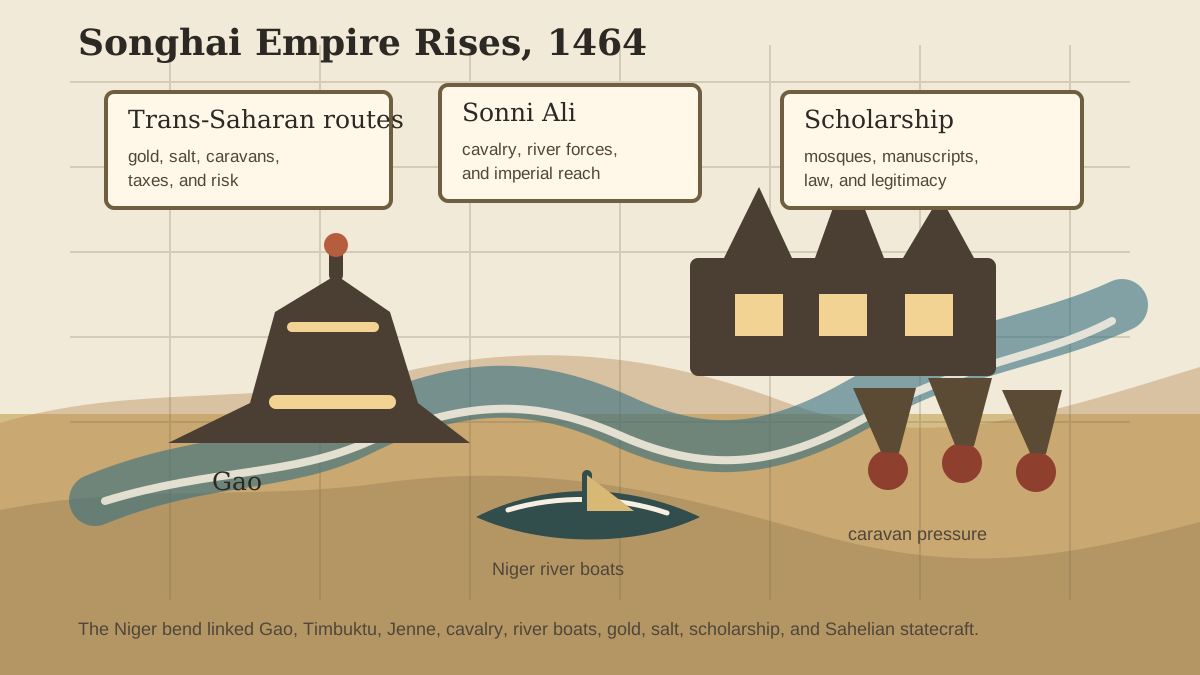
The rise of Songhai had immediate actors and military choices, but its meaning also rested on pre-existing institutions, geography, resources, and the expectations of merchants and elites across the region. No single explanation—charismatic leadership, economic opportunity, or institutional failure—suffices on its own. Songhai's rise should begin with the Niger bend, not with a list of rulers. Gao, Timbuktu, Jenne, river transport, Sahelian pasture, desert caravans, gold, salt, books, and Islamic scholarship formed the geography of opportunity. The empire grew where river movement and trans-Saharan exchange could reinforce each other. Mali's earlier prestige still mattered. Songhai did not rise in a historical vacuum; it inherited, challenged, and redirected networks that had made Mansa Musa's world possible.
Sonni Ali's achievement was to turn Gao's position and military capacity into a broader imperial project.
The Turning Point
What changed around c. 1464 was that Songhai, based at Gao, moved from being one polity among many to a force capable of imposing authority across strategic points of the Sahel. Sunni Ali is the concrete actor most associated with that transformation: under his leadership Songhai expanded outward from Gao, taking control of key cities and routes that had previously fallen under Mali’s sphere of influence. The choices were concrete and consequential: asserting military power to seize towns, integrating captured urban centers into a broader political framework, and securing the movement of goods and people along those routes.
Those decisions reconfigured local balances of power—urban elites and merchant groups had to adapt to new centers of taxation and protection, and rival polities found their margins eroded. The moment was decisive not because one element alone created change, but because an assertive leader acted at a time when established structures and opportunities made expansion practicable. The turning point was the use of mobility. Cavalry on land and boats along the Niger allowed Songhai forces to link towns, grain zones, and trade routes across a wide space. Timbuktu and Jenne mattered not only as conquests but as intellectual and commercial nodes whose cooperation or resentment could affect imperial stability. Religion and politics added another layer.
Sonni Ali's reputation varies sharply across sources: some traditions praise military genius and state-building, while scholars associated with Timbuktu criticized his treatment of religious elites. That tension lets readers see empire as negotiation between soldiers, merchants, scholars, and local communities.
Consequences
In the near term, Songhai’s expansion produced a clear shift in who set political and commercial rules across wide stretches of the Sahel: it became the dominant political and commercial power in West Africa, exercising control over important urban hubs and the caravan lines that linked them. That dominance altered patterns of taxation, security, and patronage: merchants encountered new authorities and systems for levying tolls, and cities adjusted to new political oversight. Over the longer term, the rise of Songhai demonstrates that West African history in this period was characterized by continuity and competition among empires rather than a single isolated golden age. Institutional forms—city governance, trade networks, religious and legal authorities—continued and were repurposed under Songhai rule.
The event also set a precedent for how regional powers could combine military initiative with control over commerce to build influence. Yet caution is necessary: this outcome was contingent. Geography, existing institutions, and the flow of resources shaped possibilities, and later developments would test Songhai’s capacity to sustain that dominance. Understanding this rise helps explain subsequent shifts in authority and economy across the region without treating the moment as either wholly inevitable or entirely accidental. Songhai's rise created one of West Africa's largest premodern states. Under Askia Muhammad after Sonni Ali, administration, Islamic legitimacy, pilgrimage, taxation, and scholarship took new forms. The empire helped make the western Sahel central to world history rather than peripheral to it.
Its later fall to Moroccan forces in 1591 should not make the rise look fragile from the start. For more than a century, Songhai showed how African states could organize long-distance trade, urban scholarship, military logistics, and imperial administration across difficult environments.
Interpretation Notes
The hardest question around Songhai Empire Rises is causation. The event had immediate actors, but its meaning also came from institutions, geography, resources, and expectations already present in West Africa.
Why Keep Reading
If this moment captures your attention, follow the thread to see how political control of trade translated into the everyday life of towns, the strategies rulers used to govern diverse peoples, and how merchants navigated new authorities. Exploring what came before—Mali’s structures—and what followed will show how sunlight and shadow of power moved through the Sahel: how commerce, military force, and local institutions interacted over decades. Maps of trade routes, biographies of leaders, and urban case studies will make clear why city control mattered so much for West Africa’s political geography. Read Songhai with Ghana, Mali, Mansa Musa, Timbuktu, trans-Saharan trade, and Moroccan expansion.
The route shows continuity and change across West African empires instead of treating each kingdom as an isolated chapter.
Reading Path
Follow the story without losing the thread
Before This
- Malacca Sultanate Risesc. 1400 CE
- Majapahit Empire Peaksc. 1350 CE
- Black Death Reaches Europe1347 CE
After This
- Portuguese-Kongo Contact1483 CE
- Columbian Exchange Begins1492 onward
- Vasco da Gama Reaches India1498 CE
Same Period
- Black Death Reaches Europe1347 CE
- First Opium War Begins1839 CE
- Opening of the Suez CanalNovember 17, 1869
Wider Timeline
Mind Map
How to think about Songhai Empire Rises
Mali's decline
Weakened central authority left strategic cities and routes open to new claimants.
Map Layer
Where this event sits geographically
Gold pins mark the approximate locations of published event pages. This is a schematic locator map, not a historical border map.
Coordinates are approximate and are used to help readers orient themselves before opening a full event page.
References
Where to Check the Facts
- Encyclopaedia Britannica: Songhai EmpireReference for Songhai's chronology, geography, rulers, and imperial expansion.
- World History Encyclopedia: Songhai EmpireSupporting reference for Gao, Timbuktu, trade paths, and Songhai state formation.