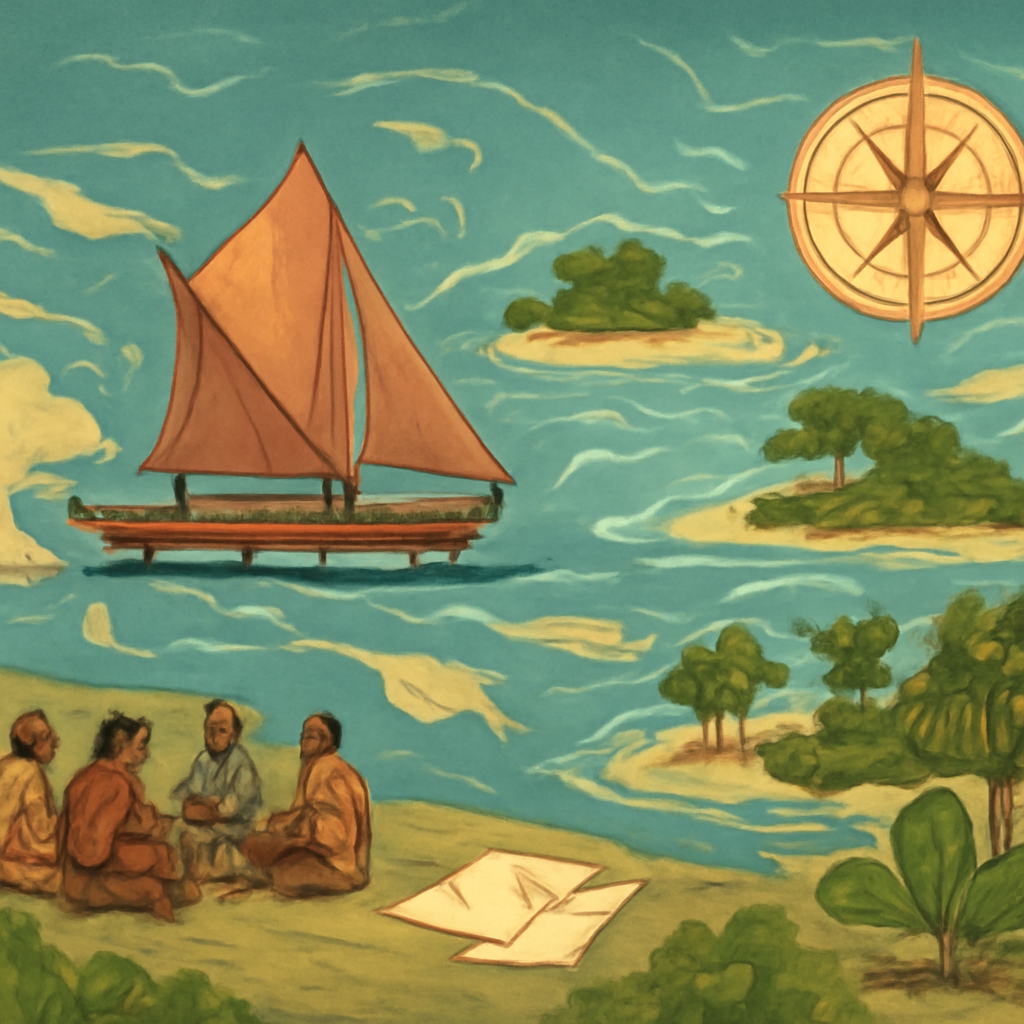
Read canoes, stars, winds, memory, and settlement as historical infrastructure.
Timeline
Pacific and Oceania Sovereignty Timeline
A route through Polynesian settlement, Pacific chiefdoms, Rapa Nui, Australia, Hawaii, Waitangi, Maori politics, nuclear testing, decolonization, and climate diplomacy.
Timeline Guide
How did Pacific voyaging, Indigenous sovereignty, nuclear testing, decolonization, and climate diplomacy shape world history?
Read this edited guide as a path through dates, places, affected lives, source limits, and contested memory rather than as an exhaustive database.
The opening dates are written as short events. c. 1600 BCE: Lapita families carried pottery, crops, and settlement knowledge into western Pacific networks. 1769: Tupaia used route, wind, reef, and island knowledge beside Cook's expedition in Tahiti and Aotearoa. 1840: Maori rangatira and Crown representatives negotiated Te Tiriti at Waitangi. 1893: Queen Liliuokalani faced annexationist pressure in Hawaii. 1966: France began nuclear testing at Moruroa in French Polynesia. 1975: Papua New Guinea became independent. 1988: Bougainville conflict grew around Panguna mine damage and autonomy. 2019: Bougainville voters chose overwhelmingly for independence in a nonbinding referendum. 2015 onward: island diplomats turned sea-level rise into law and security language.
Keep the map simple at first. Polynesia includes places such as Samoa, Tonga, Tahiti, Hawaii, Rapa Nui, and Aotearoa New Zealand. Melanesia includes Papua New Guinea, Bougainville, Solomon Islands, Vanuatu, Fiji, and New Caledonia. Micronesia includes island groups north of Melanesia such as Kiribati, the Marshall Islands, Palau, and the Federated States of Micronesia. These are modern regional labels, useful but contested, and they are not the only way Pacific people map ancestry, sea routes, kinship, language, or obligation.
Australia sits beside these histories through Sahul, Aboriginal and Torres Strait Islander sovereignty, settler colonial law, frontier violence, war, and regional diplomacy. Its colonial and legal context differs from island Pacific sovereignty debates, so the page treats it as connected but not interchangeable.
Core terms stay plain. Lapita names an archaeological culture linked to early Pacific settlement. Bougainville is an autonomous region within Papua New Guinea. Moruroa is in French Polynesia, where nuclear testing made sovereignty and environmental harm impossible to separate. Kawanatanga and rangatiratanga are Treaty of Waitangi terms often discussed through governance, authority, chiefly authority, and self-determination; exact translation and legal meaning are debated.
Start With These Dates
- c. 1600 BCELapita Expansion Begins
Lapita communities expanded across island chains, carrying pottery styles, seafaring knowledge, crops, animals, and settlement practices into the western Pacific.
- c. 900 CEHawaiian Settlement Expands
Polynesian settlement expanded in Hawaii through ocean navigation, voyaging knowledge, agriculture, kinship, and island adaptation.
- c. 1000 CEEastern Polynesia Settlement Expands
Polynesian voyagers expanded settlement across distant eastern Pacific islands, using navigation, canoe technology, ecological knowledge, and social networks.
- c. 1200 CETongan Maritime Chiefdom Expands
Tongan chiefly power expanded through voyaging, tribute, kinship, and maritime connections across parts of the central Pacific.
- 1893Overthrow of the Hawaiian Kingdom
A group of foreign residents backed by United States power overthrew Queen Liliuokalani and the Hawaiian Kingdom.
- 1987Nuclear Free New Zealand Act
New Zealand passed nuclear-free legislation that restricted nuclear-powered and nuclear-armed vessels and reshaped alliance politics.
- 1988Bougainville Conflict Begins
Conflict began in Bougainville amid disputes over mining, environmental damage, autonomy, and state authority.
- 2015Small Island States Push the Paris Agreement
Small island states, including Pacific voices, pushed climate diplomacy toward recognizing survival, sea-level rise, and the 1.5 degree goal.
Sources Used Here
- Te Ara: Pacific migrations
Reference for Pacific voyaging, settlement routes, Polynesian migration, and Aotearoa context.
- Te Ara: Tupaia
Pacific-based biographical reference for Tupaia's navigation, mediation, and role during Cook's voyage.
- University of Hawaii ScholarSpace: Epeli Hau'ofa, Our Sea of Islands
Pacific scholar's argument for reading Oceania as a connected sea of islands rather than scattered small places.
- Waitangi Tribunal: Treaty claims and Te Tiriti
Pacific-based institutional reference for Te Tiriti, Maori claims, Crown obligations, and treaty interpretation.
- Encyclopaedia Britannica: Hawaii history
Reference for Hawaiian settlement, kingdom history, and later United States annexation.
Three human-scale episodes carry the argument. At Waitangi, rangatira debated text, translation, kawanatanga, rangatiratanga, protection, land, and authority in a crowded treaty setting whose meanings remain contested. Around Moruroa, test-site secrecy, lagoon water, church protest, health fears, and anti-nuclear voyages made French strategic language answer to island experience. In Bougainville, the Panguna mine, landowner anger, women and church peace work, civil conflict, weapons disposal, and the 2019 referendum made independence a lived debate rather than a slogan.
The scenes can be read almost by touch. At Waitangi, the problem was paper, speech, translation, and land underfoot. Around Moruroa, the problem was not only a bomb but a lagoon, wind, medical records, state secrecy, and families asking what had entered bodies. In Bougainville, the problem was a mine road, a damaged river, a church meeting, a mother pressing for peace, and a ballot that still needed political negotiation after the count.
Short voices help the page stay grounded. Hau'ofa's phrase "sea of islands" gives readers a Pacific-centered way to imagine Oceania as connection rather than isolation. Bougainville peace dialogues show people asking how a referendum would affect families, land, weapons, and daily safety. Pacific climate diplomacy often speaks from lived shoreline risk as well as law, science, and state negotiation.
Difference stays visible. Maori treaty activism often centers Te Tiriti, land, language, rangatiratanga, and Crown obligation. French Polynesian anti-nuclear activism centers testing, health, archives, reparations, and French state power. Bougainville politics has to balance independence aspirations with Papua New Guinea's state integrity, mine revenue, local trauma, and referendum negotiation. Small-island climate diplomacy speaks in state, community, legal, scientific, and moral registers at once.
Local voices and institutions are named where possible. Te Ara anchors Pacific migration, Aotearoa context, and Tupaia; Epeli Hau'ofa's Our Sea of Islands pushes against the idea of tiny isolated islands; the Waitangi Tribunal anchors treaty claims; NZ History anchors anti-nuclear protest; the Bougainville Referendum Commission and PaCSIA anchor referendum and dialogue material; the Pacific Islands Forum's Blue Pacific strategy anchors climate diplomacy from a regional institution rather than an outside observer.
Health and nuclear claims are kept sourced and cautious. NZ History records French nuclear testing and regional protest, while the Moruroa Files project links declassified documents and dose reconstruction to contested health-impact claims in French Polynesia. Activists, churches, veterans, workers, and families argued from lived risk and secrecy; French state language often emphasized strategy, legality, and technical control. The page does not flatten that conflict into one unqualified sentence.
The date anchors are concrete: Lapita movement before later Polynesian voyaging, Cook's Tahiti visit in 1769, Te Tiriti o Waitangi in 1840, Hawaiian overthrow in 1893, Moruroa nuclear testing from 1966, Papua New Guinea independence in 1975, Bougainville conflict after 1988, the 2019 Bougainville referendum, and twenty-first-century climate diplomacy.
This timeline treats the Pacific as a historical center. Lapita expansion, Polynesian settlement, Hawaii, Tonga, Aotearoa, Rapa Nui, and later island polities show that the ocean was not empty space. It was a field of routes, memory, navigation, kinship, crops, canoes, winds, currents, and political relationships.
The colonial chapter follows Cook, the First Fleet, Hawaii, Waitangi, Maori political organization, and the overthrow of the Hawaiian Kingdom. Each node asks how outside powers claimed sovereignty in places where Indigenous authority, law, land tenure, monarchy, and treaty-making already existed. The point is not contact alone; it is contested authority.
The Cold War chapter moves from alliance politics to nuclear testing. ANZUS, Moruroa, and nuclear-free New Zealand show how Pacific places became strategic zones, test sites, protest arenas, and diplomatic voices. The same ocean that carried voyagers also carried warships, fallout, activists, and international law.
The decolonization and climate chapter follows Papua New Guinea, Bougainville, and small island climate diplomacy. These pages show sovereignty after formal empire: resource conflicts, autonomy claims, environmental damage, state capacity, sea-level rise, and global negotiations. Pacific states and communities are not passive symbols of vulnerability; they are historical actors.
The meaning of distance changes across the route. Navigation made distance knowable; empire made distance governable from outside; nuclear testing made distance a political excuse; climate diplomacy made distance irrelevant because sea-level rise connects local survival to global emissions.
The page needs this breadth because Pacific history is often treated as scattered islands around someone else's map. A better route begins from ocean knowledge, kinship, ceremony, land, fishing grounds, monarchy, treaty language, and Indigenous law. European voyages and settler colonies enter the story later, and they enter places that already had political meaning.
The reader path also connects older and newer forms of sovereignty. The Treaty of Waitangi, the Hawaiian overthrow, ANZUS, nuclear-free policy, Papua New Guinea independence, Bougainville, and small island climate diplomacy all ask who gets to define security. Sometimes security meant land, sometimes monarchy, sometimes freedom from testing, and sometimes survival against rising seas.
Readers can use the timeline as a corrective to continent-centered history. The Pacific is not an empty border around Asia, Australia, and the Americas. It is a route system with its own archives, navigational knowledge, diplomatic claims, protest movements, and climate arguments that changed global institutions from island-centered positions. The route turns ocean distance into historical evidence and gives readers a clearer regional memory.
This route begins from the ocean as infrastructure. Lapita expansion, Polynesian settlement, Hawaiian and Tongan histories, Maori settlement, and Rapa Nui make sense through canoes, stars, winds, currents, crops, genealogy, ritual, and memory. The Pacific was not empty distance waiting for outside maps. It was a navigated world where knowledge itself carried authority.
European contact enters a political field that already existed. Cook's voyages, the First Fleet, Hawaii, Waitangi, Maori king-making, and the overthrow of the Hawaiian Kingdom all show outsiders making claims in places with land tenure, ceremony, monarchy, kinship, law, and diplomacy. The point is not first contact as spectacle. The question is who had authority to define land, allegiance, and treaty meaning.
The settler-colonial layer gives the timeline a sharper edge. Australia and Aotearoa raise questions of invasion, treaty, dispossession, legal translation, disease, labor, pastoral expansion, and Indigenous resistance. Hawaii adds monarchy, sugar interests, United States power, and sovereignty memory. These cases differ, but all ask how empire used documents and force to make older political orders easier to deny.
The Cold War chapter changes the ocean's meaning again. Pearl Harbor, Coral Sea, ANZUS, Moruroa, nuclear-free New Zealand, and Pacific protest show the region becoming a strategic and nuclear space. Distance became an argument used by outside powers, while island communities turned testing, fallout, health, militarization, and environmental damage into claims before national and international audiences.
Decolonization and resource conflict keep the route from stopping at empire. Papua New Guinea independence, Bougainville, and regional diplomacy show that statehood brought new questions: mining revenue, autonomy, environmental harm, ethnic politics, administrative capacity, and relations with Australia, New Zealand, France, the United States, and Asian neighbors. Sovereignty had to be built through institutions as well as declared.
The reader also needs scale discipline. A single island, a voyaging network, a kingdom, a settler colony, an alliance treaty, a test site, and a climate bloc are different political units. Moving between them is the point of the page. Pacific history becomes clearer when the route shows how small places can carry world-scale arguments.
Climate diplomacy is the modern endpoint because it returns the route to land, sea, and survival. Small island states have turned sea-level rise, emissions, loss and damage, migration, fisheries, and international law into global political language. They are not symbols of helplessness; they are states and communities using diplomacy, science, moral argument, and coalition-building to defend a future.
For a quick route, follow Lapita, Polynesian settlement, Hawaii, Maori settlement, Waitangi, Hawaiian overthrow, ANZUS, Moruroa, Papua New Guinea, nuclear-free New Zealand, Bougainville, and small island climate diplomacy. For a deeper route, add Tonga, Rapa Nui, Cook, the First Fleet, Maori King movement, Coral Sea, Pearl Harbor, Midway, Hiroshima, Indonesia, and ASEAN to see the Pacific in global war and regional order.
The story is strongest when read in layers. First, follow the dates from c. 1600 BCE to 2015. Then read across the event types: migration and maritime culture, migration and settlement, oceanic settlement, maritime political expansion. The timeline becomes more than chronology when those dates reveal decisions, institutions, violence, reform, and memory.
Overthrow of the Hawaiian Kingdom sits near the middle of the sequence. Ask what had already become unavoidable by 1893, what actors still believed they could control, and which consequences were already beginning to move beyond the original setting.
The named events are Lapita Expansion Begins, Hawaiian Settlement Expands, Eastern Polynesia Settlement Expands, Tongan Maritime Chiefdom Expands, Maori Settlement of Aotearoa, Rapa Nui Moai Building Peaks. Each one pushes a more precise question: what changed, who benefited, who paid the cost, and what later page explains the aftermath more clearly?
Read the timeline against geography too. Places matter because power moves through corridors, borders, cities, ports, capitals, and frontiers. The map below keeps those distances visible while the event pages explain the human and institutional consequences.
A good timeline has a pulse: pressure, decision, expansion, resistance, and aftermath. When you move through Prehistoric Pacific, Pacific Settlement, Medieval Pacific, and Pacific Chiefdoms, keep asking whether an event is creating a new problem, revealing a hidden weakness, or making an earlier choice harder to reverse.
The human layer matters because timelines can become too abstract. Figures such as Lapita communities, Polynesian navigators, Hawaiian communities, Polynesian voyagers, Tongan chiefs, Pacific voyagers, and Maori ancestors help the sequence feel lived rather than mechanical. Their choices do not explain everything, but they show where institutions, ideas, military systems, social movements, and public fear entered real decisions.
The ending is not only the last date. With closing events such as Papua New Guinea Gains Independence, Nuclear Free New Zealand Act, Bougainville Conflict Begins, and Small Island States Push the Paris Agreement, the reader can ask what remained unsettled: which institutions survived, which arguments continued, which victims or opponents were left outside the official story, and which later crisis reused the same vocabulary.
Read this page once quickly for order, then read it again for contrast. Compare early confidence with later uncertainty, local decisions with global consequences, and visible turning points with slower changes in law, economy, belief, technology, borders, or memory. That second pass is where a timeline becomes an explanation.
Causation in this sequence is layered. One event may supply the trigger, another may reveal an older weakness, and a later event may show the consequence that people at the beginning did not expect. The useful habit is to separate background pressure, immediate decision, turning point, and aftermath before deciding which event matters most.
Consequences are uneven. A political settlement might look successful in one capital while creating resentment elsewhere; a military victory might end a campaign while deepening civilian trauma; a scientific or institutional breakthrough might solve one problem while creating new risks. The timeline is strongest when those mixed outcomes remain visible.
The final pass is comparative. After reading this sequence, open a neighboring topic or person page and ask whether the same pattern appears again. Repetition usually points to a structure; contrast usually points to a historical choice that could have gone another way.
Importance is not the same thing as drama. Some events are remembered because they were spectacular, while others matter because they changed rules, expectations, alliances, legal categories, technologies, or public language. Use the timeline to test both kinds of importance before deciding what belongs at the center of the story.
The page rewards moving outward. A timeline gives order, but the event pages give causes, maps, people, sources, and reading paths. When a date feels too compressed, open the full event page and then return here; the sequence becomes clearer with each pass instead of asking the reader to memorize a list.
Compare Hawaii, Waitangi, Australia, and Bougainville as different authority disputes.
Follow testing and protest as Cold War history from an island-centered view.
Use small island diplomacy to connect historical responsibility with survival.
Read canoes, stars, currents, islands, kin networks, ports, naval routes, test sites, and climate data as forms of historical evidence.
Use Waitangi, Hawaii, ANZUS, nuclear-free law, and climate agreements to ask how legal language travels across unequal power.
Start with voyaging, move to treaty and settler conflict, then follow nuclear testing, decolonization, resource conflict, and climate diplomacy.
Lapita Expansion Begins gives the opening problem a date and place. Ask what was already unstable before it happened.
Overthrow of the Hawaiian Kingdom is a compression point: earlier causes are now crowded together with decisions that will shape the sequence's ending.
Follow the path through Bismarck Archipelago, Hawaiian Islands, Eastern Polynesia, Tonga, Aotearoa New Zealand, and Rapa Nui and ask how distance changed communication, logistics, fear, and control.
Small Island States Push the Paris Agreement works as both an ending and a beginning: it closes one sequence while opening later disputes, institutions, memories, or reforms.
Which conditions existed before the first event, and which later decision turned those conditions into visible historical change?
Who had the power to choose, who had fewer choices, and who is missing when the story is told only through leaders or institutions?
Which facts are date anchors, which are interpretations, and which claims need checking through the event sources before being repeated?
Which linked event, person, year, or topic page would change your interpretation if you read it next?
Interactive Timeline
Explore Pacific and Oceania Sovereignty Timeline by sequence
Lapita Expansion Begins
Lapita communities expanded across island chains, carrying pottery styles, seafaring knowledge, crops, animals, and settlement practices into the western Pacific.
Read the full event pageNarrative Stages
Read this timeline in chapters
Ocean Knowledge and Island Polities
Lapita, Polynesian settlement, Hawaii, Tonga, Maori settlement, and Rapa Nui show Pacific history beginning with navigation, kinship, ritual, and political authority.
- Lapita Expansion Beginsc. 1600 BCE
- Eastern Polynesia Settlement Expandsc. 1000 CE
- Hawaiian Settlement Expandsc. 900 CE
- Tongan Maritime Chiefdom Expandsc. 1200 CE
- Maori Settlement of Aotearoac. 1250 CE
- Rapa Nui Moai Building Peaksc. 1250 CE
Contact, Settlement, and Treaty Conflict
Cook, the First Fleet, Kamehameha, Waitangi, Maori King politics, and Hawaii's overthrow show outside claims entering places with existing authority.
Pacific War and Strategic Ocean
Pearl Harbor, Coral Sea, Midway, Hiroshima, and ANZUS show the Pacific becoming central to global war, alliance systems, and nuclear modernity.
- Attack on Pearl HarborDecember 7, 1941
- Battle of the Coral SeaMay 1942
- Battle of MidwayJune 1942
- Atomic Bombing of HiroshimaAugust 6, 1945
- ANZUS Treaty Signed1951
Nuclear Testing and Decolonization
Indonesian independence, Moruroa, Papua New Guinea, nuclear-free New Zealand, Bougainville, and ASEAN show sovereignty after empire under military and regional pressure.
- Indonesia Proclaims IndependenceAugust 17, 1945
- French Nuclear Testing Begins at Moruroa1966
- Papua New Guinea Gains Independence1975
- Nuclear Free New Zealand Act1987
- Bougainville Conflict Begins1988
- ASEAN FoundedAugust 8, 1967
Climate Diplomacy
Small island climate diplomacy turns Pacific sovereignty toward emissions, sea-level rise, loss and damage, survival, and international law.
Map Layer
Pacific and Oceania Sovereignty Timeline geography
Gold pins mark the approximate locations of published event pages. This is a schematic locator map, not a historical border map.
Event location Simplified land areaClick a pin to open the event page
Coordinates are approximate and are used to help readers orient themselves before opening a full event page.
References
Where to Check the Facts
- Te Ara: Pacific migrationsReference for Pacific voyaging, settlement paths, Polynesian migration, and Aotearoa context.
- Te Ara: TupaiaPacific-based biographical reference for Tupaia's navigation, mediation, and role during Cook's voyage.
- University of Hawaii ScholarSpace: Epeli Hau'ofa, Our Sea of IslandsPacific scholar's argument for reading Oceania as a connected sea of islands rather than scattered small places.
- Waitangi Tribunal: Treaty claims and Te TiritiPacific-based institutional reference for Te Tiriti, Maori claims, Crown obligations, and treaty interpretation.
- Encyclopaedia Britannica: Hawaii historyReference for Hawaiian settlement, kingdom history, and later United States annexation.
- Encyclopaedia Britannica: Te Tiriti o WaitangiReference for the Treaty of Waitangi and British annexation of New Zealand.
- Official UNESCO World Heritage Centre: TaputapuateaInstitutional reference for a Polynesian cultural landscape connected to voyaging, ritual, genealogy, and ocean paths.
- Official NZ History: Nuclear testing in the PacificReference for French nuclear testing in the Pacific and regional protest.
- Moruroa Files: Investigation into French nuclear tests in the PacificInvestigative reference for declassified-record analysis and contested health-impact claims around French Polynesian nuclear testing.
- Bougainville Referendum Commission: PublicationsOfficial reference for Bougainville referendum materials, voter information, observers, and public communication.
- PaCSIA: Bougainville Referendum DialoguesCivil-society reference for Bougainville dialogue work, referendum education, and local peace-process participation.
- Pacific Islands Forum: 2050 Strategy for the Blue Pacific ContinentPacific regional institutional reference for climate diplomacy, ocean governance, security, and shared Blue Pacific strategy.
- Encyclopaedia Britannica: Papua New GuineaReference for Papua New Guinea's independence and modern state formation.