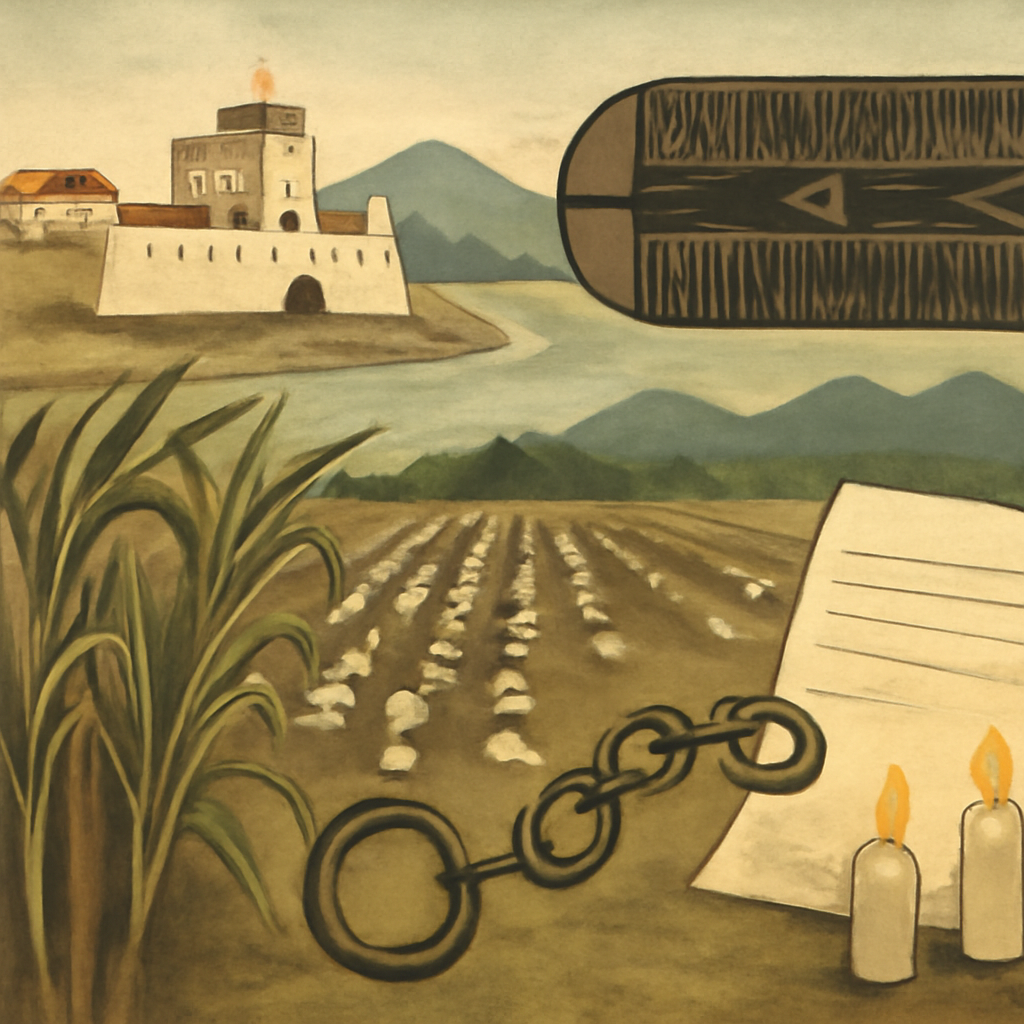
Central Question
How did forced migration, plantation power, Black resistance, abolition law, and diaspora memory reshape the Atlantic world?
Start With These Dates
- 1482Elmina Castle Established
Portuguese traders established Elmina Castle on the Gold Coast, linking West African commerce to expanding Atlantic routes.
- 1492 onwardColumbian Exchange Begins
After sustained transatlantic contact, plants, animals, pathogens, people, and forced labor systems moved across the Atlantic with world-changing consequences.
- 16th centuryAtlantic Slave Trade Expands
The Atlantic slave trade expanded as European colonial demand, coastal trade networks, African political conflicts, and plantation economies became violently connected.
- 1713Asiento System Expands
The asiento system contracted the supply of enslaved Africans to Spanish America, showing how European diplomacy and commerce organized forced migration.
- 1808United States Bans the Transatlantic Slave Trade
The United States banned the legal importation of enslaved people from abroad while domestic slavery continued to expand.
- 1888Brazil's Golden Law
Brazil's Lei Aurea, or Golden Law, abolished slavery in the last major slaveholding society in the Americas.
- 1926League of Nations Slavery Convention
The League of Nations Slavery Convention defined slavery as an international legal problem and committed states to suppression.
Sources Used Here
- Encyclopaedia Britannica: Transatlantic slave trade
Reference for the forced migration system, Atlantic routes, and slavery's global consequences.
- Gilder Lehrman Institute: Olaudah Equiano, 1789
Primary-source teaching reference for Equiano's abolitionist narrative and remembered Middle Passage experience.
- Official database: Slave Voyages
Reference database for transatlantic slave trade routes, voyages, forced migration, and estimates.
- The National Archives: British transatlantic slave trade records
Official research guide reference for British slave-trade records and digitised legislation including the Abolition of the Slave Trade Act 1807 and Slavery Abolition Act 1833.
- Official archive: Emancipation Proclamation
Reference for the United States Emancipation Proclamation and its legal setting.
Atlantic Slavery, Abolition, and Diaspora is designed as a route, not a folder. It gathers events that answer related reader questions about power, belief, conflict, exchange, institutions, and memory. The strongest way to read the page is to move from the earliest events toward the later ones, watching how one kind of pressure changes form across different places.
The route currently runs from 1482 to 1926. That span lets readers compare immediate turning points with slower consequences: the founding of institutions, the spread of ideas, the shock of war or disease, and the way later societies reused earlier events as warnings, models, or symbols.
Start with Elmina Castle Established, Columbian Exchange Begins, Atlantic Slave Trade Expands, Asiento System Expands, Stono Rebellion and then follow the internal links into people, timelines, years, maps, and source lists. The route structure stays visible when each event explains why it belongs with the others and where the next useful page is.
Compare the events by scale. Some are concentrated moments, such as a battle, proclamation, trial, or publication. Others are long processes, such as a reform movement, pandemic, trade route, or diplomatic order. Reading both types together helps prevent the page from becoming a list of dates.
A useful route keeps uncertainty visible. Historical change rarely has one cause or one clean ending, so the reader can separate background pressure, immediate trigger, turning point, result, and later memory. That pattern is what makes the atlas expandable without making the reader start over each time.
This route is also a comparison tool. After reading one event, compare it with a later event on the same page and ask what changed in scale, language, geography, technology, authority, or public memory. The comparison is often more useful than the individual summary because it reveals the pattern the topic page is built to expose. When a claim feels too neat, open the full event page and check whether the evidence supports one cause, several causes, or a contested interpretation before moving on.
Atlantic slavery is a world-history route because it connected African societies, European empires, American plantations, maritime finance, racial law, resistance, abolition, and diaspora memory. Elmina, the asiento, slave voyages, Stono, Zong, Haiti, British abolition, United States law, Amistad, emancipation, Brazil, and international conventions belong on one route because forced migration and coerced labor made the Atlantic world.
The hub keeps violence and structure together. Slave ships and plantations were not only moral crimes; they were institutions with ledgers, insurance, forts, contracts, laws, markets, and naval patrols. That institutional structure helps explain how the system lasted so long. It also makes resistance more visible: revolt, escape, litigation, religious life, family-making, maritime rebellion, and abolition organizing all pushed against the system from within and beyond it.
Abolition is treated as a sequence rather than a single enlightenment moment. Britain ended its slave trade before ending slavery in most colonies. The United States banned importation while domestic slavery expanded. Haiti destroyed slavery through revolution. Brazil abolished slavery only in 1888. International conventions later made slavery a treaty problem. The route shows that ending one legal form rarely ended coercion, racial inequality, or economic afterlives.
The reader path avoids a common explanation failure: explaining the Atlantic slave trade only as commerce. The stronger answer includes people forced aboard ships, African and African diaspora agency, plantation economies, law, memory, and the long fight over freedom. That is why this hub links to revolutions, rights movements, decolonization, and human-rights pages.
The route begins on the African coast because the Atlantic system cannot be understood from Europe or the Americas alone. Forts such as Elmina were coastal interfaces where African politics, European companies, warfare, credit, captives, brokers, languages, and maritime violence met. Starting there keeps African societies visible as historical actors under severe pressure rather than treating the continent as a blank source of labor.
The Middle Passage needs to be read as both movement and confinement. Ships crossed an ocean, but for captives the route meant crowding, disease, hunger, terror, resistance, surveillance, sale, and family rupture. Ship diagrams, voyage databases, port records, and survivor accounts show different parts of that experience. A map of arrows is too clean unless it also shows the violent institutions that made those arrows possible.
Plantation slavery turned forced migration into a labor regime. Sugar, tobacco, cotton, coffee, rice, and mining connected fields to credit, insurance, imperial law, shipping, and consumer demand. Enslaved people made families, religions, languages, music, knowledge, and resistance inside systems designed to commodify them. The hub becomes more readable when plantations are treated as social worlds of coercion and survival, not only sites of production.
Law is one of the route's recurring weapons. Slave codes, racial categories, property claims, maritime insurance, fugitive rules, manumission laws, abolition statutes, and treaties made violence appear orderly. The Zong case, the abolition of the British slave trade, the United States ban on importation, Amistad, emancipation, and Brazil's abolition all show law changing in stages. Each legal change left practical questions about enforcement, compensation, labor, citizenship, and racial hierarchy.
Resistance should not be reduced to rare revolts. Stono, Haiti, shipboard resistance, escape, sabotage, marronage, petitioning, court cases, religious organization, family preservation, and everyday refusal all belong to the route. The Haitian Revolution remains the largest rupture because enslaved people destroyed slavery and colonial rule through war and state formation. But quieter forms of resistance also changed the costs, fears, and moral arguments around slavery.
Abolition politics crossed the Atlantic through print, testimony, boycotts, churches, Black organizing, parliamentary campaigns, naval patrols, and revolutionary fear. White abolitionists mattered, but the movement becomes false if enslaved and formerly enslaved people are treated as passive evidence for other people's conscience. The route shows how Black testimony, revolt, self-emancipation, and organizing forced political language to change.
Diaspora is the route's afterlife and not just its aftermath. African-descended communities created religions, kinship networks, languages, foodways, music, political organizations, burial practices, memory sites, and freedom claims across the Atlantic world. Those cultural and political continuities do not soften the violence of slavery; they show survival and world-making under violent conditions. That gives readers a reason to connect this hub with rights movements and modern memory.
The route also needs an economic honesty check. Slavery was profitable for many merchants, planters, insurers, shipbuilders, ports, and states, but profit is not an explanation by itself. Profit depended on law, racial ideology, military force, African and European politics, plantation discipline, consumer demand, and the suppression of enslaved people's claims. A strong page asks how the system was built and maintained, not only whether it made money.
Visual material makes scale and constraint visible at the same time. A map of embarkation and disembarkation regions shows scale; a fort image shows coastal control; a ship diagram shows confinement; a plantation plan shows labor organization; an abolition broadside shows political persuasion; a memorial image shows public memory. The best route uses visuals to slow the reader down, not to decorate suffering.
The source trail for Atlantic slavery is ethically difficult. Ledgers count people as cargo; insurance papers price lives; court cases preserve conflict through legal language; abolition pamphlets can dramatize suffering for persuasion; oral traditions and later memory restore names and meanings that archives often suppressed. Readers learn to use these records without letting the archive's dehumanizing categories become the story's moral frame.
The final synthesis is that Atlantic slavery shaped modern freedom language by exposing its exclusions. Empires that spoke of law and commerce defended human property. Revolutions that spoke of liberty often preserved slavery. Abolition laws that ended trade or ownership did not automatically produce equality. The hub helps readers follow that contradiction from forts and ships to revolutions, emancipation, diaspora memory, and human-rights language.
Chronology helps readers avoid another trap. The Atlantic slave trade expanded before many familiar democratic revolutions, reached massive scale during the age of empire, faced abolitionist attack in stages, and survived legally in some places long after the British trade ban. Brazil's 1888 abolition is essential because it prevents the route from ending too early. The story is long because law, labor demand, and racial order changed at different speeds.
Geography also changes the meaning of slavery. West Central Africa, the Bight of Benin, the Gold Coast, Senegambia, the Caribbean, Brazil, North America, and the wider Atlantic each had different routes, crops, mortality patterns, legal regimes, and resistance possibilities. A careful hub does not treat the Atlantic as one identical plantation zone. It asks how each region shaped the system and was reshaped by it.
The family lens makes the violence clearer. Enslavement tore people from kin networks, but enslaved communities also rebuilt care, marriage, parenthood, fictive kinship, and memory under conditions designed to deny stability. Sale, inheritance, punishment, and migration threatened those bonds again and again. When readers follow families, abolition becomes more than legal change; it becomes a question of whether people could control their own relationships and futures.
Religion and culture belong in the route because survival required meaning. African spiritual traditions, Christianity, Islam, burial practices, songs, festivals, healing knowledge, and secret meetings created spaces of endurance and sometimes revolt. These practices moved across the Atlantic and changed in new settings. They show that diaspora history is not a footnote after slavery; it is one way enslaved and free Black communities made history under constraint.
The hub also connects slavery to modern racial capitalism without turning every later inequality into a single direct line. Plantation wealth, racial law, policing, segregation, debt, land loss, and labor control all have histories that outlived emancipation, but each place changed differently. The careful question is not whether the past still matters in general. It is which institution, memory, law, or economic structure carried the past forward.
For readers who arrive through causes, effects, or significance searches, the hub gives a full answer in one place. Causes include Atlantic demand, African and European politics, maritime technology, racial law, plantation profit, and imperial competition. Effects include demographic rupture, diaspora cultures, abolition movements, racial states, wealth accumulation, resistance traditions, and continuing fights over memory and repair.
The closing path is deliberately moral and analytical at once. Begin with coastal capture, follow the ship, enter plantation labor, watch resistance and law change together, then read abolition as an uneven transformation rather than a clean ending. That sequence helps readers keep human suffering central while still understanding the institutions that made the system durable.
This hub now needs to hold three scales at once: the intimate violence of forced migration, the institutional machinery of Atlantic capitalism, and the political afterlife of diaspora memory. Forts, ship holds, plantations, court cases, revolts, abolition campaigns, and memorials are not separate examples. They show how a system made people into property and how enslaved and free Black communities forced freedom claims into public life.
A useful route avoids a clean abolition story. The British trade ban, Haitian Revolution, United States import ban, Amistad, emancipation, Brazil's 1888 abolition, and international conventions all changed different parts of the system. Legal abolition could end ownership in one place while racial hierarchy, coerced labor, land loss, debt, and memory conflict continued in another.
Diaspora keeps the page from ending with law. Families, languages, religion, foodways, music, burial practices, political organizing, and repair debates show survival and world-making under violent conditions. The page becomes more readable when resistance includes revolt and also testimony, kinship, worship, escape, lawsuits, abolition print, and everyday refusal.
Read the events in order first; the page is built to reveal change over time.
Ask which pressures existed before the visible turning point and which actors had room to choose.
Follow what changed afterward in institutions, borders, law, belief, or everyday life.
Notice which events became symbols and why later generations kept returning to them.
Trace routes, ports, forts, ships, and plantations while keeping families, violence, and survival visible.
Read Stono, Haiti, Amistad, and abolition campaigns as different forms of resistance to slavery.
Follow laws and treaties from abolition through emancipation and modern anti-slavery language.
Keep African states, brokers, captives, soldiers, families, and communities visible under the pressure of Atlantic demand.
Read religion, family, language, music, memorials, and rights claims as afterlives of forced migration and survival.
Read ledgers, court papers, ship records, abolition testimony, oral memory, and memorials while noticing how each source frames human lives.
Choose a Reading Path
Start With the Timeline
Use the related timeline first when you want a chronological route through the topic.
Start with 1482: Elmina Castle EstablishedOpen a Person Page
Use people pages when the topic is easier to understand through leadership, resistance, reform, or memory.
Start with 1492 onward: Columbian Exchange BeginsUse Year Pages
Use year pages when you need a fast answer to what changed in a specific year.
Start with 16th century: Atlantic Slave Trade ExpandsReturn to the Map
Use the map to keep geography visible while moving between events and regions.
Start with 1713: Asiento System ExpandsStart at the Coast
Begin with Elmina and coastal trading systems to see how African politics, European companies, forts, brokers, and captives entered the same violent exchange.
Start with 1808: United States Bans the Transatlantic Slave TradeFollow the Ship
Use voyage routes, ship diagrams, and port records to connect forced migration with confinement, death, resistance, and sale.
Start with 1888: Brazil's Golden LawRead Law and Revolt Together
Move from Stono and Zong to Haiti, abolition statutes, Amistad, and emancipation to compare law, fear, testimony, and rebellion.
Start with 1926: League of Nations Slavery ConventionEnd With Afterlife
Use Brazil, international conventions, and diaspora memory to ask what survived after legal abolition and what had to be fought again.
How the Story Builds
Begin with Elmina Castle Established. The opening event usually shows the pressure that made the route necessary: a crisis of authority, an expanding exchange system, a new technology, a contested idea, or a conflict that older institutions could no longer contain.
United States Bans the Transatlantic Slave Trade works as a checkpoint because it lets readers ask what had become irreversible, which actors still had choices, and how the route changed scale between the opening event and the later consequences.
The later edge of the route includes Cuba Abolishes Slavery, Brazil's Golden Law, and League of Nations Slavery Convention. These pages help readers see what survived beyond the first shock: institutions, borders, laws, memories, technologies, movements, or arguments that kept shaping later history.
The route is easier to remember through people and places. Watch figures such as Portuguese traders, Akan coastal communities, Indigenous communities, Atlantic colonizers, African captives, and European traders move through settings such as Elmina, Atlantic World, Atlantic Africa, Spanish Atlantic, and South Carolina; that is where large structures become visible as choices, risks, costs, and memories.
Forts, brokers, credit, warfare, diplomacy, and maritime demand linked African political worlds to European Atlantic companies.
The Middle Passage turned movement into imprisonment through ship design, surveillance, disease, violence, and forced sale.
Plantations connected coerced labor to sugar, tobacco, cotton, rice, credit, law, racial hierarchy, and consumer demand.
Revolt, escape, litigation, marronage, family preservation, and Haiti made enslaved people central actors in abolition's history.
Trade bans, emancipation laws, Brazil's abolition, conventions, memorials, and diaspora politics show freedom arriving unevenly.
- Which event in Atlantic Slavery, Abolition, and Diaspora feels like the true point of no return, and why might another reader choose a different event?
- What changes if the route is read from the perspective of ordinary people rather than rulers, armies, inventors, reformers, or institutions?
- Which consequence was immediate, and which consequence only became clear decades later?
- Where does the map change the interpretation by showing distance, borders, routes, ports, capitals, or frontiers?
- Why is the Atlantic slave trade not just an economic history topic?
- How did enslaved people force abolition politics to change?
- Why did banning the slave trade not automatically end slavery?
- What parts of slavery's afterlife remained after legal emancipation?
- How can readers use ledgers and legal records without letting their dehumanizing categories control the story?
- What changes when African coastal societies and diaspora communities remain visible across the whole route?
- Why did legal abolition arrive unevenly across the Atlantic world?
- How can readers keep both institutional structure and human agency visible on slavery pages?
Interactive Timeline
Follow Atlantic Slavery, Abolition, and Diaspora by sequence
Elmina Castle Established
Portuguese traders established Elmina Castle on the Gold Coast, linking West African commerce to expanding Atlantic paths.
Read the full event pageMap Layer
Atlantic Slavery, Abolition, and Diaspora geography
Gold pins mark the approximate locations of published event pages. This is a schematic locator map, not a historical border map.
Coordinates are approximate and are used to help readers orient themselves before opening a full event page.
Route Events
Events in This Topic
Elmina Castle Established
Portuguese traders established Elmina Castle on the Gold Coast, linking West African commerce to expanding Atlantic paths.
Columbian Exchange Begins
After sustained transatlantic contact, plants, animals, pathogens, people, and forced labor systems moved across the Atlantic with world-changing consequences.
Atlantic Slave Trade Expands
The Atlantic slave trade expanded as European colonial demand, coastal trade networks, African political conflicts, and plantation economies became violently connected.
Asiento System Expands
The asiento system contracted the supply of enslaved Africans to Spanish America, showing how European diplomacy and commerce organized forced migration.
Stono Rebellion
Enslaved Africans in South Carolina launched the Stono Rebellion, one of the largest slave uprisings in British North America.
Somerset Case
The Somerset case challenged the forced removal of an enslaved man from England and became a major legal reference in British antislavery politics.
Zong Massacre
The killing of enslaved Africans aboard the slave ship Zong became a notorious example of how commerce treated human life as insurable property.
Haitian Revolution Begins
Enslaved people in Saint-Domingue rose against plantation slavery, turning the French colony into the center of the Atlantic world's most radical revolution.
Britain Abolishes the Slave Trade
Parliament abolished British participation in the transatlantic slave trade after decades of Black resistance, abolitionist campaigning, and political pressure.
United States Bans the Transatlantic Slave Trade
The United States banned the legal importation of enslaved people from abroad while domestic slavery continued to expand.
British Slavery Abolition Act
The Slavery Abolition Act ended slavery in most British colonies, though apprenticeship and compensation structures limited immediate freedom.
Amistad Case
The Amistad case centered on Africans who had been illegally transported and who resisted captivity aboard a Spanish vessel.
France Abolishes Colonial Slavery
The French Second Republic abolished slavery in French colonies and possessions, making emancipation part of the revolutionary upheaval of 1848.
Emancipation Proclamation
Abraham Lincoln issued the Emancipation Proclamation, declaring enslaved people in Confederate-held territory to be free as a war measure.
Thirteenth Amendment Ratified
The Thirteenth Amendment abolished slavery in the United States except as punishment for crime.
Cuba Abolishes Slavery
Spanish authorities ended legal slavery in Cuba in 1886 after decades of plantation expansion, resistance, gradual emancipation measures, and political pressure.
Brazil's Golden Law
Brazil's Lei Aurea, or Golden Law, abolished slavery in the last major slaveholding society in the Americas.
League of Nations Slavery Convention
The League of Nations Slavery Convention defined slavery as an international legal problem and committed states to suppression.
References
Where to Check the Facts
- Encyclopaedia Britannica: Transatlantic slave tradeReference for the forced migration system, Atlantic paths, and slavery's global consequences.
- Gilder Lehrman Institute: Olaudah Equiano, 1789Primary-source teaching reference for Equiano's abolitionist narrative and remembered Middle Passage experience.
- Official database: Slave VoyagesReference database for transatlantic slave trade paths, voyages, forced migration, and estimates.
- The National Archives: British transatlantic slave trade recordsOfficial research guide reference for British slave-trade records and digitised legislation including the Abolition of the Slave Trade Act 1807 and Slavery Abolition Act 1833.
- Official archive: Emancipation ProclamationReference for the United States Emancipation Proclamation and its legal setting.
- Legifrance: French abolition decree, 1848Official legal reference for the 1848 abolition of slavery in French colonies and possessions.
- Gilder Lehrman Institute: Frederick Douglass, 1852Primary-source teaching reference for Douglass's abolitionist Fourth of July address.
- Yale Archives: Cuban slavery collectionArchival reference for Cuban slavery and the 1886 abolition date.
- Encyclopaedia Britannica: William WilberforceBiographical reference for Wilberforce, parliamentary abolitionism, the 1807 slave-trade abolition, and the 1833 slavery abolition act.
- Encyclopaedia Britannica: Slavery Abolition ActReference for British abolition of slavery in much of the empire.