At a Glance
The shape of the event
- Date
- 1876 CE
- Place
- Washington, D.C.
- Type
- Invention
Alexander Graham Bell received a patent for the telephone, helping launch a new era of voice communication over distance.
1876 CE; place the event in Washington, D.C. before comparing causes or consequences.
The telephone changed the speed and intimacy of communication and became a key infrastructure of modern life.
Alexander Graham Bell are the first names or groups to compare before widening the story.
Telephone networks began developing as business, household, and government communication systems.
Telephone networks began developing as business, household, and government communication systems.
The telephone changed the speed and intimacy of communication and became a key infrastructure of modern life.
Follow the subsequent timeline to see how a legal acknowledgment turned experimental apparatus into public systems.
Background
By the mid-19th century, industrial and scientific pressures had been nudging societies toward faster, more reliable ways to send information. Increasingly complex businesses, expanding government bureaucracies, and households with dispersed connections wanted quicker answers than written dispatches could provide. Inventors and experimenters were probing electricity and sound, seeking devices that could carry speech rather than just signals. At the same time, markets and investors were alert to technologies that could be scaled into services. None of this amounted to a single causal chain. Social need, scientific curiosity, available capital, and individual initiative overlapped and sometimes competed.
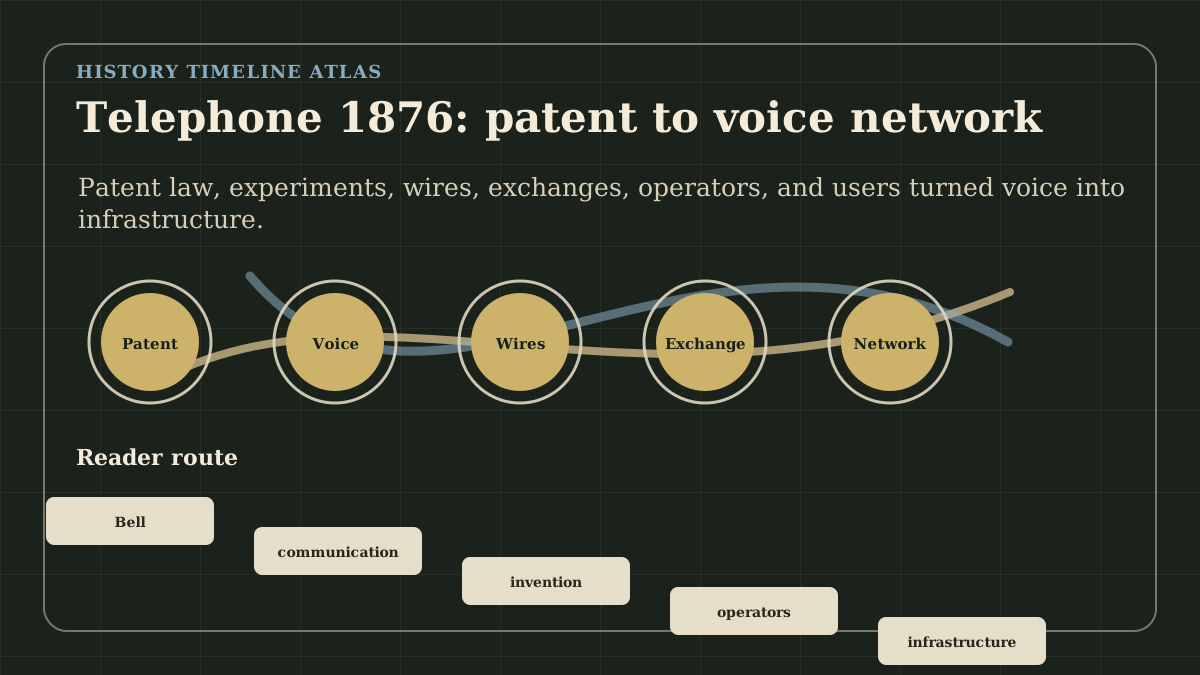
The patent granted in Washington did not spring from a vacuum; it arrived where technical experiments, commercial interest, and institutional frameworks for protecting inventions already existed. This page keeps those overlapping forces visible rather than collapsing the story into either a triumph of one person or an inevitable outcome of anonymous change. The telephone patent is strongest when the page separates invention from infrastructure. A patent could protect a claim, attract capital, and help organize business plans, but a communication revolution required exchanges, wires, operators, standards, maintenance crews, pricing, regulation, and users willing to change habits. The story is therefore about a system forming, not only an inventor receiving credit. The technology also changed the meaning of distance.
Telegraphy had already sped written signals, but voice communication carried tone, urgency, and social presence. That made the telephone attractive for business decisions, household coordination, emergency response, journalism, administration, and eventually everyday social life. Legal conflict and access also belong in the story. Patents create incentives, but they also create disputes over priority and control. Networks create connection, but not everyone receives access at the same time or price. The telephone's history is a history of invention, business power, labor, infrastructure, and unequal adoption.
The Turning Point
Receiving a patent in 1876 was an actionable legal turn. For Alexander Graham Bell, the patent translated laboratory work and prototypes into a property right that could be licensed, defended, and used to attract partners and investment. That shift matters because it moved the telephone from isolated demonstrations into the realm of marketable tools. The choice to seek formal protection in Washington, D. C. made the invention legible to business interests and government purchasers, who often relied on clear legal titles before committing resources. It also gave potential builders of networks a focal point around which to organize equipment, standards, and experiments in connecting devices across distance.
The patent did not by itself create a nationwide infrastructure; rather, it changed the incentives and the practical options available to entrepreneurs, engineers, and officials who could now plan installations knowing who held legal claim to this method of transmitting the human voice. The turning point was the move from experimental apparatus to legally defendable commercial possibility. Once Bell's patent existed, investors and companies could organize around a claim that could be licensed, contested, expanded, and monetized. A second turning point was network thinking. The telephone mattered more as each new connection increased the value of the whole system. That made exchanges, operators, technical standards, and customer density as important as the device itself.
Consequences
In the near term, the patent helped encourage the emergence of telephone systems as commercial and institutional undertakings. Businesses began to see telephones as tools to speed decisions; some households adopted them for faster coordination; governments explored them for administration and public order. The result was a patchwork of exchanges, lines, and companies building on the newly recognized technology. Over the longer term, the telephone reshaped expectations about how quickly and intimately people could communicate. Where distance had previously imposed delays, voice contact introduced immediacy and a different kind of personal presence. The technology matured into infrastructure—networks that would be maintained, regulated, and expanded—so that by the 20th century voice circuits were integral to commerce, governance, and private life.
Interpretations of these shifts vary: some emphasize Bell’s individual decisions and the legal patent as decisive, while others stress broader economic forces, institutional architectures, and concurrent technical advances. This account keeps those tensions visible and treats the patent as a catalytic, not sole, explanation. The immediate consequence was a faster path toward commercial telephone service. Demonstrations could become contracts, exchanges, business plans, and public arguments about who should control communication infrastructure. The longer consequence was a new expectation of immediacy. Voice contact over distance changed commerce, politics, emergencies, news, family life, and later electronic networks. It helped teach modern societies to expect communication systems to be always available.
Interpretation Notes
The hardest question around Telephone Patented is causation. The event had immediate actors, but its meaning also came from institutions, geography, resources, and expectations already present in North America.
Why Keep Reading
Follow the subsequent timeline to see how a legal acknowledgment turned experimental apparatus into public systems. The next pages trace the practical steps—building exchanges, laying lines, negotiating business models, and testing regulations—that turned a patent into everyday service. If you want to understand how technologies move from novelty to necessity, or how law and commerce shape what is technically possible, the surrounding stories reveal the concrete choices, resistant problems, and small innovations that made telephony ordinary. Read the telephone page after the Industrial Revolution and before radio, computing, the internet, and globalization pages. That route shows how invention becomes infrastructure through law, capital, labor, standards, and users.
Reading Path
Follow the story without losing the thread
Before This
- Paris CommuneMarch-May 1871
- First Transcontinental Railroad CompletedMay 10, 1869
- Emancipation ProclamationJanuary 1, 1863
After This
- Wall Street Crash of 1929October 1929
- Apollo 11 Moon LandingJuly 20, 1969
- ARPANET Connection1969 CE
Same Period
- Seneca Falls ConventionJuly 1848
- Emancipation ProclamationJanuary 1, 1863
- Paris CommuneMarch-May 1871
Wider Timeline
Mind Map
How to think about Telephone Patented
scientific pressure
Interest in transmitting sound electrically motivated experiments that made the telephone conceivable
Map Layer
Where this event sits geographically
Gold pins mark the approximate locations of published event pages. This is a schematic locator map, not a historical border map.
Coordinates are approximate and are used to help readers orient themselves before opening a full event page.
References
Where to Check the Facts
- Science and Industry Museum: Revolution in ProgressMuseum reference for industrial change, technology, railways, and public interpretation of industrial history.
- Encyclopaedia Britannica: Industrial RevolutionReference for industrialization, technology, labor, capital, and economic change.
- Science Museum: Objects and StoriesMuseum reference hub for science, technology, medicine, invention, and public understanding.
- Smithsonian: Telephones Through TimeMuseum reference for Alexander Graham Bell, the telephone patent, and early telephone history.