At a Glance
The shape of the event
- Date
- 1642 CE
- Place
- England
- Type
- Civil War
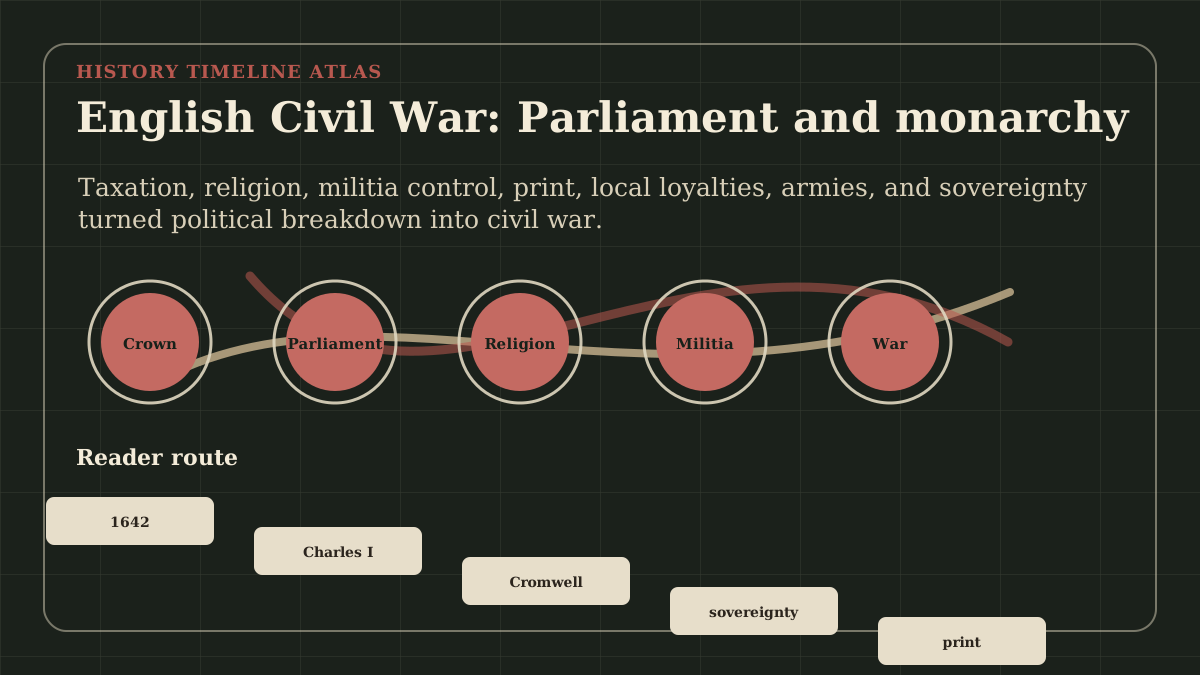
Conflict between King Charles I and Parliament broke into war after disputes over taxation, religion, military command, and royal authority.
1642 CE; place the event in England before comparing causes or consequences.
The war transformed arguments about sovereignty, parliament, religious settlement, and the limits of monarchy.
Charles I / Oliver Cromwell are the first names or groups to compare before widening the story.
England entered years of civil conflict that ended with trial, regicide, and republican experiment.
England entered years of civil conflict that ended with trial, regicide, and republican experiment.
The war transformed arguments about sovereignty, parliament, religious settlement, and the limits of monarchy.
Follow this crisis into the next chapters to see how legal innovation, military leadership and local experience remade governance.
Background
By 1642 several long-building pressures had brought the kingdom to a dangerous seam. Monarch and Parliament had clashed repeatedly over taxation: kings required revenue, and many MPs insisted on limits or parliamentary consent. Religious divisions—between a culturally established Church, Puritan critics within England, and fears of foreign influence—fanned local resentments. Military command became a flashpoint: who should control armed force, and for what ends? Charles I's belief in royal prerogative encountered a Commons increasingly confident in legal and political claims. Economic strains, regional loyalties and local grievances made any national rupture harder to contain. Historians debate the relative weight of personality and structure.
Some point to Charles's decisions—his insistence on certain prerogatives and his conflict with Parliament—while others stress deeper institutional changes: the growth of parliamentary identity, the spread of print, and long-term shifts in religion and governance that made compromise costly. This page keeps those disagreements visible. Parliament, monarchy and religion were the axes along which loyalties and calculations shifted. The English Civil War becomes clearer when it is treated as a breakdown of trust across several systems at once. Charles I and Parliament argued over taxation, religion, royal prerogative, law, and control of armed force. None of those disputes alone explains the war. The crisis came when opponents no longer believed the other side could be trusted with power.
Religion gave the conflict emotional force. Fears of Catholic influence, disputes over bishops, Scottish resistance, Puritan reform, and local parish politics made constitutional arguments feel like questions of salvation and identity. Readers need that religious texture to understand why compromise became harder. The war also had a local geography. Counties, towns, gentry networks, militias, ports, printers, and households made choices under pressure. Royalist and Parliamentarian labels mattered, but loyalties were often practical, regional, and shifting. A stronger page should show civil war as lived disruption, not only a duel between king and Parliament.
The Turning Point
In 1642 the political standoff turned to armed confrontation. Negotiation and legal maneuvering had failed to settle who controlled finance, the army, and the law; both sides made concrete choices that closed off peaceful compromise. Charles I sought to assert royal authority by maintaining command over the military and insisting on prerogatives he judged necessary to rule. Parliament responded by organizing its own political and military resources, determined to protect its privileges and secure reforms it believed essential to English life. Oliver Cromwell, among others who rose from local leadership, became a prominent military and political actor on Parliament's side.
These decisions mattered: the mobilization of forces turned disputes about taxation and religion into sieges, skirmishes, and pitched battles across the country. Authority was no longer only a question of legal argument but of who held muskets and muster rolls. The war also transformed rhetoric and expectation—language about sovereignty, liberty and divine sanction acquired a new urgency, and recruitment drew in men whose daily loyalties would shape later settlements. At this turning point, the contest moved from contested texts and petitions to contested territory and governance by force. Political calculation and contingency both steered events. The turning point was the failure to settle who controlled the militia and the coercive power of the state.
Once both sides claimed legitimate authority over armed force, political disagreement became military mobilization. Raising standards, gathering troops, and securing towns turned argument into war. Print and rumor also changed the tempo of crisis. Petitions, pamphlets, sermons, declarations, and newsbooks widened political participation and hardened suspicion. The conflict was fought with words before and during the fighting.
Consequences
The immediate consequence was years of civil conflict across England. Armies, local militias and shifting alliances prolonged fighting and deepened divisions in communities and institutions. The war did not end with a simple settlement: it continued into legal and political reckonings that culminated in the unprecedented decision to try and execute a reigning monarch—an outcome that shocked contemporaries—and in the experiment of republican government that followed. Beyond those dramatic moments, the conflict reshaped political language and practice. Debates about sovereignty moved from theoretical pamphlets to constitutional experiments: who held ultimate authority, and by what mechanisms? Parliament's role was amplified, while the limits of monarchy were tested in practice.
Religion remained a central fault line; struggles over church governance and toleration informed both policy and local life. The long-term impact was uneven and contested: some institutions reasserted older patterns, others institutionalized change. Scholars argue over how permanent those changes proved, but few dispute that the English Civil War forced a rethinking of monarchy, parliament and religion. Its memory was also contested in pamphlets, sermons and local records for generations. The immediate consequence was a chain of wars across England, Scotland, and Ireland, followed by the trial and execution of Charles I, republican experiment, military rule, and eventual restoration.
The longer consequence was a transformed language of sovereignty: where did legitimate authority sit, and what limits could law place on monarchy? The war did not create modern democracy in a straight line. It opened arguments about Parliament, conscience, army power, radical politics, empire, and religious toleration that later generations reused selectively. Its importance lies in the questions it made impossible to bury.
Interpretation Notes
The hardest question around English Civil War Begins is causation. The event had immediate actors, but its meaning also came from institutions, geography, resources, and expectations already present in Western Europe.
Why Keep Reading
Follow this crisis into the next chapters to see how legal innovation, military leadership and local experience remade governance. The trial of Charles I, the rise of republican government and Oliver Cromwell's increasing prominence were not inevitable; each developed out of choices made during the war. Tracking subsequent events explains how short-term military decisions produced long-term constitutional consequences, and how debates over religion and authority continued to shape daily life. Read on to trace the human costs as well as institutional change. If you want to understand later British constitutional forms, empire, or the vocabulary of modern politics, the seeds lie in the decisions and conflicts beginning in 1642.
Read the English Civil War before the Glorious Revolution, American Revolution, and French Revolution. That path shows how arguments about taxation, representation, religious settlement, and sovereign power traveled across the Atlantic world.
Reading Path
Follow the story without losing the thread
Before This
- Dutch East India Company Founded1602 CE
- Akbar Founds the Ibadat Khana1575 CE
- Battle of LepantoOctober 7, 1571
After This
- Peace of Westphalia1648 CE
- Newton Publishes Principia1687 CE
- Glorious Revolution1688 CE
Same Period
Wider Timeline
No curated timeline yet.
Mind Map
How to think about English Civil War Begins
Taxation disputes
Conflict over the king's ability to raise revenue without Parliament's consent.
Map Layer
Where this event sits geographically
Gold pins mark the approximate locations of published event pages. This is a schematic locator map, not a historical border map.
Coordinates are approximate and are used to help readers orient themselves before opening a full event page.
References
Where to Check the Facts
- The National Archives: Magna CartaArchive education reference for Magna Carta, monarchy, rights language, and medieval political bargaining.
- Encyclopaedia BritannicaBackground reference for chronology, names, and historical context.
- WikidataStructured reference for dates, places, alternate names, and entity links.