Compare Spanish American wars, Brazil's monarchy, and Haiti's revolution as different sovereignty routes.
Timeline
Latin American Revolutions and Modern States Timeline
A route through conquest, silver, independence wars, new republics, abolition, regional wars, revolution, Cold War coups, democracy, trade, and Indigenous rights.
Timeline Guide
How did Latin America move from conquest and colonial extraction to independence, revolution, dictatorship, democracy, and globalization?
Read this edited guide as a path through dates, places, affected lives, source limits, and contested memory rather than as an exhaustive database.
This timeline gives Latin America a broad route from conquest and silver to independence, abolition, regional war, revolution, Cold War intervention, democratization, trade, and Indigenous rights. It avoids the thin version where the region appears only through a few famous liberators. The stronger story asks how land, labor, race, empire, church, army, resources, and foreign pressure shaped state formation.
The independence chapter begins before 1810 because colonial structures mattered. Potosi, Indigenous rebellion, slavery, and Bourbon reform shaped the grievances that later movements inherited. Hidalgo, Buenos Aires, Paraguay, San Martin, Bolivar, Brazil, and Ayacucho then show different independence paths: popular revolt, elite juntas, military campaigns, dynastic separation, and continental war.
The post-independence chapter is intentionally not triumphant. Gran Colombia dissolved; Paraguay and the War of the Pacific turned state-building into catastrophe; Brazil abolished slavery late; Cuba fought Spain at the end of the nineteenth century; Mexico's revolution turned land, labor, and constitutionalism into a new political language. Sovereignty did not settle the social question.
The Cold War and globalization chapters follow Guatemala, Cuba, Chile, Nicaragua, the Falklands, Brazil's constitution, NAFTA, and the Zapatistas. These nodes keep United States policy and global markets visible while preserving local agency. Students can compare intervention, revolution, dictatorship, democracy, Indigenous rights, and economic integration without reducing the region to victimhood.
Start With These Dates
- 1521 CEFall of the Aztec Empire
Spanish forces and Indigenous allies captured Tenochtitlan after conflict, epidemic disease, and political fracture undermined Aztec power.
- 1533Fall of the Inca Empire
Spanish forces exploited civil conflict, alliances, disease, and coercion to break Inca imperial power and occupy Cusco.
- 1545Potosi Silver Boom Begins
Silver mining at Potosi became a massive colonial enterprise linking Andean labor, Spanish finance, and global silver flows.
- 1680Pueblo Revolt
Pueblo communities coordinated a revolt that temporarily expelled Spanish authorities and missionaries from New Mexico.
- 1864Paraguayan War Begins
The Paraguayan War began as a regional conflict involving Paraguay, Brazil, Argentina, and Uruguay.
- 1988Brazil's Democratic Constitution
Brazil's 1988 constitution marked a democratic turn after military rule, expanding rights language and civilian institutions.
- 1994NAFTA Takes Effect
NAFTA created a North American free-trade framework linking the United States, Mexico, and Canada.
- 1994Zapatista Uprising
The Zapatista uprising in Chiapas challenged Mexican state power, Indigenous marginalization, land inequality, and neoliberal globalization.
Sources Used Here
- Primary Source Set: Latin American Revolutionaries
Primary-source set reference for Latin American revolutionary leaders, documents, and independence politics.
- Library of Congress: Hispanic Reading Room Collections
Archive and collection reference for Latin America, the Caribbean, Iberian worlds, and related primary materials.
- Cambridge University Press: The Cambridge History of Latin America
Specialist scholarly synthesis for colonial society, independence, republic-building, regional variation, and modern Latin American historiography.
- Oxford Research Encyclopedia of Latin American History
Peer-reviewed reference for Latin American history themes, regional debates, social history, and competing interpretations.
- John Carter Brown Library: Spanish America collection
Primary-source collection reference for Spanish American independence, printed political culture, maps, and early republican debate.
The timeline works as a reading path because each node asks what kind of independence or sovereignty was actually possible. The answer changes across centuries: colonial revolt, republican war, social revolution, military dictatorship, democratic constitution, trade agreement, and Indigenous autonomy claim.
The route also keeps geography from disappearing behind leader biographies. Mountain crossings, silver mines, Caribbean ports, pampas campaigns, Pacific nitrate zones, Central American plantations, island insurgencies, and border wars shaped political choices. Bolivar, San Martin, Hidalgo, Castro, Allende, and other figures become easier to understand when their decisions sit inside these material constraints.
For reader usefulness, the timeline gathers several common questions into one canonical route: why independence happened, why post-independence states fragmented, how slavery and race shaped citizenship, why the Cold War mattered in the region, and why globalization produced both market integration and Indigenous resistance. That structure gives readers depth without forcing duplicate pages for every phrasing.
The strongest reading path alternates scale. A continental independence campaign needs a village, mine, port, battlefield, constitution, and foreign ministry beside it. That alternation keeps the page from becoming a list of presidents and coups, and it gives students a way to explain why political sovereignty did not automatically solve inequality.
This route makes Latin America larger than a sequence of liberators and coups. Conquest, silver, Indigenous rebellion, slavery, church power, caste hierarchy, Bourbon reform, Atlantic revolution, and local economy all shaped independence before the famous military campaigns began. Hidalgo, San Martin, Bolivar, Brazil, Ayacucho, and Mexico make more sense when readers see the colonial pressures they inherited.
Independence was not one regional model. Some movements grew from popular rural revolt, some from city juntas, some from military campaigns across mountains and plains, some from royalist collapse, and Brazil followed a dynastic route. The timeline uses this variety to ask what kind of sovereignty each movement created: republican, imperial, federal, centralized, elite-led, popular, military, or negotiated.
The post-independence chapter is where the route gains depth. Gran Colombia's collapse, the Paraguayan War, the War of the Pacific, Brazil's late abolition, Cuba's independence struggle, and the Mexican Revolution show that formal independence did not solve land, race, slavery, debt, border, army, or church questions. New states often inherited the social architecture of empire while trying to speak republican language.
The twentieth century cannot be reduced to outside intervention, but outside power cannot disappear either. Guatemala, Cuba, the missile crisis, Chile, Nicaragua, the Falklands, Brazil's constitution, NAFTA, and Zapatistas show local movements acting inside Cold War strategy, debt, trade, resource politics, party conflict, military doctrine, and Indigenous claims. The page is strongest when it keeps United States policy visible without erasing local agency.
A social route follows land and labor. Potosi silver, plantation slavery, haciendas, mines, ports, export agriculture, peasant mobilization, urban workers, unions, and Indigenous communities all sit behind political dates. Revolutions become easier to read when readers ask who controlled production, who paid taxes, who owned land, who could vote, and who faced military force.
The map layer matters because Latin America is not a single stage. Mountain crossings in the Andes, Caribbean ports, Brazilian plantations, Mexican villages, Paraguayan and Pacific war zones, Central American plantations, Chilean ministries, Cuban missile sites, and Chiapas communities all change the options available to leaders and movements. Geography keeps the route from becoming only names and presidents.
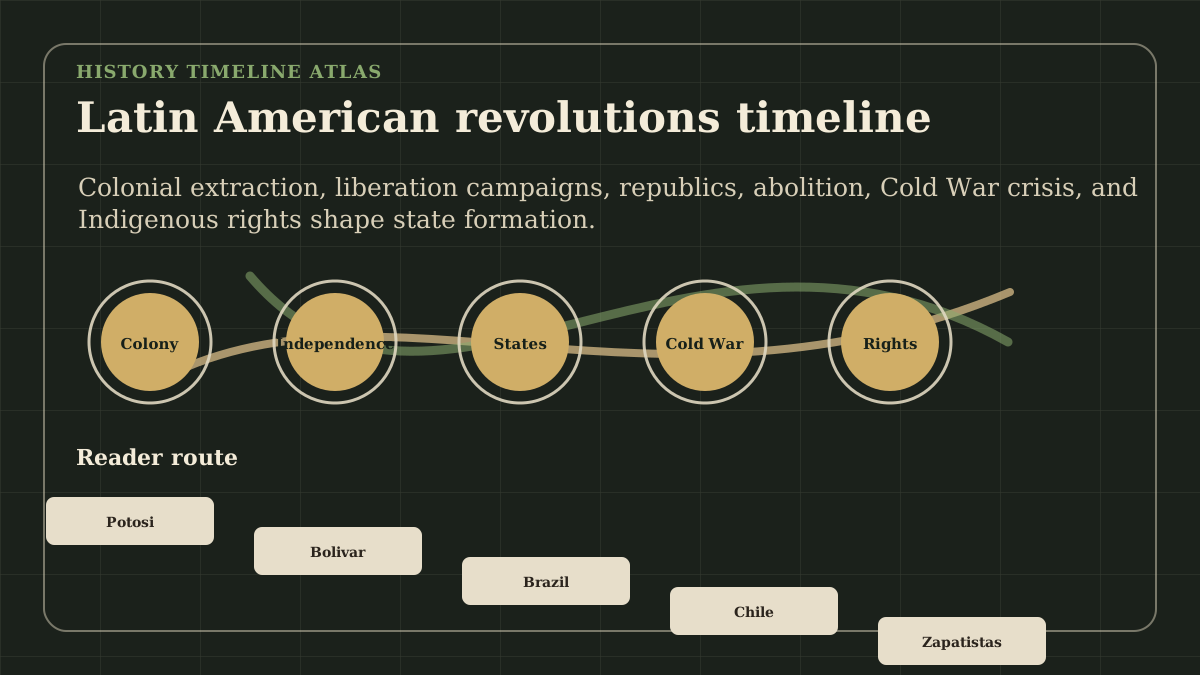
For a quick route, follow Potosi, Tupac Amaru II, Haiti, Hidalgo, San Martin, Bolivar, Brazil, Ayacucho, Mexico's Revolution, Guatemala, Cuba, Chile, Brazil's constitution, NAFTA, and Zapatistas. For a deeper route, add Paraguay, the War of the Pacific, Brazil's abolition, Cuba's independence war, Nicaragua, the Falklands, and regional people pages. The result is a sovereignty route with social depth.
The story is strongest when read in layers. First, follow the dates from 1521 CE to 1994. Then read across the event types: conquest, conquest, mining expansion, indigenous revolt. The timeline becomes more than chronology when those dates reveal decisions, institutions, violence, reform, and memory.
Paraguayan War Begins sits near the middle of the sequence. Ask what had already become unavoidable by 1864, what actors still believed they could control, and which consequences were already beginning to move beyond the original setting.
The named events are Fall of the Aztec Empire, Fall of the Inca Empire, Potosi Silver Boom Begins, Pueblo Revolt, Tupac Amaru II Rebellion, Haitian Revolution Begins. Each one pushes a more precise question: what changed, who benefited, who paid the cost, and what later page explains the aftermath more clearly?
Read the timeline against geography too. Places matter because power moves through corridors, borders, cities, ports, capitals, and frontiers. The map below keeps those distances visible while the event pages explain the human and institutional consequences.
A good timeline has a pulse: pressure, decision, expansion, resistance, and aftermath. When you move through Early Modern World, Spanish Conquest, Colonial Latin America, and Colonial Americas, keep asking whether an event is creating a new problem, revealing a hidden weakness, or making an earlier choice harder to reverse.
The human layer matters because timelines can become too abstract. Figures such as Hernan Cortes, Cuauhtemoc, Malintzin, Atahualpa, Francisco Pizarro, Andean laborers, and Spanish colonial officials help the sequence feel lived rather than mechanical. Their choices do not explain everything, but they show where institutions, ideas, military systems, social movements, and public fear entered real decisions.
The ending is not only the last date. With closing events such as Falklands War, Brazil's Democratic Constitution, NAFTA Takes Effect, and Zapatista Uprising, the reader can ask what remained unsettled: which institutions survived, which arguments continued, which victims or opponents were left outside the official story, and which later crisis reused the same vocabulary.
Read this page once quickly for order, then read it again for contrast. Compare early confidence with later uncertainty, local decisions with global consequences, and visible turning points with slower changes in law, economy, belief, technology, borders, or memory. That second pass is where a timeline becomes an explanation.
Causation in this sequence is layered. One event may supply the trigger, another may reveal an older weakness, and a later event may show the consequence that people at the beginning did not expect. The useful habit is to separate background pressure, immediate decision, turning point, and aftermath before deciding which event matters most.
Consequences are uneven. A political settlement might look successful in one capital while creating resentment elsewhere; a military victory might end a campaign while deepening civilian trauma; a scientific or institutional breakthrough might solve one problem while creating new risks. The timeline is strongest when those mixed outcomes remain visible.
The final pass is comparative. After reading this sequence, open a neighboring topic or person page and ask whether the same pattern appears again. Repetition usually points to a structure; contrast usually points to a historical choice that could have gone another way.
Importance is not the same thing as drama. Some events are remembered because they were spectacular, while others matter because they changed rules, expectations, alliances, legal categories, technologies, or public language. Use the timeline to test both kinds of importance before deciding what belongs at the center of the story.
The page rewards moving outward. A timeline gives order, but the event pages give causes, maps, people, sources, and reading paths. When a date feels too compressed, open the full event page and then return here; the sequence becomes clearer with each pass instead of asking the reader to memorize a list.
Keep slavery, land, race, labor, and Indigenous communities inside the political story.
Use Guatemala, Cuba, Chile, Nicaragua, and the Falklands to test intervention and local agency.
Read NAFTA and Zapatistas together because market integration and Indigenous rights collided in the same year.
Compare revolt, junta politics, continental military campaign, dynastic separation, social revolution, dictatorship, democratic constitution, and autonomy claim.
Keep mines, plantations, haciendas, ports, peasants, enslaved people, workers, and Indigenous communities inside the political story.
Read independence first, then follow the social question through abolition, revolution, Cold War conflict, democratization, NAFTA, and Zapatistas.
Fall of the Aztec Empire gives the opening problem a date and place. Ask what was already unstable before it happened.
Paraguayan War Begins is a compression point: earlier causes are now crowded together with decisions that will shape the sequence's ending.
Follow the path through Tenochtitlan, Cusco, Potosi, New Mexico, Cusco region, and Saint-Domingue and ask how distance changed communication, logistics, fear, and control.
Zapatista Uprising works as both an ending and a beginning: it closes one sequence while opening later disputes, institutions, memories, or reforms.
Which conditions existed before the first event, and which later decision turned those conditions into visible historical change?
Who had the power to choose, who had fewer choices, and who is missing when the story is told only through leaders or institutions?
Which facts are date anchors, which are interpretations, and which claims need checking through the event sources before being repeated?
Which linked event, person, year, or topic page would change your interpretation if you read it next?
Interactive Timeline
Explore Latin American Revolutions and Modern States Timeline by sequence
Fall of the Aztec Empire
Spanish forces and Indigenous allies captured Tenochtitlan after conflict, epidemic disease, and political fracture undermined Aztec power.
Read the full event pageNarrative Stages
Read this timeline in chapters
Conquest, Extraction, and Colonial Pressure
Aztec and Inca conquest, Potosi silver, Pueblo Revolt, Tupac Amaru II, and Haiti show the colonial structures that later independence movements inherited.
- Fall of the Aztec Empire1521 CE
- Fall of the Inca Empire1533
- Potosi Silver Boom Begins1545
- Pueblo Revolt1680
- Tupac Amaru II Rebellion1780-1781
- Haitian Revolution Begins1791 CE
Independence Routes
Dolores, Buenos Aires, Paraguay, San Martin, Bolivar, Mexico, Brazil, and Ayacucho show several paths from colonial crisis to sovereignty claims.
State Fragmentation and Social Question
Gran Colombia, Paraguay, the Pacific War, Brazilian abolition, Cuba, the Mexican Revolution, and the 1917 constitution show unresolved land, race, labor, and state-building problems.
Cold War Revolution and Intervention
Guatemala, Cuba, the missile crisis, Chile, Nicaragua, and the Falklands connect local politics to military rule, revolution, superpower pressure, and sovereignty.
- Guatemalan Coup1954
- Cuban Revolution Triumphs1959
- Cuban Missile CrisisOctober 1962
- Chilean Coup1973
- Sandinista Revolution1979
- Falklands War1982
Democracy, Trade, and Indigenous Rights
Brazil's constitution, NAFTA, and Zapatistas show democratic rebuilding, market integration, and Indigenous autonomy claims colliding in the late twentieth century.
Map Layer
Latin American Revolutions and Modern States Timeline geography
Gold pins mark the approximate locations of published event pages. This is a schematic locator map, not a historical border map.
Event location Simplified land areaClick a pin to open the event page
Coordinates are approximate and are used to help readers orient themselves before opening a full event page.
References
Where to Check the Facts
- Primary Source Set: Latin American RevolutionariesPrimary-source set reference for Latin American revolutionary leaders, documents, and independence politics.
- Library of Congress: Hispanic Reading Room CollectionsArchive and collection reference for Latin America, the Caribbean, Iberian worlds, and related primary materials.
- Cambridge University Press: The Cambridge History of Latin AmericaSpecialist scholarly synthesis for colonial society, independence, republic-building, regional variation, and modern Latin American historiography.
- Oxford Research Encyclopedia of Latin American HistoryPeer-reviewed reference for Latin American history themes, regional debates, social history, and competing interpretations.
- John Carter Brown Library: Spanish America collectionPrimary-source collection reference for Spanish American independence, printed political culture, maps, and early republican debate.
- Encyclopaedia Britannica: Latin America independenceReference for Spanish American and Portuguese American independence movements.
- Encyclopaedia Britannica: History of Latin AmericaReference for Latin American colonial, independence, national, and modern history.
- Official UNESCO World Heritage Centre: City of PotosiInstitutional reference for Potosi's mining city, colonial extraction, and global silver economy.
- Encyclopaedia Britannica: Mexican RevolutionReference for the Mexican Revolution, social conflict, constitutionalism, and revolutionary politics.
- Encyclopaedia Britannica: Cuban RevolutionReference for the Cuban Revolution, Batista's overthrow, revolutionary government, and Cold War significance.
- Encyclopaedia Britannica: Fidel CastroBiographical reference for Castro's revolutionary leadership, Cuban government, and Cold War role.