At a Glance
The shape of the event
- Date
- 1864
- Place
- Paraguay and River Plate region
- Type
- War
The Paraguayan War began as a regional conflict involving Paraguay, Brazil, Argentina, and Uruguay.
1864; place the event in Paraguay and River Plate region before comparing causes or consequences.
The event shows how post-independence state formation could produce catastrophic interstate war.
Francisco Solano Lopez / Triple Alliance leaders are the first names or groups to compare before widening the story.
The war devastated Paraguay and reshaped power in southern South America.
The war devastated Paraguay and reshaped power in southern South America.
The event shows how post-independence state formation could produce catastrophic interstate war.
Follow the subsequent campaigns, diplomatic negotiations, and reconstruction efforts to see how 19th‑century statecraft and warfare remade southern South America.
Background
By the mid‑19th century the River Plate region was a patchwork of newly independent states, shifting alliances, and competing visions of order. Paraguay, which had developed a relatively independent and centralized political system, sat between larger neighbors whose economic and strategic interests intersected along rivers, trade routes, and contested frontiers. Brazil, Argentina, and Uruguay each carried colonial legacies and internal pressures that shaped their external behaviour: leaders worried about influence, access to rivers, and the balance of regional power. Francisco Solano López, Paraguay’s president, governed with a mixture of authoritarian centralization and national ambition. Tensions fed on local disputes and diplomatic entanglements around the River Plate basin, where waterways were both arteries of commerce and lines of control.
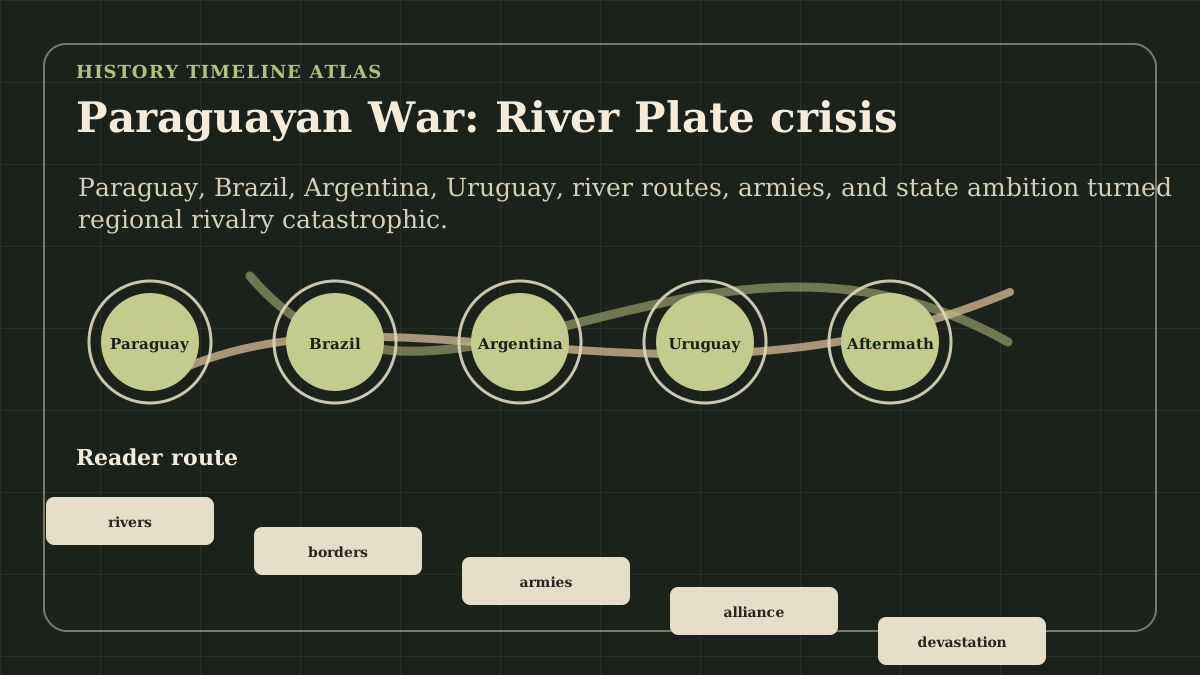
These background pressures—state consolidation, competing commercial interests, diplomatic friction, and fragile domestic politics—created conditions in which a single clash could escalate. Different sources tell different parts of this story: official correspondence highlights strategic aims, while oral memory, local records, and material evidence reveal the social costs and everyday disruptions that do not always match high‑level rationales. The Paraguayan War is most readable when the River Plate region stays on the map. Paraguay, Brazil, Argentina, and Uruguay were not abstract national labels. They were states trying to secure rivers, borders, armies, parties, trade routes, and regional influence after independence. The war began from a set of calculations that leaders believed could still be controlled. Paraguay's position made the crisis dangerous.
Landlocked geography, river access, state-building under earlier rulers, military preparation, and fear of encirclement shaped Francisco Solano Lopez's choices. Brazil and Argentina had their own ambitions and anxieties, while Uruguay's internal politics became entangled with regional power. The result was not one simple cause but a chain of intervention, alliance, mobilization, and escalation. The page should make catastrophe visible without treating Paraguay as only a victim or only an aggressor. The war devastated population, economy, territory, families, and political life. It also strengthened some neighboring states and left long memories of heroism, trauma, blame, and national survival. A generic atlas image cannot carry that emotional and regional specificity.
The Turning Point
The outbreak of war in 1864 turned simmering rivalry into sustained, interstate conflict. Concrete choices mattered: Paraguayan authorities under Francisco Solano López pursued military measures and diplomatic stances that confronted larger neighbours; Brazil, Argentina, and Uruguay’s leaders responded by coordinating against Paraguay, forming what came to be called the Triple Alliance. Rivers and border crossings became contestable spaces; troop movements and blockades shifted local economies into wartime footing. The moment of escalation was not a single dramatic battle narrated only by generals but a sequence of deliberate acts—mobilisations, declarations, naval maneuvers along the Paraná and Paraguay rivers, and collective decisions by alliance leaders—that transformed a regional dispute into a full‑scale war.
Actors at every level influenced how events unfolded: national governments calibrated force and rhetoric, regional elites sought advantage, and ordinary communities adjusted to requisitioning, conscription, and the presence of armies. Evidence remains contested: official alliance documents frame a strategic rationale; other evidence—legal petitions, diplomatic protests, and oral histories—reveals competing motives and local experiences that complicate any single explanation of why the conflict widened as it did. The turning point was escalation from regional pressure into interstate war. Once armies moved, river routes mattered as much as speeches. Supply, disease, terrain, fortifications, command decisions, and alliance politics turned a diplomatic crisis into years of destruction.
The Triple Alliance made the conflict harder for Paraguay to survive and harder for any side to end quickly. War aims, honor, revenge, and fear all narrowed choices. The page should help readers see how leaders can enter a conflict expecting leverage and then become trapped by the scale of what they have unleashed.
Consequences
The war’s immediate effect was catastrophic for Paraguay. Military defeat, sustained occupation, and the disruption of agriculture and population movements devastated the country’s capacity to recover quickly. Regionally, the conflict reconfigured political influence: Brazil emerged with enhanced military and diplomatic weight in the River Plate region, while the balance among Argentina, Uruguay, and their neighbours shifted in ways that would shape late‑19th century politics. Beyond territorial and diplomatic outcomes, the war exposed how fragile post‑independence state formation could be—centralised projects, contested sovereignty, and regional rivalries combined to produce an interstate catastrophe. Socially and economically, communities across the war zone faced displacement, labour transformations, and interrupted trade that took decades to untangle.
Legally and in the realm of memory, the conflict generated competing narratives: official triumphal accounts in some capitals, and in Paraguay an enduring sense of loss that entered family histories, oral traditions, and later commemorations. Interpreting these consequences requires attention to multiple kinds of evidence—state archives, local testimonies, archaeology, and diplomatic records—because each offers partial views of long‑term recovery and regional realignment. The immediate consequence was the beginning of one of the most destructive wars in Latin American history. Paraguay suffered enormous losses, while Brazil, Argentina, and Uruguay emerged with changed military, political, and regional positions. The demographic and social consequences were so severe that the war became part of national memory for generations. The longer consequence is interpretive.
Historians still debate causes, responsibility, casualty numbers, and the role of regional state-building. That debate is part of why the page needs depth. It should show readers that post-independence Latin America was not only about liberation from empire; it was also about borders, armies, debt, trade routes, and fragile republics facing each other.
Interpretation Notes
Interpretations of Paraguayan War Begins depend on whose evidence is centered: rulers and official records, affected communities, oral memory, archaeology, law, diplomacy, labor, and later public memory do not always tell the same story.
Why Keep Reading
Follow the subsequent campaigns, diplomatic negotiations, and reconstruction efforts to see how 19th‑century statecraft and warfare remade southern South America. The aftermath illuminates how victors consolidated power, how Paraguay attempted to rebuild its institutions and society, and how law and memory contested responsibility and meaning. If you want to understand the full ripple effects of this war—on borders, economies, and people—trace the timelines of military campaigns, alliance diplomacy, and postwar politics. Each strand reveals different evidence and different truths about a conflict that reshaped the region. Read the Paraguayan War beside Gran Colombia's dissolution, the War of the Pacific, Brazilian state formation, and Latin American revolutions.
That path turns independence history into a second question: what did new states do with sovereignty once they had it?
Reading Path
Follow the story without losing the thread
Before This
After This
Same Period
Wider Timeline
Mind Map
How to think about Paraguayan War Begins
Riverine control
Control of the Paraná and Paraguay rivers affected trade, movement of troops, and strategic leverage in the conflict
Map Layer
Where this event sits geographically
Gold pins mark the approximate locations of published event pages. This is a schematic locator map, not a historical border map.
Coordinates are approximate and are used to help readers orient themselves before opening a full event page.
References
Where to Check the Facts
- Primary Source Set: Latin American RevolutionariesPrimary-source set reference for Latin American revolutionary leaders, documents, and independence politics.
- Library of Congress: Hispanic Reading Room CollectionsArchive and collection reference for Latin America, the Caribbean, Iberian worlds, and related primary materials.
- Cambridge University Press: The Cambridge History of Latin AmericaSpecialist scholarly synthesis for colonial society, independence, republic-building, regional variation, and modern Latin American historiography.
- Oxford Research Encyclopedia of Latin American HistoryPeer-reviewed reference for Latin American history themes, regional debates, social history, and competing interpretations.
- John Carter Brown Library: Spanish America collectionPrimary-source collection reference for Spanish American independence, printed political culture, maps, and early republican debate.
- Encyclopaedia Britannica: Latin America independenceReference for Spanish American and Portuguese American independence movements.
- Encyclopaedia Britannica: History of Latin AmericaReference for Latin American colonial, independence, national, and modern history.
- Official UNESCO World Heritage Centre: City of PotosiInstitutional reference for Potosi's mining city, colonial extraction, and global silver economy.