At a Glance
The shape of the event
- Date
- 1994
- Place
- Chiapas
- Type
- Uprising
The Zapatista uprising in Chiapas challenged Mexican state power, Indigenous marginalization, land inequality, and neoliberal globalization.
1994; place the event in Chiapas before comparing causes or consequences.
The event links pre-Columbian memory, colonial inequality, modern Mexico, and globalization in one route.
EZLN / Maya communities are the first names or groups to compare before widening the story.
The revolt became a global symbol of Indigenous rights and resistance to market-led reform.
The revolt became a global symbol of Indigenous rights and resistance to market-led reform.
The event links pre-Columbian memory, colonial inequality, modern Mexico, and globalization in one route.
The Zapatista uprising connects local histories to global change; following its aftermath clarifies how Indigenous claims enter law, public memory and policy debates.
Background
Chiapas had long been a landscape of layered histories: pre-Columbian settlement, colonial dispossession and twentieth‑century agrarian struggles. By the late twentieth century those legacies met new pressures. Market-led reforms across Mexico—summarized broadly as neoliberal globalization—reshaped state priorities by promoting privatization, opening markets and privileging export-led investment. For many Maya communities this translated into the erosion of customary protections for communal land, reduced state support for rural livelihoods, and exposure to economic regimes that favored private titles and large projects over communal tenure. Social services and political representation often lagged behind official development rhetoric, reinforcing patterns of marginalization rooted in colonial and postcolonial structures.
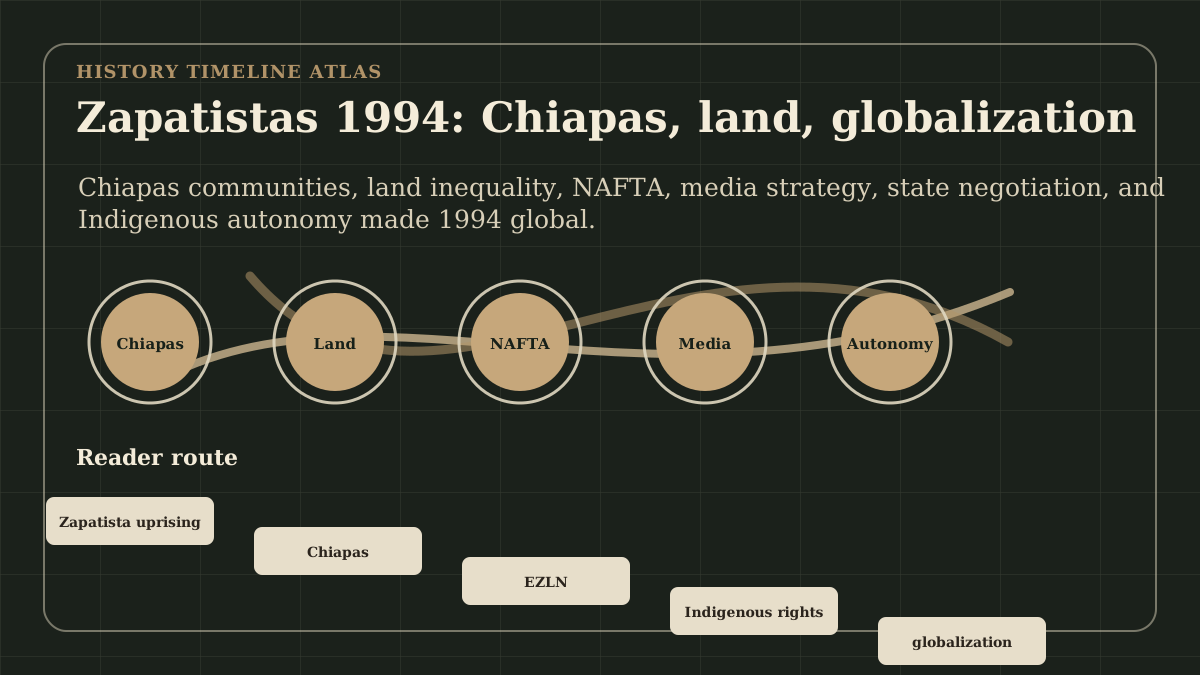
At the same time, new communications and transnational advocacy networks were beginning to circulate arguments about Indigenous rights and economic justice. Communal traditions and local resistance coexisted with legal regimes favoring private property; local assemblies and peasant organizations negotiated survival amid neglect. Those structural pressures did not produce a single cause but created the conditions in which long-standing grievances met rapid economic and political change. The Zapatista uprising becomes more readable when 1994 is treated as a collision of calendars. NAFTA entered force, Mexico presented itself as a modernizing economy, and Indigenous communities in Chiapas confronted land pressure, poverty, racism, and political exclusion. The same date could look like integration from a trade office and dispossession from a village assembly.
Chiapas also gives the event a long memory. Maya communities were not suddenly entering history in 1994; they carried older histories of communal land, colonial rule, Catholic and liberation-theology organizing, coffee economies, local bosses, and state neglect. The uprising drew on that past without turning Indigenous politics into folklore. Media strategy made the revolt unusually visible. The EZLN used communiques, interviews, symbolism, and later internet circulation to make a local conflict legible to national and international audiences. That does not make the uprising only a media event. It shows how language, image, and global solidarity became part of late twentieth-century political struggle.
The Turning Point
In 1994 the uprising changed the conversation by making visible grievances many officials had treated as peripheral. The EZLN, rooted in Maya communities, chose to foreground land inequality, communal rights and the social costs of market-driven reform, turning local complaints into a broader public contest over sovereignty and legitimacy. That choice forced Mexico’s political order to reckon with critiques that extended beyond national policy debates: images, narratives and solidarity circulated internationally and raised the political cost of ignoring demands that had been localized for decades. For Indigenous communities the moment was both assertion and appeal—an insistence on autonomy and recognition that challenged conventional policymaking.
Observers and participants thereafter interpreted the episode through competing kinds of evidence—official communications, community testimony, oral memory, legal claims and diplomatic exchanges—each emphasizing different actors, motives and remedies. The essential pivot was less about a single tactical victory than about who would define the problem and whose suffering would count in deciding how the state and society should change. The turning point was the conversion of local grievance into a national crisis. Armed action in Chiapas forced Mexico's government, parties, journalists, churches, human-rights observers, and foreign readers to confront questions that economic modernization had not solved: land, citizenship, autonomy, racism, and the meaning of democracy after one-party dominance. Negotiation then became part of the story.
Ceasefires, talks, the San Andres process, and debates over Indigenous rights showed that the uprising's importance did not end with the first days of fighting. The central question moved from who controlled territory to whether the state would recognize forms of autonomy and political voice that did not fit old institutions.
Consequences
In the immediate aftermath the uprising compelled new visibility for Indigenous claims and pressed Mexican institutions and foreign audiences to address land distribution, rural neglect and the social consequences of market reforms. It generated local organizing, legal initiatives and international solidarity efforts that extended the debate beyond Chiapas. Over time the event assumed a symbolic role well beyond its geographic origin: it became a reference point for movements and commentators as an emblem of Indigenous resistance to neoliberal reform, and a case study in how pre-Columbian memory and colonial inequalities continued to shape modern states under globalization.
That symbolic power has been ambivalent—amplifying voices and transnational critiques of market-led policy while also risking simplification of complex local realities into distant icons. Importantly, the meanings attached to the uprising remain contested. Official archives, community narratives, legal records and oral memory still produce different emphases about causation, responsibility and justice. Rather than a single settled outcome, the Zapatista moment endures as an ongoing set of debates about who counts in Mexico’s future and how global economic change should be governed. The consequences were uneven. The uprising amplified Indigenous rights and inspired transnational movements critical of neoliberal globalization, but many material problems in Chiapas persisted.
That tension matters because symbolic power is not the same as solved poverty, secured land, or full political recognition. For readers, the event is a bridge between deep Indigenous history and the modern global economy. It connects pre-Columbian memory, colonial inequality, post-revolutionary Mexico, NAFTA, media activism, and debates over autonomy in one route. The page becomes stronger when it keeps those layers together instead of making the Zapatistas only rebels, only symbols, or only internet-age activists.
Interpretation Notes
Interpretations of Zapatista Uprising depend on whose evidence is centered: rulers and official records, affected communities, oral memory, archaeology, law, diplomacy, labor, and later public memory do not always tell the same story.
Why Keep Reading
The Zapatista uprising connects local histories to global change; following its aftermath clarifies how Indigenous claims enter law, public memory and policy debates. Read further to trace timelines of Indigenous organizing in Mexico, the 1990s debates over market reform and sovereignty, and the transnational networks that turned Chiapas into a symbol. Those threads reveal how contested events can reshape legal arguments, activist strategies and diplomatic attention—and why historians and participants keep returning to the same evidence to ask different questions. Read the Zapatista uprising beside NAFTA, the Mexican Revolution, Tenochtitlan, the Spanish conquest, Pueblo Revolt, and broader Indigenous Americas routes. The path follows land, memory, law, and globalization across centuries.
Reading Path
Follow the story without losing the thread
Before This
After This
- COVID-19 Pandemic DeclaredMarch 11, 2020
Same Period
- COVID-19 Pandemic DeclaredMarch 11, 2020
- Mexican Revolution Begins1910
- Grito de Dolores1810
Wider Timeline
Mind Map
How to think about Zapatista Uprising
Neoliberal reform
Market-led policy shifts weakened protections for communal land and emphasized private investment, creating new pressures on rural communities.
Map Layer
Where this event sits geographically
Gold pins mark the approximate locations of published event pages. This is a schematic locator map, not a historical border map.
Coordinates are approximate and are used to help readers orient themselves before opening a full event page.
References
Where to Check the Facts
- Encyclopaedia Britannica: Zapatista National Liberation ArmyReference for the EZLN, the 1994 Chiapas uprising, Indigenous rights claims, and negotiations with the Mexican state.
- Oxford Research Encyclopedia of Latin American HistoryPeer-reviewed reference for Latin American social movements, Indigenous politics, globalization, and contested modern history.
- The Metropolitan Museum of Art: TenochtitlanMuseum reference for Mexica urban power, Tenochtitlan, and pre-Columbian imperial context.
- Encyclopaedia Britannica: The Spanish Conquest of the AztecsReference for the Spanish conquest, alliances, Tenochtitlan siege, and Indigenous context.