At a Glance
The shape of the event
- Date
- 1810
- Place
- Dolores
- Type
- Revolutionary Call
Miguel Hidalgo's call at Dolores helped launch the Mexican War of Independence against Spanish colonial rule.
1810; place the event in Dolores before comparing causes or consequences.
The event anchors Mexican independence in popular mobilization, religion, local grievances, and imperial crisis.
Miguel Hidalgo / Insurgent communities are the first names or groups to compare before widening the story.
The uprising spread through central Mexico and opened a long independence struggle.
The uprising spread through central Mexico and opened a long independence struggle.
The event anchors Mexican independence in popular mobilization, religion, local grievances, and imperial crisis.
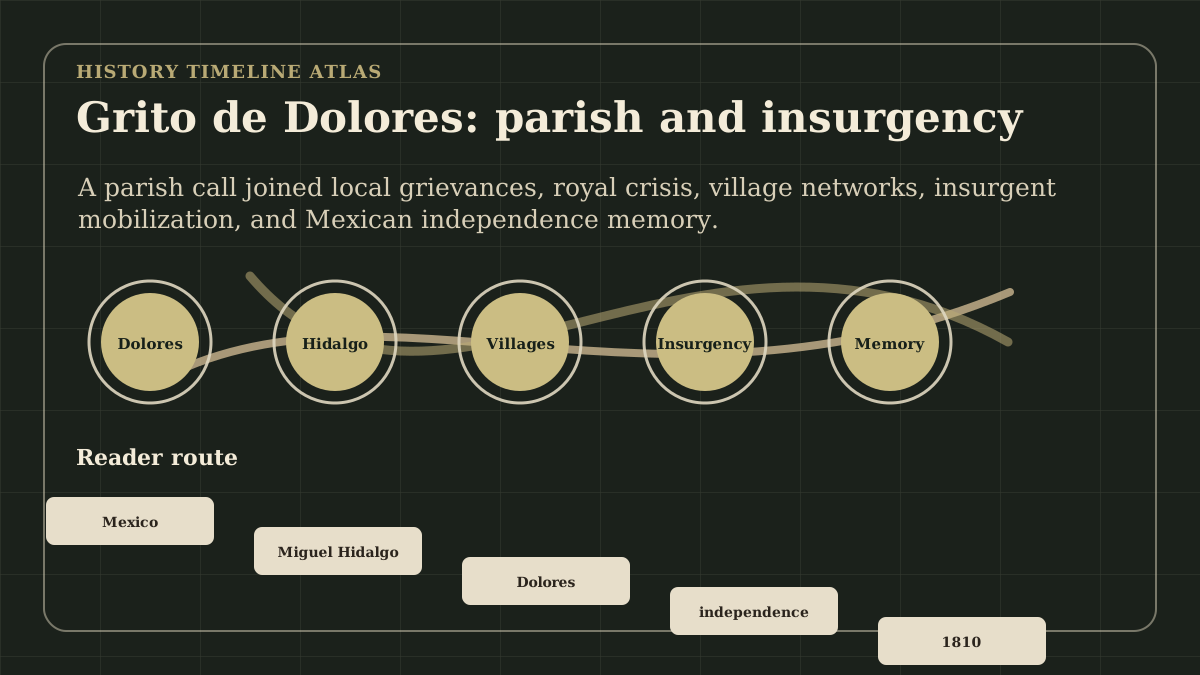
Follow the timeline from Dolores to understand how a local proclamation turned into a regional uprising and then into a protracted war for independence.
Background
By 1810 New Spain was a layered society under imperial rule, where legal hierarchies, religious institutions, local economies, and daily grievances intersected. Longstanding tensions over land, labor, tribute, and access to courts and offices coexisted with the moral and ritual authority of the church and the practical authority of local officials. At the same time, empires across the Atlantic were strained: war, commerce, and diplomatic disruption had weakened the usual circuits of power and information. Within this combination of local pressures and imperial uncertainty, networks of communication and rumor spread rapidly; parish churches, market towns, and household ties linked rural outposts to regional centers. Insurgent communities that rose in the wake of the call drew on these existing connections.
The Grito did not emerge from a single cause; it unfolded where popular grievances, religious language, and imperial crisis met, creating the conditions for collective action across central Mexico. The Grito de Dolores is more than a patriotic opening scene. It belongs to a crisis of Spanish imperial authority after Napoleon's invasion of Spain, local grievances in New Spain, social inequality, parish networks, and the question of who could speak for legitimate rule when the old monarchy was shaken. Miguel Hidalgo's role matters because a priest could connect religious authority, local trust, public speech, and insurgent mobilization. The call at Dolores did not produce one unified independence program.
It released a movement with mixed aims, uneven discipline, popular anger, elite anxiety, and regional variation. The page becomes clearer when village and parish life stay visible. Sermons, bells, local relationships, rumor, markets, labor obligations, caste hierarchy, and loyalty to the Virgin of Guadalupe all helped political language become mobilizing language.
The Turning Point
What changed at Dolores was a shift from private complaint to public mobilization. Miguel Hidalgo’s call made dissent audible in a way that invited collective response: it named a moment when people could leave the private sphere and act together. Insurgent communities answered that summons not as a single, centralized army but as multiple, locally driven mobilizations — militia groups, armed townspeople, and networks of support that moved across the countryside. Choices mattered on both sides: authorities had to decide whether to negotiate, repress, or attempt to reassert order; local leaders and ordinary people chose whether to join, resist, or stay neutral.
The Grito anchored rebellion in familiar forms of public speech and religious ritual, which helped it travel through parishes and marketplaces. In short, the event converted diffuse discontent into organized movement: it provided a focal point and language for action, redistributed agency to local actors, and forced a confrontation with imperial power that neither side had fully anticipated. The turning point was the conversion of imperial crisis into insurgency. A disrupted monarchy created uncertainty, but Hidalgo's call gave some communities a public route into action. That move made independence a lived conflict rather than only an elite constitutional debate. The insurgency's early scale also created fear.
Popular mobilization could challenge colonial authority, but it also frightened many elites who feared social revolution, violence, and loss of property. The event therefore opened both independence politics and conflict over what kind of society independence might produce.
Consequences
In the near term, the call at Dolores set off an uprising that spread across central Mexico, creating military campaigns, regional realignments, and episodes of negotiation, violence, and local self-government. These immediate shifts disrupted colonial administration and provoked a sustained response from imperial authorities. Over the long run, the Grito’s real legacy is its role in making independence a matter of popular mobilization as much as elite diplomacy. The struggle that began after the call extended into a long independence process, shaped by the interplay of religion, local grievance, labor concerns, and international pressures.
Historians and communities read the event differently depending on their evidence: official records emphasize command and counterinsurgency, oral memory highlights local leadership and sacrifice, and later public rituals recast the moment into national symbolism. Archaeology, legal documents, and diplomatic files add other angles. Together, these sources show that the Grito’s consequences were multiple: military upheaval, contested political authority, and a shifting social order whose full meanings were debated across time and place. The Grito did not immediately create the Mexican nation-state, and Hidalgo did not survive to govern an independent Mexico. Its importance lies in memory, mobilization, and the beginning of a long struggle that would involve different leaders, regions, armies, negotiations, and political visions.
Its afterlife turned Dolores into a national origin point. That memory is powerful, but the history remains more complicated: insurgency mixed anti-colonial claims, royalist language, religious symbols, local grievances, racial hierarchy, and social conflict.
Interpretation Notes
Interpretations of Grito de Dolores depend on whose evidence is centered: rulers and official records, affected communities, oral memory, archaeology, law, diplomacy, labor, and later public memory do not always tell the same story.
Why Keep Reading
Follow the timeline from Dolores to understand how a local proclamation turned into a regional uprising and then into a protracted war for independence. Reading the campaigns, municipal records, and survivors’ accounts reveals how insurgent action was organized in practice, how authorities tried to respond, and how ordinary people navigated violence, law, and hope. Exploring subsequent months and years also clarifies why later generations remembered the Grito in different ways: as a legal rupture, a religious calling, a social revolution, or a founding myth. If you want to see how public speeches meet politics on the ground, continue into the military engagements, civic experimentation, and memory-making that followed 1810.
Read this page before Boyaca, Ayacucho, Brazilian independence, and Latin American revolutions routes. The path helps compare popular insurgency, elite independence, military campaigns, and the uneven creation of new republics.
Reading Path
Follow the story without losing the thread
Mind Map
How to think about Grito de Dolores
imperial strain
War and diplomatic disruption weakened administrative reach and fiscal stability in New Spain, creating openings for unrest
Map Layer
Where this event sits geographically
Gold pins mark the approximate locations of published event pages. This is a schematic locator map, not a historical border map.
Coordinates are approximate and are used to help readers orient themselves before opening a full event page.
References
Where to Check the Facts
- Primary Source Set: Latin American RevolutionariesPrimary-source set reference for Latin American revolutionary leaders, documents, and independence politics.
- Library of Congress: Hispanic Reading Room CollectionsArchive and collection reference for Latin America, the Caribbean, Iberian worlds, and related primary materials.
- Cambridge University Press: The Cambridge History of Latin AmericaSpecialist scholarly synthesis for colonial society, independence, republic-building, regional variation, and modern Latin American historiography.
- Oxford Research Encyclopedia of Latin American HistoryPeer-reviewed reference for Latin American history themes, regional debates, social history, and competing interpretations.
- John Carter Brown Library: Spanish America collectionPrimary-source collection reference for Spanish American independence, printed political culture, maps, and early republican debate.
- Encyclopaedia Britannica: Latin America independenceReference for Spanish American and Portuguese American independence movements.
- Encyclopaedia Britannica: History of Latin AmericaReference for Latin American colonial, independence, national, and modern history.
- Official UNESCO World Heritage Centre: City of PotosiInstitutional reference for Potosi's mining city, colonial extraction, and global silver economy.