At a Glance
The shape of the event
- Date
- 1979
- Place
- Managua
- Type
- Revolution
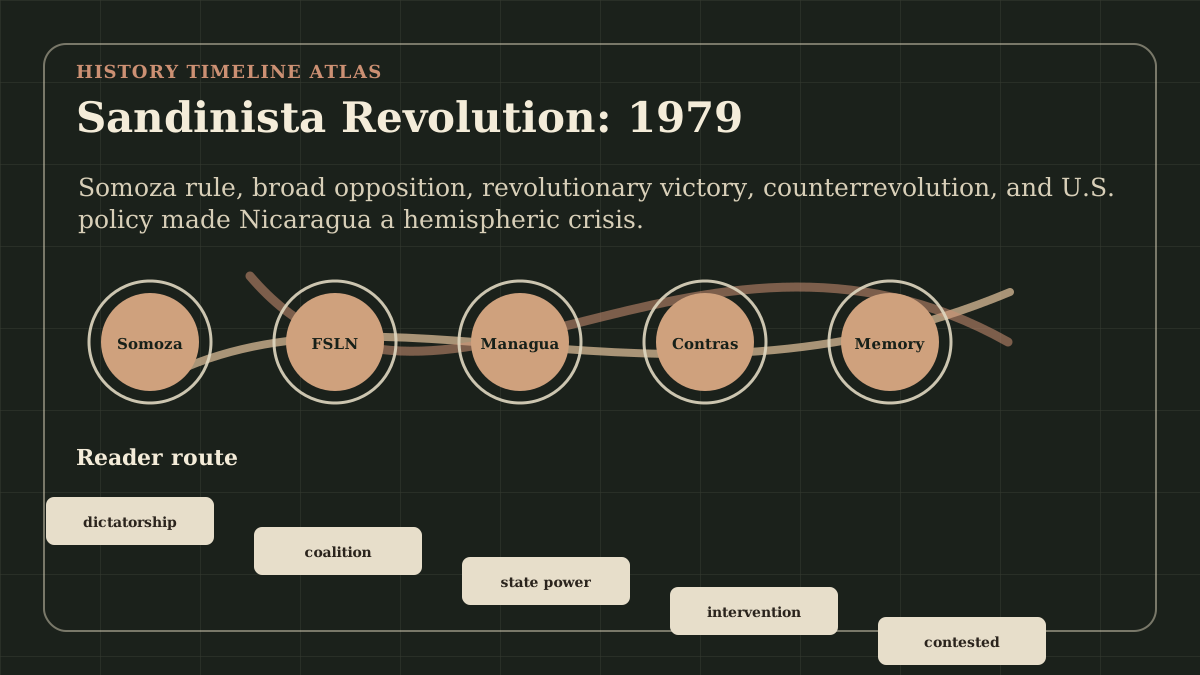
The Sandinista revolution overthrew the Somoza dictatorship and made Nicaragua a central Cold War battleground in Central America.
1979; place the event in Managua before comparing causes or consequences.
The event links dictatorship, revolution, United States policy, and civil conflict in the late Cold War.
Sandinista Front / Anastasio Somoza Debayle are the first names or groups to compare before widening the story.
A revolutionary government took power and faced counterrevolution, intervention, and economic crisis.
A revolutionary government took power and faced counterrevolution, intervention, and economic crisis.
The event links dictatorship, revolution, United States policy, and civil conflict in the late Cold War.
Follow the aftermath to see how revolution becomes governance—and how governance survives when opposed.
Background
By the late 1970s Nicaragua was shaped by decades of concentrated authority under the Somoza family. Power had been centralized in the hands of the president and his allies, and opposition had deep roots in urban movements, rural communities, labor organizations, and exile networks. The Sandinista Front emerged from this contested terrain as one of several forces opposing the dictatorship. Their rise drew on grievances about political exclusion, economic inequality, and state violence, but it also intersected with broader regional tensions. The Cold War cast a long shadow over Central America; local demands for reform and justice became entangled with international agendas and strategic calculations.
No single cause explains the revolution: long-term structural pressures, immediate political choices, and the actions of active citizens combined to make 1979 the year the old order could no longer hold. The revolution becomes easier to read when the Somoza dynasty is treated as a system rather than only a family name. The National Guard, U. S. ties, earthquake reconstruction scandals, business networks, censorship, exile politics, Catholic voices, student organizing, labor pressure, and rural anger all shaped the field before 1979. The Sandinistas did not appear in an empty space. They gained force because many Nicaraguans had already concluded that ordinary reform channels could not remove a dictatorship protected by armed power and external tolerance.
Central America also belongs in the frame. Guatemala, El Salvador, Honduras, Costa Rica, Cuba, and the United States all shaped how people interpreted Nicaragua's crisis. Local actors made choices for local reasons, but Cold War governments read those choices through regional fear: whether revolution would spread, whether counterrevolution could be sponsored, whether human-rights language would restrain allies, and whether a small country could keep sovereignty inside a heavily watched hemisphere.
The Turning Point
The decisive moment of change in 1979 was the collapse of the Somoza regime and the Sandinista Front’s assumption of state power in Managua. That shift was not merely a change of faces in government; it represented a realignment of political authority and of the terms on which Nicaraguan society would be governed. Leaders of the Sandinistas had to move quickly from armed opposition to governance, making choices about who would fill administrative posts, how to organize security, and how to maintain essential services amid political turmoil. At the same time, opponents of the new government mobilized, creating a counterrevolutionary response that turned the country into a contested field.
External actors—governments and diplomatic networks watching the Cold War balance—saw those choices as signals about regional influence. In short, the revolution altered the mechanics of power in Nicaragua and invited both internal resistance and international scrutiny, turning a national change into a broader geopolitical crisis. The decisive turn was not only Somoza leaving power. It was the moment an armed opposition movement had to become a state. Guerrilla legitimacy, broad anti-Somoza coalition politics, neighborhood defense, literacy campaigns, land questions, relations with business, and control of security forces all became urgent at once. Victory created authority, but it also created tests the insurgency had not faced in the same way while fighting from outside government.
That transition explains why the event page should not stop at triumph. Some Nicaraguans saw a chance for dignity, social repair, education, and national independence. Others feared party control, property seizure, censorship, or alignment with Cuba and the Soviet bloc. Both reactions mattered because legitimacy after revolution is not automatic. It has to be built through food, safety, law, participation, and whether opponents can imagine a future inside the new order.
Consequences
In the immediate aftermath, Nicaragua saw a revolutionary government attempt to consolidate control, implement policy, and address popular demands. But that government soon confronted organized counterrevolutionary forces, outside intervention, and mounting economic strain. Those pressures compounded one another: political conflict disrupted production and services; intervention and counterrevolution intensified insecurity; and economic difficulties limited the new administration’s capacity to deliver on promises. Over the longer term, the revolution’s legacy became a knot of competing narratives. For some communities it remains a story of emancipation from dictatorship; for others it is remembered through loss, displacement, or the experience of civil conflict.
Internationally, 1979 made Nicaragua a salient example of how local revolutions could become central Cold War battlegrounds, linking analyses of dictatorship, revolutionary change, United States policy, and protracted conflict. Historians and communities continue to weigh different kinds of evidence—official records, oral memory, law, and material traces—so interpretations of what happened and why remain contested. The Contra war turned the revolution's promise into a prolonged crisis of survival. Armed opposition, U. S. policy, regional diplomacy, military mobilization, economic pressure, and civilian displacement made daily life part of geopolitics.
A village, a school, a coffee cooperative, a border road, or a family with relatives on different sides could experience the Cold War as fear, shortages, recruitment, mourning, and rumor rather than as an abstract ideological contest. The memory remains contested because the revolution carried more than one history forward. It ended a dictatorship and inspired many people who wanted social justice and anti-imperial sovereignty. It also led into coercion, war, economic hardship, polarization, and later arguments over whether revolutionary institutions served popular power or concentrated it. A useful reading path keeps those tensions visible so the page does not become either a victory poster or a Cold War talking point.
Interpretation Notes
Interpretations of Sandinista Revolution depend on whose evidence is centered: rulers and official records, affected communities, oral memory, archaeology, law, diplomacy, labor, and later public memory do not always tell the same story.
Why Keep Reading
Follow the aftermath to see how revolution becomes governance—and how governance survives when opposed. The Sandinista takeover did not end politics in Nicaragua; it transformed it into a prolonged struggle over economy, security, and memory. Reading subsequent events and timelines reveals how counterrevolution, external interventions, and economic crisis unfolded together, and why those dynamics mattered to neighboring countries and to foreign policymakers. If you want to understand how a single year can reshape a nation’s trajectory and reverberate across a hemisphere, continue with the political and diplomatic sequences that followed 1979. Read this page between Cuba, Chile, Guatemala, and the late Cold War. Cuba shows a revolutionary government becoming a central U. S. -Soviet issue.
Chile shows elected socialism destroyed by military force. Guatemala shows intervention before Nicaragua. The Sandinista route then asks a different question: what happens when revolution wins, inherits the state, and is immediately forced to govern under counterrevolution, embargo pressure, and divided public memory?
Reading Path
Follow the story without losing the thread
Before This
- Soviet-Afghan War BeginsDecember 1979
- Iranian Revolution1978-1979 CE
- Fall of SaigonApril 30, 1975
After This
- Solidarity Movement in Poland1980
- Chernobyl DisasterApril 26, 1986
- INF Treaty SignedDecember 8, 1987
Same Period
Wider Timeline
Mind Map
How to think about Sandinista Revolution
Long-term rule
Decades of concentrated authority under the Somoza family created political exclusion and grievances.
Map Layer
Where this event sits geographically
Gold pins mark the approximate locations of published event pages. This is a schematic locator map, not a historical border map.
Coordinates are approximate and are used to help readers orient themselves before opening a full event page.
References
Where to Check the Facts
- Encyclopaedia Britannica: Mexican RevolutionReference for the Mexican Revolution, social conflict, constitutionalism, and revolutionary politics.
- Encyclopaedia Britannica: Cuban RevolutionReference for the Cuban Revolution, Batista's overthrow, revolutionary government, and Cold War significance.
- Encyclopaedia Britannica: Fidel CastroBiographical reference for Castro's revolutionary leadership, Cuban government, and Cold War role.
- Encyclopaedia Britannica: NicaraguaReference for Nicaragua's modern political history, Somoza rule, Sandinista government, and conflict after 1979.
- Encyclopaedia Britannica: SandinistaReference for the Sandinista National Liberation Front, the overthrow of Somoza rule, and later Nicaraguan politics.
- U.S. National Archives: The Cold WarArchive reference hub for Cold War records, federal documentation, and research guidance.
- Office of the Historian: The Early Cold War, 1945-1952Official diplomatic history reference for early Cold War foreign-policy context.